Material Tracking: Know What You Have, Where It Is, and When It Moved
A fabrication shop ships 40 steel beams to Site A on Monday. By Wednesday, the site super has transferred 12 to Site B without telling anyone. Thursday morning, the project manager orders 15 more beams because the ERP says Site A should have 40. Now there are 55 beams across two sites, 15 of them unnecessary, and $12,000 in surplus steel sitting in the rain.
That's the material tracking problem. Not a technology gap. A visibility gap. Materials move between locations constantly, and the spreadsheet never catches up.
What Material Tracking Actually Solves
Material tracking answers three questions in real time:
- Where is this material right now? Not where the purchase order says it should be. Where it actually is.
- How much do we have across all locations? Aggregated, not per-site guesses.
- When did it last move? Movement history reveals patterns: which sites consume fastest, which ones hoard, which ones leak.
Every downstream problem, from over-ordering to theft to project delays, traces back to one of those three questions being unanswered.
The Cost of Not Knowing
Shrinkage: 3-8% Annually
Companies operating across multiple sites lose 3-8% of material value per year. Some of that is theft. Most of it is misplacement, miscounting, and materials sitting at the wrong location while someone orders more.
| Loss Category | Typical Annual Cost (5+ sites) | Root Cause |
|---|---|---|
| Duplicate orders | $20,000-60,000 | Can't see existing inventory at other sites |
| Materials at wrong site | $15,000-40,000 | Transfers happen without records |
| Theft and pilferage | $10,000-50,000 | No alerts when materials leave after hours |
| Expired/spoiled materials | $5,000-20,000 | No visibility into material age or shelf life |
| Rush shipping for "missing" items | $5,000-15,000 | Panic orders when items are actually on hand |
| Total | $55,000-185,000 | Visibility gap |
Waste: 30% of Construction Deliveries
The EPA estimates that construction waste accounts for 30% of everything delivered to a job site. Not all of that is preventable, but a significant portion comes from over-ordering materials that were already available at another location or ordering wrong quantities because nobody had an accurate count.
Manufacturing sees similar patterns. Raw material waste runs 10-15% in shops without real-time inventory visibility. The waste isn't in the cutting or forming. It's in ordering 120 sheets of steel when 95 would have covered the job, because the estimator didn't know the shop floor already had 25 sheets from a previous run.
Project Delays from Material Misallocation
A misallocated delivery doesn't just cost the material price. It costs the crew sitting idle waiting for it.
A concrete crew standing idle costs $2,000-4,000 per day in labor alone. If the forms they need are at a different site and nobody knows it, that's a full lost day before someone drives over, confirms, and arranges the transfer. For steel fabrication, a missing beam can halt an entire erection sequence.
Material misallocation is the single largest source of "soft" project delays, the ones that don't show up on the critical path until they've already cost a week.
Material Tracking Methods Compared
Different materials and industries call for different tracking approaches. No single method covers everything.
Method Comparison
| Method | Best For | Cost Per Unit | Range | Update Frequency | Infrastructure Needed |
|---|---|---|---|---|---|
| AirTags + Airpinpoint | Reusable materials, pallets, forms, steel bundles | $29 tag + $11.99/mo | Anywhere with iPhone traffic | Passive, minutes to hours | None |
| RFID | High-volume items, receiving/shipping checkpoints | $0.10-5.00/tag + $2K-10K reader | 1-30 feet (passive), 300 feet (active) | At scan points only | Readers at checkpoints |
| GPS/Cellular | High-value items in remote areas | $50-200 + $15-40/mo | Anywhere with cell service | Real-time, seconds | None |
| QR Codes | Consumables, delivery verification, low-value items | $0.05-0.50/label | Line of sight (phone camera) | Manual scan only | None |
| BLE Beacons | Indoor positioning, warehouse zones | $5-30/beacon + gateway hardware | 30-100 feet | Seconds (with gateways) | BLE gateways |
When to Use What
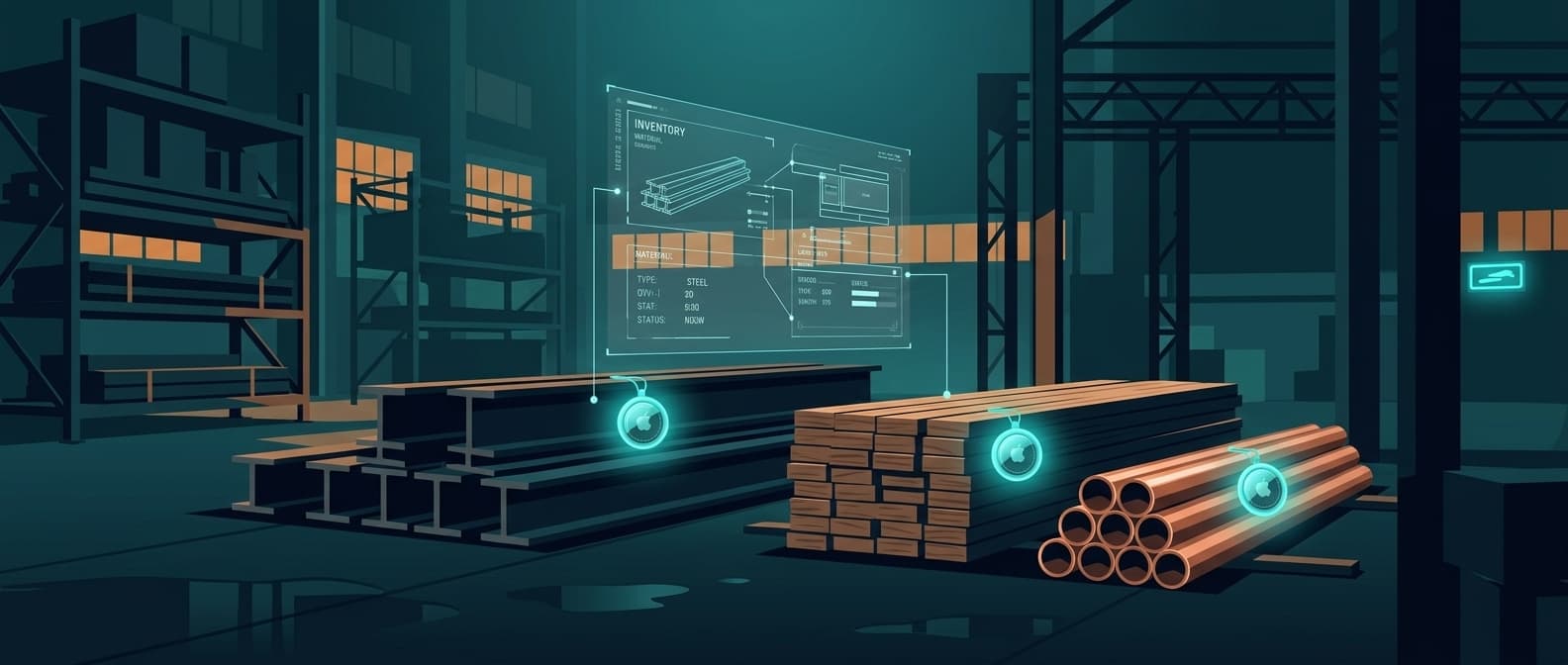
AirTags work best when materials move between sites unpredictably and you need continuous location without infrastructure. A steel bundle sitting in a yard, a concrete form cycling between job sites, a pallet of copper fittings on a delivery truck. No readers to install, no cellular plans to manage.
RFID excels at checkpoint verification. Scanning 200 items in and out of a warehouse in minutes. Confirming that a delivery matches a PO. But it only tells you what passed through the reader, not where something is right now.
GPS trackers make sense for high-value items in rural areas where iPhone density is low. A $200,000 piece of equipment in a remote oil field needs cellular tracking, not passive Bluetooth.
QR codes are the cheapest option for consumables where you just need delivery confirmation and basic inventory counts. Scan the pallet when it arrives, scan it when it's consumed.
Most companies use a combination. AirTags for continuous multi-site visibility on reusable materials, RFID at receiving docks, QR codes on consumables.
Material Tracking by Industry
Construction
Construction is the highest-ROI application for material tracking because materials move between sites constantly and the "where is it?" problem compounds across every active project.
Key materials to track:
- Concrete forms ($500-2,000/set, cycle between sites every 2-4 weeks)
- Steel beams and fabricated assemblies ($2,000-50,000+, one misallocation halts erection)
- Copper wire and pipe ($3-4/lb scrap value, highest theft target)
- Scaffolding systems ($2,000-10,000/section)
- Generators and compressors ($2,000-15,000, constantly "borrowed" without records)
Construction material tracking is covered in depth at /asset-tracking/construction-material-tracking, including per-material tracking strategies and theft prevention playbooks.
Manufacturing
Manufacturers track materials through transformation, not just transportation. Raw steel becomes cut parts becomes welded assemblies. The tracking challenge is maintaining visibility as materials change form.
Key materials to track:
- Raw material inventory (sheet metal, bar stock, wire, plastic resin)
- Work-in-progress (WIP) batches moving between stations
- Tooling and dies that move between machines
- Finished goods in staging areas
- Packaging and shipping materials
What tracking solves for manufacturing:
- WIP visibility: Know which batch is at which station without walking the floor
- Raw material reconciliation: Match consumption to orders, spot yield losses early
- Tooling location: Stop searching for the die that was last on Machine 7 but got moved to Machine 3 during second shift
- Staging area management: Finished goods waiting for shipment don't get lost in a crowded warehouse
Logistics and Warehousing
Pallet-level tracking is the backbone of logistics material visibility. Every pallet that enters a warehouse should be trackable through storage, picking, staging, and loading.
Key materials to track:
- Inbound pallets (receiving verification, put-away location)
- Returnable containers and totes (cycle between facilities)
- High-value inventory in distribution centers
- Cross-dock shipments (minutes matter)
- Packaging supplies (shrink wrap, boxes, dunnage)
What tracking solves for logistics:
- Receiving accuracy: Verify deliveries match POs at the dock door, not after the truck leaves
- Put-away location: Know where each pallet was stored without relying on the WMS being updated manually
- Returnable container recovery: Stop buying new totes because nobody tracks which customer has yours
- Cross-dock velocity: Tag high-priority shipments and see when they clear each checkpoint
Oil, Gas, and Utilities
Remote sites, harsh environments, and high-value materials make tracking both more difficult and more valuable.
Key materials to track:
- Pipe and fittings staged for pipeline construction
- Casing and tubing at well sites
- Electrical switchgear and transformers
- Cable spools (fiber, copper, conductor)
- Specialty valves and actuators ($5,000-50,000+ each)
For sites with minimal iPhone traffic, pair AirTags with cellular GPS trackers on the highest-value items. Use AirTags for everything else and rely on crew iPhones for updates during work hours.
Multi-Site Coordination: The Core Problem
Material tracking technology isn't the hard part. Multi-site coordination is.
The Phone-Tag Loop
Without tracking, multi-site material management works like this:
- Project manager at Site C needs 20 steel beams
- Calls procurement: "Do we have any in stock?"
- Procurement checks the ERP, which was last updated two weeks ago
- ERP says zero on hand (wrong, there are 15 at the fabrication shop)
- Procurement orders 20 new beams, 3-week lead time
- Meanwhile, the 15 beams at the fab shop sit untouched
This loop repeats daily across every site, for every material. The information exists somewhere in the organization. Nobody can access it fast enough to act on it.
The Dashboard Fix
Airpinpoint's multi-site dashboard shows all tracked materials on a single map:
- Fabrication shop: 15 steel beams, 200 ft copper pipe, 40 sheets plate steel
- Site A: 12 beams (3 consumed this week), 8 scaffolding sections
- Site B: 8 beams, 2 generators, 500 ft conduit
- Site C: 0 beams (needs 20, 15 available at fab shop)
The project manager sees this on their phone. Calls the fab shop directly. Beams arrive the next day instead of three weeks from now. $12,000 in unnecessary purchasing avoided.
Geofence Alerts for Material Movement
Geofence alerts are the automated version of "did that material just leave?" Draw a boundary around each location. When a tagged material crosses it, the system notifies the site supervisor and project manager.
Scheduled transfers? Expected. Flag it and move on.
After-hours movement on a Saturday night? That's theft. Share the live location with law enforcement.
The key is that you don't need to actively watch anything. The system watches for you and only interrupts when something unexpected happens.
Implementation Playbook
Week 1: Audit and Prioritize
Walk every site and warehouse. List every material category worth $500+ that moves between locations. Rank by:
- Value at risk (replacement cost if lost or stolen)
- Movement frequency (how often it changes location)
- Pain level (how many phone calls does this material generate per week)
The intersection of high value, high movement, and high pain is where you start.
Week 2: Tag and Register
- Order AirTags in bulk (multi-packs run cheaper per unit)
- Get weatherproof cases appropriate to your environment (IP67+ for outdoor/construction, standard for warehouse)
- Attach tags to each prioritized material in a hidden but accessible location
- Register in Airpinpoint with clear naming: "Steel Beam Bundle #14" not "Tag 7"
Start with 50-100 tags on your highest-priority materials. Don't try to tag everything in the first pass.
Week 3: Configure Geofences and Alerts
- Draw geofence boundaries around every site, warehouse, and staging area
- Set movement alerts: notify the site supervisor when materials leave
- Configure after-hours alerts separately for theft detection
- Test by moving a tagged item out of a geofence, confirm the alert fires
Week 4: Train and Go Live
Training takes 15 minutes. Show your team two things:
- How to check the dashboard (bookmark on their phone)
- What to do when an alert fires (verify transfer or escalate)
That's the entire training curriculum. If it takes longer than 15 minutes, you've over-complicated it.
ROI: Real Numbers
Scenario: Multi-Site Operation, $1M Material Inventory
| Category | Annual Cost Without Tracking | Annual Cost With Tracking | Savings |
|---|---|---|---|
| Duplicate material orders | $40,000 | $8,000 | $32,000 |
| Theft and pilferage | $25,000 | $5,000 | $20,000 |
| Material waste (over-ordering) | $20,000 | $8,000 | $12,000 |
| Labor: locating materials | $18,000 | $3,000 | $15,000 |
| Rush shipping for "missing" items | $12,000 | $2,000 | $10,000 |
| Materials stranded at old sites | $10,000 | $2,000 | $8,000 |
| Total | $125,000 | $28,000 | $97,000 |
Tracking System Cost
| Item | Cost |
|---|---|
| 100 AirTags | $2,900 (one-time) |
| Weatherproof cases | $1,000 (one-time) |
| Airpinpoint subscription (100 devices) | ~$12,000/year |
| Year 1 total | ~$15,900 |
| Year 2+ total | ~$12,000/year |
Year 1 ROI: ~510% Ongoing ROI: ~710%
Even if you only prevent two duplicate orders and one theft incident per year, the system pays for itself. Everything else is margin.
Supply Chain Visibility: Beyond Your Own Sites
Material tracking doesn't stop at your property line. The most impactful visibility gains come from tracking materials in transit.
Inbound Shipment Tracking
Tag materials at the supplier's dock before they ship. Know exactly when they'll arrive at your site instead of relying on carrier ETAs that slip by days.
Transfer Tracking
When materials move between your own facilities, geofence departure and arrival events create an automatic chain of custody. No paperwork, no phone calls, no "I thought you sent it yesterday."
Customer Delivery Verification
For companies that deliver materials to customer sites, tagged deliveries provide proof of delivery location and timing. Dispute resolution becomes a data lookup instead of a he-said-she-said.
Read more about supply chain applications in our pallet tracking system guide.
Airpinpoint for Material Tracking
Airpinpoint was built for the multi-site visibility problem. Not just construction. Any operation that moves physical materials between locations.
Why companies choose Airpinpoint:
- Single map, all locations shows every tracked material across warehouses, job sites, and staging areas
- Geofence alerts fire when materials leave a location, distinguishing planned transfers from theft
- Team access lets warehouse managers, PMs, and field supervisors all see the same data
- Location history shows movement patterns over time, useful for optimizing material flow and theft recovery
- No infrastructure per site, no SIM cards, no cellular contracts per device
- $11.99/device/month with volume discounts for 100+ tags
How it works:
- Attach an AirTag to each material asset or pallet
- Register in Airpinpoint with a clear name and category
- Draw geofences around every location
- Open the dashboard and see everything on one map
Apple's Find My network, over a billion devices strong, handles the location updates passively. No monthly cellular fees per tag. No infrastructure to install at each site. No IT deployment project.
The Bottom Line
Material tracking isn't a technology problem. It's a visibility problem that technology solves in about a week.
The companies losing 3-8% of material value annually aren't being robbed blind (though some are). They're losing materials to the friction of operating across multiple locations without real-time inventory visibility. Duplicate orders, stranded materials, expired stock, unrecorded transfers.
Start with your highest-value, most-mobile materials:
- Reusable items that cycle between locations (forms, scaffolding, containers)
- High-theft-risk materials (copper, specialty metals, electronics)
- High-value items that cause project delays when misallocated (structural steel, specialty pipe)
Tag 50-100 items. Draw geofences. Open the dashboard. The phone calls stop, the duplicate orders stop, and the "where is it?" question gets answered in two seconds instead of two hours.
 Our Solution