Updated
Warehouse Inventory Tracking System: Real-Time Visibility Without the Six-Figure Price Tag
Most warehouse inventory tracking pitches start with a list of features. This one starts with a number: $1.1 trillion. That's what inventory distortion (shrinkage, stockouts, and overstock combined) costs retailers and distributors globally each year, according to the IHL Group.
The tracking system you choose determines which side of that number you land on. And the choice is no longer between "expensive system" and "clipboard." There are now three real options for warehouse inventory tracking, each with different cost curves, deployment timelines, and accuracy profiles.
This guide breaks down what actually works, what it costs, and where BLE tracking fits into a warehouse that might already have barcode scanners or is considering RFID.
Why Warehouses Lose Inventory (And Why Traditional Fixes Fall Short)
Inventory disappears for predictable reasons. Understanding the pattern matters more than bolting on technology.
The five failure modes:
- Receiving errors. Items arrive, get counted wrong or put in the wrong location. Downstream, the WMS thinks you have 200 units in Aisle 4. You have 180.
- Mispicks. A picker grabs the wrong SKU or the wrong quantity. The customer gets the wrong item. You write off the return and the re-ship.
- Staging drift. Pallets or totes get moved from staging to the wrong zone, or sit in a temporary location that nobody logs. The WMS says it's in Zone B. It's actually behind a column in Zone D.
- Shrinkage. Theft, damage, or items that simply walk out the door. Warehouses average 1-2% shrinkage, which compounds across thousands of SKUs.
- Cycle count gaps. You count Section A on Monday, Section B on Thursday. Between counts, items move and nobody records it. The count was accurate when you took it. It's wrong by the time you act on it.
Barcode scanning catches problems at scanning events. But most warehouse errors happen between scans, when items move without being logged. That's the gap real-time tracking fills.
Three Approaches to Warehouse Inventory Tracking
Barcode/QR: The Baseline
Every warehouse should have barcode scanning. It's the cheapest entry point, the most mature technology, and the foundation that everything else builds on.
How it works in a warehouse: Items get scanned at receiving, putaway, pick, pack, and ship. Each scan creates a record in the WMS. Between scans, the system assumes the item hasn't moved.
Where it works well:
- High-volume, predictable workflows (e-commerce fulfillment)
- SKUs that follow a linear path (receive, store, pick, ship)
- Operations where every touch point has a scanner
Where it breaks down:
- Items that move between zones without being scanned
- Staging areas where pallets sit for hours or days
- Returns processing, where items re-enter the flow at unpredictable points
- Any workflow where someone moves something without scanning it first
Typical cost: $200-$500 per handheld scanner. Labels cost $0.01-$0.10 each. WMS software runs $5,000-$50,000/year depending on scale. Total deployment for a 50,000 sq ft warehouse: $15,000-$75,000.
RFID: The Enterprise Play
RFID readers can scan hundreds of items per second without line of sight. For high-volume warehouses doing 10,000+ SKUs with predictable chokepoints, RFID delivers genuine ROI.
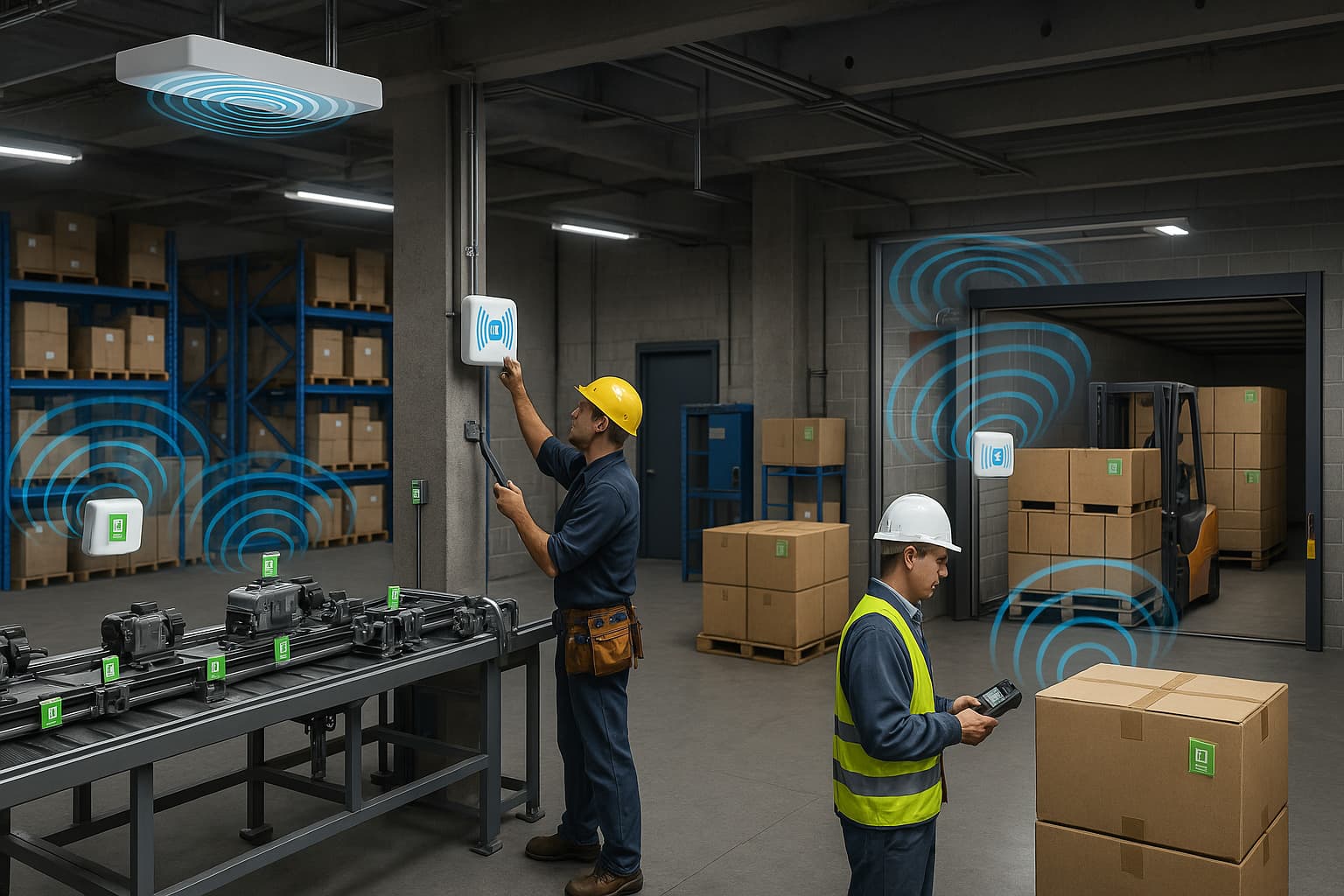
How it works in a warehouse: Passive RFID tags ($0.10-$2.00 each) on every item or pallet. Fixed readers at dock doors, zone transitions, and conveyor systems. Items get read automatically as they pass through, no manual scanning required.
Where it works well:
- Dock door verification (did the right pallets load on the right truck?)
- Receiving counts (scan an entire pallet in seconds vs. counting by hand)
- Cycle counting (walk the aisle with a handheld reader, count 500 items in minutes)
- High-value inventory with strict chain-of-custody requirements
Where it breaks down:
- Facilities with metal racking, water, or dense materials (signal interference)
- Assets that leave the warehouse (RFID stops tracking at the last reader)
- Small or irregularly shaped items where tag placement is difficult
- Multi-site operations (each facility needs its own reader infrastructure)
Typical cost: Tags: $0.10-$2.00 each in volume. Fixed readers: $1,000-$3,000 each (you need 4-20 per warehouse). Portal readers: $3,000-$10,000 each. Middleware and software: $15,000-$100,000/year. Implementation and cabling: $20,000-$80,000. A full deployment for a 50,000 sq ft warehouse runs $80,000-$250,000 upfront. See our detailed RFID cost breakdown for more.
BLE/Find My: The Distributed Network
BLE tracking uses Apple's Find My network (over a billion devices) or dedicated BLE gateways to locate tagged assets. No fixed readers. No cabling. No six-month implementation.
How it works in a warehouse: Attach a Find My-compatible tracker to pallets, totes, equipment, or high-value inventory. Every iPhone, iPad, and Mac in the building (and globally) acts as a detection point. Airpinpoint aggregates location data into a dashboard with zone assignments, movement history, and geofence alerts.
Where it works well:
- Mixed indoor/outdoor tracking (warehouse + yard + in-transit)
- Multi-site operations (same tracker works at every location, no new infrastructure)
- Zone-level monitoring (receiving, staging, shipping, returns)
- High-value assets that move between warehouses or to customer sites
- Supplementing barcode systems with continuous location between scan events
Where it breaks down:
- Individual item-level tracking for thousands of low-value SKUs (cost per tracker is higher than RFID tags)
- Environments with zero Apple devices nearby (rare in 2026, but possible in remote facilities)
- Sub-meter precision requirements (BLE provides zone-level, not aisle-level accuracy)
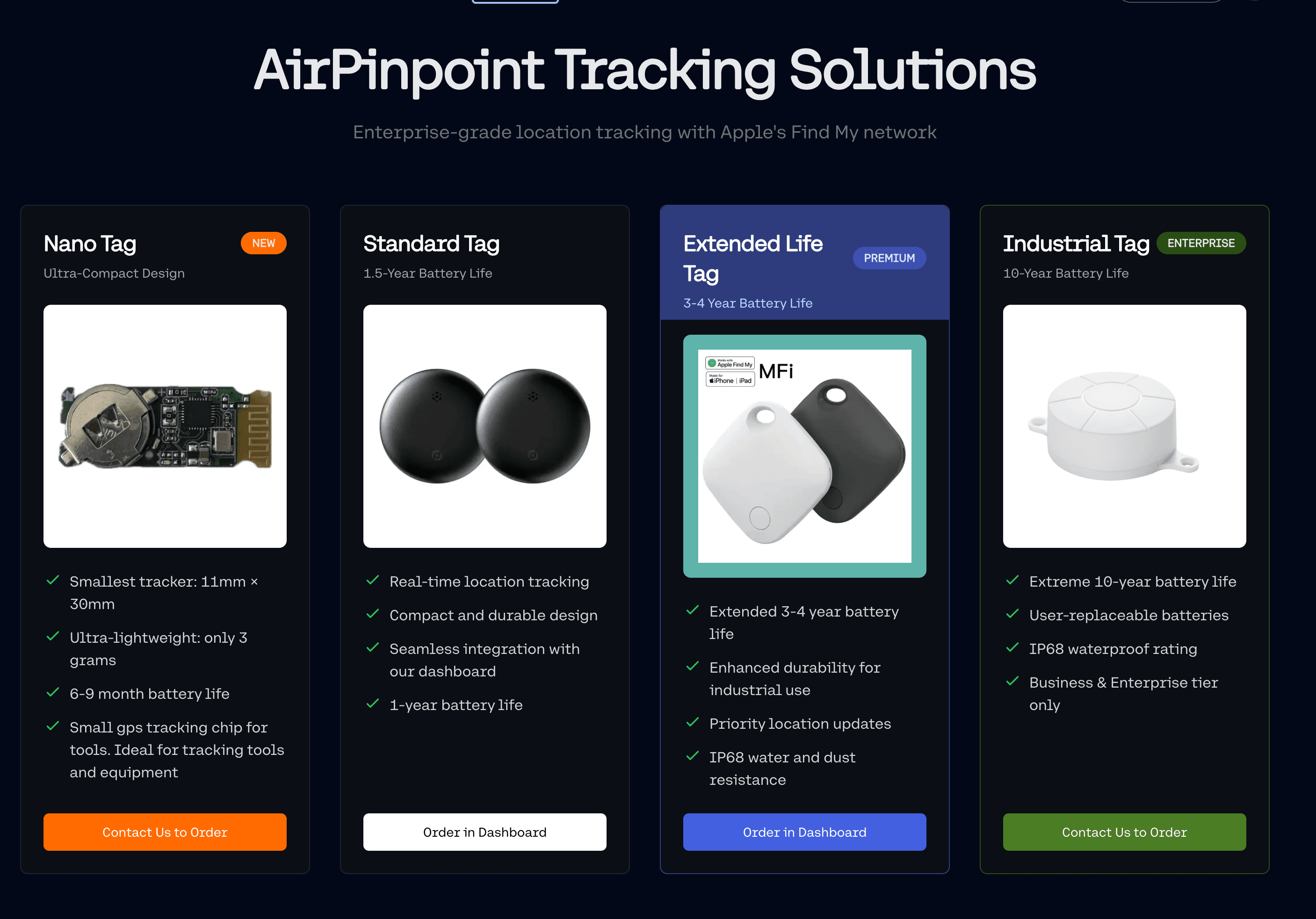
Typical cost: $29 per tracker (one-time). Airpinpoint plans start at $11.99/tag/month for the business dashboard, geofencing, webhook integrations, and team access. Deployment for 100 tracked assets: ~$4,100 upfront + $1,199/month. No infrastructure. No implementation fees. No cabling.
Side-by-Side: Picking the Right Stack for Your Warehouse
| Factor | Barcode/QR | RFID | BLE/Find My |
|---|---|---|---|
| Upfront cost (50K sq ft) | $15K-$75K | $80K-$250K | $3K-$12K |
| Monthly cost | $500-$4K (software) | $1.5K-$8K (software + maintenance) | $1.2K-$6K (per-tag plans) |
| Deployment time | 2-4 weeks | 3-6 months | 1-3 days |
| Accuracy | Event-level (at scan points) | Chokepoint-level (at readers) | Zone-level (continuous) |
| Infrastructure required | Scanners + labels | Readers + antennas + cabling | None |
| Works outside warehouse | No | No | Yes (global) |
| Best for | High-volume fulfillment | 10K+ SKU warehouses | Multi-site, mixed fleets |
Most warehouses don't need to choose one. The strongest setups layer them: barcode for every item at every touchpoint, BLE for continuous location on high-value assets and equipment, and RFID only if you're processing 10,000+ SKUs through fixed chokepoints daily.
Zone-Based Tracking: The Feature That Changes Warehouse Operations
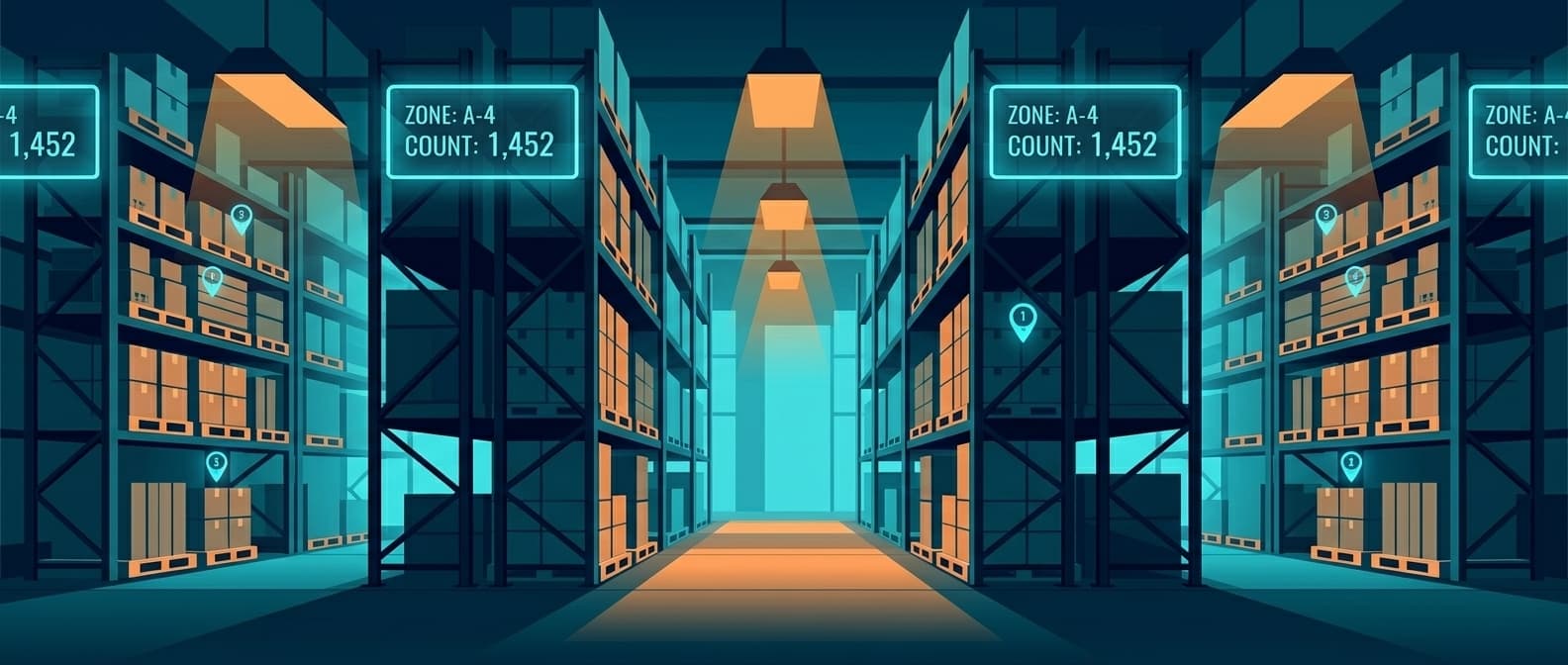
Zone-based tracking divides your warehouse into logical areas and monitors which items are in which zone at all times. It's the single most valuable feature for catching errors before they become customer-facing problems.
How zones work in practice:
Define zones that match your physical layout: receiving dock, bulk storage, forward pick area, packing stations, staging lanes, shipping dock, returns processing. Assign tracked assets to expected zones based on their workflow state.
When an asset shows up in the wrong zone, or stays in one zone too long, the system flags it.
Real examples of what zone tracking catches:
- Mispicked pallet: A pallet tagged for Customer A ends up in Customer B's staging lane. Geofence alert fires before the truck loads.
- Stuck inventory: A tote sits in receiving for 48 hours because it got pushed behind other freight. The system flags it as overdue for putaway.
- Unauthorized movement: A high-value pallet moves from bulk storage to the dock outside of normal shipping hours. After-hours alert triggers.
- Returns routing: Returned items enter the returns zone but never make it to inspection. Zone tracking shows they got diverted to outbound staging by mistake.
Airpinpoint's geofencing supports polygon-based zones, so you can draw boundaries that match your actual warehouse layout rather than fitting into grid squares.
Integrating Tracking With Your WMS
A tracking system that doesn't talk to your WMS is a second screen nobody checks. Integration is what turns location data into workflow automation.
What integration looks like:
-
Webhook events. When a tracked asset enters or leaves a zone, Airpinpoint sends a JSON webhook to your WMS with the asset ID, zone, timestamp, and coordinates. Your WMS processes the event like any other inventory transaction.
-
Receiving verification. Truck arrives. Pallets get unloaded. BLE trackers confirm each pallet entered the receiving zone. WMS auto-advances the PO status from "in transit" to "received" without manual scan.
-
Pick confirmation. Picker moves a tote from forward pick to packing. Zone transition triggers a pick-complete event in the WMS. No handheld scan needed for the zone change (barcode scan still handles SKU-level verification).
-
Shipping validation. Pallets staged for a specific carrier. Geofence around the staging lane confirms all expected pallets are present before the truck loads. Missing pallet triggers an alert, not a customer complaint three days later.
-
Dwell time alerts. Item sits in staging longer than the SLA threshold. WMS gets a dwell-time webhook. Supervisor gets a notification. Problem gets fixed before the delivery window closes.
Airpinpoint's webhook API works with any WMS that accepts HTTP callbacks. No custom middleware. No vendor-specific connectors.
Real-Time Inventory Tracking Software: What to Look For
Not every product marketed as "real-time inventory tracking software" delivers continuous location. Many are event-based systems that update only when someone scans a barcode.
Genuine real-time tracking means:
- Location updates without manual intervention
- Continuous monitoring, not just point-in-time events
- Alerts that fire when items move, not when someone notices they've moved
Questions to ask any vendor:
- What triggers a location update? (Scan? Timer? Movement?)
- What's the update frequency? (Every 15 minutes? Every hour? On-demand?)
- Does tracking work between my four walls, or only within them?
- What happens when an asset goes offline?
- How do you handle multi-site visibility?
Airpinpoint provides location updates through Apple's Find My network, with on-demand refresh from the dashboard and automatic background updates every 30 minutes by default, configurable down to 5. Location history is stored and queryable, so you can trace an asset's path through your facility after the fact.
Common Warehouse Tracking Architectures
Small Warehouse (Under 20,000 sq ft)
Recommended stack: Barcode WMS + BLE on high-value assets and equipment.
At this scale, most items are within visual range. Barcode scanning handles the workflow. BLE trackers on forklifts, pallet jacks, and high-value inventory add continuous location without complexity.
Cost: $8,000-$15,000 total first year.
Mid-Size Distribution Center (20,000-100,000 sq ft)
Recommended stack: Barcode WMS + BLE zone tracking on pallets and staging areas.
Zone-based tracking pays for itself by catching staging errors and mispicks. Tag every pallet that moves between zones. Use geofence alerts for dock doors and staging lanes.
Cost: $20,000-$50,000 total first year. Compare to $100,000-$200,000 for RFID at this scale.
Large Fulfillment Center (100,000+ sq ft)
Recommended stack: Barcode WMS + RFID at dock doors and conveyors + BLE for yard management, equipment, and in-transit tracking.
At high-volume fulfillment scale, RFID at fixed chokepoints earns its ROI through automated dock-door verification and conveyor-based counts. BLE fills the gaps: tracking returnable containers in the yard, monitoring equipment across the facility, and maintaining visibility on assets that leave the building. See our pallet tracking guide for the hybrid approach in detail.
Cost: $150,000-$400,000 total first year. RFID handles volume. BLE handles range.
Deployment: What the First Week Looks Like
One of the biggest differences between tracking technologies is how long it takes to go from purchase to production data.
RFID deployment timeline (typical):
- Week 1-4: Site survey, reader placement planning, cabling design
- Week 5-8: Hardware installation (readers, antennas, cabling)
- Week 9-12: Middleware configuration, WMS integration, tag encoding
- Week 13-16: Testing, training, parallel operation
- Week 17+: Go-live, tuning, optimization
BLE/Airpinpoint deployment timeline:
- Day 1: Create account, add team members, define zones
- Day 1-2: Attach trackers to assets, register in dashboard
- Day 2-3: Set up geofence alerts, configure webhook integration
- Day 3: Production data flowing
No site survey. No cabling. No parallel operation period. If it's not working, you move the tracker. The infrastructure is already everywhere.
Making the Decision
Start with what you're losing. If your warehouse shrinkage is under 0.5% and your picking accuracy is above 99.5%, your current system is working. Don't add technology for the sake of it.
If you're losing 2-5% to shrinkage, mispicks, or staging errors, do the math on what that costs annually. Then compare it to the tracking options above.
For most warehouses under 100,000 sq ft, BLE tracking on high-value assets and zone transitions delivers the highest ROI per dollar spent. It deploys in days, not months. It works inside your warehouse and follows assets when they leave. And it costs a fraction of RFID infrastructure.
For warehouses already running barcode-based WMS, BLE fills the gap between scan events with continuous location data. You're not replacing your barcode system. You're adding a layer that sees what happens between scans.
Next steps:
- Read our complete warehouse inventory management guide for WMS selection and best practices
- Compare RFID vs. BLE in detail
- See how AirTag 2 performs in warehouse environments
- Explore pallet-level tracking for distribution operations
- Start a free trial to test zone-based tracking in your facility
 Our Solution