Updated
Construction Material Tracking: Know What's Where Across Every Job Site
A GC running 8 active sites owns $2 million in reusable materials: concrete forms, scaffolding, generators, temporary fencing, copper wire. At any given moment, nobody knows exactly which site has what. The office gets 15 calls a day asking "where are the forms?" and "did anyone pick up the scaffolding from the Henderson job?"
That's the construction material tracking problem. Not just theft (though that's $1 billion annually), but the daily chaos of materials scattered across a dozen job sites with no system to track them.
How to Manage Construction Materials in 7 Steps
To manage construction materials, keep one list of every material and reusable asset you own, assign each item to a job site, record every delivery and transfer against that list, and check it against what is physically on site each week. Consumables are managed by quantity and delivery ticket. Reusable items such as forms, scaffolding and generators are managed by location, because they move between sites and get lost there.
- Split materials into consumables and reusables. Lumber, rebar, concrete and wire are built into the job and tracked by quantity per project. Forms, shoring, scaffolding, fencing panels, generators and compressors come back and are tracked by where they are.
- Order against the schedule. Tie each order to the schedule activity that uses it so deliveries land a few days before the work. Materials that sit on site for weeks are the ones that get stolen, rained on or used on the wrong task.
- Check every delivery against the ticket. Count or scan on receipt, write shortages on the ticket before the driver leaves, and photograph damage.
- Store by job and lock up by value. Keep copper wire and other scrap-value stock in a locked container, and stage materials close to where they will be installed to cut double handling.
- Record every transfer between sites. A transfer that only exists in a foreman's memory is how the office ends up buying forms the company already owns.
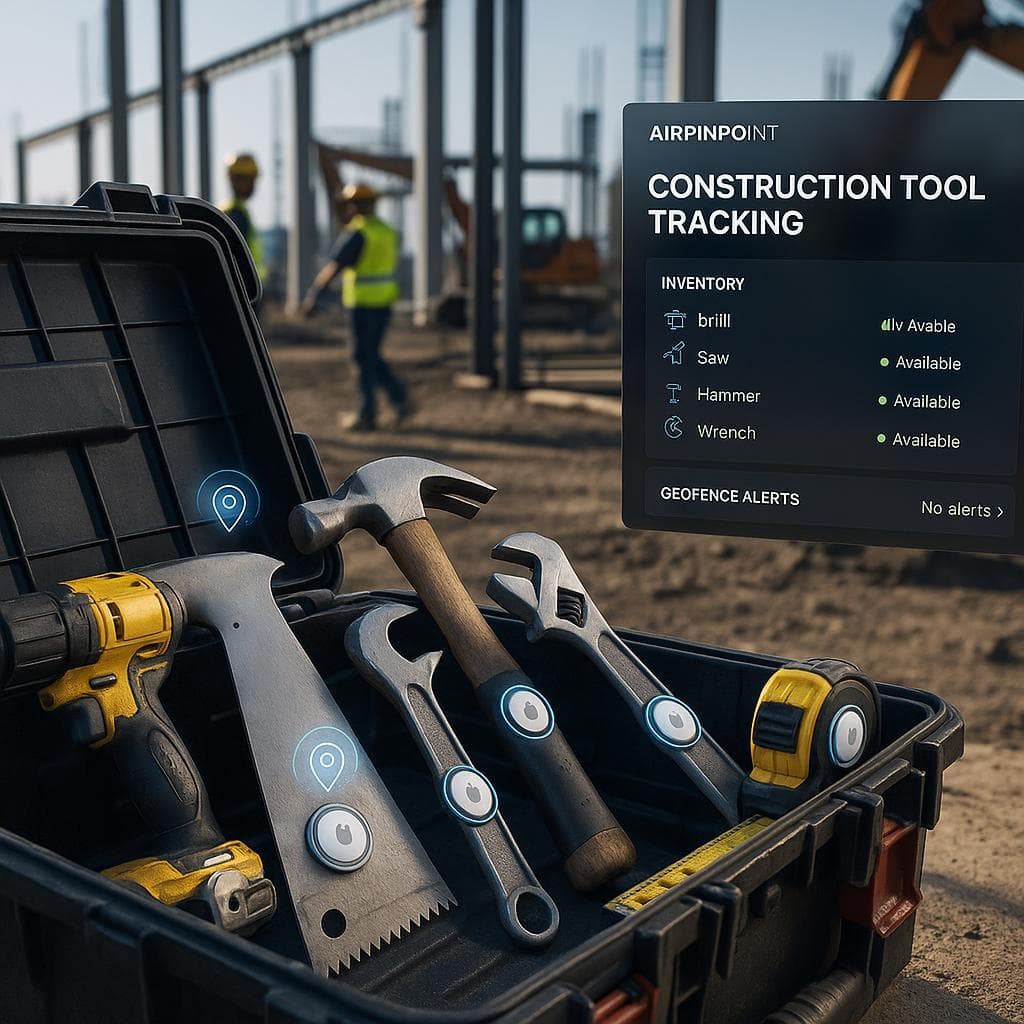
- Tag the reusable assets. A Find My tag on a form set, generator or scaffold bundle reports its location without anyone scanning it, and a geofence alert fires when it leaves a site after hours.
- Reconcile weekly. Compare what the system says is on each site with a walk-through, and fix the record the same day.
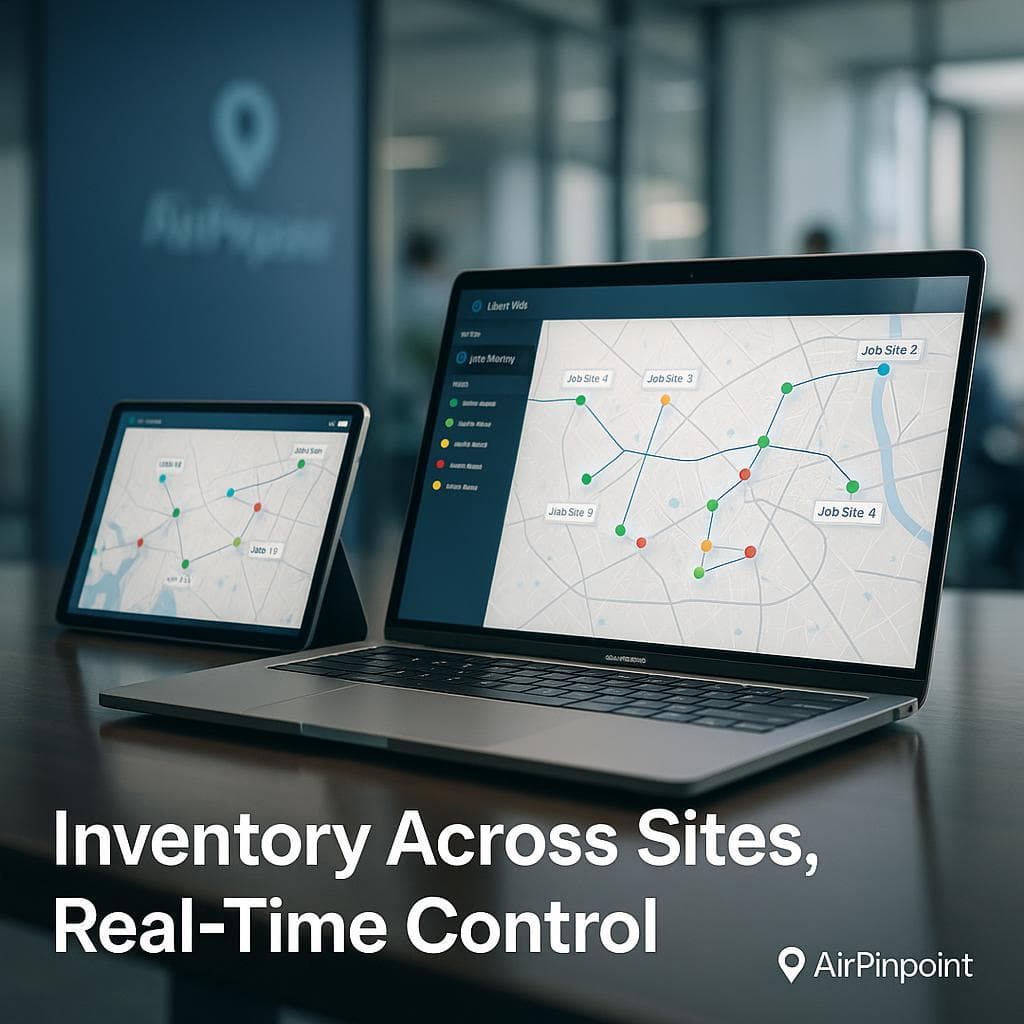
Steps 1 to 5 work with a spreadsheet or any construction inventory management software. Step 6 is where most systems stop, because a scan-based list only knows where an item was the last time someone scanned it. Airpinpoint shows every tagged form set, generator and scaffold bundle on one map across all sites, with location history and email or webhook geofence alerts, for $29 per tag plus $11.99 per tag per month. The method comparison below covers which tracking method fits each material.
Why Construction Materials Disappear
Theft: $1B+ Per Year
Construction sites are open, high-value targets. The FBI reports over 11,000 construction site thefts annually, more than convenience store robberies.
Copper is the #1 target. Theft has surged 40%+ since 2020 as scrap prices climbed:
| Material | Scrap/Resale Value | Typical Theft Scenario |
|---|---|---|
| Copper wire | $3.00-4.50/lb | Cut from walls overnight |
| Copper pipe | $2.50-3.80/lb | Stripped from rough-in plumbing |
| Lumber (framing) | $400-800 per MBF | Loaded onto pickup trucks after hours |
| Steel rebar | $600-800/ton | Taken from staging areas |
| Aluminum forms | $0.50-0.80/lb scrap | Forms stolen for scrap value |
Copper theft doesn't just cost the material. Rewiring a building after theft can cost 10-20x the material value in labor and project delays.
Misallocation: The Bigger Problem
For most GCs, theft isn't even the primary cost. Misallocation is.
Materials end up at the wrong site, sit at completed jobs that nobody closes out, or get purchased twice because the PM doesn't know the company already owns enough.
Common misallocation scenarios:
- Concrete forms sitting at a finished job because nobody scheduled pickup
- PM buys new scaffolding because he can't reach anyone who knows where the existing sets are
- Temporary fencing panels left at old sites for weeks, racking up rental costs
- Generators borrowed between sites with no record of who has them
A mid-size GC with 10 active sites typically loses 2-5% of material value annually to misallocation alone, $40,000-$100,000 on a $2M material inventory.
The Multi-Site Visibility Gap
Construction is fundamentally a multi-site business. Materials move constantly:
- Concrete forms cycle between sites every 2-4 weeks
- Scaffolding gets reassigned as phases complete
- Generators and compressors float between sites based on need
- Temporary fencing gets installed, moved, and reinstalled
- Specialty equipment (SASE grinders, panel carts, laser levels) gets shared across projects
Without tracking, "where is it?" becomes the most-asked question in the company.
What Construction Materials Cost (And Why Tracking Pays for Itself)
| Material | Unit Cost | Typical Inventory | Total Value at Risk |
|---|---|---|---|
| Concrete form sets | $500-2,000/set | 15-40 sets | $15,000-80,000 |
| Scaffolding sections | $2,000-10,000/section | 20-50 sections | $40,000-500,000 |
| Generators (portable) | $2,000-15,000 each | 5-20 units | $30,000-300,000 |
| Copper wire (spools) | $200-2,000/spool | 10-50 spools | $5,000-100,000 |
| Temporary fencing | $50-150/panel | 200-500 panels | $15,000-75,000 |
| Compressors | $1,500-8,000 each | 3-10 units | $10,000-80,000 |
| Rebar bundles | $600-800/ton | 5-20 tons on site | $5,000-16,000 |
| Lumber (framing) | $400-800/MBF | Varies by project | $10,000-50,000+ |
| SASE grinders | $3,000-8,000 each | 2-5 units | $10,000-40,000 |
| Panel carts | $500-2,000 each | 5-15 units | $5,000-30,000 |
A typical mid-size GC has $500K-$2M in reusable materials. Tracking 200 of the highest-value items with Airpinpoint costs roughly $6,000-$8,000/year. Preventing one duplicate purchase of concrete forms or recovering one stolen generator pays for the entire system.
How to Track Construction Materials: Method Comparison
Different materials need different tracking approaches. Here's what actually works on job sites.
Tracking Method Comparison
| Method | Best For | Cost Per Asset | Pros | Cons |
|---|---|---|---|---|
| AirTags + Airpinpoint | Forms, scaffolding, generators, fencing | $29 tag + $11.99/device/mo | No infrastructure needed, multi-site dashboard, geofence alerts, works across all sites | Needs iPhone traffic nearby, not real-time |
| GPS trackers | High-value items in rural areas | $50-200 + $15-40/mo | Real-time tracking, works anywhere with cell service | Monthly cellular cost per device, battery replacement |
| RFID tags | High-volume items (lumber bundles, rebar, pipe) | $0.10-5.00/tag + reader hardware | Scan hundreds of items in minutes, great for receiving/shipping | Requires handheld reader, no continuous tracking |
| QR codes | Consumables, delivery verification | $0.05-0.50/label | Cheapest option, works with any phone camera | Manual scan required, no automatic location |
| Barcode/serial tracking | Inventory management, tool cribs | $0.02-0.10/label | Integrates with ERP systems | Manual process, no location data |
The Right Combination for Most GCs
Most construction companies don't need to pick just one method. The practical approach:
- AirTags on reusable assets (forms, scaffolding, generators, compressors, grinders): track them across all job sites on one map
- RFID for receiving (scan lumber deliveries, verify rebar shipments)
- QR codes on consumables (verify delivery, track allocation by project)
- GPS on your highest-value items if you operate in rural areas with low iPhone density
This layered approach gives you continuous visibility on the assets that matter most while keeping per-unit costs low for bulk materials.
Construction Material Tracking by Material Type
Concrete Forms
Concrete forms are the poster child for construction material tracking. They're expensive ($500-2,000 per set), they cycle between sites every few weeks, and every PM thinks "the other site has them."
Tracking approach:
- Attach an AirTag in a weatherproof case to each form set
- Mark each set with a unique ID (spray paint or metal tag)
- Set up geofence alerts for each job site
- Dashboard shows which site has which forms at a glance
Payoff: Eliminate the "where are the forms?" phone calls. Stop buying duplicate sets. Schedule form transfers between sites proactively.
Copper Wire and Pipe
Copper theft is a crisis. Job sites lose copper to theft overnight, and the rework cost dwarfs the material value.
Tracking approach:
- Place AirTags inside wire spools (hidden, not visible)
- Store copper in locked containers when not actively installing
- Set after-hours geofence alerts on storage areas
- Install last, reduce exposure window
- Consider security cameras at material storage
Payoff: Geofence alerts catch theft in progress. If copper does leave the site, share live AirTag location with police for recovery.
Scaffolding Systems
Scaffolding sections represent significant capital: $2,000-$10,000 per section, with most GCs owning 20-50+ sections.
Tracking approach:
- Tag each scaffolding section with an AirTag in a rugged mount
- Track by site to manage inventory allocation
- Alert when sections leave a site (scheduled transfer vs. unplanned)
- Plan ahead: know when a site's scaffolding is freed up for the next project
Payoff: Stop renting scaffolding you already own. Recover sections left at completed sites. Prevent theft of high-scrap-value aluminum scaffolding.
Generators and Compressors
Portable generators and compressors are shared constantly and often "borrowed" without anyone recording it.
Tracking approach:
- AirTag in a rugged weatherproof case attached to frame
- GPS tracker as backup on high-value units ($5K+)
- Geofence every job site: alerts when a generator leaves
- Dashboard shows utilization: which units are where and when they last moved
Payoff: Know which sites have generator coverage. Redistribute idle units. Recover stolen generators with police-ready location data.
Temporary Fencing
Fencing panels are individually cheap ($50-150) but collectively expensive ($5,000-15,000 for a site). They get left behind, stolen for scrap, or "lost" to neighboring projects.
Tracking approach:
- Tag every 5th-10th panel (sampling strategy, not every panel)
- Track by cluster rather than individual unit
- Set geofence for the site perimeter
- Schedule pickup alerts when project is nearing completion
Payoff: Stop abandoning fencing at completed sites. Reduce rental overruns on leased panels.
Lumber and Rebar (Bulk Materials)
Bulk materials like lumber and rebar are harder to track individually. The strategy shifts from continuous tracking to checkpoint verification.
Tracking approach:
- RFID tags on bundles during receiving (verify delivery matches PO)
- QR codes on storage locations for inventory counts
- AirTag on high-value specialty lumber orders
- Photo documentation of deliveries with timestamps
Payoff: Verify what was delivered vs. what was ordered. Reduce pilferage with documented chain of custody.
Multi-Site Dashboard: The Core Value
The most valuable feature of construction material tracking isn't theft prevention. It's the multi-site visibility dashboard.
What You See
Airpinpoint's dashboard shows all your tracked materials on a single map. Each job site appears as a cluster:
- Site A (Downtown Office): 4 form sets, 2 generators, 12 scaffolding sections
- Site B (Henderson Reno): 2 form sets, 1 generator, 8 scaffolding sections, 200 fencing panels
- Site C (Completed - Airport): 3 form sets, 1 compressor (needs pickup)
What It Solves
Before tracking:
- PM calls office: "Where are the 24-inch forms?"
- Office calls 6 site foremen
- 3 don't answer
- 2 say "not here"
- 1 says "maybe, let me check"
- 45 minutes later: forms located
- PM already ordered new ones
After tracking:
- PM opens Airpinpoint dashboard on phone
- Sees forms at Henderson site
- Calls Henderson foreman directly
- Forms transferred next morning
- Total time: 2 minutes
Multiply that by 15 "where is it?" calls per day across a busy GC, and the time savings alone justify the system.
Implementation: Getting Started in a Week
Day 1-2: Inventory and Prioritize
List every reusable material asset worth $500+ that moves between sites:
- Concrete form sets (count and label each set)
- Scaffolding sections (count by type/size)
- Generators and compressors (serial numbers)
- Specialty equipment (grinders, panel carts, laser levels)
- Temporary fencing (count by site)
Day 3: Tag and Deploy
- Buy AirTags in bulk ($29 each, or less in multi-packs)
- Get weatherproof cases: construction sites demand IP67+ enclosures
- Attach tags to each asset in a hidden but accessible location
- Register in Airpinpoint: name each asset clearly (e.g., "Form Set #7 - 24 inch")
Day 4-5: Configure Geofences
- Draw geofence boundaries around each active job site in Airpinpoint
- Set alerts for materials leaving a geofence: notify the site foreman and PM
- Configure after-hours alerts separately for theft detection
Day 6-7: Train the Team
Keep it simple. Foremen and PMs need to know two things:
- How to check the dashboard (bookmark Airpinpoint on their phone)
- What to do when they get a geofence alert (verify transfer or report theft)
That's it. No complicated ERP rollout. No training certifications. Open the app, see where your materials are.
ROI Calculation: Real Numbers
Scenario: Mid-Size GC, 10 Active Sites
| Category | Annual Cost Without Tracking | Annual Cost With Tracking | Savings |
|---|---|---|---|
| Duplicate material purchases | $60,000 | $10,000 | $50,000 |
| Theft losses (materials) | $40,000 | $10,000 | $30,000 |
| Time spent locating materials | $25,000 | $5,000 | $20,000 |
| Materials left at completed sites | $20,000 | $3,000 | $17,000 |
| Rental overruns (fencing, scaffolding) | $15,000 | $5,000 | $10,000 |
| Total | $160,000 | $33,000 | $127,000 |
Tracking Cost
| Item | Cost |
|---|---|
| 200 AirTags | $5,800 (one-time) |
| Weatherproof cases | $2,000 (one-time) |
| Airpinpoint subscription (200 assets) | $6,000-8,000/year |
| Year 1 total | $13,800-15,800 |
| Year 2+ total | $6,000-8,000/year |
Year 1 ROI: 700-820% Ongoing ROI: 1,500%+
The math works even if you only prevent one theft incident or eliminate one duplicate purchase per year. Everything beyond that is pure savings.
Airpinpoint for Construction Material Tracking
Airpinpoint was built for exactly this use case: tracking assets across multiple locations with a team that needs instant visibility.
Why GCs choose Airpinpoint:
- Multi-site map shows every tracked material across all your job sites
- Geofence alerts notify you when materials leave a site: theft or unplanned transfer
- Team access lets foremen, PMs, and the office all see the same dashboard
- Location history shows where materials have been, useful for theft recovery with police
- No infrastructure to install at each site, just AirTags and the Airpinpoint app
- $11.99/device/month without the SIM cards, data plans, or installation fees that GPS trackers charge (volume discounts available for 100+ tags)
How it works:
- Attach an AirTag to each material asset
- Register in Airpinpoint and name it
- Draw geofences around your job sites
- Open the dashboard and see everything, everywhere
No antennas to install. No SIM cards to manage. No cellular contracts per device. Just AirTags doing their thing on the world's largest device network.
The Bottom Line
Construction material tracking solves two problems at once:
- Theft prevention: $1B+ in annual industry losses, copper theft up 40%, only 21% recovered without tracking
- Multi-site visibility: knowing which site has which materials, right now, without 15 phone calls
The technology is dead simple. AirTags cost $29. Airpinpoint shows them all on a map. Geofence alerts tell you when something moves.
Start with your highest-value reusable assets:
- Concrete forms (most moved, most duplicated)
- Generators and compressors (most "borrowed")
- Scaffolding systems (highest total value)
- Copper wire and pipe (highest theft target)
For most mid-size GCs, the system pays for itself within the first month, either by preventing a single theft, eliminating one duplicate purchase, or recovering materials left at a completed site.
Stop calling around asking "where are the forms?" Open the dashboard and see for yourself.
 Our Solution