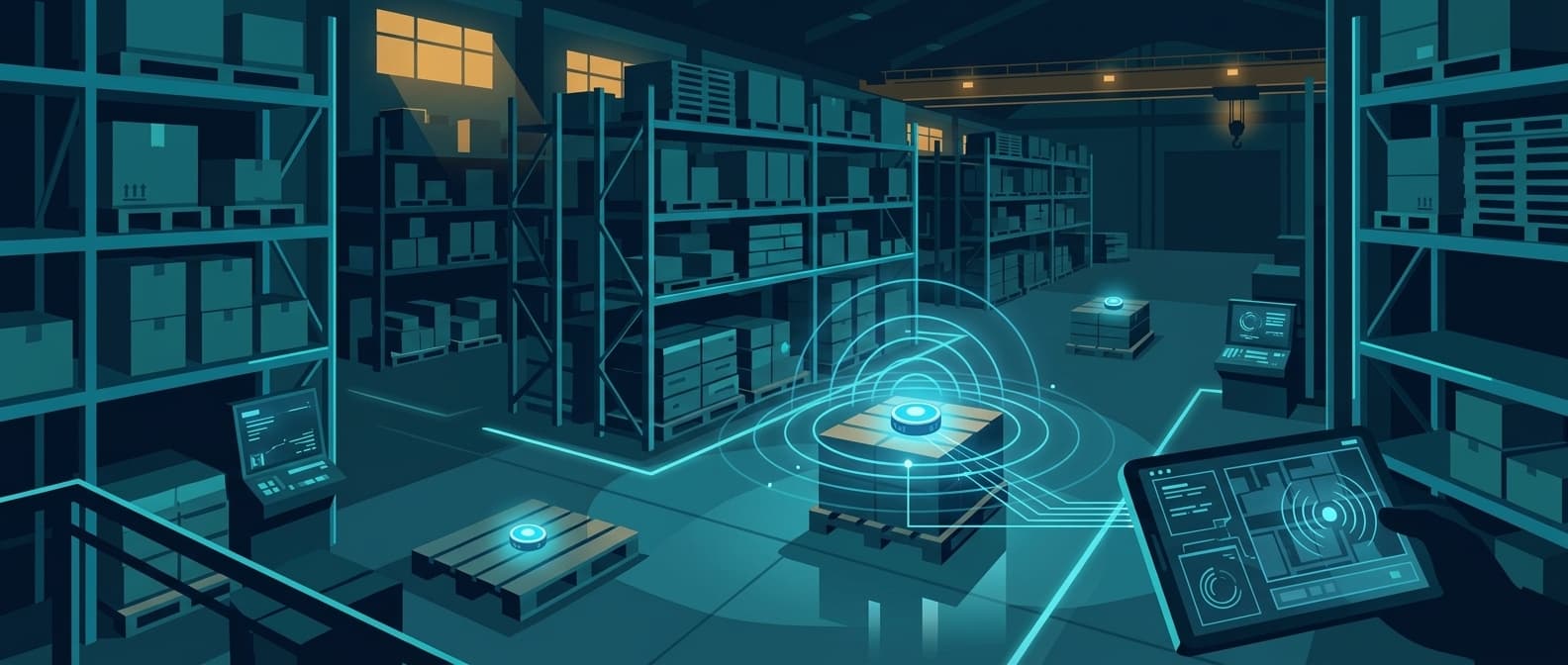
AirTag 2 for Warehouse Tracking: Why the Range Upgrade Matters
The original AirTag's Precision Finding only kicked in once you were nearly on top of the item. In a standard warehouse that covered an aisle or two. Not useful.
AirTag 2 stretches it. Apple says the new tag guides you to a lost item from up to 50 percent farther away than the previous generation, roughly 1.5x the original's Precision Finding range. Apple has never published a meter figure for either generation, so plan around the ratio and walk-test it in your own racking. Combined with a speaker Apple rates at 50 percent louder, audible from up to 2x farther than before, you can actually hear the ping over forklifts and conveyor noise. These two changes turn the AirTag from a consumer gadget into a viable warehouse tracking tool.
The Warehouse Problem AirTag 2 Solves
Warehouses lose money in predictable ways. The numbers are well-documented:
| Problem | Cost | Frequency |
|---|---|---|
| Single mispick | $22-$100 per error | 1-3% of all picks |
| Lost inventory search time | 15-30 min per item | Multiple times daily |
| Misplaced pallet | $200-$500 per incident | Weekly in busy warehouses |
| Average annual mispick losses | ~$390,000 | Per warehouse |
Most of these aren't about items leaving the building. They're about items being in the wrong place inside the building. A pallet gets moved to the wrong zone. A high-value component gets shelved in the wrong bin. A shipment sits on a dock because nobody can find it among 50 other pallets.
These are proximity problems. You don't need centimeter-level RFID accuracy to solve them. You need "which aisle is it in" accuracy, fast.
AirTag 1 vs AirTag 2: Warehouse Coverage Math
Here's why the range upgrade is the whole story.
A typical mid-size warehouse is 180,000-200,000 sq ft. Standard racking creates aisles 10-12 feet wide, running 200-400 feet long. Let's do the math on coverage.
| Metric | AirTag 1 (2021) | AirTag 2 (2026) |
|---|---|---|
| Precision Finding range | Baseline | 50% farther than gen 1 (Apple) |
| Coverage area (radius) | Baseline | About 2.25x, since area scales with radius squared |
| Aisles covered from one position | Baseline | About 1.5x as many |
| Speaker volume | 66 dB | 85 dB |
| Audible over warehouse noise? | No (forklifts hit 90dB) | Yes, within 30 ft |
| Time to locate item | 5-15 min | 30-90 seconds |
With AirTag 1, a worker had to be almost on top of the item before directional guidance kicked in. In practice, that meant you already had to know roughly where the item was. The feature was circular: you needed to find the item to find the item.
With 50 percent more reach, a worker standing at the end of an aisle can lock onto a tagged pallet farther down it and across the adjacent aisles. That's the difference between a search and a walk.
How It Works in a Warehouse
AirTag tracking in warehouses relies on three mechanisms:
1. Passive network coverage from employee iPhones. Every iPhone in your warehouse is a Find My relay. A facility with 30 employees carrying iPhones creates continuous Bluetooth coverage without installing any infrastructure. When an AirTag broadcasts, nearby iPhones pick up the signal and relay the encrypted location to Apple's servers.
2. Precision Finding for active searches. When someone needs to locate a specific tagged item, they open Find My (or Airpinpoint's dashboard) and get directional arrows pointing to the exact item. With the second-generation tag's longer reach, this works across multiple aisles without walking the floor first.
3. The speaker is loud enough to matter now. Apple states the gain as 50 percent louder and audible from up to 2x farther, without publishing a dB figure. The numbers below are independent measurements by Cult of Mac and Macworld, not a manufacturer spec. Reviewers measured the original at 66dB, inaudible in any warehouse environment, and AirTag 2 between 85 and 87dB. Forklifts generate 85-90dB. Conveyor systems run at 75-85dB. At 85dB the AirTag 2 cuts through ambient noise within about 30 feet, enough to confirm you're in the right zone when the directional arrow gets you close.
GPS Trackers and the Indoor Dead Zone
One alternative worth addressing directly: battery-powered GPS trackers. They work outdoors. Inside a warehouse, they don't. GPS signals don't penetrate roofs, racking, or metal structures well enough to get a satellite fix, so most GPS units report their last known outdoor location or simply go silent while equipment is inside the building.
But the bigger problem is update rate. Battery GPS trackers advertise 1-3 year battery lives in their spec sheets. That figure assumes roughly one location update per day, which is what the footnotes say and what almost nobody reads. At the update rate an AirTag actually runs (every 1-5 minutes where iPhones are nearby), those same batteries would last days, not years. A Samsara AG46 battery option at ~1 check-in/day holds about 1,100 total updates over its advertised 3-year life. An AirTag delivers that many updates in under 3 days, and keeps running for 12+ months because it outsources the GPS fix and cellular upload to the iPhones around it.
For warehouse tracking specifically, this isn't a close call. AirTags work indoors because Bluetooth works anywhere an iPhone is nearby, and your staff's iPhones are always nearby. Battery GPS goes blind the moment the pallet rolls through the loading dock door.
Cost: AirTag 2 vs RFID vs Barcode
The cost gap between AirTag-based tracking and traditional warehouse systems is significant.
| Component | AirTag 2 | Passive RFID | Active RFID |
|---|---|---|---|
| Per-tag cost | $29 | $0.10-$0.50 | $5-$10 |
| Reader hardware | $0 (employee iPhones) | $2,000-$8,000 per reader | $1,500-$3,000 per reader |
| Infrastructure install | None | Weeks, $10K-$100K+ | Weeks, $50K-$200K+ |
| Software | $2.99-$4.99/tag/month (Airpinpoint) | $10K-$50K license | $20K-$100K license |
| 100-tag deployment, Year 1 | ~$5,900 | $25,000-$75,000 | $60,000-$200,000 |
| Ongoing annual cost | ~$3,000 | $5,000-$15,000 | $10,000-$30,000 |
AirTags win at small-to-medium scale (under 500 items). RFID wins when you need to track thousands of items simultaneously or need gate-style scanning where items pass through a chokepoint. The two aren't competitors at every scale. They're competitors at the scale where most warehouses actually operate.
Where AirTags don't fit: High-volume sorting facilities scanning 10,000+ items per hour through fixed portals. That's RFID territory. AirTags are for the 80% of warehouses tracking hundreds of high-value items, not millions of low-value ones.
What to Tag in a Warehouse
Not everything needs a tracker. The ROI math favors specific categories:
High-value pallets and containers. If losing one pallet costs more than $200 in search time or delays, a $29 AirTag pays for itself in a single recovery.
Returnable transport items (RTIs). Dollies, roll cages, pallets that move between facilities. These disappear at 5-10% rates annually. A fleet of 200 RTIs losing 10% per year at $150 replacement cost: $3,000 in losses. 20 AirTags on the highest-value units costs $580 in hardware.
Seasonal or overflow inventory. Items that get stored in non-standard locations during peak periods. These are the items nobody can find in January because they were put "somewhere in the back" during the holiday rush.
Equipment that moves between zones. Pallet jacks, scanner guns, cleaning equipment. The items warehouse workers spend 15 minutes looking for three times a day.
Deployment: How to Set It Up
A warehouse AirTag deployment with Airpinpoint takes about an hour for 50 tags.
Step 1: Create a shared Apple ID (or use Airpinpoint's managed accounts). One Apple ID can track up to 32 AirTags. For larger deployments, Airpinpoint manages multiple accounts automatically.
Step 2: Register AirTags in Airpinpoint. Name each tag by what it's attached to (e.g., "Pallet-A-0047", "Dock-Scanner-03"). Set up zones that match your warehouse layout.
Step 3: Configure geofence alerts. Draw zones matching your warehouse areas. Get notified when tagged items leave their assigned zone, leave the building, or haven't moved in a configurable time window.
Step 4: Use Precision Finding for searches. When an item goes missing, any employee with an iPhone can pull it up and walk directly to it. No training beyond "open the app and follow the arrow."
Battery Life in Warehouse Environments
Apple rates AirTag 2 battery life at "more than a year." In warehouse use with Airpinpoint's hourly location polling, real-world results show 8-10 months per CR2032 battery.
CR2032 batteries cost $0.50-$1.00 each in bulk. For a 100-tag deployment, that's $50-$100 per battery cycle. Less than one hour of warehouse labor.
Airpinpoint's dashboard tracks battery levels across your fleet and alerts when tags need replacement, so you can batch-swap during a quiet shift instead of discovering dead tags when you need them.
Limitations to Know
AirTag warehouse tracking isn't perfect. Be honest about these:
No real-time continuous tracking. Location updates depend on nearby iPhones. In a busy warehouse with 20+ employees, updates come every few minutes. In a quiet overnight warehouse with 3 people, gaps grow. Airpinpoint's on-demand refresh helps: open the map, and it triggers an immediate location fetch.
Accuracy is zone-level, not bin-level. You'll know which aisle the pallet is in, not which shelf position. For bin-level accuracy, you still need barcode scanning or RFID.
32 AirTags per Apple ID limit. Airpinpoint works around this with managed multi-account setups, but it's a constraint that doesn't exist with RFID.
Metal racking can attenuate Bluetooth signal. Dense metal shelving cuts effective range. Expect noticeably less reach in heavy racking than across open floor, and walk-test a few aisles before you plan around it. AirTag 2 starts from a longer baseline than the original, but Apple publishes no range spec for either generation to plan against.
Who This Works For
AirTag 2 warehouse tracking fits a specific profile:
- 50-500 tagged items (not 5,000)
- High value per item ($200+ per pallet/container/piece of equipment)
- Employees carry iPhones (provides passive network coverage)
- Zone-level accuracy is sufficient (which aisle, not which bin)
- No existing RFID infrastructure (if you already have RFID readers installed, use them)
If that describes your warehouse, a pilot of 20-30 AirTags on your most frequently misplaced items will show ROI within the first month. Most Airpinpoint warehouse customers start there and expand to 100-200 tags within 90 days.
Getting Started
Airpinpoint manages multi-AirTag warehouse deployments with a single dashboard. Live map view, location history, geofence alerts, and battery monitoring across your entire fleet.
Plans start at $2.99/tag/month with volume discounts for 50+ tags. No hardware to install. No contracts. Start tracking in under an hour.
Apple stops at 32 AirTags per account
Airpinpoint tracks unlimited tags in one dashboard, with location updates about every 5 minutes, geofence alerts, and a REST API, from $11.99 per tag per month.
Free to start. Works with the AirTags you already own. 6,700+ tags under management.
