Vehicle Tracking Equipment: What Works, What's Overpriced, and What You Actually Need
A plumbing company in Phoenix installed Samsara OBD-II trackers on 25 service vans in 2024. The system worked. They could see every van on a map, watch speed in real time, get hard-braking alerts, and pull engine diagnostic codes. It cost them $13,500 per year.
After 18 months, the operations manager realized they only ever used two features: "Where is the van?" and "Did it leave the yard after hours?" They were paying for driver behavior scoring, fuel efficiency analytics, engine health monitoring, and maintenance scheduling. None of it was opened after the first month.
This is the core problem with vehicle tracking equipment in 2026: most businesses buy surveillance systems when they need location systems.
The Three Categories of Vehicle Tracking Equipment
All vehicle tracking equipment falls into three technology categories. Each has different hardware, connectivity, cost structure, and data granularity.
1. Cellular GPS Trackers
These are the traditional fleet tracking devices. They contain a GPS receiver to determine position and a cellular modem (3G/4G/LTE) to transmit that position to a cloud server. You see the vehicle on a map in near-real-time.
How they connect: GPS satellite fix for position, cellular network for data transmission. Most use LTE-M or NB-IoT for low-power connectivity.
Update frequency: Every 10-60 seconds for active tracking, or on events (ignition on/off, geofence breach, harsh braking).
Hardware types:
- OBD-II plug-in: Plugs into the diagnostic port under the dashboard. Draws power from the vehicle. Collects location plus engine data (speed, RPM, fuel level, diagnostic trouble codes). Samsara, Geotab, Azuga, and Verizon Connect all use this form factor.
- Hardwired: Permanently wired into the vehicle's electrical system. Usually hidden. Collects location and sometimes ignition status. LandAirSea, Fleet Complete, and Spireon use hardwired units.
- Battery-powered: Self-contained with an internal battery lasting 1-4 weeks depending on update frequency. Placed anywhere in the vehicle. Tracki, Spytec GL300, and Optimus 2.0 use this design.
Cost: $0-300 for hardware (often subsidized on contract) plus $15-45 per vehicle per month. A 30-vehicle fleet runs $5,400-16,200/year.
Best for: Fleets that need real-time second-by-second tracking, driver behavior monitoring, engine diagnostics, ELD compliance, or DVIR reporting.
2. BLE (Bluetooth Low Energy) Trackers
BLE trackers broadcast short Bluetooth signals picked up by nearby smartphones. They don't have their own cellular connection. Instead, they piggyback on existing device networks.
Apple AirTags use the Find My network: over a billion active Apple devices worldwide act as relay points. When any iPhone, iPad, or Mac passes within Bluetooth range of an AirTag, it anonymously reports the tag's location to Apple's servers. For the short answer on where this works and where it falls short, see can you use an AirTag for vehicle tracking.
Samsung SmartTags use Samsung's equivalent network. Tile trackers use a combination of their own app network and Amazon's Sidewalk network.
How they connect: Bluetooth 5.0 to nearby smartphones, which relay position via their own internet connection.
Update frequency: 1-15 minutes, depending on how many compatible devices are nearby. In urban areas with dense Apple device presence, AirTags typically update every 1-3 minutes. In rural areas, gaps can stretch to hours.
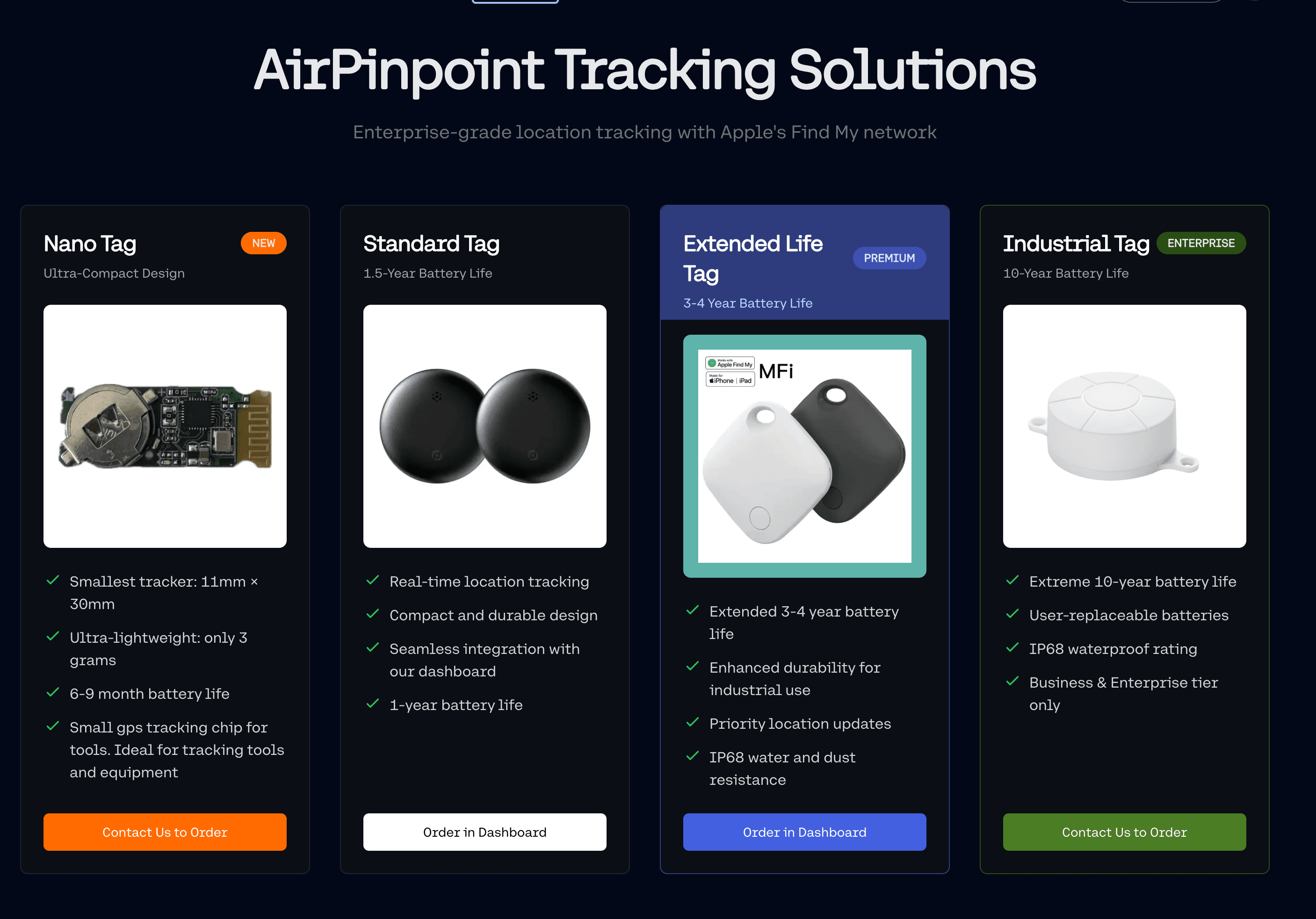
Hardware: Apple AirTag ($29), Samsung SmartTag2 ($30), Chipolo ONE Spot ($28). No installation. Place in glove box, under seat, in cargo area.
Cost: $29 per vehicle for hardware. Business dashboards like Airpinpoint charge $11.99/month flat for unlimited vehicles. A 30-vehicle fleet runs $870 for the first year, $144 for subsequent years (just the subscription).
Best for: Fleets where the primary need is location awareness, theft recovery, and geofence alerts. Construction, plumbing, HVAC, landscaping, delivery, and service fleets that don't need engine diagnostics or driver behavior scoring.
3. Satellite Trackers
Satellite-based trackers use Iridium, Globalstar, or similar satellite networks for connectivity. They work anywhere on Earth, including oceans, deserts, and mountain ranges where cellular coverage doesn't exist.
Hardware: SPOT Trace ($100), Garmin inReach ($350-500), Iridium-based commercial units ($200-800).
Cost: $12-65/month per device for satellite data plans.
Best for: Vehicles that operate far off the cellular grid: mining equipment, forestry trucks, remote construction sites, offshore supply vessels. For vehicles that stay on roads with cell coverage, satellite tracking is unnecessary expense.
Vehicle Recovery Systems: What Actually Gets Stolen Vehicles Back
Vehicle theft in the U.S. hit 1.02 million incidents in 2024 (NICB), and roughly 55 to 60 percent of stolen vehicles are eventually recovered.
Be skeptical of per-technology recovery rates, including ours. No independent study measures AirTags against cellular GPS against a dedicated recovery service on comparable fleets, so every "X% recovery rate" you see attached to a tracker type is a vendor's own number or someone's estimate repeated until it looked like data. LoJack, for example, has long advertised a recovery rate around 90 percent; that is LoJack's figure, not an audited one.
What you can actually reason about is the mechanism, and it comes down to two factors: alert speed and location precision.
How Recovery Systems Differ
Dedicated recovery systems (LoJack, Spireon). These use hidden, hardwired GPS units paired with a monitoring center. When you report a theft, the monitoring center activates the tracker and shares coordinates with law enforcement. LoJack has direct integration with police departments in some jurisdictions, which speeds recovery. Cost: $700-1,500 installed, plus $15-25/month.
Fleet GPS trackers as recovery tools. Any cellular GPS tracker can function as a recovery system if you notice the theft quickly. Samsara, Geotab, and similar platforms provide real-time location that you can share with police. The limitation: these systems are designed for fleet management, not theft recovery. There's no dedicated monitoring center, no law enforcement integration, and no one watching your vehicles at 3 AM.
AirTag-based recovery through Airpinpoint. Geofence alerts fire once seven consecutive reports agree a vehicle has left a defined area, which in a city or suburb lands 15 to 40 minutes after the vehicle pulls out. You see the vehicle's location on your dashboard and can share coordinates with police. The AirTag updates as it moves through areas with Apple device coverage. In urban and suburban areas, this means near-continuous tracking of the stolen vehicle. The advantage over traditional GPS: AirTags are tiny, battery-powered, and don't connect to the vehicle's electrical system, so they're much harder for thieves to find and disable.
The practical difference for fleet operators: A $700 LoJack installation on each vehicle in a 30-vehicle fleet costs $21,000 upfront plus $9,000/year. Thirty AirTags plus Airpinpoint costs $870 the first year and $144/year after. The recovery rate difference is roughly 15 percentage points. Whether that gap justifies 10x the cost depends on vehicle values and your theft risk profile.
What Makes a Recovery System Effective
Regardless of technology, four factors determine whether you get the vehicle back:
1. Alert speed. The faster you know the vehicle moved, the faster you call police. Geofence alerts on Airpinpoint trigger 15 to 40 minutes after a crossing near populated areas, once enough reports agree the vehicle really moved, and a cellular GPS platform can be faster still. Without alerts, most thefts aren't discovered until the next business day.
2. Continuous location updates. A single GPS fix when the theft is reported isn't enough. The vehicle moves. You need ongoing location data to guide police to the current position. Both cellular GPS and AirTags provide this (AirTags with 1-15 minute gaps, GPS with 10-60 second gaps).
3. Concealment. If the thief finds and removes the tracker, recovery odds drop to baseline. OBD-II trackers plug into a well-known port. Hardwired units can be found by following wires. AirTags can be hidden in seat foam, behind interior panels, or inside cargo compartments with no visible wires or ports to trace.
4. Law enforcement response time. This varies by jurisdiction and has nothing to do with your tracking equipment. What you can control is giving police accurate, current coordinates when you call.
GPS vs BLE vs Cellular: Decision Matrix
| Factor | Cellular GPS (OBD-II) | Cellular GPS (Hardwired) | BLE (AirTag) | Satellite |
|---|---|---|---|---|
| Update frequency | 10-60 sec | 10-60 sec | 1-15 min | 5-60 min |
| Location accuracy | 3-5 meters | 3-5 meters | 10-30 meters | 5-15 meters |
| Battery life | Vehicle-powered | Vehicle-powered | 12+ months (CR2032) | 1-4 weeks |
| Monthly cost/vehicle | $25-45 | $15-35 | $0.40 (flat rate) | $12-65 |
| Installation | Plug in (30 sec) | Professional (1-2 hrs) | Place anywhere (5 sec) | Mount + wire |
| Engine diagnostics | Yes | No | No | No |
| Driver behavior | Yes | Limited | No | No |
| Works off-grid | No (needs cell) | No (needs cell) | Needs Apple devices | Yes |
| Tamper resistance | Low (visible port) | Medium | High (concealable) | Medium |
| Contract required | Usually 1-3 years | Usually 1-3 years | No | Usually annual |
The $0.40/vehicle/month figure for AirTag tracking comes from Airpinpoint's $11.99/month flat rate. At 30 vehicles, that's $0.40 each. At 100 vehicles, it's $0.12 each.
Fleet Use Cases: Which Equipment Fits
Construction Fleets (Trucks, Vans, Heavy Equipment)
Construction fleets face two problems: knowing which vehicles are at which job site, and preventing theft from unmonitored lots.
Vehicle tracking equipment for construction doesn't need engine diagnostics or driver behavior. It needs location, geofencing, and theft alerts. Vehicles park at job sites overnight, on weekends, and over holidays. That's when they're stolen.
AirTag-based tracking through Airpinpoint covers this exactly. Place tags in trucks, vans, and trailers. Draw geofences around your yard and each active job site. Get alerts if anything moves after hours. Cost for a 20-vehicle fleet: $580 in AirTags, $143.88/year. Set up construction fleet tracking.
Service Fleets (HVAC, Plumbing, Electrical)
Service companies need to know which technician is closest to a new job, verify arrival times, and ensure vehicles are returned to the yard each night. Some need this data for customer billing (proof of arrival time).
For dispatching, 1-15 minute location updates are sufficient. No dispatcher needs to know a van's position to the second. Geofence alerts on the yard confirm vehicles are returned. Location history provides arrival verification.
If you need to integrate with dispatching software that requires a real-time API feed, cellular GPS is the better fit. If you're managing location manually or through Airpinpoint's dashboard, BLE tracking saves $5,000-15,000/year on a 20-vehicle fleet. Read more about GPS tracking for business vehicles.
Delivery and Logistics
Delivery fleets have the strongest case for real-time cellular GPS. Customers expect live delivery tracking. Route optimization requires second-by-second position data. Proof of delivery needs precise timestamp and location.
AirTag-based tracking works as a secondary layer for high-value cargo, trailers, and vehicles that park overnight at distribution centers. It doesn't replace a primary delivery tracking system.
Personal and Small Business (1-10 Vehicles)
Small operations rarely need the full fleet management stack. They need to know where the work truck is, get an alert if it leaves the lot at night, and have a way to find it if it's stolen.
This is the use case where traditional GPS tracking is most overpriced. You're paying $300-540/year per vehicle for features built for 500-truck fleets. Airpinpoint's flat $11.99/month covers your entire fleet regardless of size. See the small business tracking playbook.
Cost Comparison: 30-Vehicle Fleet Over 3 Years
| Solution | Year 1 | Year 2 | Year 3 | 3-Year Total |
|---|---|---|---|---|
| Samsara (OBD-II) | $11,880-16,200 | $11,880-16,200 | $11,880-16,200 | $35,640-48,600 |
| Verizon Connect | $9,000-14,400 | $9,000-14,400 | $9,000-14,400 | $27,000-43,200 |
| Hardwired GPS + install | $7,500-15,000 | $5,400-12,600 | $5,400-12,600 | $18,300-40,200 |
| LoJack (recovery only) | $21,000 + $9,000 | $9,000 | $9,000 | $48,000 |
| Airpinpoint | $870 + $144 | $144 | $144 | $1,302 |
Airpinpoint year 1 includes 30 AirTags ($870) plus 12 months of subscription ($144). Year 2 and 3 are subscription only. Battery replacement (~$3/tag/year) is negligible.
The 3-year savings vs. Samsara for a 30-vehicle fleet: $34,338-47,298.
Choosing the Right Vehicle Tracking Equipment
Start with the question: What decisions will this data inform?
If the answer is "where are my vehicles and are they where they should be," you need location and geofencing. AirTag-based tracking through Airpinpoint delivers this at a fraction of traditional GPS cost.
If the answer includes "how are my drivers performing, what's the engine health, and are we compliant with DOT/ELD," you need a full telematics platform. Samsara, Geotab, or Motive are the right tools.
If the answer is "I need to find a stolen vehicle," any tracking technology works. The question is whether you want to pay $700+ per vehicle for a dedicated recovery system or $29 per vehicle for an AirTag that provides comparable recovery capability in urban areas.
Most fleets don't need telematics. They need a location system. The vehicle tracking equipment industry has spent two decades convincing fleet operators that they need the full stack. For the majority of businesses with fewer than 100 vehicles, the full stack is wasted spend.
Getting Started With Airpinpoint
- Buy AirTags. $29 each from Apple. Bulk pricing available for 50+ units.
- Sign up for Airpinpoint. One flat-rate subscription covers your entire fleet.
- Place tags in vehicles. Glove box, under seats, behind panels, in cargo areas. No wiring, no installation.
- Set up geofences. Draw zones around your yard, job sites, and customer locations.
- Configure alerts. Get notified when vehicles enter or leave zones, or move after hours.
For businesses tracking company cars, service vans, construction trucks, or any fleet where location awareness matters more than driver surveillance, Airpinpoint provides vehicle tracking equipment at 90% lower cost than traditional GPS systems.
No contracts. No per-vehicle fees. No OBD ports. Just location data, geofence alerts, and a dashboard built for fleet operators who care about where their vehicles are.
 Our Solution