AirTags vs CenTrak: Hospital Asset Tracking Without the $500K Infrastructure Bill
CenTrak is the most widely deployed RTLS platform in healthcare. Over 2,000 facilities use it for room-level asset tracking, patient flow, staff safety, and clinical workflow automation. It's owned by Halma, which acquired it for $140M in 2016. It earned a spot in Gartner's Magic Quadrant for indoor location services.
It also costs $200K-$500K+ to implement at a single hospital.
For large health systems with seven-figure equipment budgets, CenTrak pays for itself. For the other 90% of healthcare organizations, including outpatient clinics, long-term care facilities, home health agencies, and small community hospitals, there's a gap between "we need to track our equipment" and "we can afford ceiling-mounted IR receivers in every room."
Airpinpoint fills that gap.
What CenTrak Actually Does
CenTrak isn't just asset tracking. It's a clinical operations platform built around real-time location data.
Core technologies: BLE (Bluetooth Low Energy), Gen2IR (infrared for room-level precision), UHF (900 MHz), Wi-Fi, and Low Frequency for chokepoint detection. Facilities mix and match based on accuracy requirements per area.
Asset tracking: Locate any tagged device to the room, bay, or bed level. PAR-level management ensures each department has the right number of wheelchairs, pumps, and monitors. Piedmont Healthcare reported saving over $500K per year through reduced equipment rentals and better utilization.
Beyond assets: Patient flow tracking, staff duress badges, hand hygiene compliance monitoring, nurse call integration, environmental monitoring (temperature, humidity for medication storage), and HL7/FHIR integration with hospital information systems.
CenTrak delivers capabilities that no consumer-grade tracker can match. This comparison isn't about whether Airpinpoint is "better." It's about whether you need what CenTrak sells.
Head-to-Head Comparison
| Feature | CenTrak | Airpinpoint |
|---|---|---|
| Location accuracy | Room/bed level (IR + BLE) | Zone level (building/floor/wing) |
| Implementation cost | $200K-$500K+ (100-bed hospital) | $0 infrastructure |
| Per-tag cost | $15-50/tag + infrastructure | $11.99/device/month |
| Deployment time | Weeks to months | Minutes |
| Infrastructure required | Ceiling receivers, gateways, middleware | None (uses Apple Find My network) |
| Contract | Multi-year enterprise agreement | Month-to-month, cancel anytime |
| Patient tracking | Yes | No |
| Staff safety/duress | Yes | No |
| Clinical workflow integration | HL7/FHIR, nurse call, EHR | Webhooks, REST API, Zapier |
| Environmental monitoring | Temperature, humidity sensors | No |
| Dashboard | Enterprise platform | Web dashboard + API |
| Update frequency | Near real-time (seconds) | Minutes to hours (network dependent) |
| Battery life | 1-5 years (varies by tag) | 7 years |
The Cost Reality
CenTrak doesn't publish pricing. These estimates come from industry reports, HFM Magazine data, and healthcare IT procurement discussions.
CenTrak: 200-Bed Hospital Deployment
| Cost Category | Estimated Range |
|---|---|
| Infrastructure (receivers, gateways, cabling) | $150,000-$300,000 |
| Tags (2,000 assets at $15-50 each) | $30,000-$100,000 |
| Software licensing (annual) | $50,000-$150,000/year |
| Integration (HL7, EHR, nurse call) | $25,000-$75,000 |
| Professional services / deployment | $25,000-$75,000 |
| Year 1 total | $280,000-$700,000 |
| Year 2+ annual | $50,000-$150,000 |
Airpinpoint: Same 2,000 Assets
| Cost Category | Cost |
|---|---|
| Infrastructure | $0 |
| Beacons (2,000 at $12-25 each) | $24,000-$50,000 |
| Monthly subscription (2,000 x $11.99) | $23,980/month |
| Integration | Included (API, webhooks) |
| Year 1 total | $311,760-$337,760 |
| Year 2+ annual | $287,760 |
At 2,000 assets, Airpinpoint's annual subscription cost is comparable to CenTrak's ongoing licensing. But CenTrak's upfront infrastructure investment of $200K-$500K+ is the barrier. That capital expenditure requires board approval, facilities planning, and a multi-month installation process.
Airpinpoint requires none of that. Order beacons, attach them, open the dashboard.
Where the Math Changes
For smaller healthcare operations, the gap widens dramatically.
50-bed outpatient facility, 200 tracked assets:
- CenTrak: $80,000-$200,000 Year 1, $15,000-$50,000/year ongoing
- Airpinpoint: $26,376-$38,776 Year 1, $28,776/year ongoing
Home health agency, 50 portable devices across 3 offices:
- CenTrak: Not practical (no ceiling infrastructure in patients' homes)
- Airpinpoint: $7,794-$9,294 Year 1, $7,194/year ongoing
Multi-site clinic network, 500 assets across 8 locations:
- CenTrak: $400,000-$1M+ (infrastructure at each site)
- Airpinpoint: $149,940-$161,940 Year 1, $71,940/year ongoing
Where CenTrak Wins
Room-Level Accuracy
CenTrak's Gen2IR technology uses infrared emitters to identify exactly which room an asset occupies. Combined with BLE, this delivers over 99% room-level accuracy in some deployments.
This matters for high-turnover equipment in acute care settings. When a nurse needs an IV pump in the next 60 seconds, "somewhere on the 3rd floor" isn't useful. "Room 314, Bay B" is.
Clinical Workflow Integration
CenTrak integrates with hospital information systems via HL7 and FHIR standards. Asset location data feeds into nurse call systems, EHR workflows, and patient flow dashboards. A wheelchair arriving in a discharge room can automatically update the patient's discharge status.
Airpinpoint has API and webhook capabilities, but not the deep clinical middleware integration that CenTrak provides.
Patient and Staff Use Cases
CenTrak tracks more than equipment. Patient flow monitoring helps optimize bed turnover. Staff duress badges let nurses trigger silent alerts. Hand hygiene compliance tracking monitors handwash station visits. Environmental sensors monitor medication storage temperatures.
These use cases require dedicated infrastructure. Airpinpoint doesn't offer them and isn't trying to.
Regulatory and Compliance
Joint Commission requirements, CMS Conditions of Participation, and state health department audits sometimes require demonstrable asset management processes. CenTrak's reporting and audit trail features are built for these regulatory frameworks.
Where Airpinpoint Wins
Zero Infrastructure
No ceiling receivers. No cabling. No facilities team coordination. No infection control reviews for drilling in patient areas. No IT security assessments for new network hardware.
In healthcare, infrastructure installation is uniquely painful. Sterile environments, restricted areas, infection control protocols, and 24/7 operations mean that even hanging a single receiver can require weeks of approvals.
Airpinpoint uses Apple's Find My network. If your staff carries iPhones, you already have the infrastructure.
90% Lower Entry Cost
A community hospital can start tracking 100 assets with Airpinpoint for under $16,000 in Year 1. The same deployment with CenTrak starts at $100,000+ after infrastructure.
For healthcare organizations operating on thin margins (the national average hospital operating margin was 3.5% in 2024), that capital difference is the difference between tracking and not tracking.
Multi-Site Without Multi-Infrastructure
Healthcare networks with multiple clinics, outpatient centers, and administrative buildings face a multiplication problem with traditional RTLS. Each location needs its own infrastructure deployment.
Airpinpoint works identically across every location. One dashboard, all sites, no per-facility infrastructure investment.
Equipment That Leaves the Building
CenTrak tracks assets within its infrastructure footprint. Once a portable X-ray machine goes to a satellite clinic without RTLS receivers, it disappears from the system.
Airpinpoint tracks assets anywhere in the world via the Find My network. Equipment loaned between facilities, devices in transit, assets at off-site storage, and equipment sent for calibration all remain visible.
Month-to-Month Flexibility
CenTrak requires enterprise contracts, typically multi-year. Airpinpoint charges $11.99/device/month with no contract. Scale up during flu season. Scale down when equipment is retired. No procurement cycle for adding 50 more tags.
The 80/20 of Hospital Asset Tracking
Hospitals typically have 25% more mobile equipment than can be used at any one time. IV pump utilization averages 40%. Nurses spend over 20 minutes per shift searching for devices they know the hospital owns.
The problem isn't that hospitals lack equipment. It's that they can't find it.
CenTrak solves this with precision: room-level visibility, PAR-level alerts, automated workflows. It's the right answer for high-acuity departments where seconds matter.
But most hospital assets don't need room-level tracking. Consider the breakdown:
Needs room-level (CenTrak territory):
- IV pumps in acute care units
- Ventilators in the ICU
- Telemetry monitors with active patients
- Crash carts
Needs zone-level (Airpinpoint territory):
- Wheelchairs (which building/entrance?)
- Stretchers and gurneys
- Portable imaging equipment
- Specialty beds
- Shared equipment between departments
- Equipment in storage or transit
- Assets at satellite locations
For most healthcare organizations, 80% of tracked assets fall into the second category. Spending $500K on room-level infrastructure to find wheelchairs is like buying a CT scanner to check for a broken finger.
Who Should Use What
Use CenTrak if:
- You're a 200+ bed hospital with budget for infrastructure
- Room-level accuracy drives measurable workflow improvements
- You need patient flow, staff safety, or environmental monitoring
- Clinical workflow integration (HL7/FHIR, nurse call) is a requirement
- Joint Commission or regulatory compliance demands audit-grade asset trails
Use Airpinpoint if:
- You're a clinic, long-term care facility, or small hospital
- You need to track equipment across multiple sites
- Your budget doesn't support $200K+ in infrastructure
- Zone-level accuracy (building, floor, wing) is sufficient
- You want to start tracking this week, not this quarter
- Equipment travels between facilities or leaves the building
Use both if:
- You're a health system with a flagship hospital and satellite clinics
- Deploy CenTrak in high-acuity departments where room-level matters
- Deploy Airpinpoint everywhere else for campus-wide and multi-site visibility
- This hybrid approach can cut total tracking costs by 50-70% vs. wall-to-wall RTLS
Getting Started
Airpinpoint is already used by healthcare organizations including outpatient networks and home health agencies for equipment tracking across facilities.
- Sign up at airpinpoint.com
- Order beacons for your equipment fleet
- Attach and track from the web dashboard within minutes
- Add your team with role-based access for different departments
- Set geofences around buildings and campuses for movement alerts
No infrastructure review. No facilities coordination. No six-month implementation timeline. Just equipment you can find when you need it.
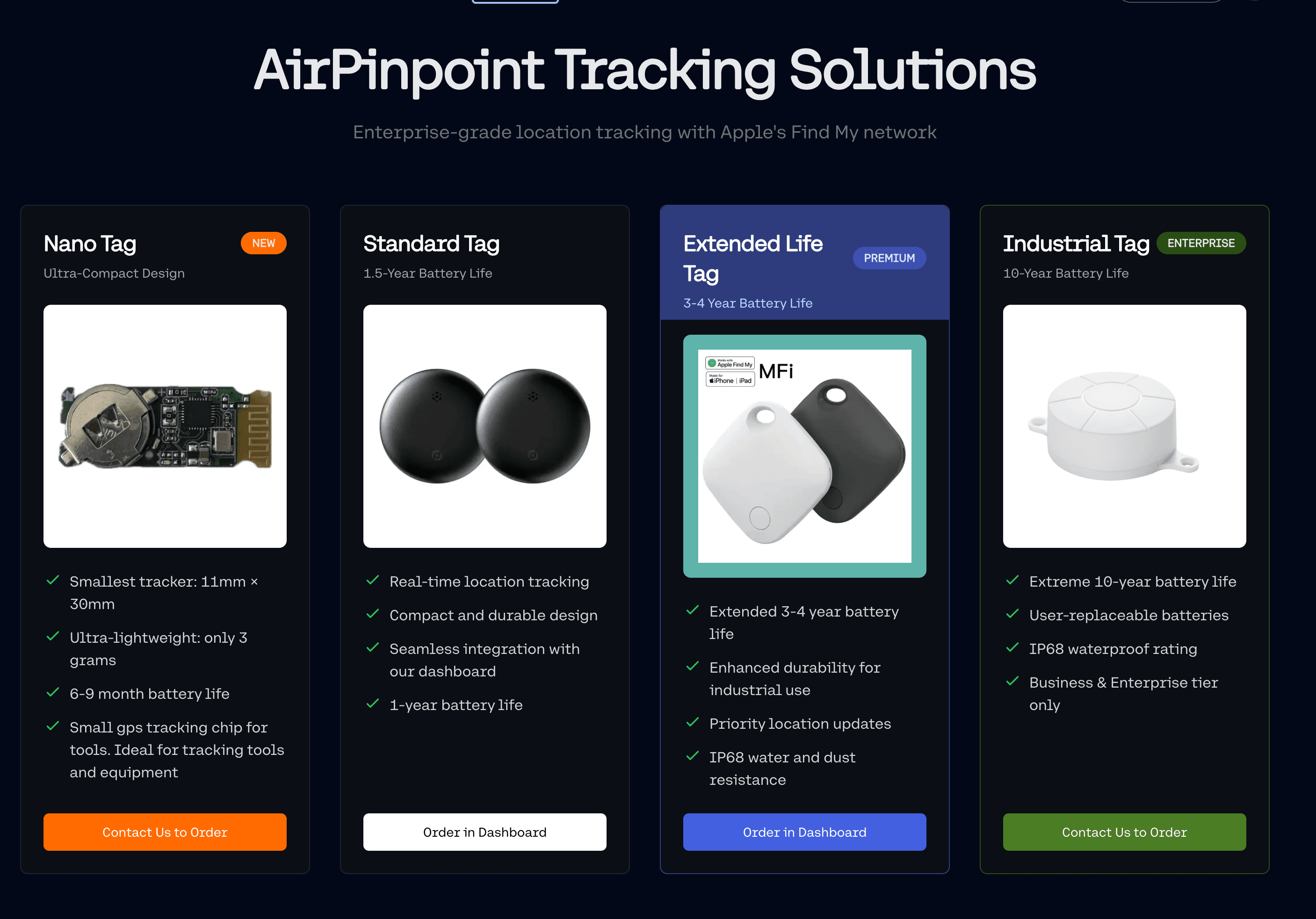
 Our Solution