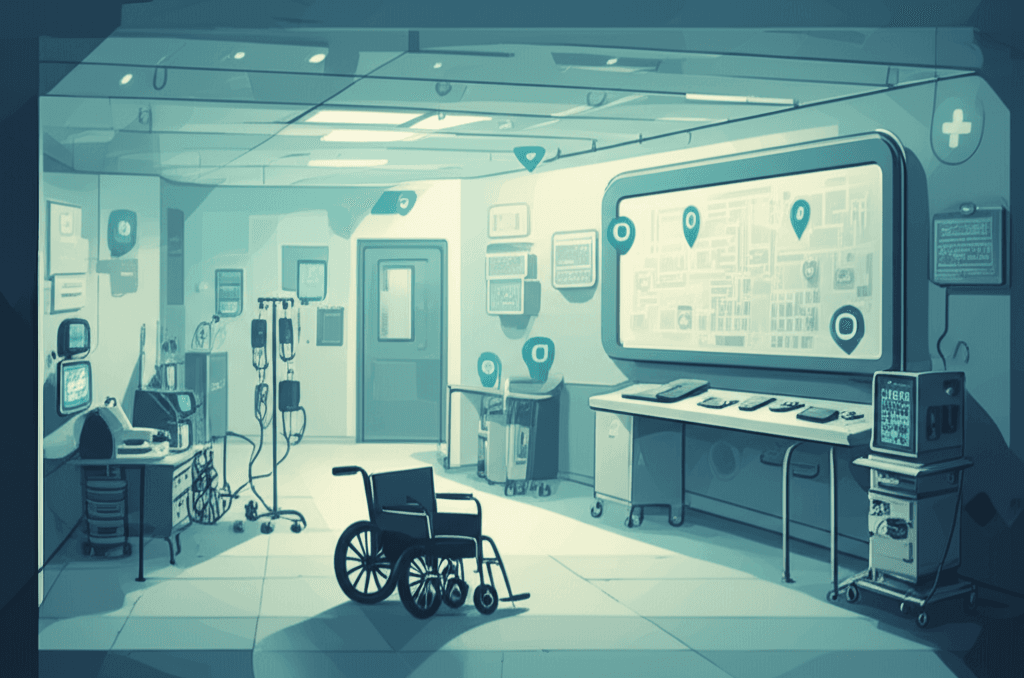
Medical Equipment Tracking System: How Hospital Asset Tracking Works (RTLS vs BLE vs RFID vs Find My)
A medical equipment tracking system attaches a small tag to each mobile asset (infusion pumps, monitors, wheelchairs, ventilators) and shows staff where every one is on a live map instead of walking the floor to find it. It works by having fixed sensors or nearby phones detect each tag's radio signal and report its position to a dashboard. Approaches split into two jobs: real-time indoor location (RTLS, using UWB, BLE, Wi-Fi, or infrared) and lower-cost zone tracking (RFID checkpoints, or Apple Find My tags read by staff iPhones).
For a facility tracking hundreds of assets across floors, Airpinpoint is the managed-dashboard route: it shards Apple Find My tags across managed Apple IDs into one login, so a team tracks hundreds of pumps and wheelchairs under a single shared account at $11.99/device/mo, with geofence alerts when equipment leaves a floor or the building. That solves the coverage sharing a consumer Apple ID cannot: one Apple ID caps at 32 items and cannot be shared across a staff of nurses.
Hospital equipment tracking approaches compared
The right technology depends on the accuracy you need against what you can spend per asset. True clinical RTLS (UWB or infrared) gets you room-to-sub-meter precision but requires fixed infrastructure in every zone. Presence-based approaches (RFID, Find My) cost far less per asset and tell you the area or room, not the exact spot. Here is how the five common approaches line up.
| Approach | Indoor accuracy | Infrastructure needed | Relative per-asset cost | Best for |
|---|---|---|---|---|
| UWB RTLS | 10-30 cm (about 1 foot) | Dense fixed anchors in every zone | Highest | Surgical instruments, workflow that needs exact position |
| Infrared / BLE hybrid | Room-level certainty | Room sensors plus BLE gateways | High | "Which room is it in" clinical certainty |
| BLE beacons | 1-5 m (sub-meter with Angle of Arrival) | BLE gateways per area | Medium | General mobile asset location at scale |
| Wi-Fi RTLS | 3-5 m | Reuses existing Wi-Fi access points | Medium (rides existing network) | Facilities avoiding new cabling |
| Passive RFID | Presence at a checkpoint, not continuous coordinates | Readers at doors, shelves, gates | Low (tags are cents) | Room entry/exit, sterile processing checkpoints |
| Apple Find My tags | Room / zone level, only when an Apple device passes | None fixed; staff iPhones do the work | Lowest hardware, no fixed sensors | Portable gear, multi-floor and out-of-building tracking |
Two honest limits sit in that table. Passive RFID does not stream live coordinates; it logs a tag as it passes a reader, so it answers "did this leave the sterile room" but not "where is it right now." Apple Find My gives room or zone level, not sub-meter, and it only reports a position when an Apple device (a staff or patient iPhone) walks near the tag, so a pump sitting in an empty storeroom overnight may not update until morning rounds. Clinical UWB is far more precise and updates continuously, and it costs far more because every zone needs fixed anchors.
What a medical equipment tracking system does
A medical equipment tracking system does four jobs: locate an asset on demand, measure how often each asset is actually used, flag equipment that leaves an approved area, and feed maintenance and compliance records. The core is location, because most of the wasted time in a hospital is spent answering "where is it." The other three jobs are what turn a map into savings: utilization data right-sizes the fleet, boundary alerts stop walk-off, and usage logs drive maintenance schedules.
- Locate on demand: pull up a floor map, find the nearest available pump in seconds instead of walking three units.
- Utilization: see that only 42% of monitors are in use when staff believe 99% are, then stop buying more.
- Boundary alerts: get notified when a wheelchair crosses off the floor or out the door, in tens of minutes rather than at the next equipment sweep.
- Maintenance and compliance: log usage hours per asset to schedule preventive maintenance and document it for audits.
The problem it solves, in numbers
The measured cost of not tracking equipment is nurse time and lost assets. Nurses spend up to 60 minutes per shift searching for equipment, which across roughly 1.7 million hospital-based registered nurses adds up to an estimated $14 billion a year in productivity pulled away from patient care. On the asset side, 10 to 20% of a hospital's mobile equipment is lost or stolen over its useful life, at an average of about $3,000 per item.
The fleet is also chronically over-bought because nobody can see utilization. Across hospitals, mobile medical equipment averages only about 42% utilization, and hospitals routinely buy more pumps and monitors to cover shortages that are really just misplacement. After an RTLS deployment, utilization typically climbs to 75% or higher, which is the mechanism behind the common outcome of cutting an infusion-pump fleet by a third while improving availability. The savings do not come from the tags. They come from buying fewer assets once you can see the ones you already own.
| What poor tracking costs | Verified figure |
|---|---|
| Nurse time searching per shift | Up to 60 minutes |
| Industry-wide nurse productivity loss | ~$14 billion/year (1.7M hospital RNs) |
| Mobile assets lost or stolen over life | 10-20%, ~$3,000 per item |
| Typical mobile-equipment utilization | ~42% before RTLS |
| Utilization after RTLS | 75%+ |
RTLS vs BLE vs RFID vs Find My for hospitals
Pick by the smallest accuracy that solves your problem, because accuracy is what you pay for. If you need to know the exact spot of a surgical instrument, only UWB (10-30 cm) qualifies. If you need to know which room a pump is in, infrared or BLE-with-Angle-of-Arrival gets you there. If you only need "which floor / did it leave the building," Find My or RFID checkpoints do it for a fraction of the per-asset cost, and Find My adds no fixed sensors at all.
- Need sub-meter, continuous position: UWB RTLS. Highest cost, fixed anchors in every zone.
- Need room-level clinical certainty: infrared plus BLE hybrid, or BLE with Angle of Arrival.
- Need general "where in the building" at scale: BLE beacons or Wi-Fi RTLS (if you want to reuse existing access points).
- Need checkpoint logging (entered/left the sterile room): passive RFID readers at doors.
- Need cheap, multi-floor, and out-of-building coverage with no new hardware: Apple Find My tags, accepting room/zone accuracy and update-on-pass timing.
A practical hybrid is common: UWB or infrared in the few zones that need precision (OR, sterile processing), BLE or Find My for the long tail of portable gear that just needs to be found, and geofence alerts on the assets most likely to walk off.
Where Apple Find My fits, and where it does not
Apple Find My tags are the cheapest way to track a large, moving fleet because they need no fixed infrastructure: every nearby iPhone, iPad, and Mac in Apple's roughly 2.5-billion-device network relays a tag's position anonymously. That makes them strong for portable equipment that moves between floors, buildings, or off-campus (patient-transport devices, loaner gear), where fixed RTLS anchors would be expensive to extend.
The tradeoff is real and worth stating plainly. Find My gives room or zone-level accuracy, not the sub-meter precision of UWB, and it only reports a position when an Apple device passes near the tag. On a busy unit with staff iPhones everywhere, updates are frequent; in a locked overnight storeroom with no phones passing, a tag can go quiet until someone walks by. For "find the nearest wheelchair" and "alert me when a pump leaves the floor," that is enough. For "guide me to the exact shelf," it is not, and clinical UWB is the right, more expensive tool.
The other Find My limit is management, and it is the one Airpinpoint exists to fix. A consumer Apple ID caps at 32 items and ties every tag to one person's login, so a hospital cannot put 300 tags under it or let a whole nursing staff see them. Airpinpoint shards tags across managed Apple IDs behind one dashboard, so hundreds of pumps, monitors, and wheelchairs live under a single shared login at $11.99/device/mo, with geofence alerts firing when tagged equipment crosses a floor or building boundary.
How to choose and roll it out
Start with the equipment that wastes the most staff time, not the most expensive equipment. High-mobility, high-frequency assets (infusion pumps, monitors, wheelchairs) return the fastest, because they are what nurses hunt for every shift. Tag those first, prove the time savings on one or two units, then expand by category.
- Audit and prioritize: list mobile assets, then rank by how often staff search for each. Pumps, monitors, and wheelchairs usually top the list.
- Match accuracy to need: use the comparison table above. Do not buy UWB for gear that only needs "which floor."
- Pilot on one to three units: measure search time and utilization before and after. This is your business case.
- Set boundaries: put geofence alerts on the assets most prone to walk-off first.
- Expand by category: add equipment types as the pilot proves out, standardizing tag attachment with biomedical engineering so it never blocks cleaning or device function.
Frequently Asked Questions
What is a medical equipment tracking system?
It is a system that tags mobile medical assets and shows their real-time or last-known location on a dashboard, so staff stop walking the floor to find equipment. Tags are read either by fixed sensors (RTLS: UWB, BLE, Wi-Fi, infrared) for continuous indoor position, or by passing devices (Apple Find My) and checkpoint readers (RFID) for zone-level location at lower cost.
How accurate does hospital equipment tracking need to be?
For most "where is the nearest available pump" use cases, room-level accuracy is enough, and zone-level helps in large open units. Sub-meter precision (UWB, 10-30 cm) is only needed for specific jobs like surgical instrument tracking or automated guided vehicles. Buying UWB for general asset location is paying for accuracy the workflow never uses.
What is the difference between RTLS, RFID, and Find My for hospitals?
RTLS (UWB, BLE, Wi-Fi, infrared) uses fixed sensors to stream continuous indoor position, from sub-meter to a few meters, and costs the most because every zone needs infrastructure. Passive RFID logs a tag only as it passes a reader, so it confirms room entry and exit rather than live position. Apple Find My tags need no fixed sensors and give room/zone-level location whenever an Apple device passes, which makes them the cheapest option for multi-floor and out-of-building tracking.
Can Find My tags track equipment that leaves the hospital?
Yes, and that is a strength. Because Find My rides Apple's roughly 2.5-billion-device network rather than fixed hospital sensors, a tagged patient-transport device or loaner keeps reporting as it moves across campus or into the community, wherever Apple devices pass nearby. Coverage thins in rural or remote areas; in urban and suburban settings it is dense enough to be a practical alternative to cellular GPS for out-of-facility tracking, at a fraction of the battery and cost.
How do we track hundreds of assets under one dashboard?
A single consumer Apple ID caps at 32 items and cannot be shared across staff, so it does not scale to a hospital fleet. Airpinpoint shards Find My tags across managed Apple IDs into one login, so a facility tracks hundreds of pumps, monitors, and wheelchairs under one shared account at $11.99/device/mo, with geofence alerts when equipment leaves a floor or the building.
How do we handle tags on sensitive medical devices?
Work with biomedical engineering to approve attachment methods that do not interfere with device operation or cleaning protocols, and confirm with the manufacturer for any device you are unsure about. Standardize attachment by equipment type so tagging is consistent and does not create an infection-control or maintenance problem.
Related Guides
- Multi-User AirTag Solution: track hundreds of assets across a team under one dashboard
- AirTag Geofence Alerts: get notified when tagged equipment leaves a defined area
- Hospital Asset Tracking: RTLS systems and vendor comparison for healthcare facilities
Ready to track your medical equipment without wiring every zone for RTLS? Explore Airpinpoint to see how a facility runs hundreds of tagged assets under one dashboard.
Apple stops at 32 AirTags per account
Airpinpoint tracks unlimited tags in one dashboard, with location updates about every 5 minutes, geofence alerts, and a REST API, from $11.99 per tag per month.
Free to start. Works with the AirTags you already own. 6,700+ tags under management.
