AirTags vs Moto Tag: The 8-Hour Detection Gap
The Core Problem with the Moto Tag
The Moto Tag's hardware is fine. The network behind it is the problem.
In a March 2025 field test by GadgetGuy, a Moto Tag left in a busy shopping mall was located within minutes. The same tag hidden beside a suburban walking track took 8 hours to report a location, even though dozens of people with phones walked past it. The reviewer ran the same scenario against Apple's Find My network and got a location in minutes without anyone visibly passing by. His conclusion: "I know which network I'd rather be relying on if I actually lost something valuable."
The gap comes from two Google design choices, not from Motorola:
- Participation is opt-in by default. Android phones ship set to report tags only "with network in high-traffic areas." The owner must dig into settings and switch to "all areas" for their phone to report a tag it encounters alone. Most users never do. Every Apple device participates in Find My automatically.
- Aggregation by default. Google requires multiple Android devices to detect a tag before its location is reported. One passing phone is usually not enough.
Google has been improving this. In April 2025 it said the network was 4x faster at finding items than at launch. Reviewers in early 2025 confirmed real gains. But the participation defaults have not changed, and for a business asset parked in a laydown yard, a rural job site, or a highway shoulder at 2 AM, "found when enough Android phones in reporting mode walk past" is not a tracking guarantee.
The Moto Tag Spent Its First Year Catching Up
A timeline of features that AirTags had on day one:
| Date | Event |
|---|---|
| June 25, 2024 | Moto Tag announced, $29.99, with UWB hardware on the spec sheet |
| August 2, 2024 | On sale. UWB chip present but disabled, because Google's network did not support it |
| April 2025 | Google claims the network is 4x faster than launch, teases UWB "very soon" |
| May 2025 | Find My Device rebranded to Find Hub; satellite support promised for late 2025 |
| June 11, 2025 | UWB precision finding finally enabled via firmware update, 10 months after launch |
| August 2025 | UWB rollout reaches all units with firmware v2.0.104 |
| October 2025 | Google confirms precision finding works on only 7 Pixel Pro models; Pixel 6 Pro and 7 Pro excluded despite having UWB hardware |
| March 2026 | Find Hub adds airline luggage-location sharing |
| May 2026 | Moto Tag 2 reaches retail: 500+ day battery, Bluetooth 6.0, IP68 |
Buyers who paid $29.99 in August 2024 for the advertised UWB feature waited 10 months to use it, and most still cannot: as of Google's October 2025 confirmation, the allowlist is the Pixel 8 Pro, 9 Pro, 9 Pro XL, 9 Pro Fold, 10 Pro, 10 Pro XL, and 10 Pro Fold. No base-model Pixels. AirTag precision finding has worked on every iPhone 11 and newer since 2021.
Hardware Comparison
| Feature | Apple AirTag (2nd Gen) | Moto Tag (2024) | Moto Tag 2 (2026) |
|---|---|---|---|
| Price | $29 / $99 (4-pack) | $29.99 / $99.99 (4-pack) | ~$40 single, $119.99 4-pack (US) |
| Network | Apple Find My (1B+ devices) | Google Find Hub | Google Find Hub |
| UWB precision finding | iPhone 11 and newer | 7 Pixel Pro models only | 7 Pixel Pro models only |
| Battery | CR2032, ~1 year | CR2032, ~1 year | CR2032, 500+ days |
| Water resistance | IP67 | IP67 | IP68 (1.5m / 30 min) |
| Bluetooth | 5.x | 5.4 | 6.0 with channel sounding |
| Speaker | Yes (50% louder on AirTag 2) | Yes | Yes |
| Keyring hole | No (requires accessory) | Built-in | Built-in |
| Camera shutter button | No | Yes | Yes |
| Setup requires | iPhone | Android 9+ | Android 9+ |
| Accessory ecosystem | Hundreds of mounts, holders, cases | Limited | Limited (same chassis as Tag 1) |
On paper the Moto Tag 2 is the better puck: longer battery, deeper water rating, newer Bluetooth. None of that matters if the network underneath reports a lost asset 8 hours late. Hardware specs determine how the tag survives. The network determines whether you get your asset back.
Network Defaults: The Detail That Decides Everything
| Network behavior | Apple Find My | Google Find Hub |
|---|---|---|
| Device participation | Automatic on every Apple device | Default limited to "high-traffic areas"; full participation requires a settings change by each phone's owner |
| Single-phone detection | Yes | No, aggregation requires multiple devices by default |
| Operating since | 2021 | April 2024 |
| Independent off-path test | Minutes (GadgetGuy, 2025) | 8 hours (same test) |
Both networks are published at the same scale: over a billion devices each, per Apple and Google respectively. The defaults are what separate them, and they mean a given Android device contributes far less than an equivalent Apple device. For assets that travel through commercial districts, highways, office parks, and suburbs in North America and Europe, where Apple market share runs 40-60%, the Find My network delivers more consistent reporting.
The Business Feature Gap
Hardware and network aside, this is where the comparison stops being close.
| Business capability | AirTag + Airpinpoint | Moto Tag |
|---|---|---|
| Fleet dashboard | Yes, web-based | No |
| Location history | Full history with timeline | Last known location only |
| Multi-user access | Team roles and permissions | Sharing capped at 10 Google accounts |
| Geofencing | Polygon geofences with alerts | No |
| Email alerts | Geofence entry/exit, movement | No |
| Webhooks | POST events on state changes | No |
| API access | REST API | No |
| Bulk asset management | Hundreds or thousands of assets | Consumer-scale only |
| Data export | CSV/JSON | No |
The Moto Tag is a consumer product. It helps one person (or up to 10 shared Google accounts) find keys and luggage through the Find Hub app. There is no business layer at any price: no way to see 50 assets on one map, no alert when a trailer leaves a yard, no location history to answer "where was this generator last Tuesday."
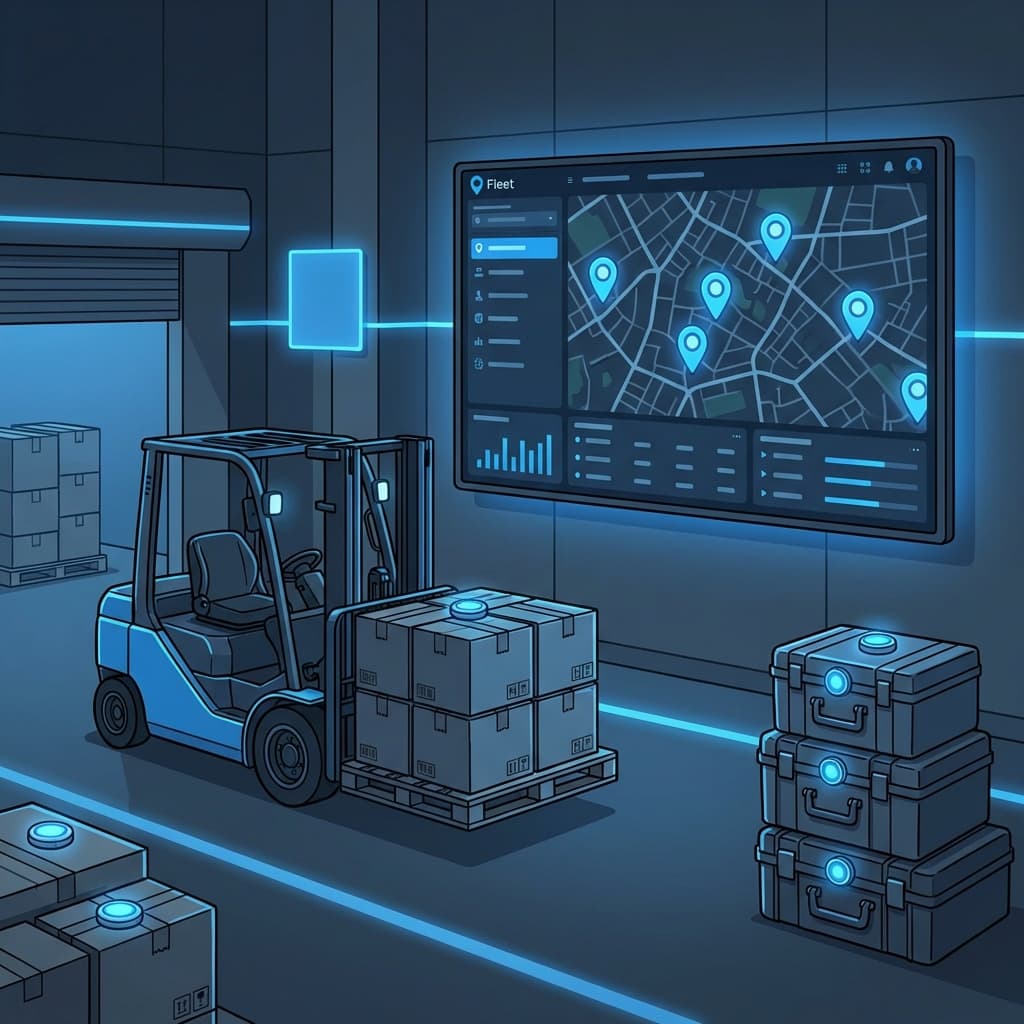
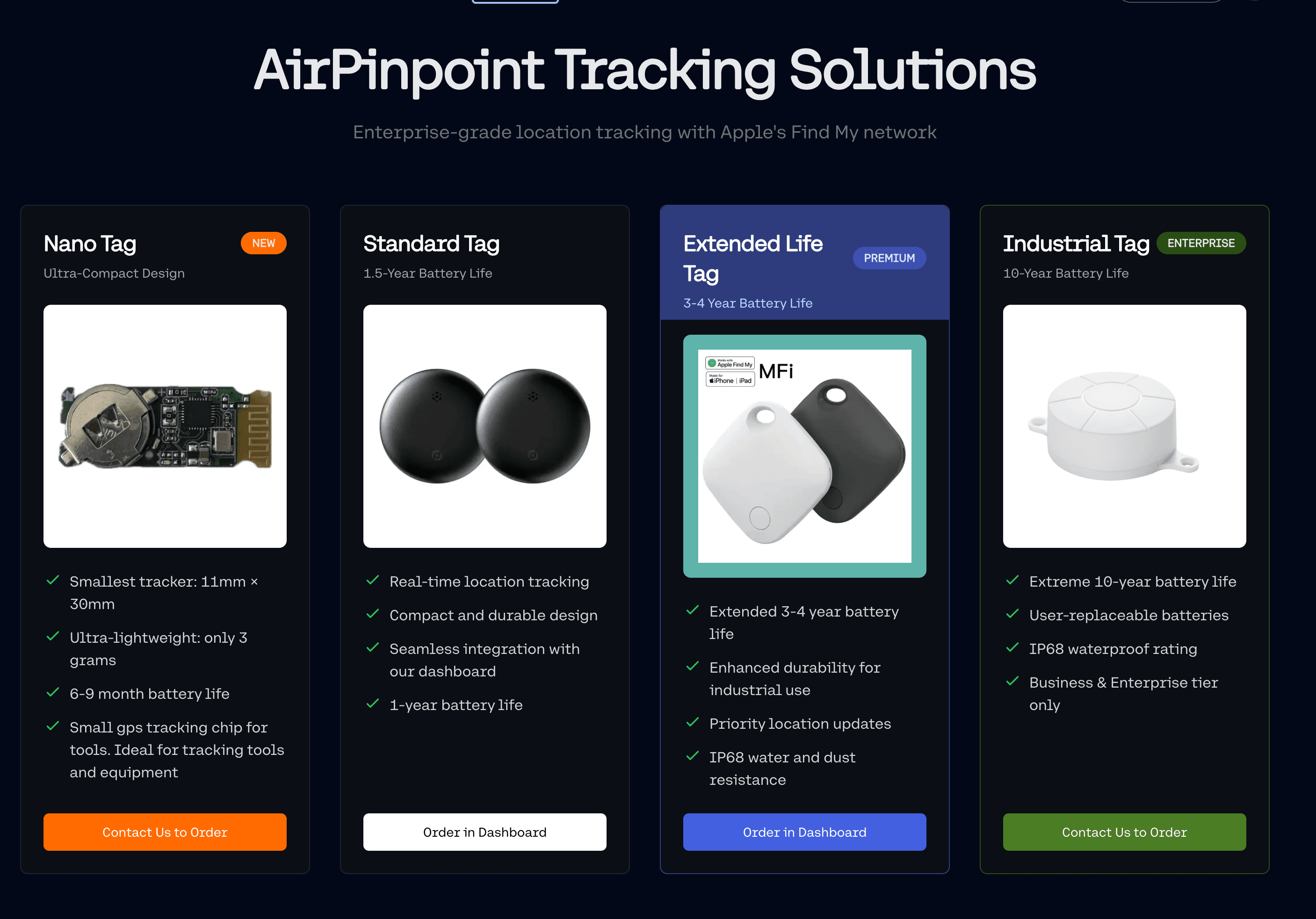
Airpinpoint turns AirTags into an asset tracking system: web dashboard, full location history, polygon geofencing with email alerts, webhooks, REST API, and team access with roles. $11.99/device/month for Business, $14.99 Enterprise, no contracts.
3-Year Total Cost of Ownership
25 assets
Moto Tags (consumer tracking only):
- Hardware: 25 x $29.99 = $750
- Batteries: ~$225 over 3 years
- Business dashboard: none exists
- Total: ~$975, with no business features
AirTags + Airpinpoint (full business tracking):
- AirTags: 25 x $29 = $725 (or $24.75 each in 4-packs)
- Airpinpoint Business: 25 x $11.99 x 36 months = $10,791
- Batteries: ~$225
- Total: ~$11,741 with fleet dashboard, geofencing, alerts, history, and API
Moto Tags + custom-built tracking:
- Hardware: $750
- Building a dashboard, geofencing, alerts, and API against a network with no public API: not feasible. Google Find Hub exposes no developer access to tag locations.
50 assets
| Moto Tags | AirTags + Airpinpoint | |
|---|---|---|
| Hardware | $1,500 | $1,450 |
| Software (36 months) | $0 (none exists) | $21,582 |
| Batteries | ~$450 | ~$450 |
| 3-year total | ~$1,950 | ~$23,482 |
| What you get | A consumer app list of 50 items, last position only | Dashboard, geofences, alerts, history, webhooks, API, team access |
The Moto Tag's lower total is real, and so is what it buys: nothing a business can operate on. At 100+ assets, Airpinpoint's Enterprise plan applies ($14.99/device/month); contact us for volume pricing.
Where the Moto Tag Genuinely Wins
Real advantages, not strawmen:
- Battery life (Moto Tag 2). Motorola's official rating is over 500 days versus roughly 1 year for the AirTag. Same cheap CR2032 cell, half the swaps.
- Water resistance (Moto Tag 2). IP68 at 1.5m for 30 minutes beats the AirTag's IP67 at 1m.
- Built-in keyring hole. The AirTag still requires a holder accessory; both Moto Tags hang on a keyring bare.
- Camera shutter button. Pressing the Moto Tag triggers the paired phone's camera. Genuinely useful for solo photos, irrelevant for asset tracking.
- Android-native setup. If everyone involved uses Android and you are tracking a personal bag or keys, the Moto Tag works where an AirTag simply cannot be set up.
- Airline luggage integration. Since March 2026, Find Hub can share a tag's location with select airlines for 7 days, matching a feature Apple shipped in late 2024.
What Reviewers Actually Say
The recurring complaints across 2025 reviews, with sources:
- Detection delay outside dense areas. GadgetGuy measured 8 hours on a walking track and traced it to Google's default participation settings, "buried in Android" where typical users never change them.
- Update frequency and accuracy. EFTM's review found tracking "mostly impressive" in cities but updates "not as frequent as users would like them to be and not as accurate," attributing the issues to the Google network rather than the tag.
- Firmware update problems. Travels with Tech reported firmware updates that failed to download despite small file sizes, and updates that drained the CR2032 well ahead of the 1-year rating.
- Precision finding UX. Reviewers note that on non-allowlisted phones, finding a nearby Moto Tag means watching a vague wavy shape fill in, versus the AirTag's directional arrow with distance readout on any iPhone 11 or newer.
None of these are dealbreakers for finding keys. All of them are dealbreakers for knowing where $40,000 of equipment is right now.
Use-Case Breakdown
Personal items, Android user: Moto Tag 2. It is the best Find Hub tracker, and the 500-day battery and IP68 rating lead the category.
Personal items, iPhone user: AirTag. The Moto Tag cannot be set up on an iPhone at all.
Job site tools and equipment: AirTags + Airpinpoint. Geofence the site, get an email when a tool crosses the boundary, check history when something goes missing. None of this exists on Find Hub.
Fleet and trailer tracking: AirTags + Airpinpoint. Trucks and trailers spend their lives on highways and in yards, exactly where Google's high-traffic-only default and aggregation requirement create blind spots, and where Apple's always-on network keeps reporting.
Theft recovery: AirTags + Airpinpoint, with the caveat that any Bluetooth tracker (AirTag or Moto Tag) fires anti-stalking alerts on the thief's phone. For high-value rolling assets, pair an AirTag with a dedicated GPS unit; see our AirTags vs GPS trackers comparison.
Our Recommendation
Buying a tracker for your keys, wallet, or luggage and you use Android? Buy the Moto Tag 2. At roughly $40 with a 500-day battery, IP68, and Bluetooth 6.0, it is the strongest consumer tracker on Google's network, and the network itself is measurably better than it was at the 2024 launch.
Tracking business assets at any scale? AirTags with Airpinpoint. The decisive facts are not on the spec sheet:
- An independent test found the Find Hub network took 8 hours to report a tag that Apple's network would have reported in minutes.
- Google's participation defaults (high-traffic areas only, multi-device aggregation) cap the network's real-world coverage regardless of its 3-billion-device headline.
- The Moto Tag's headline UWB feature took 10 months to switch on and works on 7 phone models.
- There is no dashboard, no geofencing, no history, no API, and no path to build them, because Find Hub has no developer access.
Airpinpoint gives you the fleet dashboard, polygon geofencing with alerts, full location history, webhooks, REST API, and team access, on the network that reports in minutes instead of hours. Start with Airpinpoint and get the business features your operation actually needs.
 Our Solution