Updated
AirTag Price and Cost Per Month vs GPS Trackers: 2026 Comparison
How Much Is an AirTag, and Does It Cost Anything Per Month?
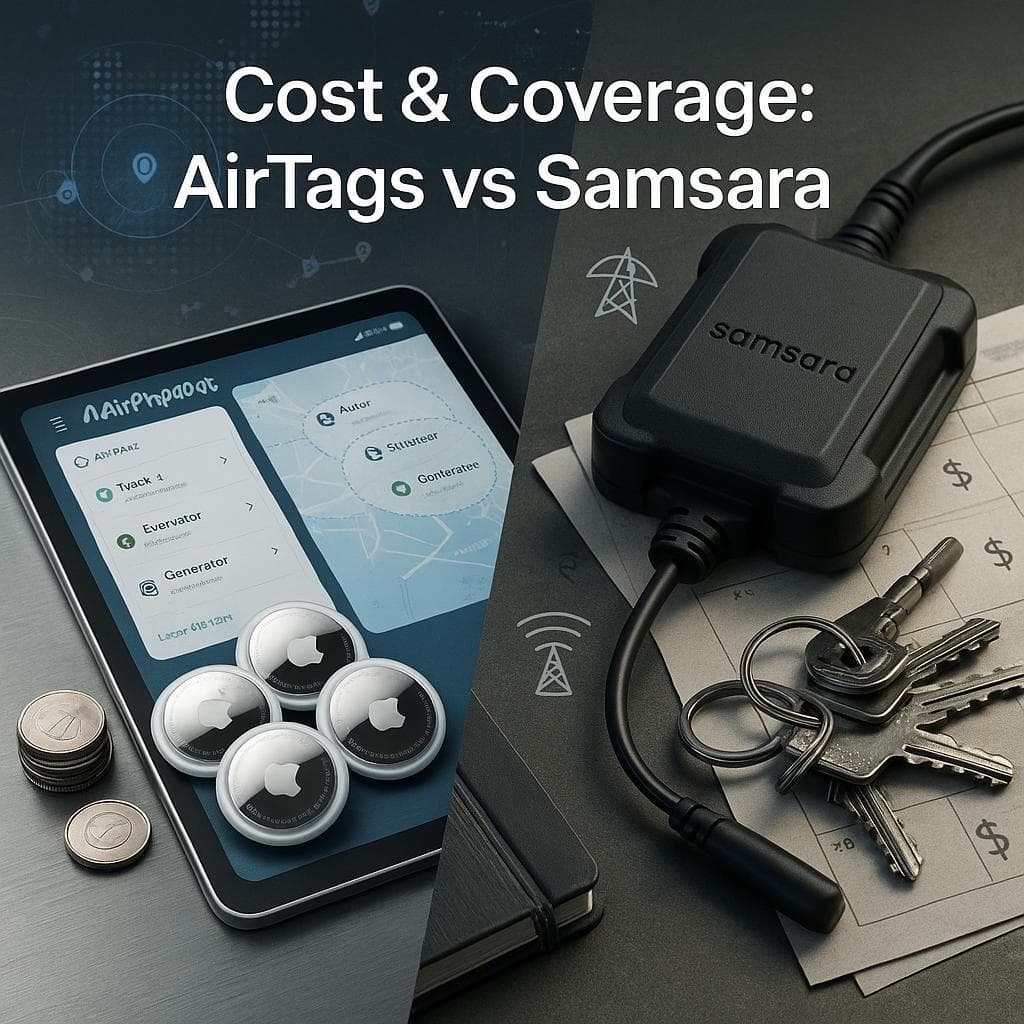
An AirTag costs $29 once ($99 for a 4-pack) and has no monthly fee. There is no AirTag subscription and no Apple subscription to use it. The Find My app is free, and the CR2032 battery lasts about a year for roughly $1 to replace. A cellular GPS tracker is the opposite: $10-45 per device per month, forever, plus $20-150 in hardware and often a multi-year contract. For a fleet, that split decides the bill. Ten AirTags cost $290 and $0/month; ten cellular GPS trackers cost $100-1,500 upfront and $100-450 every month. GPS still earns its fee where AirTags can't reach: real-time updates and remote areas with no people.
Is There a Monthly Fee for AirTag?
No. Apple charges nothing per month to use an AirTag, and there is no AirTag subscription to sign up for. Location reports travel through the Find My network for free. AppleCare+ for AirTag does not exist, so a lost or broken tag is replaced by buying another one at $29.
What the 2026 AirTag price includes
Apple held the price at $29 for one and $99 for a four-pack when it introduced the second-generation AirTag in January 2026, so the current tag costs the same as the 2021 model while doing more. Per Apple's own specs and announcement, the $29 buys a second-generation Ultra Wideband chip with Precision Finding at up to 50 percent farther range, a speaker that is 50 percent louder for locating a tag by ear, IP67 water and dust resistance, a user-replaceable CR2032 coin cell, and Share Item Location links that more than 50 airlines accept for lost-baggage claims. The recurring cost is the battery: roughly $1 to $3 once a year, with no account fee attached to it. The requirements are worth checking before you buy in volume, since the new tag needs iOS 26.0 or later, and Precision Finding needs an iPhone 11 or later or a supported Apple Watch.
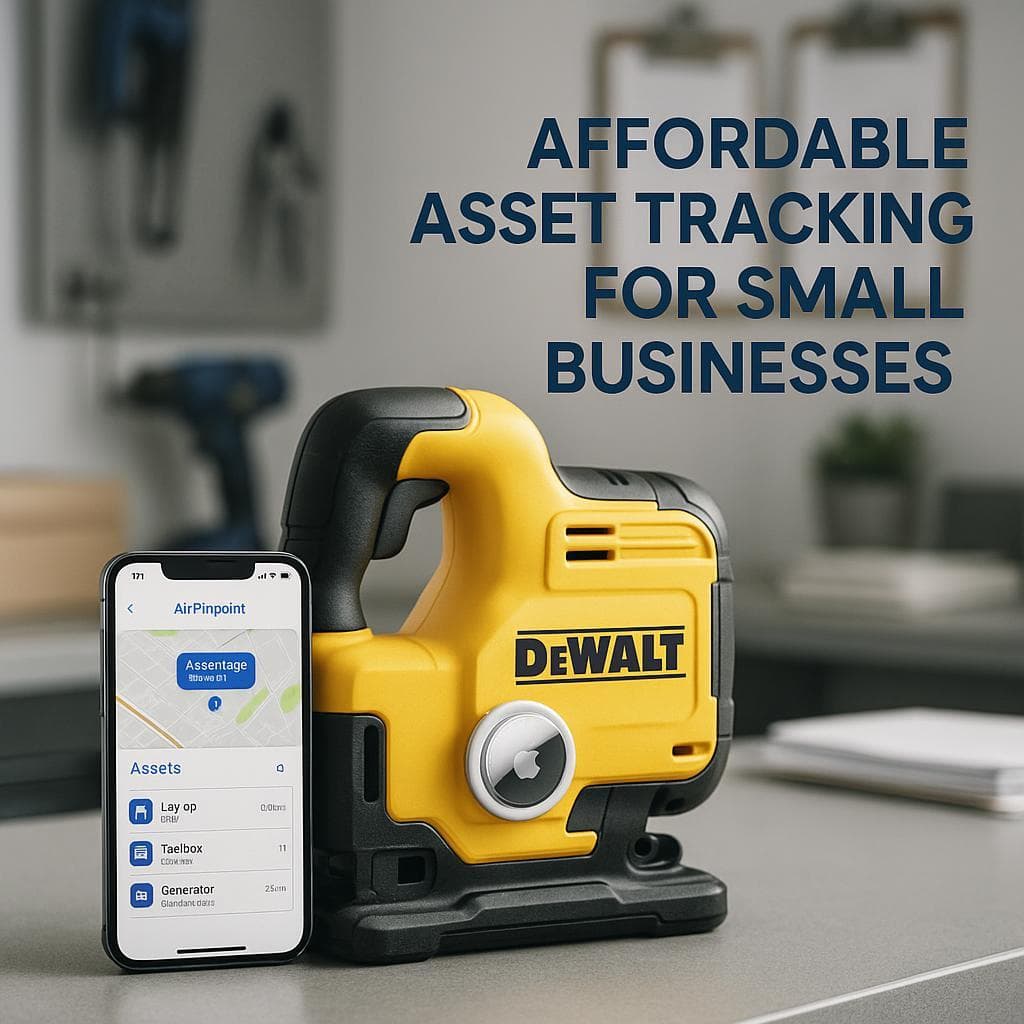
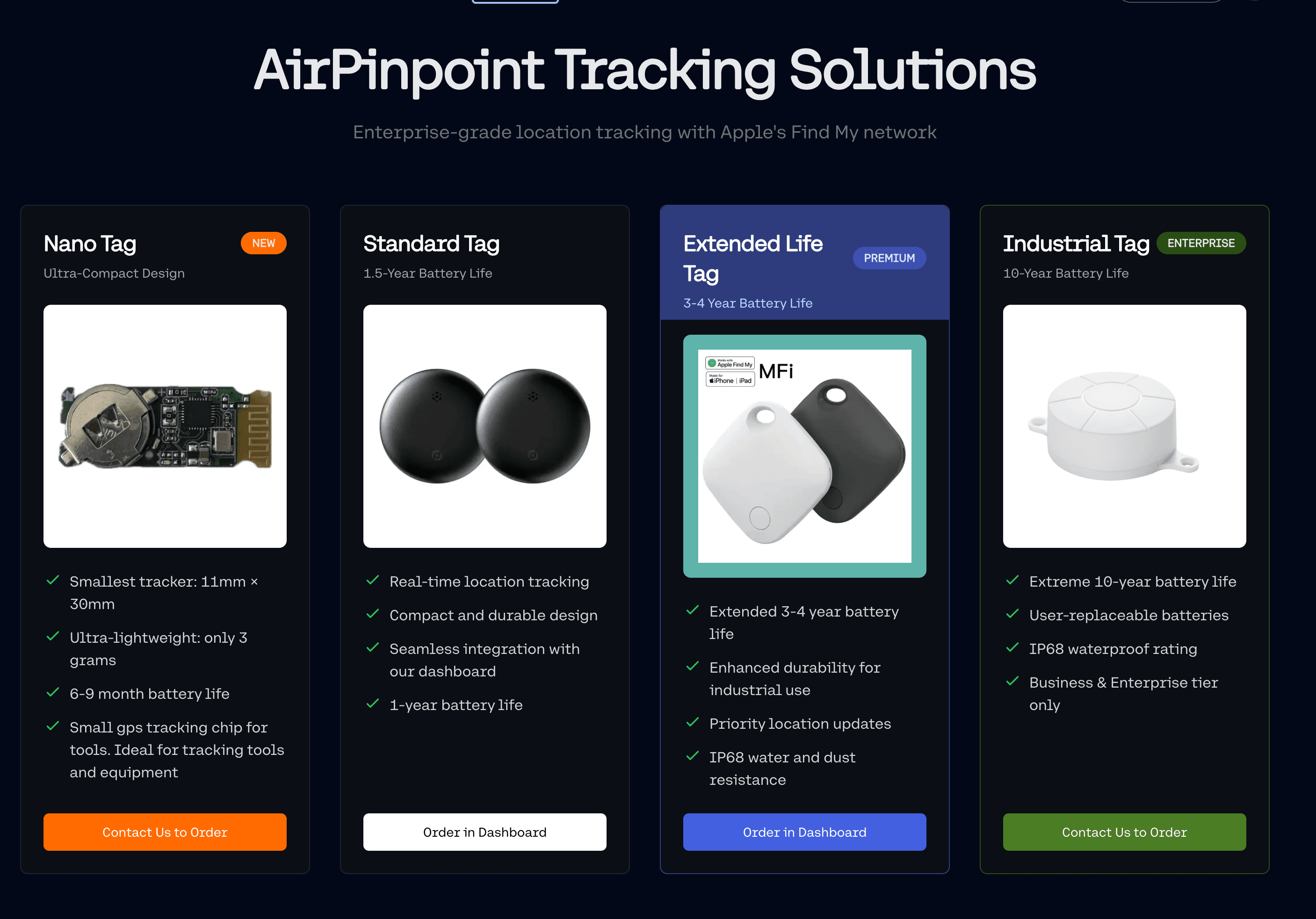
For tracking many AirTags as a business, past Apple's 32-item-per-Apple-ID limit, Airpinpoint gives you one dashboard, geofence alerts, and location history at $11.99 per device per month, with no per-tag SIM and no cellular contract. See pricing.
AirTag Price by Pack and Retailer (September 2026)
Apple list price is $29 for one AirTag and $99 for a four-pack ($24.75 per tag). The second-generation AirTag launched January 2026 at the same prices as the 2021 model. Retailers discount the four-pack in sales, so the street price per tag is often lower than Apple's.
| Pack | Apple list price | Per tag | Notes |
|---|---|---|---|
| Single AirTag | $29 | $29 | Apple list price |
| 4-pack | $99 | $24.75 | Apple list price |
| Battery per year | CR2032 | about $1-3 | Replace roughly once a year |
Amazon, Walmart, and Best Buy run periodic four-pack sales below Apple's $99 list; check the current price before buying in volume. For a fleet, the per-tag price is the whole hardware bill because there is no SIM, plan, or contract.
GPS trackers determine location via satellites, then transmit coordinates over cellular networks (4G LTE, LTE-M) to a cloud dashboard. Real-time updates every 15-60 seconds. The catch: monthly subscriptions, multi-year contracts, and hardware that needs charging or wiring.
Apple AirTags broadcast a Bluetooth signal that nearby iPhones (1B+ worldwide) detect and relay anonymously. No cellular modem, no SIM card, no wiring. The native Find My app is free.
The right choice depends on what you're tracking, where it lives, and what "good enough" location accuracy means for your operation.
AirTag vs Cellular GPS Tracker at a Glance
| Factor | Apple AirTag | Cellular GPS Tracker |
|---|---|---|
| Hardware cost | $29 each ($99 4-pack) | $20-150 each |
| Monthly fee | $0 native; $11.99/tag/mo via Airpinpoint for the business dashboard | $10-45 per device |
| Subscription required | No Apple subscription | Yes, cellular plan required |
| Battery | CR2032 coin cell, ~12 months, $1 to replace | Days to months at throttled rates; wired units run on vehicle power |
| Update rate | Every 1-5 min in populated areas (crowd-sourced) | Real-time, every 15-60 sec (cellular) |
| Range / coverage | Anywhere Apple devices are nearby (1B+); weak in remote or Android-heavy areas | Anywhere with cellular signal; fails in dead zones |
| Best for | Cost, battery, covert size, assets near people | Real-time dispatch, remote sites, compliance |
AirTags win on cost, battery, and no subscription, and their small size hides inside assets near people. Cellular GPS wins on real-time updates and coverage in remote, no-traffic areas where no iPhone will ever pass the tag.
The battery fine print GPS vendors don't advertise
Every battery-powered GPS tracker advertises runtime in months or years. None of them put the assumed update rate next to that number. It lives in the spec sheet footnotes, and it's almost always roughly one location update per day.
Each cellular GPS update requires two expensive steps: the GPS radio stays on for up to 30 seconds to get a satellite fix, then a cellular modem fires up and transmits, drawing hundreds of milliamps or more. Do that every minute and a battery is dead in days. Do it once a day and you can advertise years.
Tracki publishes the honest version of this: 2-3 days of battery in real-time mode (updates every 1-5 minutes), 30-75 days at 1-3 updates per day. That one line is the whole industry's secret.
An AirTag never runs a GPS radio or a cellular modem. It broadcasts a tiny Bluetooth packet measured in microamps, and nearby iPhones do the positioning and upload using their own batteries. The result: roughly 100,000+ location updates per $3 coin cell over 12+ months, while updating every 1-5 minutes in populated areas. The GPS tracker advertising "3 years of battery" holds about 1,100 total updates at once-a-day. Three days at AirTag pace.
For unpowered assets (trailers, generators, attachments, tools), this is the defining comparison. Cellular GPS forces you to choose between frequent updates and long battery life. AirTag gives you both, because the battery doing the hard work belongs to someone else's iPhone.
Can I Use an AirTag as a GPS Tracker?
Only in places where people carry Apple devices. An AirTag has no GPS chip and no cellular modem. It broadcasts a Bluetooth Low Energy signal, and any iPhone, iPad, or Mac in the Find My network that passes within range attaches its own GPS position and uploads it to Apple, encrypted end to end. The owner sees the tag at the position of the device that heard it.
In a city or along a busy route, that relay behaves much like a GPS tracker with a delay of a few minutes. In an empty field, on a rural yard, or in a parked trailer far from foot traffic, the AirTag can go hours without a report. A cellular GPS tracker computes its own position from satellites and sends it over a SIM, so it reports from those empty places too, in exchange for a monthly plan and a battery that needs charging.
AirTag vs GPS Tracker for a Car (Theft Protection)
Anti-stalking alerts work against you when a car is stolen. A thief with an iPhone gets an "AirTag Found Moving With You" notification, and Android phones flag unknown trackers as well, so the tag can be found and thrown away. A hardwired GPS tracker gives the driver no warning and draws power from the vehicle. If live theft recovery is the goal, use a hardwired GPS unit and keep an AirTag hidden as a cheap backup.
How Each Technology Works
GPS Trackers
- Satellite positioning: Device receives signals from GPS/GLONASS/Galileo satellites
- Location calculation: Determines coordinates with ~3-5 meter accuracy
- Cellular transmission: Sends location to servers via cellular network
- Dashboard display: View real-time location, history, alerts in web portal
Update frequency: Typically every 15-60 seconds (configurable)
Dependencies: Clear sky view (for GPS), cellular coverage (for transmission)
Apple AirTags
- Bluetooth broadcast: AirTag continuously broadcasts encrypted identifier
- Device detection: Nearby Apple device detects broadcast
- Anonymous relay: Apple device sends AirTag location to Apple servers
- Find My display: View location in Find My app
Update frequency: When near Apple devices (can be seconds in cities, hours in remote areas)
Dependencies: Nearby Apple device users, not cellular coverage
Pricing Comparison
An AirTag is a one-time $29 hardware cost with no monthly fee and no Apple subscription. A cellular GPS tracker costs $20-150 in hardware plus $10-45 per device every month, and enterprise plans (Samsara, Verizon Connect, Geotab) usually lock you into a 1-3 year contract. Over three years, 50 AirTags on Airpinpoint run about $23,800 total; 50 mid-range GPS trackers run about $64,000. The AirTag has no per-tag SIM, so there is nothing to keep paying once the hardware is bought.
GPS Tracker Costs
| Provider | Monthly Cost | Hardware | Contract | Battery note |
|---|---|---|---|---|
| Samsara | $27-33/vehicle | $99-148 | 3 years typical | Wired = real-time; battery option ~3yr claims ~1 update/day (~1,100 total updates) |
| Verizon Connect | $23.50-40/vehicle | ~$100-200 | 1-3 years | Wired (OBD/hardwire), real-time |
| Geotab | $25-40/vehicle | $80-120 (to own) | 3 years minimum | Wired (OBD), real-time |
| GPS Trackit | ~$25-35/vehicle | Included/rental | 3 years | Wired or battery |
| Consumer (Tracki, LandAirSea) | $10-25/month | $20-50 | Month-to-month | Tracki: 2-3 days real-time, 30-75 days at 1-3 updates/day |
Industry average: $25-45/vehicle/month
Hidden costs to consider:
- Activation fees: $0-50 per device
- Installation (hardwired): $50-250 per vehicle
- Early termination: Often remainder of contract
- Overage fees: Some plans have data limits
- Hardware replacement: Devices fail, get lost, or become obsolete
AirTags + Airpinpoint Costs
| Component | Cost |
|---|---|
| AirTags | $29 each (one-time) |
| Monthly subscription | From $11.99 per tag per month (Airpinpoint) |
| Platform (fleet management) | Included in subscription |
| Per-asset equivalent | $11.99 per tag per month (starting) |
| Battery replacement | ~$5/year per AirTag |
50-Asset 3-Year Comparison
Mid-Range GPS Trackers:
- Hardware: 50 × $100 = $5,000
- Monthly: 50 × $30 × 36 = $54,000
- Installation (estimated): $5,000
- Total: ~$64,000
Consumer GPS Trackers (Tracki-level):
- Hardware: 50 × $30 = $1,500
- Monthly: 50 × $15 × 36 = $27,000
- Total: ~$28,500
AirTags + Airpinpoint:
- Hardware: 50 × $29 = $1,450
- Subscription: $11.99 × 50 × 36 = $21,582
- Batteries: 50 × $5 × 3 = $750
- Total: ~$23,800
Cost difference: AirTags plus Airpinpoint cost about 60% less than enterprise GPS and about 15-20% less than consumer GPS trackers over 3 years.
Battery Life Comparison
An AirTag runs about 12 months on one CR2032 coin cell while updating every 1-5 minutes in populated areas, roughly 100,000+ updates per battery. A battery-powered cellular GPS tracker hits its advertised "months" or "years" only by updating about once a day; at real-time rates the same battery dies in days. Wired and OBD-II GPS units sidestep this by drawing vehicle power. The honest comparison is updates per battery, not months on the box.
GPS Trackers
Battery life varies dramatically based on size and update frequency:
| Category | Examples | Active Life | Fine-print update rate | Total updates per battery |
|---|---|---|---|---|
| Compact | Tracki Mini | 2-5 days real-time; 50-60 days throttled | 1-3/day in extended mode | ~50-60 updates on extended mode |
| Mid-size | Optimus 2.0, Spytec GL300 | 2-4 weeks | Hourly or less | ~336-672 updates |
| Large battery | SALIND GPS 20, Trak-4 | Up to 18 months | ~1/day | ~550 updates |
| OBD-II plug-in | Bouncie, MOTOsafety | Unlimited (vehicle power) | Real-time (every 15-60 sec) | Unlimited |
| Hardwired | Samsara, Verizon | Unlimited (vehicle power) | Real-time (every 10-60 sec) | Unlimited |
| AirTag 2 | AirTag | 12+ months | Every 1-5 min in populated areas | ~100,000+ |
The "Active Life" figures for battery-powered GPS trackers are purchased by updating less. Tracki's published spec says exactly this: 2-3 days in real-time mode, 30-75 days at 1-3 updates per day. "Trak-4: 18 months" means roughly 550 total updates, which an AirTag matches in about 12 hours.
OBD-II and hardwired trackers (Bouncie, Samsara, Verizon Connect) run on vehicle power and are genuinely real-time. The battery fine print applies specifically to battery-powered asset trackers, which is exactly the category people buy for unpowered equipment, trailers, and tools.
Key factors affecting GPS battery:
- Update frequency (every minute vs every hour)
- Cellular signal strength (poor coverage = faster drain)
- Temperature extremes
- Motion detection sensitivity
AirTags
- Battery life: 12+ months (CR2032 coin cell, $0.30-1.00 to replace)
- Consistency: Battery life is at full update rate, not throttled
- Replacement: User-replaceable in seconds, no charging required
- Update rate: Every 1-5 min in populated areas, the entire 12+ months
The AirTag's year-long battery is not achieved by updating less. It is the baseline at full frequency. No GPS tracker in the battery-powered category can say the same.
Coverage and Reliability
Cellular GPS works anywhere with cell signal and can report from empty highways, remote job sites, and rural routes where no person will ever walk past the asset. AirTags rely on nearby Apple devices (1B+ worldwide), so coverage is near-continuous in cities and suburbs but sparse in truly remote areas or Android-heavy regions. If an asset spends its life where people are, AirTag coverage is fine. If it sits alone in a field or mountain, cellular GPS is the only option that reports.
GPS Tracker Coverage
Strengths:
- Works anywhere with cellular coverage
- Real-time updates every 15-60 seconds
- Functions in remote areas (with signal)
- Satellite GPS trackers work globally (at premium cost)
Limitations:
- Requires cellular coverage to transmit
- Rural dead zones cause transmission gaps
- Mountains, forests, buildings can block signals
- Battery drains faster in poor coverage areas
- Indoor tracking often unreliable
The cellular dependency: GPS trackers can calculate location anywhere with sky view, but cannot transmit without cellular signal. In rural areas, your tracker may log locations but not send them until reaching coverage.
AirTag Coverage
Strengths:
- Works anywhere Apple devices exist
- No Apple subscription required; Airpinpoint adds a monthly subscription for business features
- Excellent in urban/suburban areas
- Works indoors (Bluetooth penetrates walls)
- 1B+ Apple devices in the network
Limitations:
- Requires nearby Apple device users
- Truly remote areas may have no coverage
- Location updates are opportunistic, not scheduled
- Less reliable in Android-dominant regions
The crowd-sourced reality: In a busy city, AirTag updates can be near-continuous. In a remote forest with no hikers, updates may not occur until the asset returns to populated areas.
Feature Comparison
| Feature | GPS Trackers | Apple AirTags |
|---|---|---|
| Real-time tracking | Yes (15-60 second updates) | No (crowd-sourced updates) |
| Location accuracy | 3-5 meters | 3-15 meters |
| Precision Finding | No | Yes (UWB on iPhone 11+) |
| Geofencing alerts | Yes | Yes (via Airpinpoint) |
| Speed monitoring | Yes | No |
| Route history | Yes (detailed) | Yes (basic) |
| Driver behavior | Yes (some) | No |
| ELD compliance | Yes (some) | No |
| Monthly cost | $25-45/asset | From $11.99 per tag per month |
| Battery life | Days-to-months at throttled update rates (fine print: ~1 update/day for "multi-year" claims) | 12+ months at full update rate (~100,000+ updates per battery) |
| Physical size | Varies (some bulky) | 31.9mm diameter, 8mm thick |
| Works without people nearby | Yes (with cellular) | No |
| Works indoors | Limited | Yes |
| Anti-theft alerts | Some models | Yes (via Find My) |
| Works globally | Yes (with roaming) | Yes (where Apple devices exist) |
When to Choose Each Solution
Choose GPS Trackers When:
- Real-time location is critical: Fleet dispatch, delivery ETAs, emergency response
- Operating in remote areas: Mining, rural construction, agricultural equipment
- Compliance requirements exist: ELD, hours of service, DVIR documentation
- Driver monitoring needed: Speed alerts, harsh braking, route deviation
- Assets travel cross-country: Long-haul trucking through varied cellular coverage
- Temperature monitoring required: Cold chain, pharmaceutical, food transport
- Integration with TMS/ERP necessary: Enterprise fleet management systems
Choose AirTags When:
- Cost is the primary concern: Can't justify $30+/asset/month
- Assets stay in populated areas: Urban/suburban operations
- Simple "where is it?" tracking: Don't need speed, routes, or driver data
- Equipment and tools: Items that don't need real-time tracking
- Trailers and containers: Assets that move between sites
- Personal vehicles and local fleets: Company cars, service vans
- Backup tracking: Secondary tracking on critical assets
- Covert placement: AirTags are small enough to hide inside assets, unlike OBD-II or hardwired GPS units that are easy to locate and remove
The Hybrid Approach
Many businesses optimize by using both:
Use GPS trackers for:
- Primary fleet vehicles (long-haul, remote routes)
- Assets requiring real-time dispatch
- Compliance-driven tracking (regulated industries)
- Vehicles with driver behavior concerns
Use AirTags for:
- Equipment and tools
- Trailers and unpowered assets
- Local delivery vehicles
- Personal/company cars
- Backup tracking on GPS-equipped vehicles
This approach provides real-time tracking where it matters while keeping monthly costs lower on assets that do not need GPS.
Real-World Scenarios
Scenario 1: Construction Company (50 assets)
Assets: 10 trucks, 15 trailers, 25 pieces of equipment
GPS-only approach:
- All 50 assets: $30 × 50 × 12 = $18,000/year
- Plus hardware: $5,000
- First-year total: $23,000
Hybrid approach:
- GPS on 10 trucks: $30 × 10 × 12 = $3,600/year
- AirTags on 40 other assets: 40 × $29 = $1,160 (one-time)
- Airpinpoint subscription: $11.99 × 40 × 12 = $5,755/year
- First-year total: $10,515
Savings: $12,485/year (about 55% reduction)
Scenario 2: HVAC Service Company (20 vans)
GPS-only approach:
- All 20 vans: $35 × 20 × 12 = $8,400/year
- Hardware: $2,000
- First-year total: $10,400
AirTags-only approach:
- 20 AirTags: 20 × $29 = $580
- Subscription: $11.99 × 20 × 12 = $2,878/year
- First-year total: $3,458
Consideration: HVAC vans operate locally in populated areas. Real-time tracking rarely needed. AirTags provide sufficient visibility at about 65-70% savings.
Scenario 3: Long-Haul Trucking (30 trucks)
Recommendation: GPS trackers required
Why: Cross-country routes through rural areas, real-time dispatch needs, ELD compliance requirements, driver hour tracking.
Cost: $35 × 30 × 12 = $12,600/year (justified by operational requirements)
GPS Tracker Providers Overview
| Provider | Best For | Starting Price | Contract |
|---|---|---|---|
| Samsara | Enterprise fleets, safety focus | $27/vehicle/month | 3 years |
| Verizon Connect | Large fleets, analytics | $23.50/vehicle/month | Varies |
| Geotab | Open platform, customization | $25/vehicle/month | 3 years |
| GPS Trackit | Mid-market fleets | ~$25/vehicle/month | 3 years |
| Azuga | Small-medium business | $25/vehicle/month | 1-3 years |
| Tracki | Budget/personal | $9.95/month | Month-to-month |
| LandAirSea | Consumer, covert | $19.95/month | Month-to-month |
Our Recommendation
For businesses primarily needing "where is it?" visibility: AirTags provide remarkable value. At $29 hardware with no Apple subscription, the cost-per-insight is strong for assets that operate in populated areas. Airpinpoint adds a monthly subscription for the business dashboard, team access, location history, and geofencing. The Find My network's 1B+ devices provide reliable coverage in most business contexts.
For operations requiring real-time tracking: GPS trackers remain necessary. If you need 30-second updates, remote area coverage, driver behavior monitoring, or regulatory compliance, the $25-45/month is a business requirement.
For most mixed operations: The hybrid approach wins. Put GPS on vehicles that need real-time dispatch and compliance. Put AirTags on everything else. You'll have complete visibility at a fraction of the cost.
The key questions:
- Do you need real-time updates, or is "updated when nearby Apple device" sufficient?
- Do your assets operate in remote areas with no people?
- Do you have compliance requirements (ELD, DVIR, hours of service)?
- Can you justify $300-500/year per asset, or is that budget better spent elsewhere?
For many businesses discovering AirTags can replace GPS trackers, the revelation is significant: they've been paying substantial monthly fees for capabilities they didn't actually need.
 Our Solution