AirTags vs Link Labs: What AirFinder Actually Costs
Link Labs does not publish a price for AirFinder. Not for tags, not for the location beacons and access points the system requires, not for the software subscription. Every page on link-labs.com ends in "book a demo." The only number you can act on without talking to sales is a $749 evaluation kit containing 4 tags and 4 location beacons, roughly $187 per tracked asset just to try the system.
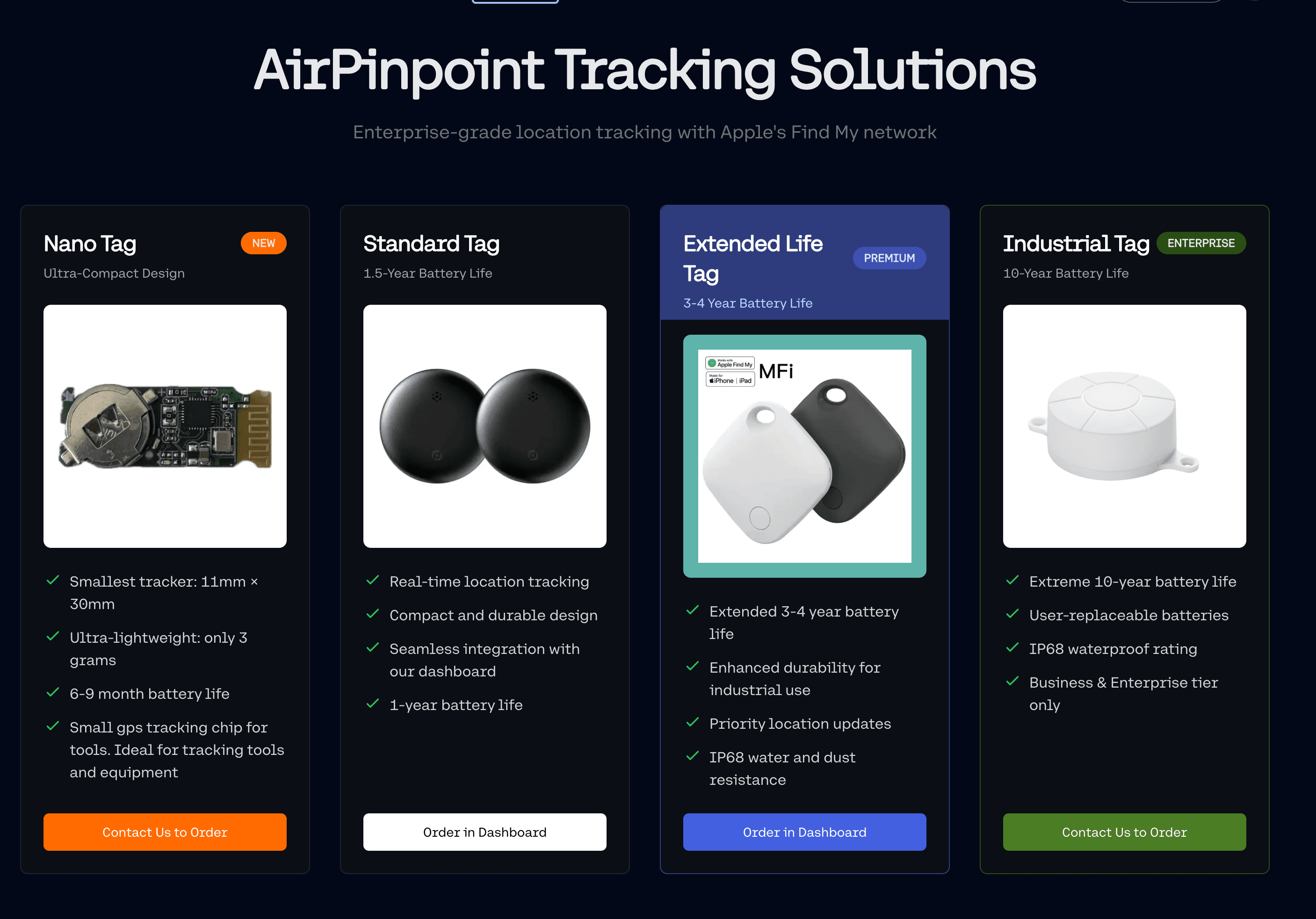
We mined Link Labs' own blog posts, trade press, and the review sites for the numbers their pricing page won't give you. They are below, with sources. Airpinpoint's numbers, for contrast, are public: $29 per tag one-time ($24.75 in 4-packs), $11.99/device/month, no contract, no infrastructure.
Link Labs AirFinder pricing: every documented number
Link Labs sells on a quote-only model, but the company has disclosed pieces of its pricing in its own content marketing and in trade interviews. This is everything we could verify:
| Item | Documented cost | Source |
|---|---|---|
| AirFinder indoor BLE tag | $8-15 per tag, volume dependent | Link Labs blog |
| SuperTag cellular service | ~$10/month per device, incl. dashboard | RFID Journal |
| SuperTag Pro Evaluation Kit | $749 (4 tags, 4 beacons, 90-day trial) | Electronic Specifier |
| SuperTag hardware (production) | Not disclosed | Quote-only |
| OnSite software subscription | Not disclosed | Quote-only |
| Location beacons, access points, gateways | Not disclosed | Quote-only |
| Installation and site survey | Not disclosed | Quote-only |
| Contract length, minimums, cancellation terms | Not disclosed | Quote-only |
Capterra lists AirFinder's starting price as "contact vendor". GetApp lists "no pricing info". Half the cost structure of an OnSite deployment (the infrastructure half) has no public number anywhere.
Airpinpoint's equivalent table is one row: $29/tag one-time, $11.99/device/month, $0 infrastructure, month-to-month.
Head-to-Head Comparison
| Feature | Link Labs AirFinder | Airpinpoint |
|---|---|---|
| Published pricing | None (quote-only) | $29/tag + $11.99/device/month |
| Infrastructure required | OnSite: beacons, access points, gateways | None (Apple Find My network) |
| Indoor accuracy | Within 1m, needs 3+ beacons in range (XLE) | Zone-level (5-30m) |
| Outdoor tracking | SuperTag (cellular/GPS/WiFi), within ~10 ft | Apple Find My network, 1B+ devices |
| Tag cost | $8-15 (BLE, their blog); SuperTag undisclosed | $29 ($24.75 in 4-packs) |
| Monthly cost | ~$10/device (SuperTag, RFID Journal); OnSite undisclosed | $11.99/device (Business), $14.99 (Enterprise) |
| Trial cost | $749 evaluation kit | $29 (one beacon) |
| Deployment process | 30-day pilot, then implementation | Same day |
| Battery life | Up to 7 years (BLE/SuperTag Plus), up to 3 years (SuperTag Pro) | 7 years (NRF52810 beacons) |
| Firmware updates | Over-the-air (FOTA) | Not user-updatable |
| API and webhooks | Yes (enterprise platform) | Yes (REST API + webhooks, all plans) |
| Geofencing | Yes, beacon-defined zones indoors | Yes, polygon geofences anywhere |
| Public reviews | 3 total (Capterra + Gartner) | Public pricing, self-serve signup |
| Contract | Terms not disclosed | Month-to-month, cancel anytime |
The Infrastructure Question
This is the core architectural difference. Everything else follows from it.
AirFinder OnSite determines location with installed hardware: location beacons defining zones, access points collecting tag data, and a gateway backhauling it to the cloud (Link Labs says one gateway can cover a large facility). The sub-meter accuracy claim depends on that density: XLE phase ranging triangulates only when at least three beacons collect phase data from the tag. Fewer beacons in range, coarser accuracy.
Airpinpoint's tracking network is Apple's Find My network: 1B+ iPhones, iPads, and Macs already deployed. You attach a beacon to the asset and it reports from any populated area on earth, with zero hardware on your walls.
Link Labs' approach buys precision inside instrumented buildings. Airpinpoint's approach buys coverage everywhere else. The right answer depends on whether your assets live in one building or move between many.
Cost Comparison: 200 Assets
An honest comparison can only use documented numbers, so the Link Labs column has gaps. The gaps are the point: you cannot compute the total yourself.
Link Labs AirFinder Everywhere (SuperTag, documented rates)
- Tags: 200 SuperTags, hardware price undisclosed (the eval kit implies roughly $187/device including beacons)
- Service: 200 x ~$10/month = ~$24,000/year (RFID Journal)
- OnSite indoor accuracy add-on: beacons, access points, gateway, installation, all quote-only
- Year 1 total: unknowable without a sales process
Airpinpoint (any number of sites)
- Infrastructure: $0
- Beacons: 200 x $24.75 = $4,950 one-time
- Subscription: 200 x $11.99 = $2,398/month ($28,776/year)
- Year 1 total: $33,726
- Year 3 total: $91,278
On documented service rates alone, the two platforms land within ~20% of each other per device per year. The differences that decide it: Link Labs adds undisclosed hardware and infrastructure costs on top, and Airpinpoint adds nothing. One total requires a quote. The other you just computed.
Where Link Labs Genuinely Wins
Sub-meter indoor positioning
When the beacon density is there, XLE phase ranging resolves position within one meter. Airpinpoint cannot do this. If your question is "which rack is the pallet on" or "which room is the infusion pump in," AirFinder OnSite answers it and Find My-based tracking does not.
Battery efficiency at high read rates
Link Labs claims XLE extends BLE tag battery life by more than 400%, up to 7 years, while reporting far more frequently than a Find My beacon. For continuous real-time tracking (second-by-second movement on a production line), that combination matters.
Industrial hardware and FOTA
AirFinder tags are built for industrial environments, and the platform supports firmware-over-the-air updates. For thousands of tags mounted in hard-to-reach spots, updating firmware without touching each device is a real operational advantage. Airpinpoint beacons are weather-resistant but not user-updatable.
Multi-radio SuperTag
The SuperTag combines cellular, GPS, WiFi, and BLE in one device with claimed accuracy within 10 feet outdoors, and the SuperTag Hub can relay up to 128 BLE tags through one cellular connection. In areas with no Apple device traffic (remote yards, rural transit corridors), cellular reporting beats crowd-sourced reporting.
Where Airpinpoint Wins
You can price it, today
Every Airpinpoint cost is on the pricing page. A 200-asset deployment is $4,950 in hardware and $2,398/month, computable in 30 seconds without a demo call. With Link Labs, the tag price came from their blog, the service price came from a trade journal, and the infrastructure price exists nowhere in public.
Zero infrastructure, zero pilot phase
Link Labs' documented deployment path is a 30-day pilot with weekly check-ins, then a review meeting, then implementation. Airpinpoint's deployment path is peeling adhesive backing. The Find My network was deployed by Apple's billion-plus devices years ago; there is nothing to pilot.
Multi-site without multi-spend
A contractor with 15 active job sites would need OnSite infrastructure at every site to get indoor accuracy there, and the infrastructure stays behind when the crew moves on. Airpinpoint beacons work at every site, every customer location, and every truck yard automatically, because the network travels with the public.
Validation before purchase
Buying AirFinder means trusting a vendor with 1 Capterra review and 2 Gartner Peer Insights reviews. Airpinpoint is self-serve: buy one $29 beacon, run it for a month at $11.99, and judge the data quality yourself before scaling to 200.
Month-to-month flexibility
Airpinpoint has no contracts. Link Labs does not publish its contract terms, and a deployed OnSite system carries built-in lock-in regardless of paper terms: the sunk infrastructure only works with their platform.
What Reviewers Say
AirFinder's public review base, in full, as of June 2026:
- Capterra: 1 review. 4.0/5 overall, 5.0 ease of use, 5.0 customer service, but 3.0/5 value for money and 6/10 likelihood to recommend. The reviewer, tracking chemical containers, reported that tags had to be manually removed, reattached, and renamed every time containers turned over.
- Gartner Peer Insights: 2 reviews, 4.0/5. Reviewers praised indoor accuracy and ease of integration; Gartner's summary notes some users find customer support limited compared to other asset management providers.
- GetApp: same single review as Capterra, "no pricing info" listed.
Three reviews is not a complaint pattern, and to be fair to Link Labs, enterprise direct-sales vendors rarely accumulate public reviews. But it means the marketing claims are effectively unaudited. Budget your evaluation accordingly: the 30-day pilot exists because you cannot validate this product any other way.
Link Labs' Claims About AirTags, Checked
Link Labs runs its own comparison content against Apple AirTags, including a July 2025 post arguing AirTags are wrong for industrial equipment. Their claims, against what a Find My platform actually does in 2026:
| Link Labs claim | Status |
|---|---|
| "Limited to Bluetooth range (~30-100 feet)" | Misleading. The billion-device Find My network relays locations globally; Bluetooth range only governs the hop to the nearest Apple device, not where you can track. |
| May not report "for hours or days" in low-traffic areas | True. Remote sites with no Apple device traffic update slowly. This is the honest case for cellular SuperTags. |
| "No centralized fleet dashboard or API integration" | True for bare AirTags, false for Airpinpoint: web dashboard, REST API, webhooks, polygon geofences, team access. |
| "Managed individually through an Apple ID" | Same: that is the consumer AirTag limitation Airpinpoint exists to remove. Fleet management, location history, and exports are the product. |
| Not built for "dust, chemicals, or impacts" | Fair for a bare AirTag. Airpinpoint beacons and cases are built for equipment mounting, though AirFinder's industrial tags are more ruggedized. |
The pattern: Link Labs' anti-AirTag arguments target the consumer Find My app, not business platforms built on the network. The two real differences that survive scrutiny are indoor precision and update frequency in dead zones, both covered above.
Who Should Use What
Use Link Labs if:
- You operate large fixed facilities (hospitals, plants, warehouses) and need room-level or sub-meter indoor positioning
- You need second-by-second real-time tracking, not periodic location reports
- Your assets sit in areas with no Apple device traffic and need cellular reporting
- You have the budget and procurement patience for a quote-driven, pilot-first enterprise sale
Use Airpinpoint if:
- Your assets move between job sites, yards, customer locations, or vehicles
- You want to compute total cost before talking to anyone ($29/tag + $11.99/month)
- You need tracking running this week, not after a 30-day pilot
- Zone-level accuracy answers your actual question ("which site is the generator at?")
- You want month-to-month terms and a $29 way to test before scaling
Use both if:
- You run a central facility needing precise indoor tracking AND field assets that leave it. AirFinder OnSite inside the building, Airpinpoint on everything that drives away.
Our Recommendation
Link Labs built a legitimate enterprise RTLS. The XLE engineering is real, the industrial hardware is real, and inside a fully instrumented facility it does things a Find My beacon never will. If you are a hospital or manufacturer with a sub-meter requirement and an RTLS budget, get the quote and run their pilot.
For everyone else, the quote-only model is the tell. The documented fragments ($8-15 tags, ~$10/month service, $749 just to evaluate, undisclosed infrastructure) describe a system priced per-deal for buyers with procurement departments. If your problem is 200 generators, trailers, and tool kits spread over 15 sites, you do not need phase-ranging beacons on every ceiling. You need to know which site everything is at, and Airpinpoint answers that for $11.99 a device on a network Apple already built.
 Our Solution