AirTags vs Google Asset Tracking: Turnkey Hardware vs. Build-It-Yourself Maps API
The Core Problem With This Comparison
"Google Asset Tracking" is not a product you buy. That's the most important thing to understand before evaluating it.
On G2, "Google Asset Tracking" (4.4/5, 17 reviews) refers to using Google Maps Platform, a developer toolkit of mapping APIs, to build an asset tracking application. Google provides excellent maps. You provide the development team, the GPS hardware, the SIM cards, the backend, and the application itself. There is no Google dashboard you log into. There is no Google beacon you attach to a forklift.
Airpinpoint is the opposite: sign up, attach an NRF52810 beacon, and your asset appears on a live map within minutes. No code. No GPS devices to source. No cellular contracts.
If you came here wondering whether to use Google Maps Platform or Airpinpoint to track business assets, the answer usually comes down to one question: does your team have engineers and months to build a tracking product, or do you need to track things now?
What Each Option Actually Is
Google Maps Platform is a developer toolkit. It provides Dynamic Maps, Geocoding, the Roads API, Geolocation, and related APIs that you integrate into custom software. Google deprecated its older Premium Plan with asset tracking license tiers; the current model is pay-as-you-go or subscription API access. To build an asset tracking system on top of it, you need:
- A development team (frontend, backend, or both)
- Your own GPS hardware, typically cellular GPS trackers at $50-200 per device
- SIM cards for each GPS device, plus monthly data plan fees ($5-30/device/month)
- A backend to receive GPS pings, store location history, and trigger alerts
- A frontend dashboard to visualize assets on a map
- Ongoing maintenance as APIs change and devices need firmware updates
The upside: you get world-class maps, deep customization, and the ability to build exactly the application your business needs. If you have 500 vehicles and a team of five engineers, building on Google Maps Platform makes sense.
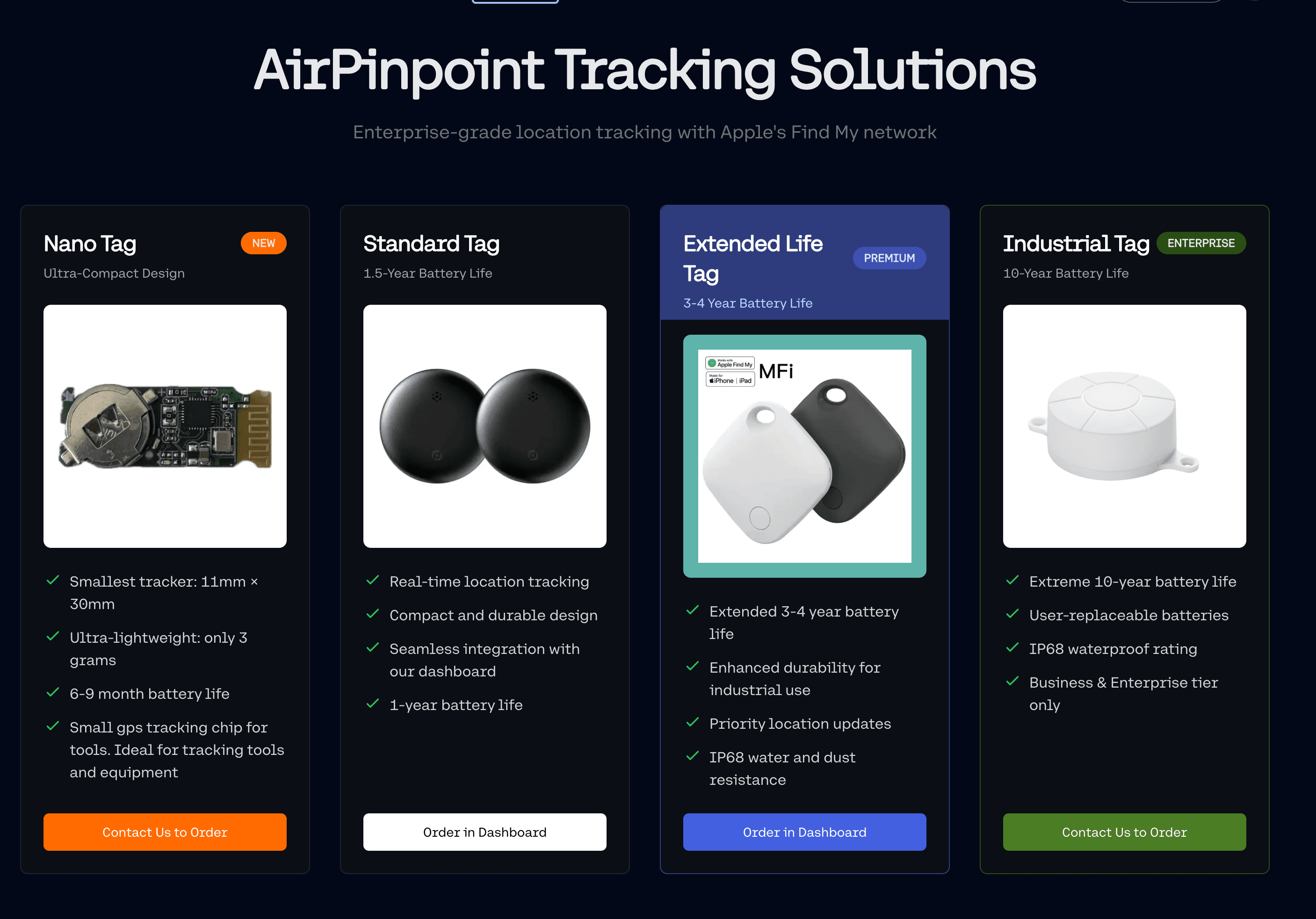
Airpinpoint is a finished product. It includes custom NRF52810 BLE beacons (7-year battery, no SIM, no charging), a web dashboard with live tracking, polygon geofencing, location history, REST API, team access controls, and webhook integrations. Location updates come through Apple's Find My network, over a billion Apple devices relay beacon positions automatically. No GPS chip in the beacon. No SIM card. No data plan.
Head-to-Head Comparison
| Factor | Google Maps Platform | Airpinpoint |
|---|---|---|
| Product type | Developer APIs and SDKs | Turnkey SaaS platform |
| Hardware included | None, you source your own | NRF52810 beacons, $12-25 each |
| Connectivity | Requires GPS + SIM per device | Apple Find My network (no SIM) |
| Dev effort to get started | Weeks to months of engineering | Minutes (sign up, attach beacon) |
| Live map dashboard | You build it | Included |
| Geofence alerts | You build it | Polygon geofencing included |
| Location history | You build it | Included |
| REST API | Google Maps APIs | Airpinpoint REST API |
| Pricing model | Per-API-call + subscription tiers | Per-device/month, flat |
| Starting cost | $100/mo API access (+ hardware + dev) | $11.99/device/month |
| G2 rating | 4.4/5 (17 reviews) | N/A |
| SIM card needed | Yes, for each GPS device | No |
| Setup time | Months | Same day |
| Maintenance | Ongoing (API changes, device firmware) | None |
Where Google Maps Platform Excels
Google Maps Platform is genuinely the best mapping infrastructure available. If your use case requires any of the following, it is the right choice:
Custom application development. You want to build a tracking product for your customers, not just track your own assets. Your use case doesn't fit any standard template. You need maps deeply embedded in an existing software product. Google Maps Platform's APIs are best-in-class for this.
Scale. Tracking thousands of vehicles with real-time updates across a global fleet. At that scale, a custom-built system on Google's infrastructure makes economic and operational sense.
Deep integrations. Your dispatch software, ERP, or warehouse management system needs location data wired directly into existing workflows. A custom build lets you control every integration point.
Regulatory requirements. Some industries require specific data residency, audit trails, or API control that only a self-built system can satisfy.
You already have GPS hardware. If your fleet vehicles have existing GPS devices transmitting location data, building a dashboard on Google Maps Platform may cost less than migrating hardware.
Where It Falls Short for Most Asset Tracking
The G2 reviews for Google Asset Tracking are largely from developers and technical users who appreciate the API quality. The gap between "this API works well" and "I can track my equipment tomorrow" is where most businesses get stuck.
No hardware. You cannot order a Google GPS tracker. Sourcing your own means evaluating vendors, managing procurement, and paying $50-200 per device before you write a single line of code. For 50 devices, that's $2,500-10,000 in hardware just to start.
SIM cards for every device. GPS trackers need cellular connectivity to transmit location. Each device needs its own SIM and data plan, typically $5-30/month. For 50 devices, add $250-1,500/month in cellular costs on top of API costs.
Months before you track anything. Building a functional asset tracking dashboard, with a map, geofences, alert logic, location history, user accounts, and a mobile-friendly UI, is a multi-month engineering project. G2 reviewers consistently mention the complexity of initial setup. For a business that needs to track equipment on Monday, this timeline doesn't work.
API pricing compounds fast. Google Maps Platform pricing changed in March 2025, replacing the old $200 monthly credit with tiered subscription plans. At $7/1,000 Dynamic Map loads and $5/1,000 Geocoding requests, a tracking app polling 50 devices every 5 minutes generates roughly 432,000 location pings per month before any dashboard views. Real cost depends on your exact API mix, but it adds up before you account for hardware or SIM fees.
You own the maintenance. When Google updates an API, deprecates a feature, or changes pricing, you update your code. When a GPS device firmware breaks compatibility, you fix it. The "build vs. buy" debate in software always underestimates ongoing maintenance cost. A platform like Airpinpoint handles all of this.
Where Airpinpoint Fills the Gap
Most businesses tracking tools, equipment, trailers, or vehicles don't need a custom-built mapping application. They need to answer one question: where is this asset right now?
Airpinpoint answers that question without a development project.
Apple Find My network as the backbone. Rather than GPS chips and SIM cards, Airpinpoint beacons broadcast a BLE signal that any nearby iPhone, iPad, or Mac relays to the Find My network. With over a billion Apple devices in circulation, urban and suburban areas provide location updates every few minutes without any cellular contract. No SIM. No data plan. No carrier relationship.
Hardware that doesn't need maintenance. NRF52810 beacons run for approximately 7 years on a single battery. Attach one to an asset and forget it for years. No charging. No firmware updates you manage. No SIM card renewals.
Dashboard on day one. Live map, location history, polygon geofencing, team access controls, REST API, webhook integrations, all included from sign-up. Not something you build; something you use.
Per-device flat pricing. $11.99/device/month for the business plan, $14.99/device/month for enterprise. No per-API-call math. No surprise bills when your usage spikes. Track 25 devices and you know your cost is $300/month, full stop.
The Real Decision: Build vs. Buy
The choice between Google Maps Platform and Airpinpoint is fundamentally a build-vs.-buy decision.
Build on Google Maps Platform when:
- You have engineers available and months to develop
- You are building a tracking product for your customers, not just your own assets
- You need custom integrations with existing enterprise software
- You already have GPS hardware transmitting location data
- You are tracking thousands of assets where custom economics justify the investment
Buy Airpinpoint when:
- You need to track assets this week, not this quarter
- You don't want to hire engineers or manage GPS hardware vendors
- Your asset count is under a few hundred (the economics strongly favor turnkey)
- You want predictable per-device pricing instead of per-API-call billing
- You prefer software that's maintained for you
Cost Comparison: 25 Assets Over 12 Months
Building on Google Maps Platform
| Cost Component | Estimate |
|---|---|
| Engineering (2 months at $8,000/mo avg) | $16,000 (one-time) |
| GPS hardware (25 x $100 avg) | $2,500 (one-time) |
| SIM + data (25 x $10/mo x 12) | $3,000 |
| Google Maps Platform API ($275/mo Essentials) | $3,300 |
| Total, Year 1 | ~$24,800 |
| Ongoing annual cost (SIM + API) | ~$6,300/year |
These are conservative estimates. Complex tracking apps cost more to build. GPS hardware quality varies. API costs depend on polling frequency and feature set.
Airpinpoint
| Cost Component | Estimate |
|---|---|
| Beacons (25 x $18 avg) | $450 (one-time) |
| Subscription ($11.99 x 25 x 12) | $3,597 |
| Total, Year 1 | ~$4,047 |
| Ongoing annual cost | ~$3,597/year |
For 25 assets, Airpinpoint costs roughly $20,000 less in year one and $2,700 less every subsequent year. The break-even for a custom Google Maps Platform build only appears at very large scale, typically 500+ assets with high-frequency update requirements that exceed what Apple's Find My network provides.
The Bottom Line
Google Maps Platform is excellent technology. It powers millions of applications and it is the right foundation for custom-built tracking products. If you have engineers and a use case that doesn't fit a standard product, it is a legitimate choice.
But "Google Asset Tracking" is not a product. It is a set of APIs that requires you to become a software company to use for asset tracking. You buy the map. You build the rest.
Airpinpoint is the rest, already built. Beacons included. Dashboard included. Find My network coverage across over a billion devices included. For any business that needs to track assets rather than build a tracking product, the comparison resolves quickly: sign up, attach a beacon, and your assets are on the map today.
 Our Solution