
Updated
What Is the Find My Network and How Does It Work?
The Find My network is Apple's crowdsourced location network: more than a billion iPhones, iPads, and Macs that listen for Bluetooth signals from AirTags and other Find My devices. When one of them hears a tag, it attaches its own location, encrypts the result with the tag's public key, and uploads it to Apple. Only the owner's devices hold the key that decrypts it, so Apple never sees where the tag is.
| Find My network fact | Answer |
|---|---|
| Size | More than a billion iPhone, iPad, and Mac devices (Apple's current figure) |
| What an AirTag has | Bluetooth LE, Ultra Wideband, NFC, an accelerometer. No GPS, cellular, or Wi-Fi |
| Where the location comes from | The Apple device that hears the tag |
| Encryption | End-to-end, elliptic curve P-224. Apple can't decrypt reports |
| Key rotation | About every 15 minutes near the owner, once a day when separated |
| Update schedule | None. A report arrives each time a connected Apple device passes the tag |
| Cost | Apple charges nothing for the network |
| Android | AirTags can't be set up or tracked on Android, but Android phones can detect unknown AirTags |
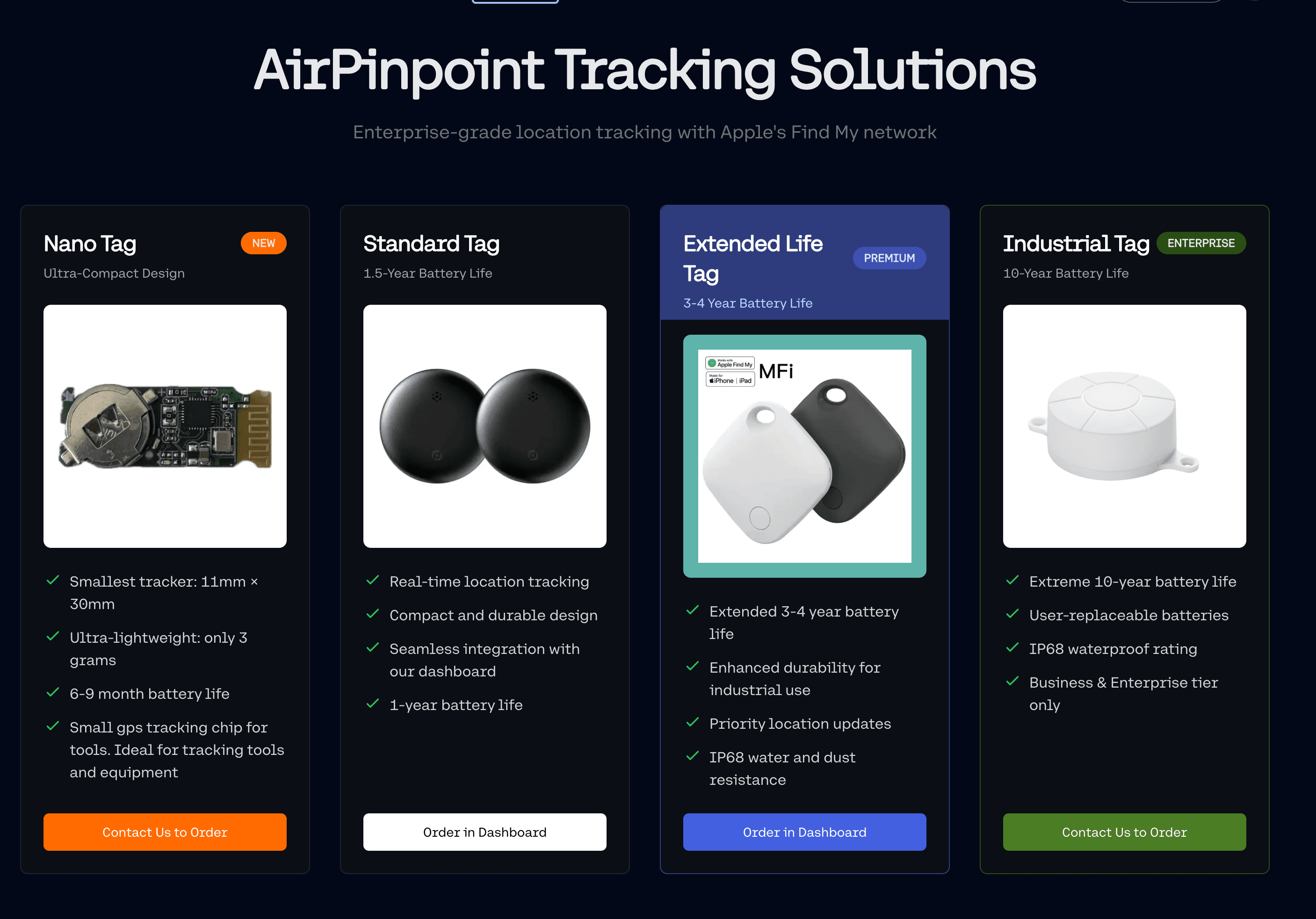
Airpinpoint reads these same encrypted reports for businesses, decrypting them with each tag's keys and putting hundreds of tags in one dashboard, past the 32-item limit Apple sets per Apple Account (multi-user AirTag tracking).
How the Find My Network Works, Step by Step
A location report passes through five steps, and the AirTag only does the first one.
- The tag broadcasts. An AirTag away from its owner sends a Bluetooth Low Energy advertisement about every 2 seconds, carrying a P-224 public key and a status byte. Nothing in it identifies the owner.
- A nearby Apple device hears it. Any iPhone, iPad, or Mac in Bluetooth range with Find My on picks up the signal in the background. Its owner sees nothing.
- The finder encrypts its own location. It creates a one-time key pair and encrypts its current position to the tag's public key (an elliptic curve key exchange on P-224, then AES-GCM).
- The finder uploads the report. The report goes to Apple over the finder's own Wi-Fi or cellular connection, with no authentication information attached. Apple files it under a hash of the tag's public key.
- The owner fetches and decrypts. The owner's device knows every public key its tag has used, asks Apple for the reports filed under those hashes, and decrypts them locally. The Find My app shows the most recent one.
AirTag Technology: Bluetooth and the Find My Network, Not GPS
An AirTag has no GPS chip. It borrows the position of the Apple device that hears it, which is how it runs for more than a year on a CR2032 coin cell and sells for $29.
A GPS tracker has to power a satellite receiver and a cellular modem, which drains its battery and needs a data plan. The Find My network hands both jobs to phones people already carry. The trade-off: an AirTag's location is only as fresh as the last Apple device that walked past it. See Bluetooth vs GPS vs cellular tracking for the full comparison.
End-to-End Encryption: How Find My Keeps Locations Private
Nobody but the owner can read an AirTag's location, including Apple and the person whose iPhone relayed it.
- Keys stay with the owner. Turning on Find My generates a P-224 key pair and a 256-bit secret on the owner's device. Apple says these are never sent to Apple and sync only through end-to-end encrypted iCloud Keychain.
- The broadcast key keeps changing. Apple replaces the public key about every 15 minutes. A separated AirTag switches to a key that changes once a day at 4:00 AM local time, according to Adam Catley's AirTag teardown. Nobody can follow one fixed ID for weeks.
- Finders stay anonymous. Reports carry no authentication information, so Apple doesn't know who found a device or whose it was.
- Apple only stores ciphertext. Without the private key, a stored report is unreadable.
What's Inside a Find My Location Report
Each report decodes to five short fields, and three of them are encrypted. Airpinpoint's fetcher decrypts these reports for customer tags around the clock, so this is the data as the owner's side sees it.
| Field | Encrypted? | What it tells you |
|---|---|---|
| Timestamp | No | When the finder heard the tag, in seconds from January 1, 2001 |
| Confidence | No | A confidence value set by the finder |
| Latitude and longitude | Yes | The finder's position, encoded to 7 decimal places |
| Horizontal accuracy | Yes | The finder's own error estimate |
| Status byte | Yes | Tag state, with battery level in the top 2 bits: full, medium, low, or critically low |
What running that pipeline shows:
- Reports are looked up by key, not by tag. Our fetcher derives two key schedules per tag from its master key and shared secrets, a primary key that changes every 15 minutes and a secondary key that changes every 24 hours, and asks Apple for both. Each lookup covers the last 7 days.
- Reports can arrive late. A finder that was offline uploads when it reconnects, hours after the timestamp. Our pipeline keeps accepting reports up to 24 hours older than the newest stored point so late ones aren't lost.
- Some reports are phantoms. A report occasionally places a tag far away and the next one puts it back. Our filter drops any point that jumps more than 150 m from the last stable position and is followed by a return to within 100 m of it, and keeps steady movement in any direction. It uses that geometry because the accuracy field alone doesn't reliably separate good points from bad ones.
- Battery level comes with every report. The status byte gives a 4-level reading with no extra request, so a fleet dashboard can flag low batteries before tags go dark.
Find My Network Range and Coverage
The Find My network has no distance limit. The only short hop is Bluetooth, from the AirTag to the nearest Apple device; after that the report travels over the internet, so the owner can be anywhere.
Coverage follows people carrying Apple devices. City streets, airports, and busy job sites report a tag often. A rural yard, a locked storage unit, or open water can go hours or days with nobody in range. The second-generation AirTag has an upgraded Bluetooth chip for longer range, which gives passing devices more chances to hear it. For measured distances, see the AirTag range guide.
Location Update Frequency: How Often Find My Updates
Find My has no fixed update frequency. A new report exists only when an Apple device with Find My on hears the tag and can upload, so foot traffic sets the refresh rate, not the AirTag.
| Where the tag is | What to expect |
|---|---|
| Dense city, transit, busy venue | Frequent reports, often minutes apart |
| Suburbs, office parks | Gaps from tens of minutes to a few hours, depending on traffic |
| Rural or after-hours sites | Hours between reports |
| Nobody nearby | No new reports until someone passes |
A tag that sits still keeps broadcasting, so it still gets reports whenever someone walks by. An empty room slows updates, not a stationary tag. If a tag has gone quiet, see AirTag not updating location.
Airpinpoint asks Apple for every customer tag's reports on a set interval (every 30 minutes by default) and again when someone opens the live map, so new reports reach the dashboard soon after Apple has them (AirTag tracking for business).
What "Off Network" Means in Find My
Find My shows this when it cannot reach a person or device over the internet to get a current location. The usual causes are that the device is powered off, its battery died, it has no Wi-Fi or cellular connection, or location sharing was turned off on it.
The wording trips people up because it sounds like the crowdsourced network went down. It did not. "Off Network" describes the connection of the one device you are looking at, not the health of the Find My network itself. Apple's own published status strings on the Find My support page are "No location found", "Offline", and "Not sharing location", and the label appears next to people and devices rather than next to an AirTag.
That distinction matters for an AirTag specifically. An AirTag has no internet connection of its own and never did, so it is never "off network" in the sense of having lost one. It is found by nearby Apple devices relaying its Bluetooth broadcast. When an AirTag has no recent position, the message you get is "No location found", and the cause is that nobody has walked past it recently, not that anything is switched off. See AirTag not updating location for what to do about that.
Ultra Wideband and Precision Finding
Precision Finding is the short-range step after the Find My network gets you to the right area. It uses Ultra Wideband (UWB) radio to measure distance and direction to the AirTag and shows an arrow on your iPhone.
- AirTag (2nd generation, 2026): second-generation Ultra Wideband chip, with Precision Finding up to 50% farther away than the first AirTag. Works with iPhone Air and iPhone 15 or later (except iPhone 16e and 17e), and Apple Watch Series 9 or later or Ultra 2 or later on watchOS 26.2.1.
- AirTag (1st generation, 2021): U1 Ultra Wideband chip, with Precision Finding on iPhone 11 or later models that have an Ultra Wideband chip.
Precision Finding doesn't extend the network's reach. Without it, you use the map pin and Play Sound.
How to Turn On the Find My Network on iPhone
The Find My network setting lets your own iPhone be found while it is offline or powered off. AirTags join the network automatically once added to Find My and have no setting.
- Open Settings and tap your name.
- Tap Find My, then Find My iPhone.
- Turn on Find My iPhone and Find My network.
- Optional: turn on Send Last Location so your iPhone sends its location to Apple when the battery is low.
Does the Find My Network Work with Android?
No. An AirTag has to be set up on an iPhone or iPad signed in to an Apple Account, and Android phones don't relay Find My reports. Android's equivalent is Google's Find Hub network (called Find My Device until 2025), which works with its own tags.
For the full list of what Android can and cannot do with an AirTag, see AirTag for Android. Android phones can still detect AirTags. Since May 2024, a standard from Apple and Google alerts people on Android 6.0 and later, and iOS 17.5 and later, when an unknown tracker is moving with them.
| Apple Find My network | Google Find Hub network | |
|---|---|---|
| Relay devices | More than a billion iPhones, iPads, and Macs | Android phones (the network needs Android 9 or later) |
| Phone needed to set up a tag | iPhone or iPad | Android phone |
| Example tags | AirTag, plus Find My accessories from brands like Chipolo and Pebblebee | Moto Tag, plus Android models from Chipolo and Pebblebee |
| Unknown tracker alerts | Yes, cross-platform | Yes, cross-platform |
By default, Google's network reports lost items only in busy places, a privacy choice that also means fewer reports outside cities. If you want a tracker for an Android phone, start with AirTag vs Moto Tag. For a business fleet, the worker's phone matters less: Airpinpoint's dashboard runs in any browser, including on Android, while the tags stay on Apple's network.
Third-Party Find My Network Accessories
Apple's Find My network accessory program lets other manufacturers build products that appear in the Find My app and report through the same network with the same encryption. Chipolo and Pebblebee both sell Find My tags, and every accessory counts toward the 32-item limit on an Apple Account.
Airpinpoint's fetcher handles two kinds of Find My devices: Apple-paired accessories, whose keys roll on the schedule above, and OpenHaystack-style beacons that broadcast one fixed key. Apple returns both in the same encrypted report format.
Anti-Stalking and Safety Features
- Rotating identifiers stop anyone from following a tag by a fixed ID.
- Unknown tracker alerts on iPhone and Android warn people when an unknown AirTag is traveling with them and show how to play its sound and disable it.
- Sound and NFC: a separated AirTag plays a sound after a while, and holding an NFC phone to it shows its serial number and how to disable it by removing the battery.
Company tags riding in a vehicle or toolbox can trigger these alerts on an employee's phone, so tell staff which assets are tagged.
Lost Mode and Share Item Location
- Lost Mode notifies you when the Find My network locates the item and shows your phone number or email to anyone who taps it with an NFC phone.
- Share Item Location temporarily shares an AirTag's location with someone else, including more than 50 airlines such as Delta, Lufthansa, and United.
- Notify When Left Behind alerts you when your iPhone moves away from the tag. It is not a geofence: it fires when your phone leaves the tag, not when the tag leaves a place. For real geofences, see geofence alerts with AirTags.
Find My Network Limits for Business Asset Tracking
The Find My network was built to find one person's keys, so the Find My app leaves out most of what fleet tracking needs.
| Gap in the Find My app | Why it matters for a fleet |
|---|---|
| Latest location only, no history | You can't see where a trailer was last Tuesday |
| 32 items per Apple Account | A 200-tool fleet needs several accounts and logins |
| No geofences | No alert when equipment leaves a yard |
| No team roles, export, or API | Locations stay on one person's phone |
| Update speed set by foot traffic | Remote sites report slowly, and no plan changes that |
Airpinpoint covers the first four: it stores every decrypted report as AirTag location history, keeps hundreds of tags in one team dashboard, runs geofences with email and webhook alerts, and exposes the data through the AirTag API. The fifth is physics. If nobody with an Apple device passes a tag, nothing can report it, so equipment that lives at remote sites is better served by a GPS tracker.
AirTag and Find My Network Technical Specifications
| Specification | AirTag (2nd generation) |
|---|---|
| Size | 31.9 mm diameter, 8.0 mm tall |
| Weight | 11.8 g |
| Location method | Find My network (no GPS) |
| Radios | Bluetooth LE, second-generation Ultra Wideband, NFC |
| Battery | User-replaceable CR2032, more than a year |
| Water resistance | IP67 (1 m for up to 30 minutes) |
| Setup | iPhone with iOS 26 or later, or iPad with iPadOS 26 or later |
| Price (US) | $29 each, $99 for four |
| Network encryption | End-to-end, EC P-224 |
| Items per Apple Account | 32, including third-party Find My accessories |
Sources
- Apple Platform Security: Find My: key pair, key rotation, anonymous finders
- Apple: Find My and Apple: AirTag: network size, specs, Precision Finding, airlines
- Apple Newsroom, January 2026: second-generation AirTag
- Apple Newsroom, May 2024: cross-platform tracking alerts
- Apple Support: 32-item limit
- Android: Find Hub: Find Hub requirements
- Adam Catley: AirTag reverse engineering: advertising interval, daily key change
- Airpinpoint's Find My fetch pipeline: report fields, key schedules, lookup window, phantom filter


 Our Solution