AirTags vs ArcGIS GeoEvent Server: Turnkey Tracking vs Enterprise GIS Infrastructure
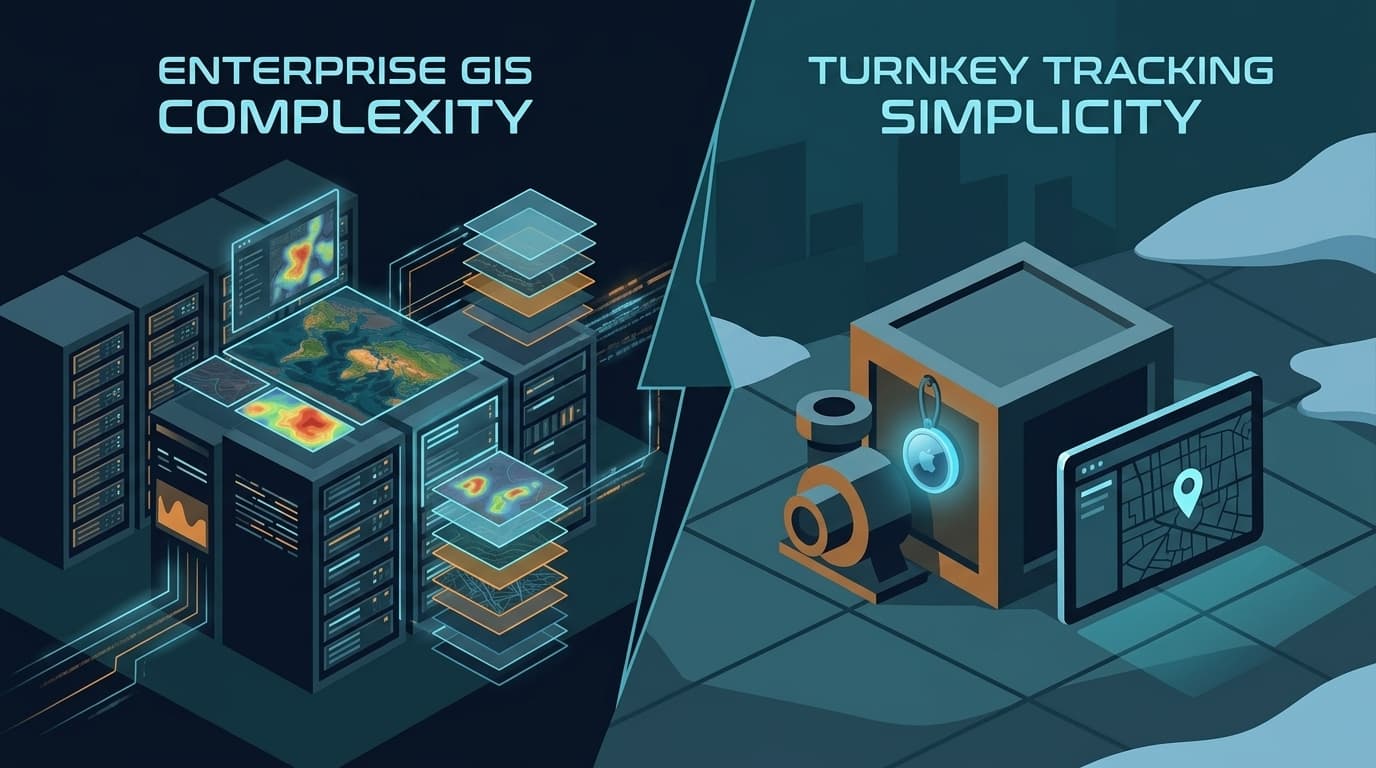
ArcGIS GeoEvent Server is not a tracking product. It is a real-time data pipeline that routes streaming location feeds into an ArcGIS Enterprise GIS environment. To use it, you need ArcGIS Enterprise, a GeoEvent Server license, your own tracking hardware, and GIS staff who know how to configure it.
If you have all of that, GeoEvent Server is a powerful piece of infrastructure. If you don't, you are looking at months of procurement and setup before a single asset shows up on a map.
Airpinpoint is the opposite: beacons ship in a few days, plug into Apple's Find My network, and appear on a live map after a 10-minute setup. No GIS stack. No dedicated staff. No separate hardware contract.
What Each Tool Actually Does
ArcGIS GeoEvent Server is an extension to ArcGIS Enterprise that ingests, filters, routes, and archives real-time streaming data. Per Esri's documentation, it "enables real-time event-based data streams to be integrated as data sources in your enterprise GIS." It supports geofencing, automated alerts, and data enrichment, but it assumes you already have the ArcGIS platform running and you are supplying your own device feeds. It does not track anything on its own. It processes data you bring to it.
Esri has formally announced that GeoEvent Server 12.3 (planned for 2027) will be the final release, with the product removed in ArcGIS Enterprise 12.4. Esri is directing existing customers toward ArcGIS Velocity, a cloud-based successor service, for new deployments.
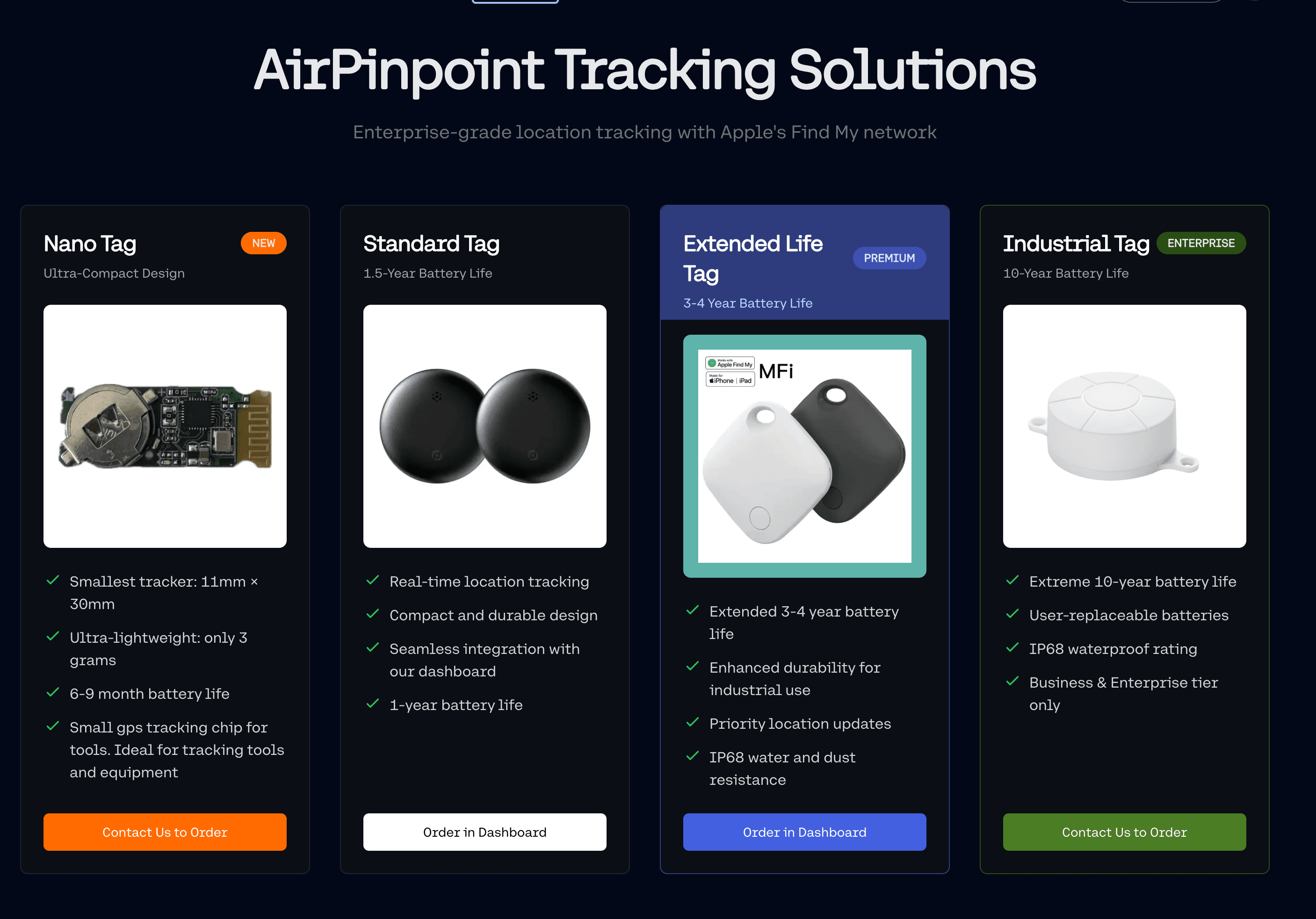
Airpinpoint is a turnkey asset tracking platform. Custom NRF52810 beacons (7-year battery, no SIM card, ~$12-25 each) broadcast on Apple's Find My network. Any nearby iPhone, iPad, or Mac relays the beacon's position back to the Airpinpoint dashboard. You get a live map, location history, polygon geofence alerts, REST API, and team access at $11.99 to $14.99 per device per month. No infrastructure. No GIS team. No separate hardware procurement.
Head-to-Head Comparison
| Feature | ArcGIS GeoEvent Server | Airpinpoint |
|---|---|---|
| What it is | Real-time GIS data pipeline extension | Turnkey asset tracking platform |
| Tracking hardware included | No, bring your own device feeds | Yes, NRF52810 beacons |
| Requires ArcGIS Enterprise | Yes, mandatory (Standard or Advanced) | No |
| GIS team required | Yes, for configuration and operation | No |
| Pricing model | Enterprise/quote (ArcGIS Enterprise + GeoEvent license) | $11.99-$14.99/device/month |
| Setup time | Weeks to months (licenses, servers, connectors) | Days (order beacons, sign up, attach) |
| Deployment | On-premises or ArcGIS Online integration | Cloud, any browser |
| Live map | Yes, via ArcGIS dashboards | Yes, built-in |
| Geofencing | Yes, polygon-based | Yes, polygon-based |
| Automated alerts | Yes, configurable | Yes, geofence + movement alerts |
| Data inputs | Any streaming feed (GPS, IoT, social media) | Apple Find My network (passive relay) |
| Location history | Yes, feature services + big data store | Yes, full history |
| REST API | Yes, via ArcGIS REST services | Yes |
| Product status | Announced for deprecation (final release: 12.3, planned 2027) | Active |
| Target user | GIS analysts, utilities, government agencies | Operations teams, field managers |
Where ArcGIS GeoEvent Server Excels
GeoEvent Server is genuinely powerful for the organizations it was designed for. Esri cites customers including the Port of New Orleans, National Fuel Gas Company, the City of Raleigh, and the US Army Corps of Engineers. These are organizations with large GIS practices already invested in ArcGIS Enterprise.
Deep ArcGIS Integration
For organizations running ArcGIS Enterprise, GeoEvent Server adds real-time data to an ecosystem that already handles everything else: cartography, spatial analysis, enterprise dashboards, permitting, asset registries, and field operations. A utility company that uses ArcGIS for grid planning can layer live sensor data onto the same maps its engineers already use. The integration value is real for buyers already inside the Esri stack.
High-Volume Streaming Data
GeoEvent Server is built for continuous, high-frequency data streams. It can ingest thousands of events per second from GPS trackers, environmental sensors, vessel transponders, or social media feeds, and it routes and archives that data through configurable pipelines. For organizations managing port operations, grid infrastructure, or emergency response across a large geographic area, that throughput matters.
Custom Connectors and Processing Logic
GeoEvent Server supports custom input and output connectors, filter logic, and data enrichment. An organization can build a connector for a proprietary sensor protocol, enrich incoming location events with GIS reference data, and route alerts to multiple downstream systems. That flexibility is valuable when you have a team capable of using it.
Spatial Analysis at Scale
Because GeoEvent Server outputs into ArcGIS Enterprise, real-time data feeds immediately become available for spatial analysis, integration with other GIS layers, and long-term archiving in spatiotemporal big data stores. For agencies that need to correlate live tracking data with land use, utility infrastructure, or environmental data, that is a meaningful capability.
Where GeoEvent Server Falls Short for Asset Tracking
No Hardware Included
GeoEvent Server is a software pipeline. It processes feeds you supply. For a company tracking field equipment, this means selecting, procuring, deploying, and maintaining a separate fleet of GPS trackers or IoT devices, each with its own SIM card, data plan, and management overhead. The tracking hardware cost and complexity are entirely outside the GeoEvent Server scope.
ArcGIS Enterprise Is the Gate
GeoEvent Server cannot run without ArcGIS Enterprise Standard or Advanced. ArcGIS Enterprise is itself a substantial platform: ArcGIS Server, Portal for ArcGIS, ArcGIS Data Store, and Web Adaptor deployed and configured on your own infrastructure or cloud environment. For organizations not already running ArcGIS, this is not a starting point, it is a multi-year infrastructure commitment.
Esri does not publish ArcGIS Enterprise pricing publicly. Licensing is quote-based and scales with organizational size and ArcGIS user counts. The GeoEvent Server extension is priced on top of that base. Total cost of ownership for a new ArcGIS Enterprise + GeoEvent deployment is typically in the tens of thousands to hundreds of thousands of dollars annually before hardware.
Requires GIS Expertise to Operate
Configuring GeoEvent Server requires GIS staff who understand ArcGIS Server administration, connector configuration, GeoEvent processing pipelines, and spatial reference systems. Standing up a working real-time tracking deployment requires multiple skill sets: GIS administration, connector development, and dashboard configuration. Operations teams tracking equipment in the field cannot manage this without GIS staff.
Announced for Deprecation
Esri has formally announced that GeoEvent Server 12.3 (planned Q2 2027) will be the final release, with removal from ArcGIS Enterprise planned for 12.4 (Q4 2027). New real-time capabilities are moving to ArcGIS Velocity, a separate cloud-based service. Organizations evaluating GeoEvent Server today are buying into a product with a confirmed end date and a migration to Velocity ahead.
Not Designed for Simple Equipment Tracking
GeoEvent Server is designed for high-frequency, complex streaming data scenarios. A company tracking 200 generators across 20 job sites, checking location every hour and getting geofence alerts when equipment leaves a site, does not need a real-time GIS data pipeline. The overhead is massive relative to the use case.
Where Airpinpoint Fills the Gap
Hardware and Software Together
Airpinpoint beacons arrive ready to deploy. Attach one to a piece of equipment, and it starts broadcasting on Apple's Find My network. No SIM card. No data plan. No device management console. The 7-year battery means beacons don't need routine maintenance. At $12-25 each, hardware cost is a fraction of enterprise GPS tracker alternatives.
No Infrastructure Required
Airpinpoint runs as a cloud service. The dashboard works on any browser, including Android and Windows. There is no server to manage, no ArcGIS license to maintain, and no GIS team required. Setup is measured in hours, not months.
Live Map and Geofence Alerts
Every tracked asset appears on a live map. Draw a polygon geofence around a yard, job site, or warehouse and set it to alert when assets enter or exit. Configure schedules so you only receive after-hours alerts. Location history shows every recorded position for insurance, utilization analysis, or dispute resolution.
REST API for Integration
Airpinpoint's REST API lets operations teams pull location data into existing tools without building a GIS integration. Sync positions to your ERP, fleet management system, or custom dashboard without needing ArcGIS middleware.
The Real Decision: GIS Platform vs Turnkey Tracker
This is not a close comparison for most buyers. The two products serve fundamentally different customers with different technical resources.
ArcGIS GeoEvent Server makes sense when:
- Your organization already runs ArcGIS Enterprise and has GIS staff
- You need to process high-frequency streaming data from many device types simultaneously
- Real-time data needs to be spatially analyzed alongside other GIS layers
- You have IT infrastructure to support ArcGIS Server on-premises or in the cloud
- The use case is complex situational awareness, not simple equipment location
Airpinpoint makes sense when:
- You need to know where physical assets are, without GIS infrastructure
- The team managing tracking is operations, not GIS
- Deployment needs to happen in days, not months
- Hardware should be included and low-maintenance
- Budget is per-device and predictable, not enterprise contract and quote
Cost Comparison
ArcGIS GeoEvent Server (illustrative enterprise deployment)
- ArcGIS Enterprise license: $15,000-$100,000+/year depending on org size and tier (quote-based)
- GeoEvent Server extension: Additional enterprise license (quote-based, on top of ArcGIS Enterprise)
- Tracking hardware: GPS trackers or IoT devices at $50-300+ each, plus SIM cards and data plans
- GIS staff: 1+ GIS administrators or analysts to configure and maintain the system
- Total: Highly variable, typically $50,000+ annually before headcount for new deployments
Airpinpoint (200 assets)
- Hardware: 200 beacons at $12-25 each = $2,400-5,000 one-time
- Subscription: $11.99/device/mo = $2,398/mo
- Annual cost: $28,776 + hardware, no dedicated staff required
For organizations with an existing ArcGIS Enterprise investment and a GIS team, GeoEvent Server adds real-time capability to infrastructure they already own. For organizations starting from scratch, Airpinpoint delivers tracking at a fraction of the cost and timeline.
The Bottom Line
ArcGIS GeoEvent Server is serious enterprise GIS infrastructure. For a utility company mapping real-time pipeline sensor data onto a GIS grid, or a port authority tracking vessel movements in an ArcGIS dashboard, it is the right tool. It is powerful, flexible, and deeply integrated with ArcGIS.
It is also not a product you buy to track equipment. It does not come with tracking hardware. It requires ArcGIS Enterprise to function. It needs GIS staff to configure. And Esri has formally announced its deprecation, with version 12.3 as the planned final release.
Airpinpoint is the opposite of that. Beacons ship in days. The dashboard is live in an afternoon. No GIS stack, no procurement process, no specialized staff. At $11.99 per device per month with hardware included, the total cost of ownership for 200 assets is under $30,000 per year, with one person able to manage the whole fleet.
If you are already an Esri shop with GIS staff and ArcGIS Enterprise, GeoEvent Server is worth evaluating, though its announced deprecation (final release 12.3, planned 2027) means ArcGIS Velocity may be the better long-term bet. If you are not an Esri shop, you are looking at buying an entire GIS platform just to track where your equipment is. Airpinpoint was built for that second group.
 Our Solution