Scaffolding Management Software: Stop Losing Components Across Job Sites
A mid-sized scaffolding company manages 10,000 to 50,000 individual components, frames, braces, platforms, planks, couplers, spread across 10 to 100 active job sites at any given time. That inventory is worth $500,000 to $5 million. And every year, 5-10% of it disappears.
Components get left behind at completed job sites. Crews "borrow" braces from one project to fill a shortage at another without telling anyone. Entire pallets of frames vanish overnight from sites with poor security. After a few months of this, your actual inventory and your records diverge so far that a physical count becomes a week-long project nobody wants to do.
The U.S. scaffolding market is worth over $13 billion and growing. But the software built for this industry focuses on design, engineering, and billing. Almost none of it answers the question scaffolding operations managers ask every day: where is my equipment right now?
The Scaffolding Inventory Problem
What Gets Lost
Every scaffolding company deals with the same categories of loss:
| Loss Type | Typical Impact | How It Happens |
|---|---|---|
| Left at completed sites | 30-40% of total loss | Job ends, demobilization crew misses a stack of braces behind the building |
| Inter-site transfers | 20-30% of total loss | Foreman takes 50 frames from Site A to cover a shortage at Site B, never logs it |
| Theft | 15-25% of total loss | Components stolen overnight, especially from unsecured perimeter sites |
| Damage and unreported scrap | 10-15% of total loss | Bent frames tossed in a dumpster instead of returned for repair |
| Rental non-returns | 10-20% of total loss (rental companies) | Customer keeps equipment past rental period, disputes the count |
What Components Actually Cost
Scaffolding components are individually cheap but collectively expensive:
| Component | Unit Cost | Typical Bundle | Bundle Value |
|---|---|---|---|
| Standard frame (5') | $30-$80 | 25 per cage | $750-$2,000 |
| Cross brace | $15-$35 | 50 per cage | $750-$1,750 |
| Horizontal/ledger | $20-$45 | 100 per pallet | $2,000-$4,500 |
| Scaffold plank (wood) | $20-$50 | 20 per pallet | $400-$1,000 |
| Scaffold plank (aluminum) | $80-$200 | 20 per pallet | $1,600-$4,000 |
| Base plate/screw jack | $15-$40 | 25 per bin | $375-$1,000 |
| Coupling/clamp | $8-$25 | 100 per bin | $800-$2,500 |
A single scaffold cage loaded for a commercial job holds $3,000-$8,000 in components. A flatbed truck carries 4-6 cages. One truckload is $12,000-$48,000 in equipment rolling down the highway.
The Real Cost of Shrinkage
For a company with $500,000 in scaffold inventory:
- 5% annual shrinkage = $25,000/year in replacement costs
- 10% annual shrinkage = $50,000/year in replacement costs
- Add labor costs: crews searching for "missing" components, physical inventory counts, resolving disputes with job sites about what was delivered vs. returned
- Add project delays: when a crew arrives at a site and the frames they expected aren't there because someone moved them to another job without logging it
Total cost of poor inventory visibility easily reaches $50,000-$100,000/year for a mid-sized operation. For large scaffolding companies running 50+ sites, it runs into the hundreds of thousands.
What Existing Scaffolding Software Actually Does
Several established platforms serve the scaffolding industry. They all solve real problems. But they share a blind spot.
Avontus (Designer + Quantify + ScaffoldIQ)
Avontus is the market leader. Designer handles 3D scaffold layout and engineering. Quantify manages rental contracts, billing, and inventory quantities on paper. ScaffoldIQ adds mobile field inspections and QR code scanning. Pricing starts in the thousands per year and scales with company size ($5,000-$20,000+/year for a full deployment).
What Avontus does well: scaffold design, material take-offs, rental billing, inspection documentation.
What Avontus does not do: tell you the physical location of your scaffold cages and pallets across job sites right now.
Barcode and QR Scanning Tools
Several platforms (SCAFFTRACK, CloudScaff, ScaffoldIQ) use barcode or QR scanning to track components at check-in and check-out. The logic is straightforward: scan when it leaves the yard, scan when it comes back, and the delta tells you what's still out.
This works when every scan happens. In practice, it breaks down:
- Crew loads truck at 5:30 AM, scanner won't connect, they skip it
- Components transferred between sites without returning to the yard first
- Returns dumped in the yard at end of day, nobody scans until Monday
- Damaged components scrapped on site, never scanned as returned
The gap between scanned records and physical reality widens over time. By the end of a quarter, your system says you have 8,000 frames but a physical count finds 7,200.
ERP and Rental Software
General-purpose rental ERP systems (InTempo, Point of Rental, Alert Rental) handle the business side: contracts, invoicing, asset depreciation. They track inventory as numbers in a database. They don't know where those assets are physically sitting today.
The Missing Layer: Physical Location
Every one of these platforms tracks inventory on paper. None of them track inventory in physical space. When your operations manager calls a job site and asks "do you still have our scaffold cages?" the answer is only as reliable as whoever picks up the phone.
Airpinpoint fills this gap.
How Airpinpoint Tracks Scaffolding Across Job Sites
The practical approach: don't track individual $30 frames. Track the bins, cages, and pallets that hold them.
Tag Your Containers, Not Your Components
A typical scaffolding company organizes components into:
- Scaffold cages: Steel containers holding 25 frames + 50 braces + hardware. Worth $3,000-$8,000 loaded.
- Plank pallets: Wooden or steel pallets holding 20-40 planks. Worth $400-$8,000 depending on material.
- Hardware bins: Bins of couplings, base plates, screw jacks. Worth $500-$2,500 each.
- Transport racks: Specialty racks for ledgers and horizontals.
Attach one AirTag ($29) to each container. A company with 100 containers across 20 job sites spends $2,900 on tags and knows where every container is at all times.
What You See in the Dashboard
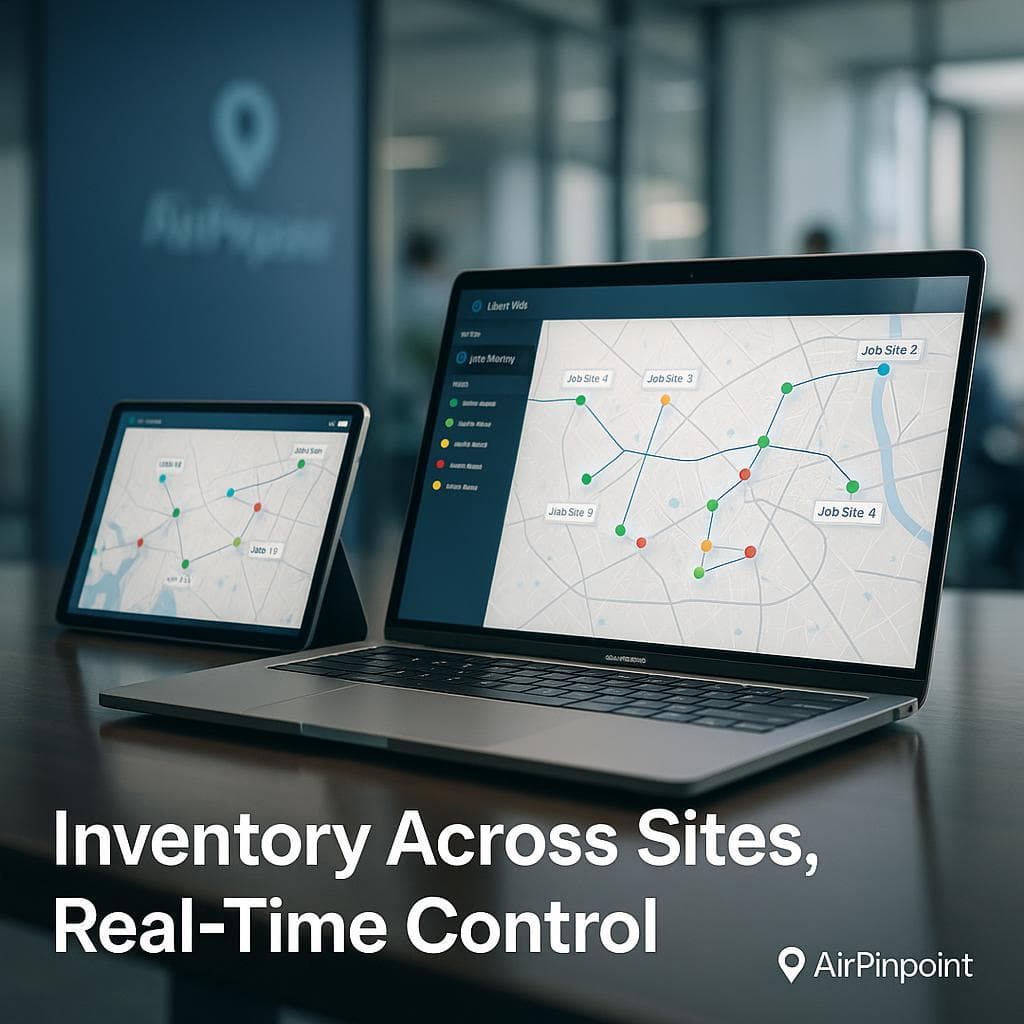
Job site map. Every tagged container plotted on a map. Color-coded by status: green (at active site), yellow (in transit), red (at completed/unknown site). Filter by job site, container type, or date range.
Container history. Tap any container to see where it's been: left the yard Tuesday at 6 AM, arrived at the Downtown Tower project at 7:15 AM, still there as of this morning.
Multi-site overview. See all 20 job sites at once. How many containers at each site. Which sites are wrapping up and should have equipment heading back to the yard.
Geofencing for Scaffold Yards and Job Sites
Set up geofences around your storage yard and every active job site.
Departure alerts. Get notified when scaffold cages leave a job site outside scheduled transport windows. If a cage leaves the Downtown Tower project at 2 AM on a Saturday, something is wrong.
Return tracking. When a job completes, track whether all containers actually come back. The geofence around your yard confirms arrivals. Three cages sent to the Riverside project, two returned, one still sitting on site.
Unauthorized movement. Crews sometimes shuffle equipment between sites without telling dispatch. Geofence alerts catch this in real-time so your inventory records stay accurate.
How It Works with Your Existing Software
Airpinpoint doesn't replace Avontus, InTempo, or your ERP. It adds the physical tracking layer that none of them have.
Your existing software says: "Customer ABC rented 4 scaffold cages, contract ends March 15."
Airpinpoint says: "Those 4 cages are at 455 Industrial Blvd. Two have been stationary for 3 weeks. One moved to a different address Tuesday."
Together, you have the full picture: contractual and physical.
OSHA Compliance and Scaffolding Tracking
OSHA standard 29 CFR 1926.451 requires that scaffolds and scaffold components be inspected for visible defects by a competent person before each work shift. After any event that could affect structural integrity, another inspection is required.
This creates a documentation burden: which components are at which site, who inspected them, and when.
Airpinpoint doesn't perform inspections. But it provides a verifiable record of which scaffold containers are at which job site and when they arrived. Pair this with your inspection checklists (paper or digital) and you have a complete chain:
- Airpinpoint confirms: Scaffold cage #47 arrived at Site 12 on February 3rd
- Inspection log confirms: Competent person inspected components from cage #47 on February 3rd before first use
- Airpinpoint confirms: Cage #47 has remained at Site 12 continuously since delivery
If OSHA asks whether you tracked which equipment was on which site, you have GPS-timestamped proof, not just a foreman's memory.
Scaffolding Rental Companies: Tracking Equipment on Rent
Rental companies face a sharper version of the inventory problem. Your equipment leaves your control entirely when it goes to a customer site. Getting it back depends on the customer's honesty and your ability to verify returns.
The Unreturned Equipment Problem
A typical scenario: you rent 6 scaffold cages to a general contractor for a 3-month project. The contract ends. The GC says everything is back. Your yard crew counts 5 cages. You call the GC, who insists they returned everything. Without proof, you either eat the loss or start an adversarial dispute.
With Airpinpoint: your dashboard shows cage #23 is still at the customer's site. You share the screenshot. Dispute resolved in 30 seconds. You schedule a pickup.
Automated Rental Period Alerts
Set geofence rules tied to rental periods:
- 7 days before contract end: notification that equipment should be returning soon
- Contract end date: alert if equipment is still at customer site
- 7 days past due: escalation alert for collections or pickup scheduling
This replaces the manual process of checking contracts, calling customers, and sending overdue notices. The system watches your equipment 24/7.
Per-Customer Inventory Visibility
See exactly how much equipment each customer has, where it is, and how long it's been there. Useful for:
- Verifying pick-up requests ("customer says they're returning 4 cages but we show 6 on site")
- Scheduling efficient pickup routes when multiple jobs end the same week
- Identifying customers who consistently keep equipment past contract dates
Cost Breakdown: Tracking 100 Scaffold Containers
| Item | Cost |
|---|---|
| AirTags (100 units, one-time) | $2,900 |
| Airpinpoint Business plan (100 devices, annual) | $14,388 |
| Battery replacements (annual, 100 units) | $300 |
| Total Year 1 | $17,588 |
| Total Year 2+ | $14,688 |
Compare to typical annual losses:
| Inventory Value | 5% Shrinkage | 10% Shrinkage |
|---|---|---|
| $250,000 | $12,500/year | $25,000/year |
| $500,000 | $25,000/year | $50,000/year |
| $1,000,000 | $50,000/year | $100,000/year |
For a company with $500K+ in scaffold inventory, the tracking pays for itself in year one by preventing roughly half the annual shrinkage. The non-financial benefits, faster demobilization, fewer crew hours searching for equipment, better OSHA documentation, are on top of that.
Enterprise pricing: Airpinpoint offers custom pricing for companies tracking 200+ containers. Contact sales for volume rates.
Setting Up Scaffold Tracking: Step by Step
1. Tag Your Containers (Day 1)
Attach AirTags to every scaffold cage, plank pallet, hardware bin, and transport rack. Use weatherproof mounts bolted to protected spots on each container. Label each tag with the container number for easy reference.
2. Register in Airpinpoint (Day 1)
Add all tags to your Airpinpoint dashboard. Name each one to match your container numbering system (e.g., "Cage-047", "Plank-Pallet-12", "Hardware-Bin-08"). Group by type if helpful.
3. Set Up Geofences (Day 2)
Create geofences around:
- Your main storage yard
- Each active job site
- Any satellite storage locations
Set alert rules: notify dispatch when containers leave a site, notify operations when containers arrive at the yard.
4. Establish Load-Out Process (Day 3)
When a truck loads for a job site, the driver or dispatcher logs which containers are on the truck. Airpinpoint confirms arrival at the destination. Discrepancies (container logged but doesn't arrive) trigger investigation.
5. Run and Refine (Week 2+)
Within a week, you'll have a live map of your entire scaffold fleet. Patterns emerge: which sites accumulate surplus equipment, which customers return late, which crews are shuffling components between sites without telling dispatch.
Scaffolding Tracking vs. Other Construction Tracking
| Need | Best Solution |
|---|---|
| Scaffold design and engineering | Avontus Designer |
| Rental billing and contracts | Avontus Quantify, InTempo, Point of Rental |
| Field inspections and QR scanning | ScaffoldIQ, CloudScaff |
| Physical location of scaffold containers across sites | Airpinpoint |
| General construction material tracking | Airpinpoint Construction Material Tracking |
Airpinpoint is not a replacement for scaffold design or billing software. It's the physical tracking layer that plugs into whatever you already use.
Who This Works Best For
Scaffolding companies with 10+ active job sites. If you're running one or two sites, you can keep track of equipment manually. At 10+ sites, the complexity requires a system.
Companies with $250K+ in scaffold inventory. Below that threshold, the tracking cost may exceed the savings. Above it, the math works clearly in your favor.
Rental companies with recurring non-return issues. If you're writing off more than $10K/year in unreturned scaffold equipment, tracking pays for itself immediately.
Companies facing OSHA scrutiny. If you've had citations or near-misses related to scaffold documentation, adding physical location tracking strengthens your compliance posture.
Getting Started
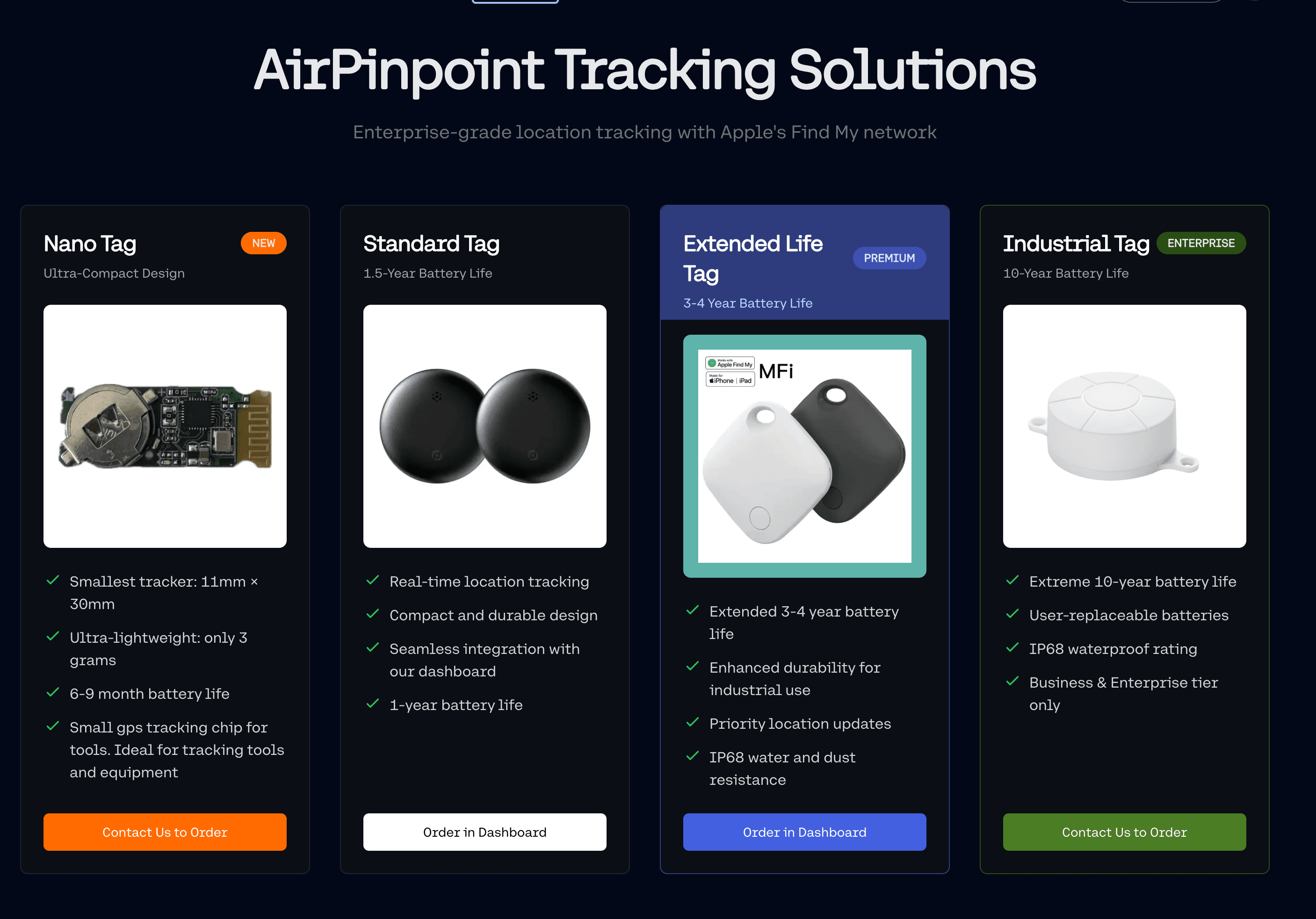
Airpinpoint works with standard Apple AirTags ($29 each) and the Find My network, which leverages over a billion Apple devices worldwide to relay tag locations. No cellular plans and no proprietary hardware. Just AirTags plus your Airpinpoint subscription ($11.99/device/month on Business).
For scaffolding companies already managing inventory in spreadsheets or paper systems, Airpinpoint provides the first real-time visibility into where your equipment actually is, not where someone logged it last.
 Our Solution