Chemical Inventory Tracking: Why Spreadsheets and Walkthroughs Aren't Cutting It
Chemical inventory management sits at the intersection of three pressures that don't forgive mistakes: regulatory compliance (OSHA, EPA, NFPA, state fire codes), shelf-life constraints (chemicals expire and become disposal liabilities), and storage compatibility rules (wrong combinations in the wrong cabinet can cause fires, toxic gas release, or explosions).
Most facilities manage this with some combination of spreadsheets, periodic walkthroughs, and an ERP system that reflects what should be on the shelves rather than what actually is. The gap between the system of record and physical reality grows wider every week. Containers get moved between buildings. Technicians grab a bottle from secondary storage and forget to log it. A drum of solvent sits in a corner past its expiration because nobody walks that aisle regularly.
The result: EH&S managers spend 8-15 hours per week on manual inventory reconciliation, facilities fail audits on chemicals they own but can't locate, and 10-15% of chemical stock expires before use because poor visibility prevents proper first-in-first-out rotation.
This page covers what chemical inventory tracking actually requires, where traditional systems fail, and how to deploy location-based tracking on the containers that carry the most regulatory and financial risk.
The Regulatory Landscape
Chemical inventory tracking isn't a nice-to-have efficiency tool. It's a legal requirement under multiple overlapping federal, state, and local regulations.
OSHA HazCom (29 CFR 1910.1200)
The Hazard Communication Standard requires every employer to maintain a list of all hazardous chemicals present in the workplace, with corresponding Safety Data Sheets accessible to employees. "Maintaining a list" sounds simple until you manage 200+ chemical SKUs across multiple buildings and the list hasn't matched physical reality since the last full audit.
OSHA citations for HazCom violations averaged $16,000 per violation in 2025. Willful violations run $161,000+. The most common citation: "failure to maintain an accurate chemical inventory." Not because facilities don't try. Because paper-based tracking can't keep up with how chemicals actually move through a facility.
EPA EPCRA Tier II Reporting (Section 312)
Facilities that store hazardous chemicals above EPA threshold planning quantities must file annual Tier II reports disclosing chemical identities, quantities, and storage locations to local emergency planning committees (LEPCs), state emergency response commissions (SERCs), and local fire departments.
The operative word is "locations." Tier II doesn't ask how much sulfuric acid you purchased this year. It asks how much is on-site right now, where it's stored, and what the maximum quantity at any point during the year was. Answering that accurately requires knowing where every container is, not where your purchase orders say it should be.
EPA penalties for Tier II reporting violations: up to $67,627 per day per violation as of 2025.
NFPA 30 and Local Fire Codes
NFPA 30 (Flammable and Combustible Liquids Code) limits quantities of flammable liquids outside approved storage rooms, dictates separation distances between incompatible chemicals, and requires specific cabinet types for different hazard classes. Local fire marshals enforce these limits during inspections.
A common violation scenario: a maintenance technician moves three 5-gallon containers of acetone from the flammable storage room to a work area for a project. The project takes two weeks. The containers sit in the work area, exceeding the NFPA 30 limit for flammable liquids outside approved storage. Nobody notices because the inventory system still shows them in the flammable storage room.
GHS Classification and SDS Management
The Globally Harmonized System of Classification and Labelling of Chemicals (GHS) standardizes hazard communication worldwide. Every container needs proper GHS labeling, and every chemical on-site needs a current Safety Data Sheet. SDS documents expire when manufacturers update them, and facilities are required to maintain the most recent version.
The tracking connection: you can't maintain accurate SDS coverage if you don't know what's actually on-site. A chemical that was delivered 18 months ago, used partially, and relocated to a different building may not appear in your SDS binder for that building. During an emergency or an OSHA audit, that gap becomes a citation.
Where Traditional Chemical Inventory Systems Fail
Spreadsheets and Manual Counts
The most common approach at facilities with fewer than 500 chemical containers. Someone walks the facility weekly or monthly with a clipboard or tablet, counts containers, and updates a spreadsheet. Problems:
- Accuracy degrades between counts. A weekly walkthrough means 5 days of untracked movement between each snapshot. Containers moved Monday through Thursday are invisible until Friday's count.
- Counts are labor-intensive. A facility with 400 containers across 3 buildings takes 6-10 hours to inventory thoroughly. At $40-$60/hour for an EH&S specialist, that's $240-$600 per count, or $12,000-$31,000 annually for weekly counts.
- Human error compounds. Miscounts, missed areas, transposed numbers. A 2% error rate per count means your inventory is effectively fiction within a few months.
Barcode and QR Code Systems
Better than spreadsheets because they reduce transcription errors. You scan a container's barcode, confirm the location, and the system updates. But barcodes share the fundamental weakness of manual counts: they only capture data when someone actively scans. Between scans, the system is blind.
Chemical-specific barcode systems (ChemInventory, Quartzy, Chemical Safety's EH&S platform) add SDS management, expiration tracking, and compatibility checking on top of the barcode scan. These features are genuinely useful. The gap is location: the system knows a container was scanned in Room 204 on March 3rd, but it doesn't know the container was moved to Room 112 on March 5th because nobody scanned it there.
RFID Systems
RFID (Radio-Frequency Identification) eliminates the "someone has to scan it" problem by using readers that detect tags automatically. Install RFID readers at doorways and the system logs every tagged container that passes through.
For chemical tracking specifically, RFID has three drawbacks:
Infrastructure cost. RFID readers at every doorway, storage area entrance, and loading dock run $5,000-$15,000 per reader. A multi-building campus needs 20-50 readers, plus integration software. Total deployment: $150,000-$500,000.
Metal and liquid interference. Many chemical containers are metal (drums, gas cylinders, solvent cans). Liquids absorb RF energy. Both degrade RFID read rates. Specialty RFID tags rated for metal and liquid environments cost $10-$50 each instead of $0.50-$2 for standard tags.
Gate-only visibility. RFID tells you a container passed through a doorway. It doesn't tell you where in the building the container is now. If someone carries a container of hydrochloric acid past the reader at the east entrance and sets it down in the maintenance shop at the far end of the building, the system logs "entered east entrance" but can't tell you it's in the maintenance shop.
How Location-Based Tracking Changes Chemical Inventory Management
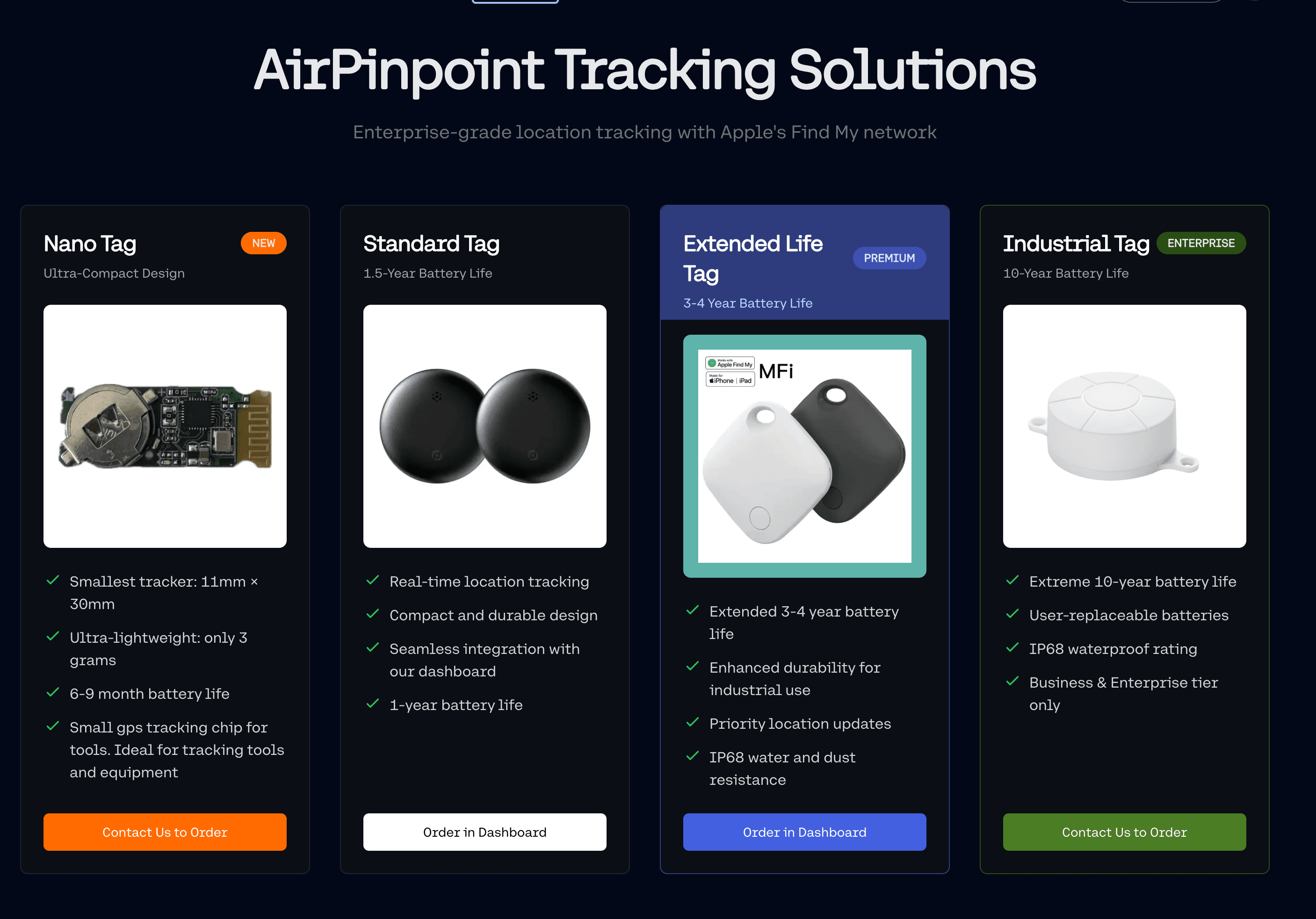
Airpinpoint uses Apple's Find My network, over a billion Apple devices worldwide, to provide continuous location data on tagged chemical containers. Every iPhone, iPad, and Mac that comes within Bluetooth range of an AirTag anonymously relays its position. This works inside your facilities (where employees carry phones), outside in yard storage, on delivery trucks, and at any location where Apple devices exist.
Compliance Zone Enforcement
The highest-value application for chemical tracking isn't knowing where every container is. It's knowing when a container is in the wrong place.
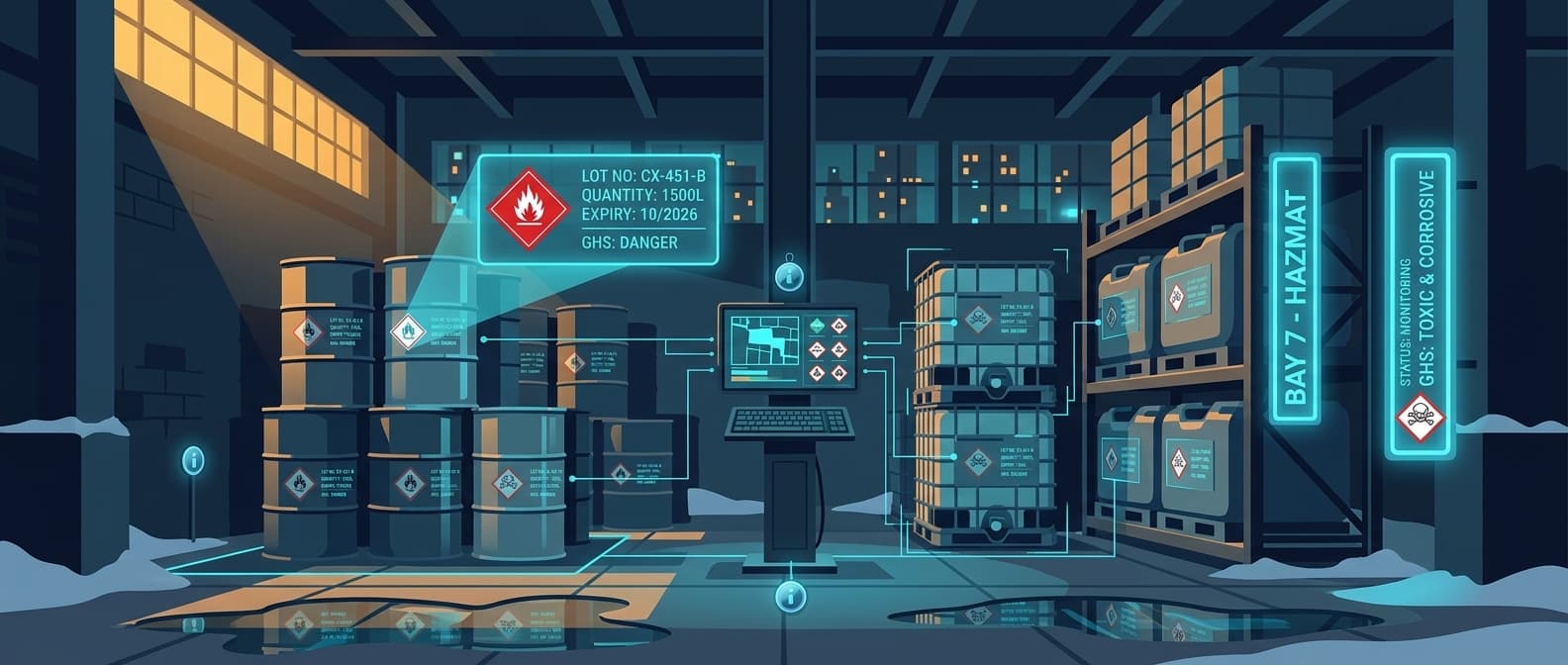
Set up geofences that map to your storage compatibility zones:
- Flammable storage room (NFPA Class I solvents: acetone, toluene, MEK, ethanol)
- Acid storage cabinet (mineral acids: HCl, H2SO4, HNO3)
- Oxidizer storage (hydrogen peroxide, sodium hypochlorite, permanganates)
- General chemical storage (non-reactive materials)
When a tagged container crosses from its approved zone into an incompatible zone, Airpinpoint fires a geofence alert. Your EH&S manager gets a notification before the chemicals sit together long enough to become a hazard.
This catches the scenario that causes the most chemical incidents in industrial and lab settings: temporary relocations that become permanent. Someone moves a container "just for today" and it stays in the wrong place for weeks.
Expiration and FIFO Enforcement
Chemicals have shelf lives. Reagent-grade solvents: 3-5 years. Many lab reagents: 12-24 months. Certain reactive chemicals: 6-12 months. Peroxide-forming compounds (diethyl ether, THF, isopropyl ether): 3-12 months, and become explosive shock-sensitive when expired.
The financial cost of expired chemicals is double: you lose the purchase value and you pay for hazmat disposal. A 55-gallon drum of expired solvent costs $100-$500 to dispose of through a licensed hazmat waste hauler. Multiply that by 10-15% of your inventory expiring annually and you're looking at $5,000-$50,000 per year in avoidable waste.
Airpinpoint's dwell-time tracking surfaces containers that haven't moved in abnormally long periods. A drum of MEK that's been sitting in Building C for 9 months when it has a 12-month shelf life shows up as a flag. You move it to the front of the rotation or use it before it becomes waste.
This isn't a feature that chemical-specific software can't offer in theory. The difference is that barcode and QR systems only know a container's dwell time since its last scan. Airpinpoint knows it continuously, without anyone scanning anything.
Multi-Site Inventory Visibility
Facilities with multiple buildings, campuses, or sites face the chemical inventory version of the inventory across sites problem: each site maintains its own count, but chemicals flow between sites through informal channels that bypass the tracking system.
Site A's lab manager walks to Site B and grabs a bottle of methanol because it's faster than requisitioning. Site B's count drops, but nobody updates Site A's system. When the Tier II report is due, neither site's numbers match reality, and the total on-site quantity may exceed reporting thresholds that neither site thought they'd hit individually.
Geofenced sites with automatic transfer logging eliminate this. When a tagged container leaves Site B's geofence and enters Site A's, the movement is recorded. No manual entry required.
Chain of Custody
For controlled or restricted chemicals (DEA-regulated substances, dual-use chemicals subject to export controls, chemicals with known diversion risks), chain of custody documentation is a legal requirement, not just good practice.
Location tracking creates an automatic custody record: the container was in the locked storage room from January 1 through February 15, then moved to Lab 204 on February 15 at 2:30 PM, where it remained until returned to storage on February 16 at 5:15 PM. This audit trail is generated passively. No sign-in sheets, no manual logging, no reliance on people remembering to document every access.
What Chemical Inventory Tracking Costs Without Location Data
Before sizing a tracking deployment, quantify what poor chemical inventory visibility already costs you.
Direct Costs
| Cost Category | Typical Annual Cost (200+ SKU Facility) |
|---|---|
| Expired chemical disposal | $5,000-$50,000 |
| Compliance fines (OSHA/EPA/fire marshal) | $0-$160,000+ per incident |
| Manual inventory labor (EH&S specialist) | $12,000-$31,000 |
| Emergency reorders (can't find existing stock) | $3,000-$15,000 |
| Audit preparation overtime | $2,000-$8,000 |
| Over-purchasing (safety stock for "missing" inventory) | $5,000-$25,000 |
Indirect Costs
Production downtime. When a technician can't find the chemical they need and it's somewhere on-site but nobody knows where, the job stops until someone walks the facility looking for it. At manufacturing rates, 30 minutes of downtime costs $500-$5,000.
Audit failures. A failed audit doesn't always result in fines, but it always results in corrective action plans, follow-up inspections, and management attention that pulls resources from productive work.
Insurance premiums. Insurers ask about chemical inventory management practices. "Spreadsheets and monthly walkthroughs" gets a different rate than "continuous location tracking with geofenced compliance zones."
Deploying Chemical Inventory Tracking with Airpinpoint
Step 1: Classify Your Chemical Inventory by Risk (Week 1)
Not every container justifies a $29 tag and $11.99/month subscription. Prioritize:
Tier 1: Tag immediately. Flammable solvents in quantities near NFPA storage limits. EPA-reportable substances near Tier II thresholds. Any chemical with a shelf life under 12 months. High-value reagents ($200+ per container). DEA-controlled or export-controlled substances.
Tier 2: Tag when budget allows. Corrosives stored in compatibility-sensitive zones. Moderate-value chemicals ($50-$200) with historically poor rotation. Compressed gas cylinders (see gas cylinder tracking).
Tier 3: Don't tag. Low-cost consumables (isopropanol wash bottles, common lab-grade solvents under $20). High-turnover stock that cycles through in days, not months.
Step 2: Map Your Compliance Zones as Geofences (Week 1)
Walk your facility with the Airpinpoint app and create geofences for:
- Each flammable storage room/cabinet
- Acid storage areas
- Oxidizer storage areas
- Outdoor secondary containment areas
- Receiving docks (to log arrivals)
- Waste staging areas (to catch containers heading for disposal)
These geofences become your automated compliance monitors. Any container that crosses into the wrong zone triggers an alert.
Step 3: Tag During Routine Inventory (Weeks 2-4)
Attach AirTags to containers during your next scheduled inventory audit. This avoids adding a separate deployment step. As each container is counted and verified, attach the tag:
- Drums (55-gallon, 30-gallon): AirTag in a ruggedized holder, secured to the drum rim with a band clamp or industrial adhesive mount.
- Carboys and large bottles: AirTag holder attached to the carrying handle or neck.
- Smaller containers (1-4L): Tag the secondary containment tray or the shelf position rather than individual bottles if per-container tagging is too granular.
- Gas cylinders: Valve cap or collar mount (see gas cylinder tracking for specifics).
A technician can tag 30-50 containers per hour while performing a standard inventory count.
Step 4: Set Alerts and Integrate (Week 3)
Configure alerts for:
- Zone violations: Container leaves its approved storage zone.
- Dwell time thresholds: Container hasn't moved in X days (set based on shelf life: 60 days for 6-month chemicals, 120 days for 12-month chemicals, etc.).
- Departure from facility: Container leaves the campus geofence (possible theft, unauthorized transfer, or disposal without documentation).
If you run a chemical inventory system (ChemInventory, Quartzy, Chemical Safety, or a custom ERP), Airpinpoint's webhook API can feed location events into your existing system. The chemical software handles SDS management, expiration dates, and regulatory reporting. Airpinpoint provides the location layer those systems lack.
Step 5: Use Data to Fix Systemic Problems (Ongoing)
After 60 days of tracking data, patterns emerge:
- Which departments move chemicals without logging it. These are your process gaps, not bad actors. Fix the process (make logging easier) instead of scolding the behavior.
- Which containers sit unused the longest. These are your expiration and over-purchasing risks. Reduce order quantities or improve rotation.
- Which storage zones are over capacity. If your flammable storage room regularly exceeds NFPA limits based on what's actually in there (not what the spreadsheet says), you need more storage capacity or better distribution across zones.
Industry-Specific Applications
Manufacturing and Chemical Processing
Manufacturing floors consume bulk chemicals: solvents for cleaning, acids for etching, adhesives, coatings, and lubricants. The tracking challenge is volume: 100-500 drums across a facility, with containers staged at workstations throughout the floor.
Tag drums at receiving. Set geofences for each work area with quantity limits matching your OSHA and NFPA allowances. When the 4th drum of toluene enters a workstation zone that's rated for 3, the alert catches a violation before the fire marshal does.
Research Laboratories
Labs manage the widest variety of chemicals in the smallest spaces: hundreds of SKUs in a single room, from common solvents to milligram quantities of exotic reagents costing thousands of dollars. Per-container tagging makes sense for high-value reagents and controlled substances. For common chemicals, tag shelf positions and use the Airpinpoint dashboard as a zone-level inventory map.
Peroxide-forming compounds deserve special attention. Diethyl ether, THF, and similar solvents form explosive peroxides over time. A bottle that's been sitting undisturbed for 12+ months is a potential detonation risk. Dwell-time alerts on tagged containers of peroxide-formers are a safety control, not just an inventory tool.
Pharmaceutical and Biotech
GMP (Good Manufacturing Practice) environments require full chain of custody documentation for raw materials. Every gram of API (Active Pharmaceutical Ingredient) must be accounted for from receipt to use or disposal. Location tracking adds a spatial dimension to existing lot-tracking systems: not just which lot was used when, but physical confirmation that the material was in the correct storage conditions (temperature-controlled area, segregated from incompatible materials) for its entire residence time.
Water Treatment and Utilities
Water treatment plants store large quantities of chlorine, fluoride compounds, caustic soda, and coagulants. These chemicals are EPA-reportable, and many (particularly chlorine gas) are DHS Chemical Facility Anti-Terrorism Standards (CFATS) regulated. Tracking provides both the inventory visibility for compliance and the security monitoring (geofence alerts on after-hours movement) that CFATS requires.
Cost Analysis: A 400-Container Deployment
Scenario: Manufacturing Facility, Tag 400 High-Priority Containers
| Cost Category | Without Tracking | With Airpinpoint (400 containers) |
|---|---|---|
| AirTags (one-time) | $0 | $11,600 |
| Airpinpoint subscription (annual) | $0 | $57,552 |
| CR2032 batteries (annual) | $0 | $400 |
| Expired chemical disposal (annual) | $15,000-$50,000 | $3,000-$10,000 (80% reduction) |
| Manual inventory labor (annual) | $15,000-$31,000 | $4,500-$9,300 (70% reduction) |
| Emergency reorders (annual) | $5,000-$15,000 | $1,000-$3,000 |
| Compliance fines (expected value, annual) | $5,000-$30,000 | $0-$5,000 |
| Total Year 1 Cost | $40,000-$126,000 | $78,052-$96,852 |
| Total Year 2+ Cost | $40,000-$126,000 | $66,452-$85,252 |
For facilities at the higher end of the cost spectrum (many SKUs, multi-building campuses, history of compliance issues), the deployment pays for itself in year one. For smaller operations, the payback is in year two. The compliance risk mitigation alone, avoiding a single $50,000+ EPA fine, can justify the entire deployment.
Enterprise pricing note: Airpinpoint offers custom pricing for 200+ devices. Contact sales for volume rates.
Getting Started
-
Audit your current state. Count your chemical SKUs. Identify which are EPA-reportable, which have shelf-life constraints under 12 months, and which have the worst "can't find it" frequency. This gives you your tagging priority list.
-
Map your compliance zones. Walk your facility and document each storage area, its approved chemical classes, and its capacity limits per NFPA and local fire code.
-
Contact Airpinpoint for volume pricing. Standard: $29/tag (one-time) + $11.99/device/month. Enterprise rates for 200+ containers bring per-device costs down. Request a quote.
-
Tag during your next scheduled inventory audit. No infrastructure to install, no IT integration required for basic deployment. Tags go on containers in minutes.
-
Set geofences and start catching violations. Most facilities discover containers in wrong zones within the first week of deployment. That's not a failure of your team. It's the system finally showing you what was always happening.
 Our Solution