
Updated
Boat GPS Tracker: How to Track a Boat on the Water, on the Trailer and in Storage
A boat GPS tracker reports your boat's location to your phone so you can find it after a theft, confirm it is still at the slip, or follow it on the water. There are three kinds, and each fails in a different place. Cellular trackers need a cell signal and a powered battery. Satellite trackers work offshore but cost the most to run. Find My tags such as the AirTag run on a coin cell for about a year and keep reporting in storage, but they depend on iPhones passing nearby.
The right pick depends on where your boat is when it is most at risk. For most owners that is on a trailer in a driveway, in a storage yard over the winter, or tied up at a slip overnight, so this guide covers storage and marina tracking first and offshore tracking after.
Where Boats Actually Get Stolen
A boat is rarely taken while someone is aboard. The common pattern is a trailered boat hitched and towed away from a driveway, a boat ramp lot or an unattended storage yard, or an outboard and electronics stripped at the slip. The National Insurance Crime Bureau publishes annual watercraft theft reports, and Florida consistently leads the country, which tracks where boats are densest.
That pattern matters for tracker choice. A tracker that works only while the engine battery is on, or only when a cell tower is in range of the boat's hull, can be offline during the exact window a thief uses. The first question to ask of any boat tracker is what it does when the boat has been sitting untouched for three months.
How Boat Tracking Works: Cellular vs Satellite vs Find My
| Cellular GPS tracker | Satellite tracker | Find My tag (AirTag) | |
|---|---|---|---|
| How it reports | GPS fix sent over a cellular data network | GPS fix sent over a satellite network | Nearby Apple devices hear its Bluetooth signal and report their own location |
| Offshore coverage | Fades a few miles from shore | Works on open water | Only when Apple devices are close by |
| Marina and storage coverage | Good where there is cell signal | Good with a clear view of the sky | Good where people with iPhones pass |
| Power | Boat battery (hardwired) or rechargeable | Rechargeable or boat battery | CR2032 coin cell, about a year |
| Keeps reporting with battery switch off | No, unless it has a backup battery | Only on its internal battery | Yes |
| Recurring cost | Monthly data plan | Monthly or annual airtime plan | None in Find My; $11.99/mo with Airpinpoint |
| Live track while underway | Yes | Yes, at the plan's interval | No |
| Easy for a thief to find | Often, if wired to the helm | Often, needs sky view | Hard, fits in a small compartment |
Use a hardwired cellular unit to watch a boat move in real time near the coast, and a satellite unit if the boat goes far offshore. For the long stretches when the boat is parked, a Find My tag wins because nothing about it depends on the boat's electrical system.
The No-Subscription Option for Docked and Stored Boats
Every cellular and satellite tracker has a plan attached, because someone pays for the SIM or the satellite airtime. A Find My tag does not. The tag broadcasts a Bluetooth signal, and any iPhone, iPad or Mac that hears it reports the location through Apple's network at no cost to you or to the passerby.
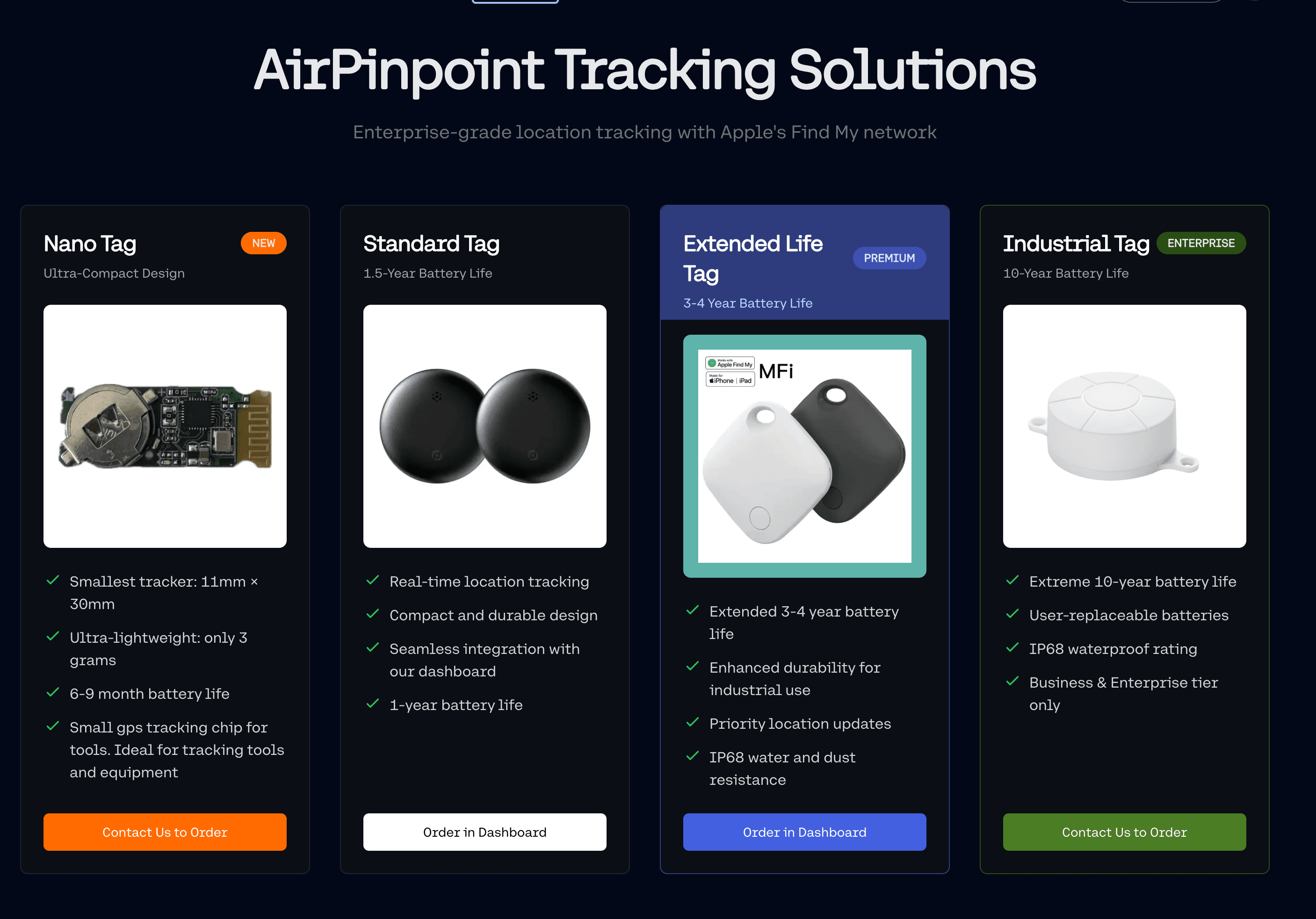
On its own in the Find My app, an AirTag shows its last reported location and can notify you when it is found. What Find My does not do is alert you when the boat leaves a place, keep a searchable location history, or hold more than 32 items on one Apple Account. Airpinpoint adds those on top of the same tag for $11.99 per device per month. That is still a subscription, but the tag itself needs neither a SIM nor any wiring, and it runs independently of the boat's battery.
3-Year Cost for One Boat
The table below uses Airpinpoint's published prices and a cellular plan cost you plug in. Plan prices vary by vendor and billing term, so replace the example figure with the quote you actually get.
| Setup | Hardware | Monthly | 3-year total |
|---|---|---|---|
| AirTag in Find My only | $29 | $0 | $29 plus about 3 coin cells |
| AirTag with Airpinpoint | $29 | $11.99 | $29 + (36 x $11.99) = $460.64 |
| Cellular tracker, example $20/mo plan | Vendor price | $20 | Hardware + $720 |
| Satellite tracker | Vendor price | Plan price | Hardware + (36 x plan) |
For a marina or rental operator with ten boats, the Airpinpoint line scales linearly: ten tags are $290 in hardware and $119.90 per month.
Waterproofing and Saltwater
Apple rates the AirTag IP67, tested as submersion in 1 meter of water for up to 30 minutes. That covers spray, rain and a dunk, not months sitting in bilge water. Salt residue also works its way into battery covers over time. Two habits keep a tag working on a boat:
- Mount it in an enclosed dry compartment, and use a sealed case or a zip bag if the compartment takes spray.
- Rinse and dry the tag when you change the battery, and check that the battery contacts are clean.
Cellular and satellite trackers carry their own ratings, commonly IP66 or IP67 for marine models. Check the rating of the exact unit, and check whether the rating still holds after you open it to charge it.
Our AirTag waterproof guide covers the IP67 test in more detail.
Where to Put a GPS Tracker on a Boat
| Spot | Signal | Hidden from a thief | Notes |
|---|---|---|---|
| Inside the console behind a panel | Good | Very good | Best all-round spot on center consoles |
| Under-seat storage or seat base | Good | Good | Keep it off the hull skin |
| Bow or stern storage locker | Good | Good | Use a sealed bag if the locker takes spray |
| Under a hatch lid, taped in a bag | Good | Very good | Easy to reach for battery changes |
| Inside a sealed metal box | Poor | Very good | Metal blocks Bluetooth and cellular |
| Bilge | Poor | Good | Water and fuel vapor exposure |
On an aluminum hull, mount the tag high in the boat and away from large metal surfaces. On a fiberglass boat, most interior compartments pass Bluetooth well. If the boat lives on a trailer, put a second tag in the trailer frame, because a thief may separate the two.
Geofencing Your Slip, Mooring and Storage Yard
A geofence turns a tracker from something you check into something that tells you. You draw a boundary around the slip, the mooring field or the storage lot, and the platform alerts you when the boat's reported position leaves it.
Set the fence to at least 100 meters. Every location source drifts, and a tight fence around a single slip will fire when the boat has not moved. With a Find My tag, Airpinpoint waits for consecutive reports to agree before it alerts, which at a busy marina typically lands 15 to 40 minutes after the boat leaves. A hardwired cellular unit can alert faster while it has power and signal.
Two fences cover most owners: one around the slip or storage lot for theft, and one larger fence around the home cruising area for a boat you lend out or rent. Our geofence alerts guide walks through the setup.
Boat Trailer Tracking on the Road
A trailered boat is most exposed in a driveway or a ramp parking lot, and a thief who takes the rig can move it hundreds of miles before you notice. A tag on the trailer frame covers the tow, since trucks on highways and at fuel stops pass plenty of iPhones. A tag on the boat covers the case where the boat is moved to a different trailer.
The trailer GPS tracker guide covers trailer mounting spots and hitch-lock pairing in detail.
What a Boat Tracker Cannot Do
- A Find My tag cannot give you a live track while you are underway offshore. If you need to follow a boat on open water, use a satellite tracker.
- A cellular tracker cannot report from beyond cell coverage, and a hardwired one cannot report once the battery switch is off unless it has a backup battery.
- No tracker recovers a boat by itself. Share the location with police rather than going to the boat yourself.
- Apple's anti-stalking alerts can notify a thief's iPhone that an unknown AirTag is traveling with them. That can take time to trigger, and a hidden tag often reports the location before it is found.
Tracking a Fleet of Boats
Rental operators, marinas, clubs and dealers run into the limits of consumer apps quickly. Find My caps each Apple Account at 32 items and has no shared dashboard. Airpinpoint puts every tag on one map, keeps location history per boat, sends geofence alerts by email or webhook, and exposes the data through an API. The jet ski GPS tracker guide covers rental-zone geofencing and seasonal storage for PWC fleets, and the same setup applies to pontoon, kayak and paddleboard rentals.
Getting Started
- Decide where your boat is most at risk: storage, slip, trailer or offshore.
- For storage, slip and trailer coverage, hide a Find My tag in a dry compartment and a second one in the trailer frame.
- For offshore tracking, add a satellite unit.
- Draw a geofence of at least 100 meters around the slip or storage lot and turn on alerts.
- Set a reminder to check the coin cell each spring before launch.


 Our Solution