AirTags vs Invoxia: What "No Monthly Fees" Actually Costs
The Core Problem with Invoxia
Invoxia built its reputation on "no monthly fees." The fine print in 2026: the $129 GPS Tracker Pro now includes 1 year of service (earlier bundles included 2), and after that year, Invoxia's own US store lists renewal at $59.85/year, or $7.95/month. The Amazon listing still advertises renewal "from $3.33/month," a number 50% below what the official store charges new renewals. Buyers find out which price applies when the included year runs out.
The second surprise is the battery. The listing claims up to 3 months. A verified Amazon owner in May 2026 measured "barely up to 2 weeks" from a full charge on a parked car. Independent testing puts daily-driver battery life at about 3 weeks. For one device, that is an annoyance. For a fleet, it is a standing charging rotation.
Neither issue makes Invoxia a bad personal tracker. Both make it the wrong tool for business asset tracking, which is what this page is about.
Invoxia in 2026: Product Line and Company Status
Invoxia is a French hardware company based in Paris. Its US lineup centers on the GPS Tracker Pro (LTE-M cellular plus GPS, Wi-Fi, and Bluetooth positioning). The GPS Tracker Classic, which runs on LoRa and Sigfox low-power networks, is sold in Europe only.
The company's recent direction is pets, not fleets. Invoxia launched the Minitailz pet health tracker at CES 2024 and acquired pet-care company Caremitou in March 2025. There is no business dashboard, API, or fleet product on its roadmap. If you are buying tracking infrastructure for a company, the vendor's attention is somewhere else.
Invoxia Actual Pricing: What Buyers Pay in 2026
Invoxia's headline price is honest. The recurring cost after year one is where buyers get surprised. Every row below is sourced.
| Item | Price | Source |
|---|---|---|
| GPS Tracker Pro, 1-year subscription included | $129 | Amazon listing |
| GPS Tracker Pro, no subscription | $99 | Amazon listing |
| Subscription, no-bundle model | $8.95/month | Amazon listing |
| Annual renewal, official US store | $59.85/year | invoxia.com product page |
| Monthly plan, official US store | $7.95/month (or $19.95 per 3 months) | invoxia.com product page |
| Renewal advertised on Amazon | "from $3.33/month" ($39.90/year) | Amazon listing |
| 3-year cost, one tracker | ~$249 ($129 + 2 x $59.85) | calculated from above |
Two things to note. First, the $39.90/year figure on Amazon is a "from" price tied to grandfathered loyalty discounts for older bundle buyers; the standard renewal on the official store is $59.85/year. Second, subscriptions auto-renew by default, and reviewers report that when a device dies mid-subscription, the remaining months are not refundable.
If service lapses, the tracker stops reporting over cellular and GPS entirely. You are left with short-range Bluetooth, which defeats the point of a GPS tracker.
Real Battery Life vs the Claim
Invoxia advertises up to 3 months per charge. Actual battery life depends almost entirely on how much the asset moves and which of the three modes (Eco, Standard, Intensive) you run.
| Usage pattern | Reported battery life | Source |
|---|---|---|
| Claimed (listing) | Up to 3 months | Amazon listing |
| Parked car, full charge | "Barely up to 2 weeks" | Amazon verified review, May 2026 |
| Bicycle, lowest frequency (30-min updates) | 2-3 weeks | Amazon verified review |
| Daily 2-hour commute, standard mode | ~3 weeks | independent test |
| Daily motion alerts | ~6 weeks | independent test |
| Mostly stationary, low frequency | Up to 4 months | independent test |
The pattern: assets that move get 2-6 weeks. Business assets move. So a 20-tracker Invoxia fleet means a charge cycle roughly every 3 weeks per device, and during the 90-minute USB charge the asset is dark.
An AirTag runs about 12 months on a $3 CR2032 coin cell. The swap takes 30 seconds and the tag never goes offline.
Full Feature Comparison
| Feature | Invoxia GPS Tracker Pro | AirTag + Airpinpoint |
|---|---|---|
| Hardware cost | $129 (1-yr service incl.) or $99 (none) | $29 ($24.75 each in 4-packs) |
| Recurring cost, year 1 | $0 (bundle) or $8.95/mo | $11.99/device/mo |
| Recurring cost, year 2+ | $59.85/yr official, $7.95/mo monthly | $11.99/device/mo |
| Contract | Auto-renewing subscription | None, cancel anytime |
| Location method | GPS + LTE-M + Wi-Fi + Bluetooth | Apple Find My network (1B+ devices) |
| Update frequency | 30 sec to 30 min by mode; 5-15 min typical reported | When Apple devices pass nearby |
| Battery | Rechargeable USB, 2-6 weeks real-world in motion | CR2032, ~12 months, swappable |
| Water resistance | IP33 (splash only; waterproof pouch sold separately) | IP67 |
| Size / weight | 105 x 27 x 9.5 mm, 27 g | 32 x 32 x 8 mm, 11 g |
| Coverage | 40+ countries on LTE-M | Worldwide wherever Apple devices exist |
| Amazon rating | 3.7/5 (757 ratings) | 4.6/5 (AirTag) |
| App rating | 3.2/5 Google Play, 3.5/5 App Store | Native Find My + Airpinpoint web dashboard |
| Fleet dashboard | No | Yes, all assets on one map |
| Team access / roles | No, single account | Yes |
| Geofencing | Zones in consumer app | Polygon geofences with alerts |
| API / webhooks | No | REST API + webhooks |
| Location history export | Limited, clears views daily | Yes (dashboard, CSV, API) |
| Anti-theft alerts | Motion, tilt, tow detection | Geofence exit alerts |
| Works indoors / garages | Falls back to approximate Wi-Fi | Yes, via nearby Apple devices |
Sources: Invoxia product page, Amazon listing, Google Play, Apple App Store.
What Owners and Reviewers Say
Invoxia holds a respectable 4/5 on Trustpilot across 961 reviews, and many single-vehicle owners are satisfied. The complaints that repeat across platforms from 2023 through 2026 cluster into four patterns:
1. App instability. Crash reports appear across Trustpilot, the App Store, and Google Play, where the app sits at 3.2/5 over roughly 1,240 reviews. Specific reports: the app crashing when changing notification settings, trackers randomly disappearing after being added, and updates after which the app shows only home zones instead of tracker locations.
2. Battery shortfall. The most-repeated hardware complaint. "The battery does not last up to 3 months. Barely up to 2 weeks" (Amazon, May 2026). Another owner on the lowest update frequency got 2-3 weeks per charge and found the device stopped tracking while the app still showed 60% charge.
3. Inconsistent update intervals. Owners on motorcycle forums report the high-sensitivity setting updating at 5 minutes sometimes, 15-20 minutes other times, and occasionally 45 minutes. One widely-read theft account on the Amazon listing describes a stolen motorcycle reporting every 4-plus minutes with missed movement alerts; thieves found and ditched the tracker before police could intercept.
4. Slow, email-only support. Support runs from Paris with no phone line. Reviewers report multi-day response gaps and, in one case, four months to resolution. Another owner whose battery died was told the remaining six months of subscription could not be cancelled or refunded.
Where Invoxia Genuinely Wins
An honest comparison requires the cases where Invoxia is the better product.
Live GPS pursuit. Invoxia reports actual GPS coordinates over LTE-M on a schedule you control, including a 30-second Real Time Boost mode. AirTags update when Apple devices pass nearby, which is frequent in populated areas but never guaranteed on a fixed interval. If you need to watch one vehicle move across a map in near-real time, Invoxia does that and AirTags do not.
Motion and tilt alerts. Tow-away detection and tilt alerts fire within about 90 seconds in independent testing. Useful for a motorcycle or scooter parked on the street. Airpinpoint covers theft scenarios with geofence exit alerts instead, which work at fleet scale but are not motion-triggered.
Areas with no Apple device traffic. Deep rural land, wilderness, long-haul routes through empty country: anywhere people rarely walk past, an AirTag has nothing to report through. Invoxia works wherever LTE-M coverage exists (40+ countries).
Three-year cost for a single asset. One Invoxia tracker costs about $249 over 3 years. One AirTag plus Airpinpoint costs about $461 ($29 hardware + 36 months at $11.99). If you are tracking exactly one thing and need none of the fleet features, Invoxia is cheaper.
Where AirTags + Airpinpoint Win for Business
Fleet visibility. Invoxia's app is a consumer app under one login. Airpinpoint puts every asset on one web dashboard with search, filters, team roles, and per-group visibility. This is the baseline requirement for business tracking, and Invoxia simply does not have it.
Zero charging logistics. A 20-asset Invoxia fleet at real-world 3-week battery life means roughly 340 charge cycles per year, each one requiring someone to retrieve the device, charge it for 90 minutes, and reinstall it while the asset goes untracked. Twenty AirTags need 20 battery swaps per year, about one hour of work total.
Integrations. Airpinpoint exposes a REST API and webhooks for geofence events and location data. Invoxia has no public API; its data stays in its app.
Hardware cost at scale. 50 AirTags cost $1,238 in 4-packs. 50 Invoxia Pros cost $6,450, and each one still needs a subscription after year one.
Indoor tracking. AirTags report from parking garages, warehouses, and basements via nearby Apple devices. Invoxia loses GPS indoors and falls back to approximate Wi-Fi positioning.
No contract. Airpinpoint is month-to-month at $11.99/device ($14.99 Enterprise). Invoxia's plans auto-renew, and unused months are not refunded if hardware fails.
Use-Case Breakdown
One personal car or motorcycle: Invoxia. Real-time GPS, tow alerts, and a lower 3-year cost. Accept the charging routine and the app's rough edges.
Job site tools and equipment: AirTags + Airpinpoint. Generators, toolboxes, scaffolding, and trailers have no power source and no slack for a 3-week charging rotation. AirTags mount anywhere and report for a year untouched, and IP67 beats IP33 outdoors.
Business fleet (3+ vehicles or mixed assets): AirTags + Airpinpoint. The dashboard, team access, geofencing, exports, and API are the product. Invoxia has none of them at any price.
Active theft recovery: Split decision. Invoxia's live GPS is the right shape for following a stolen vehicle, but the documented motorcycle theft on its own Amazon listing shows 4-minute update gaps and missed alerts losing the chase. AirTags excel at recovering equipment that ends up parked somewhere (a garage, a yard, a storage unit) because any passing iPhone reports it.
Remote, low-traffic areas: Invoxia, if LTE-M coverage exists there. AirTags need humans with Apple devices to pass by.
Our Recommendation
Buying for yourself, tracking one vehicle: Invoxia is a legitimate option. Budget $129 up front and $59.85/year from year two, plan to charge it every 2-6 weeks, and keep it out of heavy rain or buy the pouch.
Buying for a business: Airpinpoint with AirTags. The decision is less about the per-device math and more about what Invoxia is missing: no fleet dashboard, no team roles, no API, no webhooks, no usable history export, and a charging cycle that scales linearly with every asset you add. Invoxia's own trajectory (the Caremitou acquisition and the Minitailz pet line) points at consumer pet health, not business tooling.
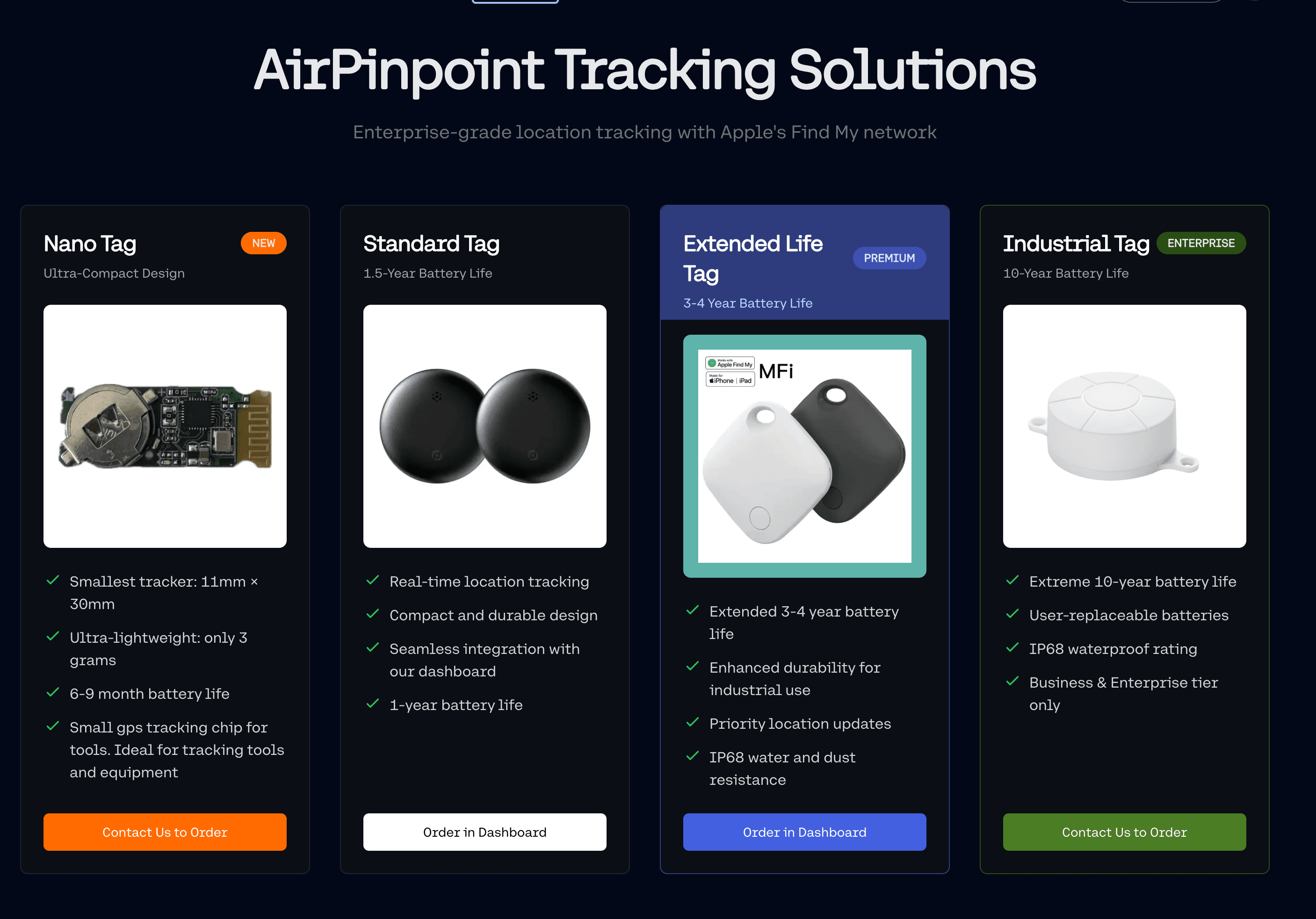
The hybrid setup works too. Put an Invoxia Pro on one or two high-theft-risk vehicles where live GPS earns its charging routine. Put $29 AirTags on everything else and manage them all in Airpinpoint: one dashboard, polygon geofences, webhooks into your existing systems, and one battery swap per asset per year.
 Our Solution