AirTags vs BrickHouse Security: The $9.95 Tracker That Costs $360 a Year
The Core Problem with BrickHouse
The Spark Nano 7 costs $9.95. The service to make it do anything costs $29.99 per month per device, or $17.99 per month if you prepay the year ($215.88). Over three years, that $9.95 tracker costs $658 to $1,090 per device. The device is the loss leader; the subscription is the product.
The numbers come from BrickHouse's own product page, which also lists the battery spec most buyers miss: 14 hours of constant tracking. The "7 days" figure is for average use, and 14 days is standby. The 140-day extended battery is a separate purchase.
For surveillance work, that trade can be worth it. For business asset tracking across 5, 10, or 50 devices, it usually is not. This page lays out the verified 2026 numbers so you can decide.
BrickHouse Actual Pricing: What Customers Report Paying
BrickHouse publishes Spark Nano 7 pricing, but its dedicated fleet line (TrackPort, EON Odyssey, LiveWire Volt) is quote-only: the GPS trackers category page shows "Call for Pricing" and a consultation form instead of numbers. TechRadar's review flagged the same issue: BrickHouse "does not list specific monthly pricing tiers on its website" for much of its lineup. Here is everything we could verify:
| Item | Price | Source |
|---|---|---|
| Spark Nano 7 device | $9.95 | BrickHouse product page |
| Basic plan | $29.99/mo monthly, $17.99/mo billed annually ($215.88/yr) | BrickHouse product page |
| Plus plan | $39.99/mo monthly, $27.99/mo billed annually ($335.88/yr) | BrickHouse product page |
| Premium plan | $49.99/mo monthly, $34.99/mo billed annually ($419.88/yr) | BrickHouse product page |
| 140-day extended battery + waterproof magnetic case | Sold separately (17,800 mAh kit) | Amazon listing |
| Fleet trackers (TrackPort, EON Odyssey, LiveWire Volt) | "Call for Pricing" (quote only) | BrickHouse GPS trackers page |
| Activation fee | None | BrickHouse product page |
| Contract | None, cancel anytime | BrickHouse product page |
What customers report when billing goes wrong, from ComplaintsBoard's BrickHouse record (3.4/5, 6 of 15 complaints unresolved):
| Report | Date | Status |
|---|---|---|
| Charged $30/month while unable to access the account (app security certificate error, support unresponsive) | July 2024 | Unresolved |
| Billed for several months after cancelling trackers, refund refused | August 2019 | Documented complaint |
| $600+ in cumulative charges on a GPS device the customer says never worked | 2017 | Unresolved |
BrickHouse's response on review platforms is that service plan requirements are disclosed on the product page, in the cart, and at checkout, and the company has said it is working to make plans more transparent. The pattern in the complaints is not hidden fees; it is buyers who did not register the recurring cost until it hit their card, and friction when they tried to stop it.
Airpinpoint pricing, for contrast
| Item | Price |
|---|---|
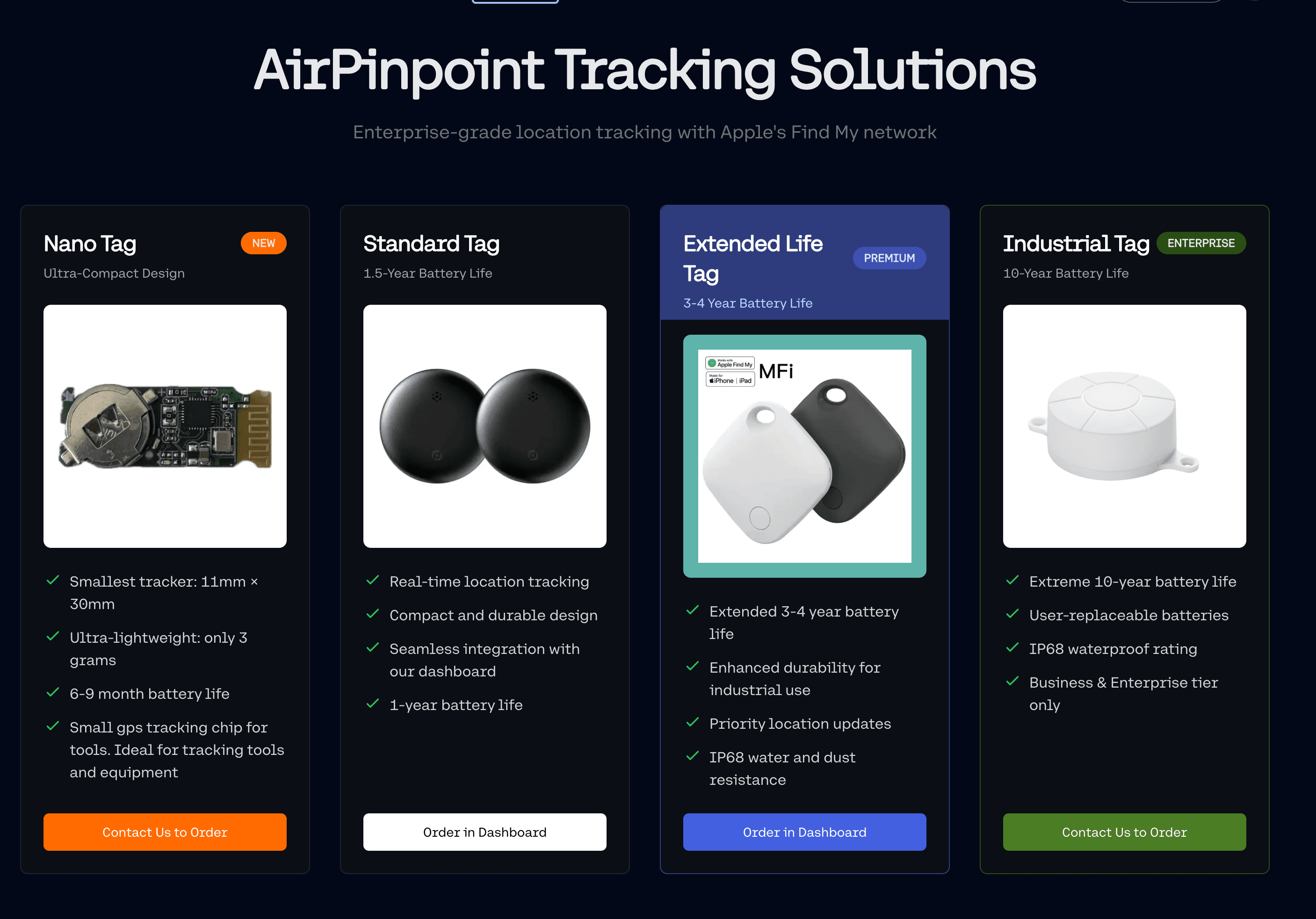
| AirTag hardware | $29 one-time ($24.75 each in 4-packs) |
| Business plan | $11.99/device/month |
| Enterprise plan | $14.99/device/month |
| Contract | None |
| Activation fee | None |
Every number is on the public pricing page. No quote calls.
The Battery Spec That Decides This Comparison
BrickHouse's official Spark Nano 7 spec reads: "14 Days Standby / 14 Hours Constant Tracking / 7 Days Average Use." Read that again before paying for the Premium plan's 5-second updates: the update frequency you are paying $49.99/month for is the mode that drains the battery in 14 hours.
Capterra reviewers rate BrickHouse GPS 4.9/5 overall but the recurring con is battery life: reviewers say it is too short, ask for a sleep mode when the device is not moving, and ask for hardwired power options. BrickHouse's answer is the extended battery kit (17,800 mAh, rated up to 140 days, sold separately with a waterproof magnetic case).
Multiply that across a fleet:
- 10 devices on extended batteries: a retrieve-charge-reinstall cycle on every unit roughly 2-3 times a year.
- 10 devices on standard batteries with frequent updates: charging becomes a weekly chore, and a dead tracker in the field reports nothing until someone drives out to it.
An AirTag runs about a year on a CR2032 coin cell that costs under $1 and swaps in 10 seconds. Ten devices means ten battery swaps a year, about two minutes of total labor. That difference, not the dashboard, is why fleets that tried cellular trackers on unpowered assets end up on the Find My network.
Feature Comparison
| Feature | BrickHouse Spark Nano 7 | AirTag + Airpinpoint |
|---|---|---|
| Hardware cost | $9.95 (extended battery kit extra) | $29 ($24.75 in 4-packs) |
| Monthly cost per device | $17.99-49.99 | $11.99-14.99 |
| Contract | None | None |
| Tracking method | Cellular GPS (4G LTE) | Apple Find My network (1B+ devices) |
| Update frequency | Up to 60s / 30s / 5s by plan | Minutes in populated areas, hours in remote areas |
| Battery life | 14 hrs constant tracking, 7 days average, 14 days standby; up to 140 days with extended kit | About 1 year |
| Battery replacement | Recharge cycle (retrieve, charge, reinstall) | $1 CR2032 coin cell, 10-second swap |
| User logins | 1 (Basic), 4 (Plus), unlimited (Premium) | Team access on all plans |
| Geofences | 5 (Basic), 60 (Plus), unlimited (Premium) | Polygon geofences on all plans |
| Text alerts | 100/mo (Basic), 250/mo (Plus), unlimited (Premium) | Alerting included |
| Location history | 30 days (Basic), 90 days (Plus), 400 days (Premium) | Unlimited |
| Coverage | North America (Basic), adds Europe (Plus), worldwide (Premium) | Anywhere Apple devices exist, all plans |
| Webhooks / REST API | No | Yes |
| Speed alerts | Yes | No |
| Anti-stalking detection | None | Apple alerts nearby iPhones to unknown AirTags |
| Size | Larger with case and extended battery | 1.26" diameter, 0.31" thick |
| Pricing transparency | Spark Nano published; fleet line is "Call for Pricing" | All pricing public |
Note the plan-tier structure. The features a business actually needs (more than one login, more than 5 geofences, more than 100 alerts a month) sit in the Plus and Premium tiers. The advertised $17.99/month entry price assumes one person tracking from one account.
3-Year Total Cost of Ownership
These use BrickHouse Basic on annual billing (its cheapest published option, bare device, no extended batteries) against Airpinpoint Business at $11.99/device/month. Adding extended battery kits widens the gap further.
1 Device Over 3 Years
| BrickHouse (Basic annual) | AirTag + Airpinpoint | |
|---|---|---|
| Hardware | $9.95 | $29 |
| Subscription (36 mo) | $647.64 | $431.64 |
| Batteries | Recharging labor | ~$3 (3 coin cells) |
| Total | ~$658 | ~$464 |
Savings with AirTags: ~$194 (29%). On BrickHouse monthly billing ($29.99/mo), BrickHouse totals ~$1,090 and the savings grow to ~$626 (57%).
10 Devices Over 3 Years
| BrickHouse (Basic annual) | AirTag + Airpinpoint | |
|---|---|---|
| Hardware | $99.50 | $290 |
| Subscription (36 mo) | $6,476.40 | $4,316.40 |
| Batteries | Recharging labor | ~$30 |
| Total | ~$6,576 | ~$4,636 |
Savings with AirTags: ~$1,940 (29%). And BrickHouse Basic caps you at 1 user login; a 10-device operation with a team realistically needs Plus ($10,076 in subscriptions) or Premium ($12,596).
25 Devices Over 3 Years
| BrickHouse (Basic annual) | AirTag + Airpinpoint | |
|---|---|---|
| Hardware | $248.75 | $725 |
| Subscription (36 mo) | $16,191 | $10,791 |
| Batteries | Recharging labor | ~$75 |
| Total | ~$16,440 | ~$11,591 |
Savings with AirTags: ~$4,849 (29%). On monthly billing the BrickHouse figure is ~$27,240 and the gap exceeds $15,000.
For enterprise pricing on 100+ devices, contact us.
Where BrickHouse Genuinely Wins
BrickHouse is a real company with a real product. Founded in 2005, headquartered in Indianapolis, 73 employees as of April 2026 (Tracxn), BBB A+ rated and accredited since 2011, and it consolidated the Securus and Zoombak GPS businesses in 2015. It earns its price in four scenarios:
Live pursuit of a moving target
Premium plan updates every 5 seconds over cellular. If you are a private investigator following a vehicle in real time, or running time-critical dispatch on a moving asset, no Find My tracker can do that. This is BrickHouse's core market and it serves it well.
Speed alerts
The Spark Nano 7 sends instant notifications when a device exceeds a speed threshold. Airpinpoint does not do speed alerts. If monitoring driver speed is a hard requirement, BrickHouse has the feature and we do not.
Covert tracking without Apple's anti-stalking alerts
Apple intentionally makes AirTags bad at covert tracking: unknown AirTags trigger alerts on nearby iPhones. BrickHouse trackers have no equivalent detection mechanism, and the waterproof magnetic case is built for hidden placement. Legitimate investigators need this. Businesses tracking their own labeled assets do not.
Dead zones for Apple devices, live zones for cellular
An AirTag updates when an Apple device passes nearby. In deep wilderness with cellular coverage but zero foot traffic, a cellular GPS tracker reports and an AirTag waits. With 1B+ devices in the Find My network this scenario is rare, and remote areas often lack cell coverage too, but it exists.
Customer support
This one deserves a fair mention: across Capterra and Trustpilot, BrickHouse support gets consistent praise for responsiveness via phone and chat, with free lifetime technical support.
What Reviewers and Customers Say
BrickHouse's review profile is split by platform, which usually means the product works when it fits the buyer and stings when it does not:
| Platform | Rating | Notes |
|---|---|---|
| Trustpilot | 4.9/5 | Mostly purchase-experience reviews |
| Capterra | 4.9/5 | Praise for ease of use and support; battery life is the recurring con |
| Sitejabber | 3.4/5 (88 reviews) | Mixed; billing and product complaints |
| ComplaintsBoard | 3.4/5 | 15 complaints, 6 unresolved |
| BBB | A+ | Accredited since 2011, re-accredited July 2024 |
The recurring negative themes, with sources:
Battery life under real update frequencies. Capterra reviewers repeatedly flag short battery life and ask for motion-based sleep or hardwired power. The official 14-hour constant-tracking spec explains why.
Subscription surprise. PissedConsumer and ComplaintsBoard records describe buyers who did not register the monthly cost until checkout or the first charge. BrickHouse responds that plans are disclosed at three points in the purchase flow.
Cancellation friction. The August 2019 ComplaintsBoard report describes months of billing after cancellation; the July 2024 report describes $30/month charges on an account the customer could not access. These are individual records, not a pattern across thousands of customers, but they are the failure mode to guard against: cancel in writing and confirm the billing stop.
Cellular dead zones. Reviewers in rural and mountain areas report tracking gaps where LTE coverage is weak. Cellular GPS is only as good as the cell network under it.
Use-Case Breakdown
Job sites and equipment yards: Airpinpoint. Tags on generators, compressors, trailers, and attachments need year-long batteries and polygon geofences, not 5-second updates. BrickHouse's recharge cycle does not survive contact with a 30-asset yard.
Vehicle fleets (location, not telematics): Airpinpoint for "where is truck 7" visibility at $11.99/device. BrickHouse if you need speed alerts or live-following, and only on the specific vehicles that need it.
Theft recovery: Split decision. An AirTag hidden on equipment gives police a live trail through the Find My network, and thieves with iPhones may get an alert. A BrickHouse tracker streams position over cellular with no alert to the thief, but only while its battery holds (14 hours in constant mode).
Surveillance and investigation: BrickHouse. This is what the product is for. AirTags are intentionally hostile to covert tracking of people.
Personal items and small business inventory: Airpinpoint. $216-600/year per item is surveillance pricing, not inventory pricing.
Our Recommendation
Choose BrickHouse Security if you need live second-by-second tracking of moving targets, speed alerts, or covert placement without Apple's anti-stalking alerts. Buy the extended battery kit with every unit, budget $216-420 per device per year on annual billing, and confirm cancellations in writing.
Choose AirTags with Airpinpoint if you are tracking assets you own: vehicles between jobs, trailers, equipment, tools, containers. You save about 29% against BrickHouse's cheapest published plan (57% against its monthly rate), replace a $1 battery once a year instead of running a charging rotation, and get team access, polygon geofencing, webhooks, a REST API, and unlimited location history at every price tier, with all pricing public.
A hybrid works too: if one or two assets genuinely need live GPS pursuit, put a cellular tracker on those and AirTags on everything else. Most operations discover the "everything else" pile is 95% of their assets.
Start tracking your fleet with Airpinpoint and see the difference in your first month.
 Our Solution