E-Bike Tracking: Fleet Management and Theft Recovery Guide
E-bikes are the fastest-growing theft target in urban America. More valuable than regular bikes, constantly left unattended on city streets, and with a recovery rate that barely clears 2% in major cities: the math is brutal for riders and fleet operators alike.
This guide covers everything you need to know about e-bike tracking: theft statistics, fleet use cases, tracker comparisons, real recovery stories, and why AirTags outperform dedicated GPS units in urban environments where most e-bike theft happens.
The E-Bike Theft Problem
How Bad Is It?
More than 2.4 million bicycles are stolen in the US annually, representing over $1.4 billion in losses according to a 2024 survey by Bike Index, UC Davis, and UC Santa Barbara. E-bikes punch well above their weight in that number:
- E-bikes are stolen at 3x the rate of regular bikes due to their higher value and desirable components
- E-bikes account for 12-25% of all bike thefts despite being a small fraction of bikes on the road
- The 2024 Bike Index report showed a 15% increase in reported stolen bikes year-over-year
- Only about 40% of bike thefts are reported to police, meaning official figures capture a fraction of actual losses
In New York City alone, roughly 15,000 bikes are reported stolen every year, and with only 20% of thefts reported, the real figure may exceed 75,000 annually. Police recover just 2% of them.
What Makes E-Bikes Attractive to Thieves
The calculus is straightforward. A $2,000 Rad Power bike sells for $600-800 in parts or through grey markets. An angle grinder cuts through most U-locks in 30 seconds. Professional theft rings operate across multiple cities, with stolen bikes disappearing into vans before anyone notices.
How e-bikes get stolen:
- Street theft (daytime): Quick cut with battery-powered angle grinder. 30-60 seconds. Most common.
- Residential garage theft: Thieves target shared underground garages. 59% of e-bike thefts now happen in residential areas, not public streets.
- Apartment storage: Shared bike storage rooms with access codes see coordinated break-ins. Thieves take their time without real-time monitoring.
- Delivery rider theft: Food delivery workers are ambushed mid-shift. One NYC deliverista reported losing six e-bikes in two years, totaling nearly $10,000 in losses.
- During charging: Bikes left to charge in building lobbies or on stoops.
- Event/transit theft: Bikes locked at transit hubs, stadiums, and shopping centers during multi-hour errands.
Professional vs. opportunistic theft:
Most casual thieves carry basic bolt cutters. But organized theft rings use angle grinders, battery-powered reciprocating saws, and operate in pairs with lookouts. They specifically target high-value e-bikes and have disposal networks ready. In 2019-2020, one Denver ring stole 200 bikes valued at nearly $1 million across 30 coordinated break-ins.
City-by-City Risk
The highest theft cities for bikes in the US, per FBI data and Bike Index reporting:
| City | Annual Reported Thefts | Notes |
|---|---|---|
| New York City | ~15,000 reported | Real figure likely 75,000+ |
| Portland | ~10,000 | Over 1 bike stolen per hour |
| Chicago | High density | Delivery bikes specifically targeted |
| San Francisco | Elevated | Financial District, Mission District hotspots |
| Denver | ~1,350/year | Colorado has 4x national per-capita rate |
| Philadelphia | High | Listed in top-5 nationally |
| Austin | Growing | Campus and delivery theft rising |
College campuses are a distinct and worsening category. At UC Riverside, 60 e-bikes were stolen in a single year. Cal State Northridge saw 78 motorized vehicle thefts in 2024. At University of Washington, e-bike theft jumped 360% year-over-year between 2024 and 2025.
Recovery Rates Without Tracking
| Situation | Recovery Rate |
|---|---|
| Unregistered bike, no tracker | ~2-5% |
| Registered with Bike Index | 23.1% |
| GPS tracker equipped | 80%+ (Zoomo data) |
| AirTag equipped (cities) | Multiple documented recoveries |
These numbers make the case plainly. A $29 AirTag or $11.99/month Airpinpoint subscription is not optional for an e-bike worth $1,500+.
Fleet Use Cases: Who Needs E-Bike Tracking
E-bike tracking isn't just for individual riders. Several business categories manage fleets of 10-500+ bikes and need professional tracking dashboards.
Food Delivery Fleets
The food delivery industry runs on e-bikes. DoorDash, Uber Eats, and Grubhub all allow e-bike delivery, and two-wheeled deliveries have tripled on DoorDash since 2022. Companies like Zoomo and Getwhizz have built entire businesses renting e-bikes to delivery riders (Zoomo starts at $15-20/week for Uber Eats riders) with GPS tracking baked into every bike.
Pain points for delivery fleet operators:
- Bikes are in the street 8-12 hours per day, parked unattended during pickups
- A single stolen bike means a rider stops earning and a replacement costs $1,000-2,000
- Fleet operators need to know where every bike is for maintenance scheduling and recovery
- 54% of NYC delivery workers surveyed reported experiencing bike theft; 30% were physically assaulted during robberies
What fleet tracking solves:
- An alert when a bike leaves its expected area, confirmed across several reports rather than one stray ping
- Location history to verify rider routes and investigate theft claims
- Recovery mode coordinates with police within minutes of theft
- Maintenance scheduling by distance traveled, not calendar days
Hotel and Resort Amenity Fleets
E-bikes have become a premium hotel amenity. Hilton properties in San Francisco, Mandarin Oriental in New York, and boutique resorts nationwide offer guest e-bike rental. A typical hotel fleet runs 5-30 bikes. At $2,000-4,000 per bike, a 20-bike fleet represents $40,000-80,000 in assets leaving the property daily.
Hotel fleet challenges:
- Guests check out bikes then fail to return them on time, or at all
- Bikes loaned to guests leave the property boundary with no automated alerts
- Staff can't monitor 20 bikes across 2 shifts manually
- Insurance requires documentation of where bikes were when incidents occur
What a tracked hotel fleet looks like:
- AirTag in each bike (hidden in frame or battery compartment)
- Geofence set to the hotel property boundary in Airpinpoint
- Alert fires 15 to 40 minutes after a bike crosses the boundary unexpectedly, once the reports agree it is really gone
- Dashboard shows all 20 bikes on one map, visible to front desk and security
- Location history exportable for insurance claims
The MOBY Bikes turnkey hotel program serves this exact use case, but any property can build a comparable solution with AirTags and Airpinpoint for a fraction of managed fleet pricing.
Campus Bike Programs
Universities run some of the largest e-bike fleets in the country. Programs range from free-floating bike share (Bird at 150+ campuses) to point-to-point rentals to departmental pool bikes. Campus theft is acute:
- University of Maryland: 261 of 287 motor vehicle thefts in 2024 were e-scooters/e-bikes
- Long Beach State: 14 of 18 motor vehicle thefts were e-bikes or e-scooters
- Texas A&M: 70+ stolen since November 2024, up 26% year-over-year
Campus tracking requirements:
- Multiple geofences (dorms, athletic facilities, parking lots)
- High-density iPhone environment = frequent AirTag location updates
- Fleet visibility for transportation administrators
- Integration with campus security notification systems
Bike Rental Companies
Traditional bike rental shops and tour operators adding e-bikes to their fleets face the same tracking problem. A bike rented for 4 hours can disappear in 20 minutes. Rental software platforms like Joyride and bike.rent Manager integrate with GPS tracking for this reason.
Key metrics for rental operators:
- Utilization rate: Tourist areas average 60-70% in peak season; college towns 40-50% year-round
- Asset recovery: Each unrecovered bike erases weeks of rental revenue
- Maintenance scheduling: Know distance traveled per bike, not just time since last service
Tracking Solutions: Full Cost Comparison
Category 1: Built-In OEM Systems
VanMoof (now reacquired)
VanMoof's S5 and A5 include Apple Find My integration. Their "Theft Proof" guarantee replaced a stolen bike within 14 days (€150/year) or offered full recovery service with their "Bike Hunters" team for $690/three years. VanMoof went bankrupt in 2023, was acquired, and has resumed operations. Their integrated tracking is excellent, but you're locked into their brand.
Bosch ConnectModule
Compatible with any e-bike running Bosch Smart System drive units, the most common motor platform in mid-to-high-end e-bikes (Trek, Specialized, Riese & Müller, and hundreds of others).
| Bosch ConnectModule | Detail |
|---|---|
| Hardware | $225 retail, $100-140 online |
| Subscription | $59.99/year ($5/month) US |
| Features | GPS + motion alarm + app control |
| Network | LTE + NB-IoT |
| Battery | Powered by e-bike battery |
| Limitation | Bosch-only, stops working if e-bike battery is dead or removed |
The Flow+ subscription gives you GPS tracking and motion alerts. When the e-bike battery dies, so does the tracker, a key vulnerability for stolen bikes that get stored with a dead battery.
Category 2: Aftermarket Cellular GPS Trackers
These are standalone devices installed on any e-bike, operating independently of the bike's electronics.
| Tracker | Hardware | Monthly Fee | Annual Total | Battery |
|---|---|---|---|---|
| PowUnity BikeTrax | $150-200 | $3.95/mo | $47.40/yr | Connects to e-bike motor |
| Invoxia GPS Pro | $80-100 | $8.95/mo | $107.40/yr | 2-3 months |
| Tracki GPS | $30-50 | $19.95/mo | $239.40/yr | 2-5 days on high update |
| LandAirSea 54 | $30-40 | $9.95/mo | $119.40/yr | 2-4 weeks standby |
PowUnity BikeTrax is the most popular aftermarket option. It integrates directly with Bosch, Shimano, Yamaha, Giant, and Brose drive systems, drawing power from the motor and hiding inside the motor housing. If the bike is on, the tracker is on: no dead battery risk. Compatible with most mid-drive e-bikes.
3-year total cost of ownership:
| Solution | Hardware | Subscriptions (3yr) | Total |
|---|---|---|---|
| AirTag alone | $29 | $0 | $29 |
| AirTag + Airpinpoint | $29 | $431 | $460 |
| PowUnity BikeTrax | $175 | $142 | $317 |
| Bosch ConnectModule | $225 | $180 | $405 |
| Invoxia GPS Pro | $90 | $322 | $412 |
For a fleet of 20 bikes:
| Solution | 3-Year Fleet Total |
|---|---|
| AirTags + Airpinpoint (one plan) | ~$2,870 |
| PowUnity BikeTrax | $6,340 |
| Bosch ConnectModule | $8,100 |
Category 3: Apple AirTag
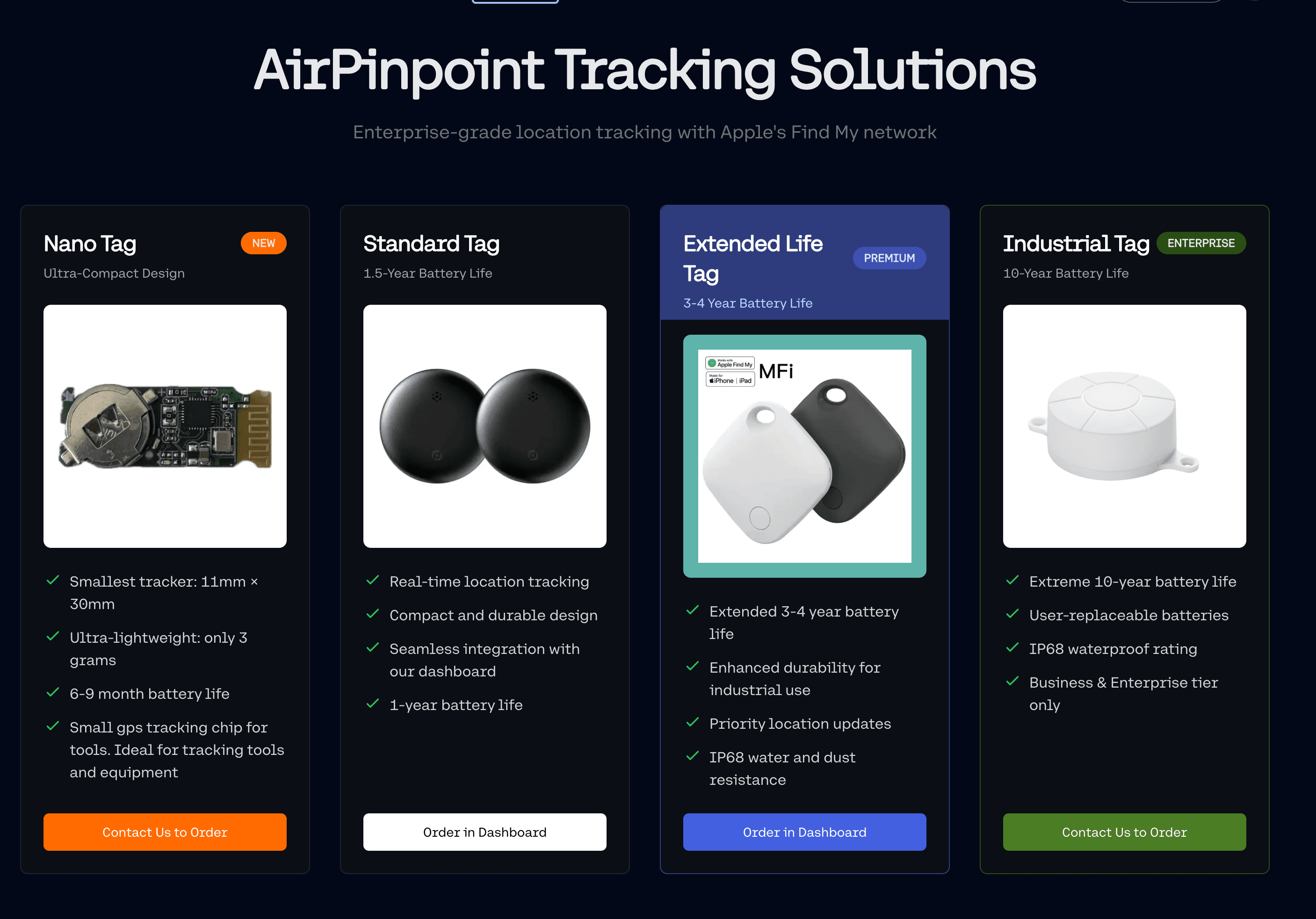
The AirTag is $29 with no subscription required for basic Find My tracking. Paired with Airpinpoint, you get a professional fleet dashboard.
Why AirTags work well specifically for e-bikes:
Urban density advantage. E-bikes are used in cities. Cities have the highest concentration of iPhones anywhere. In neighborhoods like Manhattan, SoHo, or the Mission in San Francisco, there are hundreds of iPhones within range at any moment. The Find My network updates AirTag location every 1-2 minutes under these conditions. That's faster than most cellular GPS trackers set to battery-conserving update intervals.
Battery independence. Unlike Bosch ConnectModule or PowUnity BikeTrax, an AirTag runs on its own CR2032 battery for approximately one year. Thieves who steal an e-bike, drain its battery, and store it in a garage haven't killed the tracker.
Concealment. An AirTag is the size of a quarter. It can be hidden where a thief won't think to look:
- Inside the battery compartment behind the battery
- Inside the headtube, inserted through cable ports
- Under the bottom bracket shell
- Inside a reflector housing (concealed mounts exist for this)
- Hidden in the handlebars
Thieves familiar with GPS trackers often look for and remove them. A hidden AirTag in the battery compartment, accessible only to someone who knows it's there, is far harder to defeat.
Network scale. Apple's Find My network spans over 1 billion devices globally. A stolen e-bike transported to another city, state, or country will still report location whenever any iPhone comes within Bluetooth range. Multiple real-world recoveries have occurred across city boundaries using this passive network.
Limitations of AirTags:
AirTags are not real-time GPS. Location updates depend on proximity to iPhones. In rural areas or inside metal-shielded warehouses, updates slow to 15-30 minute intervals or stop entirely. They don't provide speed or direction data. And they require an iPhone or Mac to view location. Android users need Find My compatible apps.
For fleet management beyond basic Find My, Airpinpoint solves the Apple consumer app's limitations: one dashboard for all bikes, geofence alerts, location history, and team access.
Real Recovery Stories
Colorado: Two Years Later
James LaChapelle's e-bike was stolen from the Basin Recreation Fieldhouse in 2021. He had hidden a $29 AirTag in the battery compartment. Two years later, in March 2023, the AirTag pinged. The bike had moved. Police followed the coordinates and recovered the bike.
California: Mid-Theft Catch
A RadPower RadRunner Plus cargo bike was stolen from a home in Aliso Viejo, California. The family tracked the AirTag in real time as the bike moved. They shared live coordinates with Orange County Sheriff's Department. Officers arrived at an apartment complex to find the thief with an angle grinder still trying to cut the lock, and the original owner walked away with the bike.
Austin: Homeless Encampment Recovery
A Reddit user's $2,000 e-bike was tracked via AirTag to a homeless encampment in Austin. Police recovered the bike, though no arrest was made. The user's comment captured the sentiment of most recovery stories: without the AirTag, that bike was gone forever.
Colorado Vail: 20-Bike Recovery
Vail Police used AirTags to track down a stash of 20 high-end bikes stolen across the Colorado Rockies. The AirTags led officers directly to the storage location where all bikes were recovered in a single operation.
NYC Delivery Worker Networks
Unable to rely on police (2% recovery rate), NYC delivery workers formed WhatsApp groups to crowdsource bike recovery. When a theft is reported, dozens of workers converge on the last known location. In one documented case on West 57th Street, a large group surrounded the thief, identified the bike by serial number, and the thief returned it rather than face the crowd. Location data from phones and AirTags supports these operations.
E-Bike Insurance and Tracking
Does Insurance Require GPS Trackers?
In the US, GPS trackers are not universally mandated by e-bike insurers, but they're encouraged through discounts.
US market:
- Installing a recognized GPS tracker can lower theft premiums
- Some policies offer anti-theft discounts for documented security measures
- Optional theft insurance runs approximately $8/month with up to $10,000 protection per bike
European market (stricter requirements):
- Dutch insurers ENRA and ANWB require Kiwa-certified GPS trackers for bikes over €3,500-4,500
- French and German insurers offer 25% discounts on theft premiums for GPS-equipped bikes
What Insurers Want to See
Whether or not they mandate trackers, insurers responding to a theft claim will want:
- Police report number
- Serial number registration (Bike Index, Project 529)
- Proof of locking method
- Location data showing last known position
- Airpinpoint location history exports serve as documentation
Key E-Bike Insurers in the US
- Velosurance: Specialized e-bike coverage, theft included
- Markel: Electric bike policies with theft
- Sundays Insurance: E-bike specific, theft + liability
- GEICO: Bicycle and e-bike add-on policies
Practical Guide: Setting Up E-Bike Tracking
For regular pedal bikes and a side-by-side comparison of GPS and Find My trackers, see our bike tracker guide.
Individual Rider Setup (1-2 Bikes)
What you need:
- 1 AirTag per bike ($29)
- Weatherproof mount or DIY installation
- Airpinpoint account if you want geofence alerts and location history
Installation:
-
Choose your hiding spot. Battery compartment (check if metal blocks signal), inside frame tubes via cable ports, under saddle in a TagVault mount, or under the reflector. Test signal in each location before committing.
-
Test signal. Walk 100 feet from the bike and check the Find My app for a ping. If no signal, try another location.
-
Register your bike. Add it to Bike Index (free). Registration improves recovery rates by 23%.
-
Enable Airpinpoint. Set a geofence around your home or regular parking location. Get an alert when the bike moves unexpectedly.
Fleet Setup (10-200 Bikes)
What you need:
- 1 AirTag per bike
- Airpinpoint Business account
- Installation protocol for consistent placement
Process:
-
Bulk purchase AirTags. Four-packs are $99. For 20 bikes: $500 in hardware.
-
Standardize placement. Pick one hiding spot that works for your bike models and document it. Consistency means faster setup and easier maintenance.
-
Register all bikes in Airpinpoint. Name each bike clearly (Bike-01 through Bike-20, or by serial number). Add your property geofence.
-
Set alert thresholds. For hotel bikes, geofence the property. For delivery fleets, set alerts for bikes inactive more than 2 hours or leaving a city boundary.
-
Train staff. Who gets alerted? Who calls police? Have a recovery protocol before you need it.
-
Document serial numbers and photos. Every bike, every angle. Police need this for recovery and prosecution.
Comparison: AirTag vs Dedicated GPS for E-Bikes
| Factor | AirTag + Airpinpoint | Cellular GPS Tracker |
|---|---|---|
| Hardware cost | $29 | $80-225 |
| Monthly fee | From $11.99 (fleet) | $4-25/bike |
| Update frequency (city) | 1-2 minutes | 10-60 sec (real-time mode) |
| Update frequency (rural) | 15-30+ minutes | 10-60 sec |
| Battery life | ~1 year (independent) | Varies; some draw from e-bike |
| Works if bike battery dead | Yes | Depends on model |
| Concealability | Excellent (coin-sized) | Moderate |
| Fleet dashboard | Yes (Airpinpoint) | Varies by brand |
| Geofence alerts | Yes (Airpinpoint) | Yes |
| Best environment | Urban, high iPhone density | Rural, real-time needs |
| 3-year total (20 bikes) | ~$2,870 | $5,000-15,000+ |
When to use cellular GPS: Rural areas with sparse iPhone traffic. High-value single bikes where real-time tracking justifies $5-25/month. Bikes that integrate directly with their motor system (BikeTrax).
When AirTag + Airpinpoint wins: Urban fleets of 5+ bikes. Delivery operations in cities. Hotel and campus programs. Any situation where cost per bike and fleet-wide visibility matter.
The Delivery Worker Problem
NYC delivery workers (primarily Latin American immigrants working 12-hour days for DoorDash, Uber Eats, and Grubhub) face a theft crisis that deserves direct attention.
54% of the 500 NYC delivery workers surveyed by the Workers' Justice Project had their bike stolen. 30% were physically assaulted during the robbery. One worker lost six bikes in two years, roughly $10,000 gone. DoorDash and Uber Eats provide no replacement assistance or insurance beyond accident coverage.
These workers earn $300-600 per week. A stolen $1,500 e-bike means months of income wiped out. They've organized (Los Deliveristas Unidos, representing 65,000 workers), formed WhatsApp recovery networks, and in some cases, confronted thieves directly.
Tracking is not optional for these workers. It's survival. Delivery fleet operators like Zoomo and Getwhizz build recovery tracking into their rental plans specifically because of this problem. The Zoomo rental plan at $15-20/week includes theft recovery service with an 80%+ success rate.
For individual delivery workers: an AirTag ($29) hidden in the bike is the lowest-cost protection available. Combined with Bike Index registration and a WhatsApp recovery network, it's the most practical theft deterrent available given the economics.
Campus and University Fleet Management
University campuses are uniquely difficult environments for bike tracking:
High theft rates. Campus police reports show e-bike theft up 250-600% at multiple universities in 2024-2025. Shared bike racks, minimal overnight surveillance, and thousands of new students unfamiliar with theft risks create ideal conditions.
But also ideal AirTag conditions. College campuses have some of the densest iPhone concentrations anywhere. Every student with an iPhone participates in the Find My network passively. A stolen bike on campus will receive location pings every few minutes as it moves through iPhone-saturated dorm areas, dining halls, and common spaces.
What campus programs need:
- Multiple geofences. Dorms, athletic facilities, academic buildings, parking structures
- Role-based access. Transportation office sees all bikes; students see only their checkout
- Movement history. Essential for investigating disputes about where bikes went
- Fleet availability status. Which bikes are checked out vs. available
Airpinpoint's dashboard handles all of this. For a fleet of 30 campus bikes, the setup is: 30 AirTags ($750), one Airpinpoint Business account, geofences for campus zones, and alerts to campus police when a bike leaves the boundary overnight.
Geofencing for E-Bike Fleets
Geofencing is where tracking becomes proactive rather than reactive.
How it works: Draw a digital boundary around your property or permitted area in Airpinpoint. When a bike with an AirTag crosses that boundary in either direction, Airpinpoint waits until seven consecutive location reports agree it is on the new side, then sends the alert. On a city street or a hotel property that lands about 15 to 40 minutes after the crossing.
Practical applications:
- Hotel fleet: Alert fires if a bike leaves property after checkout hours
- Delivery fleet: Alert fires if a bike is inactive in a known theft zone for 30+ minutes
- Campus fleet: Alert fires if a bike is off-campus overnight during semester
- Rental shop: Alert fires when bike exceeds the allowed rental area
The alert gives you a head start before a bike disappears into the theft pipeline. A bike still moving in your neighborhood can be intercepted; a bike in a van heading to a chop shop 30 miles away is much harder to recover.
Setup in Airpinpoint: draw the geofence polygon on the map, set entry/exit alert preferences, choose who gets notified (email, SMS, or both). Takes under 5 minutes per property.
Summary: Which E-Bike Tracking Solution Is Right for You
| Situation | Recommended Solution | Why |
|---|---|---|
| Individual urban commuter | AirTag + Airpinpoint | $29 hardware, city iPhone density gives frequent updates |
| Delivery rider | AirTag (hidden) + Bike Index registration | Lowest cost protection, WhatsApp recovery network |
| Hotel amenity fleet (5-30 bikes) | AirTags + Airpinpoint Business | Fleet dashboard, geofence alerts, team access |
| Campus fleet (20-200 bikes) | AirTags + Airpinpoint Business | Dense iPhone campus = fast updates, one dashboard |
| Rental company | AirTags + Airpinpoint | Fleet tracking without per-bike GPS subscription |
| Bosch-motor e-bike | BikeTrax or AirTag | BikeTrax draws motor power; AirTag works if battery removed |
| Rural/suburban use | Cellular GPS tracker | iPhone density too low for reliable AirTag updates |
For fleet operators: The case for Airpinpoint over standalone GPS is the dashboard. Managing 20 bikes through Apple's consumer Find My app requires 20 separate devices signed into 20 Apple IDs. That is not how businesses operate. Airpinpoint gives you one screen, all bikes, team access, geofence management, and location history, built for the way fleet operators actually work.
Start here:
- Get an AirTag for each bike ($29 each, or $99/4-pack)
- Install in a concealed location: battery compartment or inside frame
- Register bikes on Bike Index (free, improves recovery odds)
- Set up Airpinpoint with property geofences
- Document serial numbers and photos for every bike
The $29 cost of an AirTag makes the question simple: compared to replacing a $1,500-3,000 e-bike, it's irrelevant. The question isn't whether to track your e-bike. It's which system fits your operating environment.
 Our Solution