AirTags vs Decklar: Enterprise Supply-Chain AI vs Turnkey Physical Asset Tracking
Decklar is not a tracker for your tools. It is an enterprise Decision AI platform that helps Global 2000 companies automate logistics decisions across complex global supply chains.
That is not a criticism. It is a clarification. If your problem is "our $8,000 compressor keeps going missing between job sites," Decklar is the wrong category of product entirely. If your problem is "we need AI-driven decision automation across 25 carriers and 50 trade lanes," Airpinpoint is the wrong one.
These products serve different buyers at different scales with different definitions of the word "tracking."
What Each Tool Actually Does
Decklar (formerly Roambee, rebranded September 2025) is a Real-Time Decision AI platform for supply chains. It ingests signals from 12 million daily shipments, maps commercial trade routes, and applies AI reasoning to automate responses to supply-chain disruptions. Its RADAR product is a logistics control tower: autonomous alerting, carrier coordination, risk mitigation. Customers are Global 2000 enterprises in pharmaceutical, CPG, and manufacturing, with average contract lengths of about three years. According to the company's January 2026 announcement, it grew 48% year-over-year and is EBITDA positive.
G2 lists Decklar at 4.3 out of 5 stars across 74 reviews, with roughly 47% of reviewers from enterprise organizations.
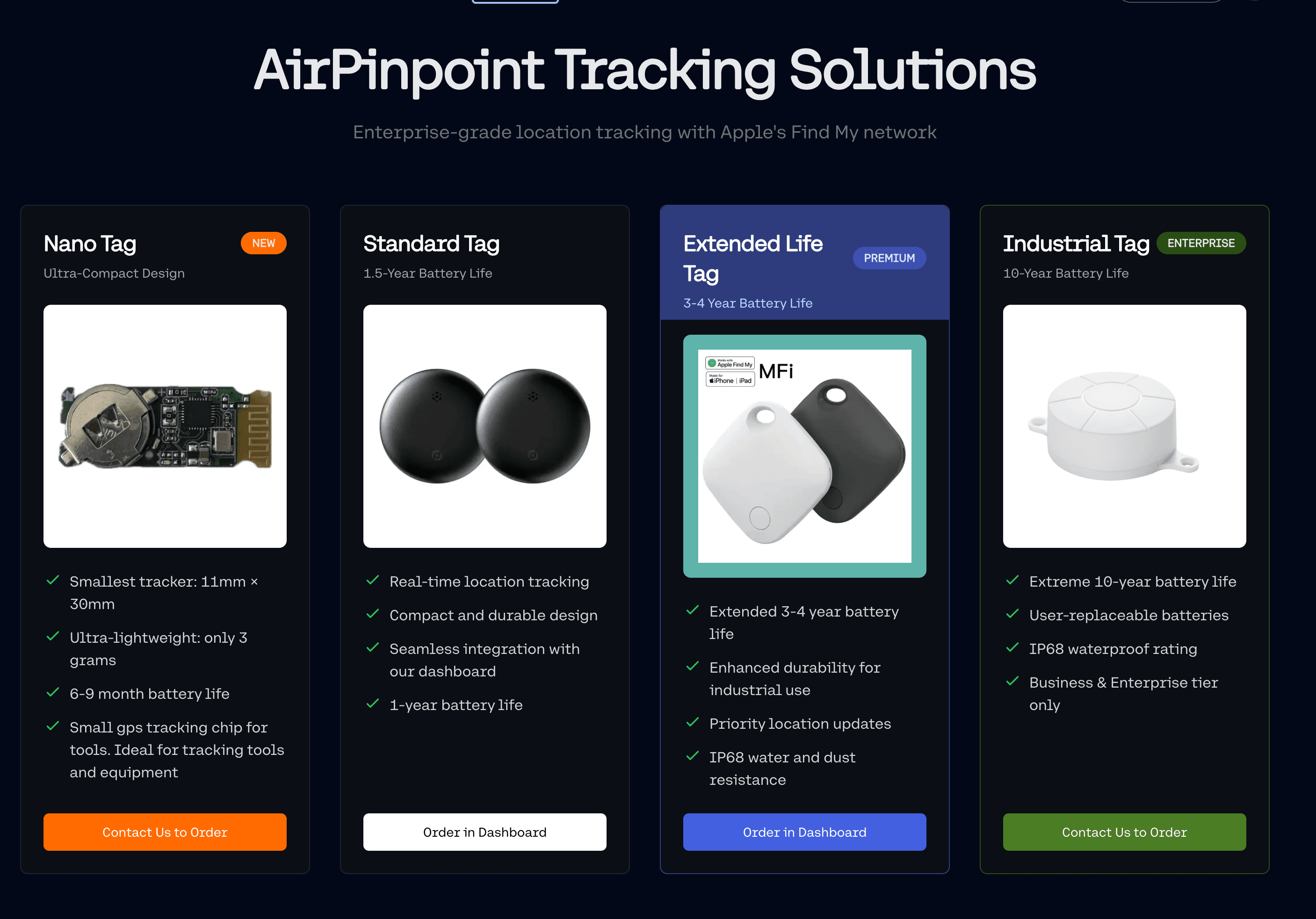
Airpinpoint is a physical asset location tracker. Order beacons, attach them to equipment, and every tracked asset shows up on a live map. Location updates flow automatically through Apple's Find My network (over a billion relay devices worldwide). Set polygon geofences, get after-hours movement alerts, pull location history for any asset. Pricing is $11.99 per device per month. No enterprise contract, no multi-year commitment, no implementation team required.
Head-to-Head Comparison
| Feature | Decklar | Airpinpoint |
|---|---|---|
| Category | Enterprise supply-chain Decision AI | Physical asset location tracking |
| Target buyer | Global 2000, enterprise logistics teams | SMB to mid-market, field ops, construction |
| Hardware included | None (software only) | NRF52810 BLE beacons ($12-25, 7-yr battery) |
| Deployment time | Enterprise implementation, multi-month | Days (ship beacons, attach, done) |
| Pricing | Quote-based enterprise contract | $11.99/device/mo, no long-term lock-in |
| Contract length | ~3 years average | Month-to-month |
| What it tracks | Shipments, carriers, trade lanes, logistics events | Individual tools, equipment, vehicles, pallets |
| Live asset map | No (not designed for it) | Yes, with location history |
| Geofence alerts | No (supply-chain disruption alerts, not asset geofences) | Yes, polygon-based with custom schedules |
| Location history | Shipment event logs | Per-asset location trail |
| API | Enterprise integration layer | REST API |
| Mobile app | Enterprise dashboard | Web app, any browser or device |
| G2 rating | 4.3/5 (74 reviews, ~47% enterprise) | N/A |
Where Decklar Excels
Decklar is genuinely strong inside its category. If you run global supply chains at enterprise scale, it solves real problems.
Decision AI at Shipment Scale
Decklar's knowledge graph covers more than 50% of global commercial trade routes, enriched by 1 billion historical logistics events. It does not just surface alerts, it recommends and in some cases executes responses: rerouting, carrier coordination, compliance enforcement. For a pharma company managing cold-chain shipments across 30 countries, this is meaningful automation.
Autonomous Logistics Execution
The RADAR product can call drivers, alert teams, and enforce compliance without a human triggering each action. Early deployments reported cold-chain compliance rising from 57% to over 90%. That level of automation requires deep integration with carrier systems and logistics workflows, which Decklar provides.
Global 2000 Fit
Three-year contracts, enterprise onboarding, a knowledge graph tuned to global trade. Decklar is purpose-built for the scale and complexity of a Fortune 500 supply chain.
Where It Falls Short for Asset and Equipment Tracking
It Does Not Track Physical Assets
Decklar tracks shipments and logistics events, not the physical location of a drill press, generator, or aerial lift. There are no beacons to attach to equipment. There is no live map showing "your 47 tracked tools and where they currently are." This is not a gap or a limitation, it is simply not the product.
No Hardware Included
If you need something attached to a physical object, Decklar does not ship anything. You would need a separate hardware layer entirely.
Enterprise-Only Pricing and Complexity
Decklar's average customer commits to about three years. Pricing is quote-based with no published tiers. For a 50-person contractor managing 200 pieces of equipment across 10 job sites, this pricing structure and sales process is not designed for you.
Overkill for the Problem Most SMB Teams Have
Most SMB and mid-market asset tracking needs come down to one question: where is it right now? That question does not require a Decision AI platform with a global trade route knowledge graph. It requires a beacon and a map.
Where Airpinpoint Fills the Gap
Physical Location, Updated Automatically
Attach an Airpinpoint beacon to any asset and it broadcasts its position via Apple's Find My network. No cellular plan, no monthly SIM cost, no manual check-in. Any nearby iPhone, iPad, or Mac relays the signal. Location updates happen automatically.
Turnkey in Days, Not Months
Order beacons. Attach them. The dashboard shows a live map with every tracked asset. Most teams are tracking within 48 hours. No implementation team, no enterprise contract, no onboarding call required.
Geofences That Actually Alert on Physical Assets
Draw a polygon around a job site, yard, or warehouse. Set operating hours. If a tracked asset leaves that boundary outside of hours, you get an alert. Decklar handles supply-chain disruptions. Airpinpoint handles "the trailer left the yard at 2 AM."
Location History for Every Asset
Every position update is stored. Pull up any beacon and see where it traveled over the past day, week, or month. This data settles insurance disputes, tracks utilization by site, and catches unauthorized movement patterns.
7-Year Battery, Zero Maintenance
Airpinpoint's custom NRF52810 beacons run for approximately 7 years on a single battery. Attach one and do not think about it again.
The Real Decision: Control Tower vs. Physical Tracker
These two products solve different versions of the word "tracking."
Decklar tracks logistics events across a global supply chain. It answers questions like: "Is our pharmaceutical shipment on track to arrive at the Singapore hub on time, and if not, what should we do?" That is enterprise supply-chain visibility.
Airpinpoint tracks physical objects. It answers: "Where is the scissor lift that was at Site A last Tuesday?" That is asset location tracking.
Choose Decklar when:
- You are a Global 2000 enterprise with complex multi-carrier global logistics
- You need AI-driven decision automation for supply-chain disruptions
- You have a dedicated supply-chain ops team and an enterprise software budget
- Your tracking problem involves shipment lanes, carrier coordination, and trade route visibility
Choose Airpinpoint when:
- You need to know where physical equipment is right now
- Your team shares tools, vehicles, or assets across multiple sites
- You want to stop losing equipment to theft or displacement
- You need to be up and running this week, not after a multi-month implementation
- Your budget is per-device, not a multi-year enterprise contract
Cost Comparison
Decklar
Pricing is not publicly listed. Enterprise quote-based, average contract approximately 3 years. Not designed for sub-100-employee companies.
Airpinpoint (100 assets)
- Hardware: 100 beacons at $12-25 each = $1,200-2,500 (one-time)
- Subscription: $11.99/device/mo at the starter tier ($14.99 at higher tiers) = $1,199-1,499/mo
- Annual subscription: $14,388-17,988
- No long-term contract. Cancel or scale at any time.
For a 20-asset fleet, that math is roughly $240-500 hardware one-time plus $239/mo. Most teams recoup that within the first month of not losing a piece of equipment.
The Bottom Line
Decklar is a real product solving a real problem at enterprise scale. If you run global logistics for a Fortune 500 company, its Decision AI layer is worth evaluating.
But the comparison with Airpinpoint is mostly a category mistake. Decklar does not track where your generator is. Airpinpoint does not automate carrier coordination across 30 countries.
Most people searching this comparison are trying to track physical assets on job sites, in warehouses, or across a fleet of work trucks. For that problem, Airpinpoint is the answer: beacons ship to you, you attach them, and every asset shows up on a map the same day.
No multi-year contract. No enterprise implementation. No global trade route knowledge graph required.
 Our Solution