
Asset Tracking ROI: The Formula, a Worked Example, and a CFO-Ready Calculator
Asset and fleet tracking ROI is (annual savings - annual cost) / annual cost, expressed as a percent. Annual savings is the dollar value of recovered assets, avoided rentals, insurance discounts, and search-labor hours you stop paying for. Annual cost is hardware plus subscription. Airpinpoint's low per-asset cost, $11.99/device/month plus a one-time $29 tag, makes that math favorable: at 60-80% less than $30-50/device GPS, you break even on far fewer recovered tools.
How do you calculate asset tracking ROI?
ROI is (annual savings - annual cost) / annual cost. Multiply by 100 for a percent. The companion number a CFO will ask for is the payback period: annual cost / (annual savings / 12), in months.
The two inputs:
- Annual savings = recovered or unbought assets + avoided emergency rentals + insurance premium reduction + search-labor hours removed.
- Annual cost = hardware (one-time, amortized) + subscription + install.
The formula is the same whether you are evaluating AirTags, a GPS telematics platform, or RFID. The only thing that changes between options is the cost input, which is exactly why cost per asset decides the winner. The savings side is roughly fixed by your operation; the cost side is what you control.
What savings should you count?
Count only line items you can defend with a number a CFO can check against the budget. Four categories hold up:
- Recovered or unbought assets. Tools and equipment you stop losing, or recover after a theft, because you can see where they are. Value them at replacement cost.
- Avoided emergency rentals. When you can find the asset you already own, you stop renting a duplicate at premium rates. Pull last year's emergency rental spend as the baseline.
- Insurance premium reductions. Many insurers discount premiums for tracked equipment. Use the actual quoted reduction, not an industry guess.
- Search-labor hours removed. Hours crews spend looking for equipment, multiplied by loaded labor cost. Measure your own baseline; do not borrow a study's number.
Leave out vague "productivity gains." If you cannot tie a saving to a specific line in the budget, it does not belong in a number you hand to finance.
What does asset tracking cost?
| Cost component | Airpinpoint | Wired GPS |
|---|---|---|
| Hardware | $29/tag, one-time | $100-200/unit |
| Subscription | $11.99/device/month | $30-50/device/month |
| Install | None (peel and stick) | Professional install |
| API access | $14.99/device/month (Enterprise) | Varies |
Airpinpoint Business is $11.99 per device per month, 60-80% less than GPS fleet trackers. The AirTag 2 hardware is $29 per tag, one-time, against $100-200 for a GPS unit. There is no cellular plan and no installation. That low per-asset cost is the lever that makes ROI favorable, because the lower your annual cost, the less loss you have to prevent before the return turns positive.
A worked ROI example: 100 assets
This example uses Airpinpoint's real prices and clearly labeled assumptions for the savings side. Swap in your own baseline numbers; the structure is what matters.
Annual cost (real Airpinpoint prices)
| Component | Calculation | Amount |
|---|---|---|
| Subscription | 100 x $11.99 x 12 | $14,388 |
| Tags (one-time, year 1) | 100 x $29 | $2,900 |
| Year 1 total | — | $17,288 |
| Year 2+ total | subscription only | $14,388 |
Annual savings (labeled assumptions)
These are assumptions, not measured averages. Replace them with your own figures.
| Saving | Assumption | Amount |
|---|---|---|
| Recovered / unbought tools | 12 fewer tools lost per year at $600 each | $7,200 |
| Avoided emergency rentals | 6 fewer emergency rentals at $1,500 each | $9,000 |
| Search labor removed | 3 crew x 2 hrs/week x 48 wks x $45/hr loaded | $12,960 |
| Total assumed annual savings | — | $29,160 |
The ROI math
Plugging year 1 into the formula:
ROI = (annual savings - annual cost) / annual cost
ROI = ($29,160 - $17,288) / $17,288
ROI = $11,872 / $17,288
ROI = 0.687 = 69%  (year 1, with one-time hardware)
Payback period:
Payback = annual cost / (annual savings / 12)
Payback = $17,288 / ($29,160 / 12)
Payback = $17,288 / $2,430
Payback = 7.1 months
In year 2, with the one-time tag cost gone, the cost drops to $14,388 and ROI on the same assumptions rises to ($29,160 - $14,388) / $14,388 = 103%.
The point is not the exact percent, which depends entirely on your assumptions. The point is the breakeven is low. At $17,288/year all-in for 100 assets, recovering roughly a dozen mid-priced tools, or avoiding a handful of emergency rentals, covers the entire program. Everything past that is upside.
How do you justify it to a CFO?
A CFO funds the lowest-risk path to a defensible return, not the longest list of benefits. Structure the case in four moves:
- One cost line. State the all-in annual cost as a single number. For 100 assets on Airpinpoint that is $17,288 in year 1, $14,388 after. No menu of add-ons.
- The breakeven, not the projection. Show how little has to go right to break even: about a dozen recovered tools or a few avoided rentals. A breakeven a CFO believes beats an ROI percent they do not.
- Conservative, labeled assumptions. Mark every savings figure as an assumption and keep it on the low side. A defensible 69% survives scrutiny; an aggressive 500% gets challenged and stalls the approval.
- Compare on cost per asset. The savings are roughly the same whatever you bolt on, so the decision reduces to cost. Airpinpoint at $11.99/device/month against $30-50 GPS plus install is the clearest version of that argument.
CFOs in construction in particular have watched GPS deployments stall on the $100-200-per-unit hardware and install bill before any asset got tracked. The pitch that lands is the one where the cost is small enough that breakeven is obviously reachable.
How do you measure ROI after you deploy?
Set a baseline before you start so you can prove the return later:
- Tools lost or written off in the last 12 months, at replacement cost.
- Emergency rental spend last year.
- Current insurance premium on the relevant equipment.
- Hours per week crews spend locating equipment.
Track the same four numbers after deployment. The change, minus the tracking cost, is your realized return. Without a baseline you cannot prove ROI to stakeholders, which is the single most common reason a tracking program loses its budget at renewal.
Why cheap tracking wins on ROI
Two deployments recover the same lost tools and avoid the same rentals. The only difference in the ROI formula is the cost denominator. A GPS program at $30-50/device/month plus hardware and install needs to prevent two to four times more loss than Airpinpoint at $11.99/device/month to reach the same return.
That is the whole argument for AirTag-based tracking on assets that spend time near people. You give up second-by-second positioning, which matters for vehicle dispatch and driver-behavior scoring. You do not give up the ability to find a trailer, a generator, or a tool crate within minutes and a few meters. For locating assets, Airpinpoint delivers the savings at a fraction of the cost, and a lower cost is a higher ROI on the same savings.
Sign up at airpinpoint.com, tag your highest-value or most-frequently-lost assets first, and measure the baseline you set against the first 90 days.
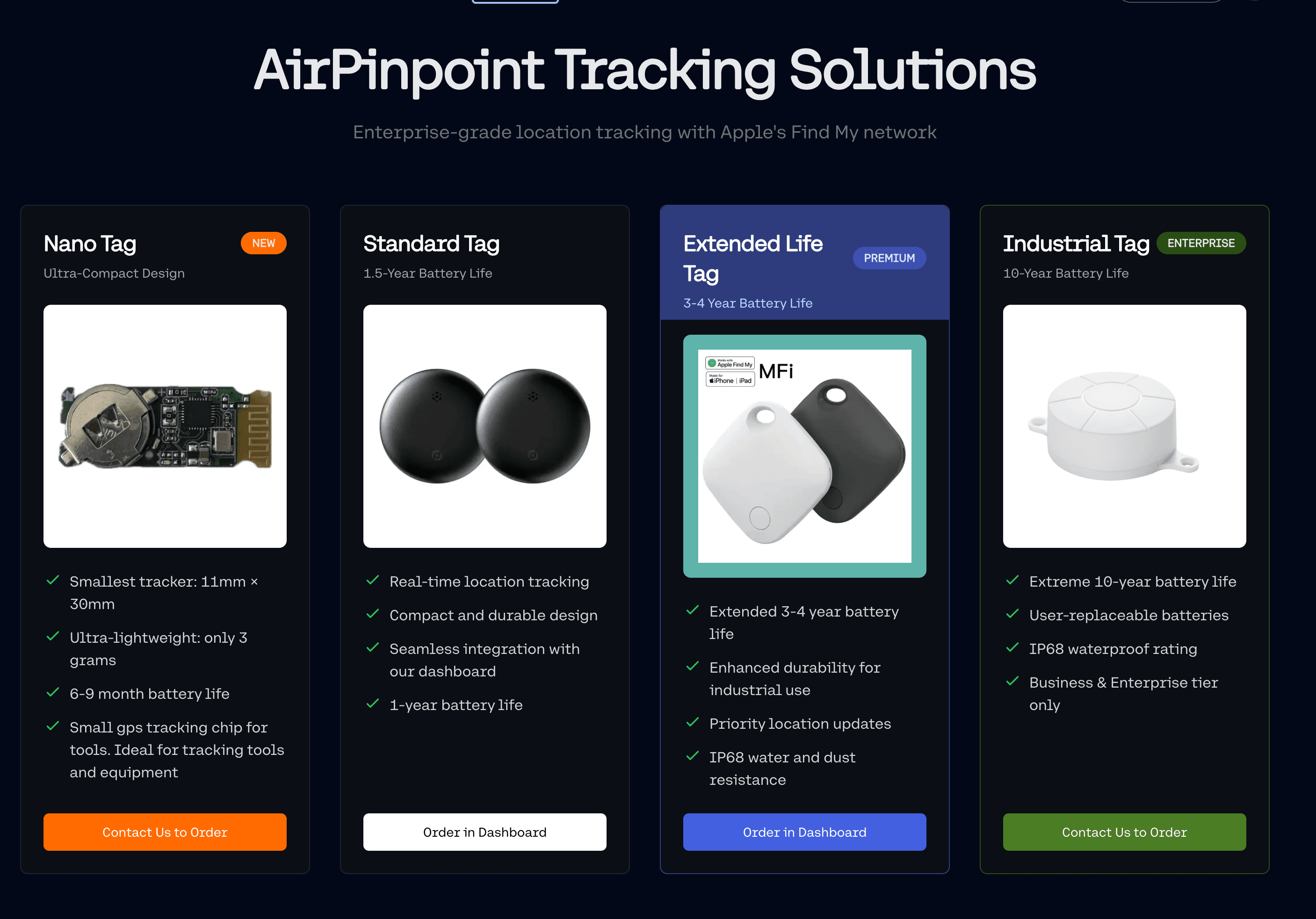


 Our Solution