
Equipment Utilization Benchmarks 2025: Industry Data & Tracking ROI
The Utilization Problem
Most organizations dramatically overestimate how well they use their equipment. Without tracking data, managers rely on assumptions, schedules, and memory, all of which prove unreliable.
A note on the numbers below. Utilization benchmarks are one of the worst-sourced areas in this industry. The same handful of percentages get copied between vendor blogs until they look like established fact, and when you chase the citation there is nothing at the end of it. We have gone through this page and marked each figure with where it actually comes from. Where the honest answer is "we could not find the source," we say that instead of quietly dropping the citation column.
The commonly cited reality check, with caveats attached:
- Average construction equipment utilization: 30-40% without tracking. Widely repeated across the industry, source untraceable. Do not plan around it.
- Industry optimal target: 65-75%. A rule of thumb from rental and fleet practice, not a study.
- Documented improvement ceiling: up to 40%, from Monnot and Williams (ASCE, 2011), and only from exact machine hours.
Whatever your real starting number is, the gap it represents is equipment sitting idle while you pay insurance, depreciation, storage and maintenance on it. It means renting equipment you already own because no one knows where it is. It means capital tied up in assets that could be sold or redeployed. The size of your own gap is measurable in about a month, and that measurement is worth more than any benchmark on this page.
Industry Utilization Benchmarks
Construction Equipment
| Metric | Benchmark | Source |
|---|---|---|
| Average utilization (untracked) | 30-40% | Widely repeated, no traceable study |
| Typical downtime rate | 20-30% | Widely repeated, no traceable study |
| Target utilization (tracked) | 60-70% | Rule of thumb, not a measured benchmark |
| Improvement potential from exact machine hours | Up to 40% | Monnot & Williams, ASCE J. Constr. Eng. Manage. 137(10), 2011 |
Equipment Rental Industry
| Metric | Benchmark | Source |
|---|---|---|
| Optimal time utilization | 70-75% | Industry standard |
| Physical utilization target | 72% on rent, 20% ready, 8% maintenance | Industry benchmark |
| Financial utilization (independents) | 38.1% average | Rental industry data |
| Financial utilization (nationals) | 55-65% acceptable | Major rental chains |
| Fleet age target | 36 months median | Industry average |
Fleet Vehicles
| Metric | Benchmark | Source |
|---|---|---|
| Target utilization | 80%+ | Fleet management standard |
| Average unplanned downtime | 8.7 days/vehicle/year | Industry data |
| Downtime cost per day | $448-$760 | Fleet studies |
| Idle time (typical) | 25% of operational time | Vehicle telemetry |
| Heavy equipment idle time | 30-40% | Loaders, graders |
The Cost of Poor Utilization
Per-Vehicle Impact
A 1% drop in utilization equals 3.5 lost working days per vehicle per year. That is not a research finding, it is division: 1% of a 350 day operating year. It gets quoted like a discovery, so it is worth seeing the arithmetic once.
The rest is your arithmetic, not ours, because the only number that matters is what a day of that machine is worth to you:
- 1% utilization drop across a 50-vehicle fleet = 175 lost working days
- Multiply by your own day rate. Use your rental rate if you rent the machine out, or the day rate you would pay to rent a replacement if you do not
- A 10% gap is ten times that
We have deliberately not filled in a dollar figure here. A previous version of this page assumed $700 per day for every vehicle in every fleet and multiplied out to seven figures, which was meaningless. Your rate card has the real number and it varies by an order of magnitude between a pickup and a crane.
Downtime Costs by Equipment Type
Only one row of this table has a source we can name. We have left the others in because the shape is useful, and marked them for what they are.
| Equipment | Daily Downtime Cost | Where this number comes from |
|---|---|---|
| Fleet vehicle | $448-$760 | Commonly cited fleet industry range, original study untraced |
| Dozer | $500-$800 | Vendor estimates, unverified |
| Excavator | $600-$1,000 | Vendor estimates, unverified |
| Crane | $1,000-$2,500 | Vendor estimates, unverified |
| Industrial production line | $532,000/hour | Siemens, True Cost of Downtime. Note: this is an average across large manufacturing plants, not construction equipment |
The better version of this table is the one you build from your own last twelve months: the machines that went down, the days they were out, and what you paid to cover each gap.
The Rental Penalty
When you don't know where your equipment is, you rent what you already own:
The clearest measured figure here comes from ABAX, which found construction workers spend an average of 38 hours a year looking for their tools, close to an hour a week per worker (ABAX). We previously quoted a "47% of their time" figure on this page. It traces back to a vendor blog with no study behind it and we have removed it.
Emergency rental rates run higher than planned rentals, which anyone who has made that phone call at 6am knows, though we have not found a credible published spread and will not invent one. Work out your own: pull the last five emergency rentals off your invoices and compare the rate to your standing agreement. Then count how many of those machines you already owned and could not find.
Ghost Assets: The Hidden Drain
What Are Ghost Assets?
Ghost assets are items that appear in your asset register but:
- No longer exist (disposed, stolen, damaged beyond repair)
- Cannot be located
- Are not usable (broken, obsolete, missing components)
Ghost Asset Statistics
| Finding | Percentage | Source |
|---|---|---|
| Fixed assets that are ghost assets | 15-30% | Gartner, industry studies |
| Organizations with 30%+ inventory discrepancy | 70% | Asset management research |
| Companies unaware of ghost asset definition | 49% | Wasp Barcode survey |
| Retail revenue lost to ghost inventory | 1-3% | Retail industry data |
Financial Impact
If 20% of your $5 million asset base consists of ghost assets:
- $1 million in phantom value on your books
- Overstated asset values
- Unnecessary insurance premiums
- Wasted maintenance budgets
- Tax implications from incorrect depreciation
Tracking eliminates ghost assets by providing continuous visibility. When everything is tracked, nothing is "ghost."
How Tracking Improves Utilization
Research-Backed Improvements
One citation here is real, and it is worth reading carefully rather than quoting as a headline.
Monnot and Williams, "Construction Equipment Telematics," ASCE Journal of Construction Engineering and Management 137(10), 2011, pages 793 to 796 (DOI 10.1061/(ASCE)CO.1943-7862.0000281), reports that up to 40% improvement in utilization can be realized once the home office receives information on exact machine hours.
Three things about that sentence matter more than the 40%:
"Up to" is a ceiling, not an expectation. It is the best case in the paper, not the median outcome.
"Exact machine hours" is the mechanism. The improvement comes from the office knowing how many hours each machine actually ran, which lets it reallocate and schedule against real usage. That data comes off the engine.
Airpinpoint does not produce machine hours. A Find My tag reports where an asset is and how long it has been there. It has no connection to the engine, no hour meter reading and no ECU access. So we cannot claim this result, and any vendor selling you a Bluetooth tag while quoting the 40% figure is borrowing credibility from a study of a different technology. If exact machine hours are what you need, buy telematics.
What a location record substitutes is coarser: dwell time instead of run time. A machine that has not moved from one set of coordinates in three weeks is probably not working, and that inference is usually right, but it is an inference and not a measurement. A generator running flat out in one spot for three weeks looks identical to an abandoned one.
Documented Case Study Results
We have none of our own. Airpinpoint has no published customer case studies, and nothing in this section is an Airpinpoint result. An earlier version of this page listed outcomes under company names in a way that implied otherwise, including one company that does not exist. That has been removed.
What follows is third-party published work, named and linked, so you can check it and judge how much it transfers to your situation. Note that both used RFID or IoT sensor hardware, not Find My tags:
Byrne Group, published by AssetTagz (case study). Equipment loss and theft down 50%, manual paperwork down 87%, and over £300,000 in savings within the first two years. The deployment combined AssetTagz RFID tags with the COINS Plant Manager module for automated issue and return, which is a different and more labour-intensive system than a Find My tag: RFID requires readers and a check-in or check-out step.
An unnamed construction firm, published by Dalos (case study). Reported 30% reduction in equipment misplacement, 40% decrease in theft via geofencing alerts, and 25% improvement in utilization, using IoT sensors and GPS on excavators, bulldozers and cranes. Dalos does not name the customer, and neither will we: Dalos is the vendor, not a construction company.
Read both as vendor-published marketing, because that is what they are. Neither is independently audited and neither reports what the baseline measurement looked like.
Typical Tracking ROI
There is no honest industry table for this, so instead of a fabricated one, here is what to measure yourself during the first 90 days. Each row is something a location history can answer and a spreadsheet cannot:
| What to count | How to get it | Why it converts to money |
|---|---|---|
| Assets that never moved | Filter the map for zero movement over 30 days | Candidates to sell, off-rent or redeploy |
| Duplicate assets within a few miles | Compare locations across sites | You may be renting what you already have nearby |
| Emergency rentals of owned equipment | Cross-check rental invoices against the map for that week | The most direct saving available, and the easiest to prove |
| Assets left at closed-out sites | Compare asset locations to your project schedule | Recovery before they disappear |
| Off-hours departures | Geofence exit alerts | Theft and unauthorized use, caught early |
Multiply each count by your own numbers: your rental rates, your replacement costs, your deductible. That produces a figure you can defend in a budget meeting, which no borrowed percentage will.
Right-Sizing Your Fleet
The Utilization Decision Framework
| Utilization Rate | Action | Rationale |
|---|---|---|
| 70%+ | Invest | High performers justify expansion |
| 50-70% | Maintain | Solid performers, monitor trends |
| Below 50% | Investigate | Declining demand? Wrong location? Sell? |
Rent vs. Own Decision
Rule of thumb: The breakeven typically falls around 60-65% utilization.
| Utilization | Recommendation |
|---|---|
| Below 50% | Rent when needed |
| 50-60% | Analyze costs; often rent |
| 60-70% | Own if costs favor it |
| Above 70% | Own; consider adding capacity |
Seasonal Considerations
Don't size your fleet for peak demand:
- Right-size for off-peak utilization needs
- Rent supplemental equipment during peaks
- Track utilization by season to optimize mix
- Avoid carrying costs on equipment used 3 months/year
Key Metrics to Track
Primary Utilization KPIs
| Metric | Formula | Target |
|---|---|---|
| Time Utilization | (Hours Used ÷ Hours Available) × 100 | 65-75% |
| Financial Utilization | (Actual Revenue ÷ Potential Revenue) × 100 | 55-65% |
| Downtime Rate | (Downtime Hours ÷ Total Hours) × 100 | <8% damage, <5% maintenance |
| Idle Time | (Idle Hours ÷ Operating Hours) × 100 | <25% |
Secondary Metrics
| Metric | What It Measures | Why It Matters |
|---|---|---|
| Ghost asset % | Assets on books vs. verified | Financial accuracy |
| Emergency rental frequency | Unplanned rentals per month | Planning effectiveness |
| Asset turnover | Revenue ÷ Asset value | Return on equipment investment |
| Average fleet age | Months since acquisition | Maintenance/reliability indicator |
| Location accuracy | % of assets with known location | Operational visibility |
Implementing Utilization Tracking
Phase 1: Baseline Measurement (Month 1-2)
- Tag all assets with tracking devices
- Establish current utilization baseline without changing operations
- Identify ghost assets through physical verification
- Document current pain points: rental frequency, search time, theft incidents
Phase 2: Analysis (Month 2-3)
- Compare actual vs. assumed utilization (expect surprises)
- Identify underperformers: equipment with <50% utilization
- Map equipment locations vs. where it's needed
- Calculate opportunity cost of current utilization gaps
Phase 3: Optimization (Month 3-6)
- Redistribute equipment to high-demand locations
- Sell or dispose of chronic underperformers
- Consolidate rental needs based on usage patterns
- Implement preventive maintenance schedules from usage data
Phase 4: Continuous Improvement (Ongoing)
- Monitor utilization trends monthly
- Adjust fleet size based on actual data
- Forecast seasonal needs from historical patterns
- Track ROI from utilization improvements
AirTag Tracking for Utilization
What AirTags Provide
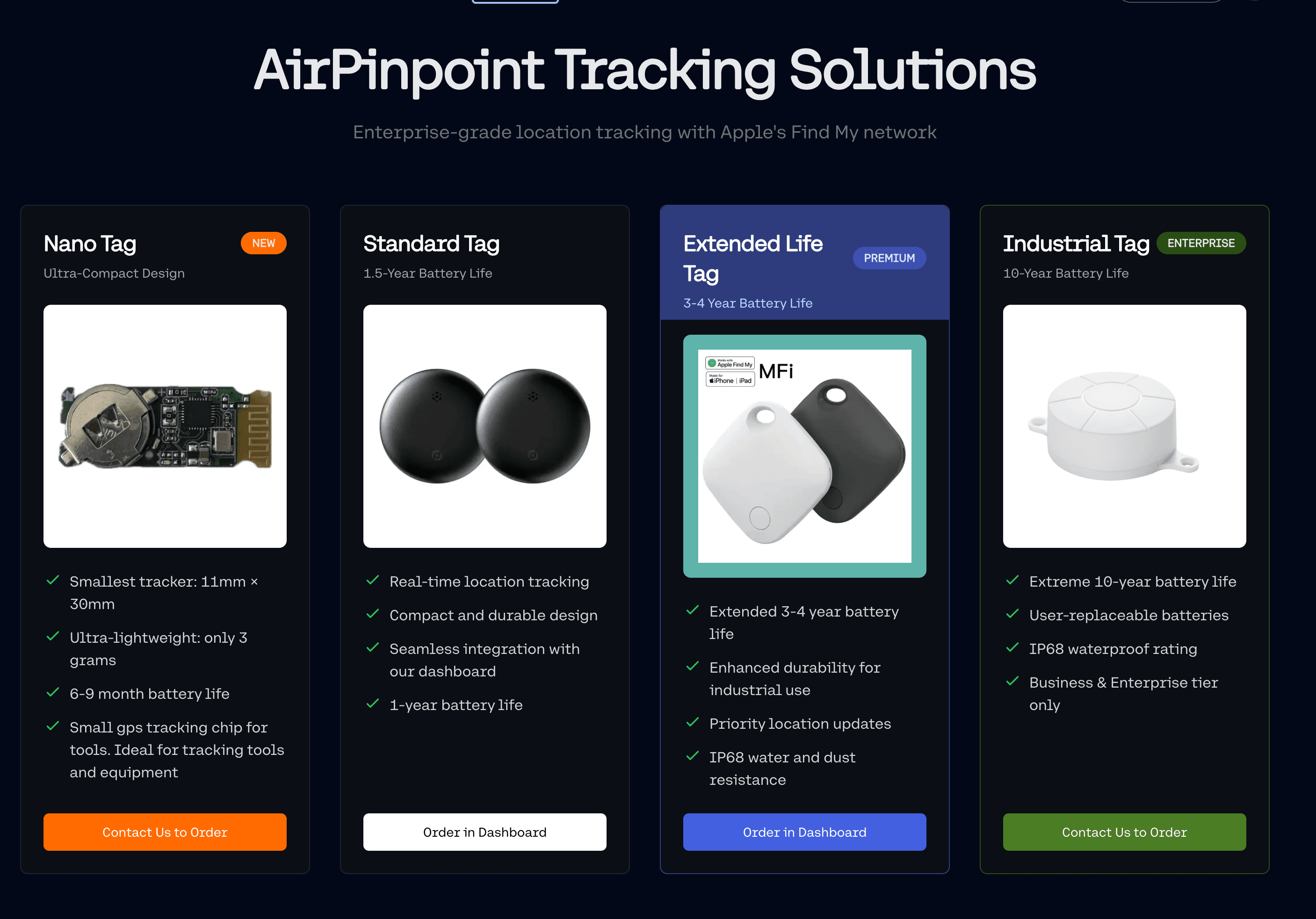
- Location, updated when an Apple device passes nearby: not a live feed. In a busy yard or metro area that is every few minutes. In a rural outbuilding with nobody around it may be hours or days
- Movement history: see patterns over time, exportable as CSV or JSON
- Geofencing: polygon zones with entry and exit alerts. A confirmed alert typically lands 15 to 40 minutes after the crossing, because it waits for consecutive readings to agree
- Accuracy of roughly 10 to 30 meters: address level, not shelf level. Good enough to find a machine in a yard, not to find a drill in a gang box
- $29 per tag, $11.99 per tag per month: no cellular plan, no contract
What it does not provide: engine hours, run time, fuel, ECU or fault codes, maintenance scheduling, or any usage metric derived from the machine itself.
Utilization Insights from Location Data
Even without engine-hour telematics, location tracking reveals:
| Pattern | What It Indicates |
|---|---|
| Asset stationary for weeks | Potential underutilization |
| Frequent site-to-site movement | High utilization, may need more capacity |
| Equipment at wrong location | Deployment inefficiency |
| Assets leaving after hours | Potential theft or unauthorized use |
| Clustering at one site | Rebalancing opportunity |
Cost Comparison for 100 Assets
GPS Telematics (full utilization data):
- Hardware: $10,000
- Monthly: $3,000 ($30/asset)
- Annual: $46,000
AirTags + Airpinpoint (location and dwell time only):
- Hardware: $2,900 (100 x $29, one time)
- Monthly: $1,199 (100 x $11.99)
- Year one: $17,288. Subsequent years: $14,388
Difference in year one: $28,712. An earlier version of this page showed $150/month for the platform, which was wrong and understated our own price by a factor of eight. Our published rate is $11.99 per tag per month and the corrected arithmetic is above.
The two columns do not buy the same thing, so do not read this as a like-for-like saving. The GPS column includes engine hours and true run time. Ours does not. What you are choosing between is full utilization data on the assets you can afford to instrument, or location and dwell time on all of them.
The Bottom Line
Equipment utilization is measurable, improvable, and directly impacts profitability:
- Benchmark against yourself, not this page: a month of your own history beats every borrowed percentage here
- Find your ghost assets: the 15-30% figure is an industry estimate, but your count is a physical verification away
- Know what the 40% figure requires: Monnot and Williams measured exact machine hours. A location tag does not produce those
- Right-size based on data: stop guessing about rent versus own decisions
- Do the arithmetic yourself: a 1% utilization gap is 3.5 days per vehicle per year, times whatever a day is worth to you
The organizations achieving best-in-class utilization aren't guessing. They're tracking. With location data alone, you can identify underutilized assets, optimize deployment, and make data-driven fleet decisions.
The utilization gap is your opportunity. Close it with visibility.


 Our Solution