
Property Management Asset Tracking: The Complete Guide for 2025
Property management runs on things that move: keys, tools, pressure washers, service vans, and the people carrying all of it between doors. Whether you manage single-family rentals, multifamily apartments, or commercial properties, the assets that cost you money are almost never the building. They are the $400 appliance dolly that went out on a turn and never came back, and the master key that means rekeying a block.
This guide covers everything property managers need to know about asset tracking, from simple AirTag solutions for keys to comprehensive IoT platforms for building-wide management.
The Hidden Costs of Poor Asset Management
Key Management Nightmare
Lost keys are one of the most expensive (and preventable) problems in property management:
Run the arithmetic on your own portfolio. Every input is in your accounts payable or your timesheets:
| Cost Factor | Where to get your number |
|---|---|
| Rekeying | Your locksmith's per-door rate times doors rekeyed last year. At a common rate near $150 per home, 250 homes rekeyed once is past $37,500 |
| Staff time coordinating access | Hours logged letting vendors and applicants in when a key is missing, times loaded hourly cost |
| Emergency locksmith calls | After-hours invoices, which carry a premium your standard rate does not |
| Tenant complaints and delays | Days a unit sat unshowable, times daily rent |
| Your annual key cost | Add the four. That is the number any key system has to beat |
We are not going to quote you an ROI percentage for key tracking. The published ones come from lockbox vendors describing their own customers, and the answer depends entirely on your rekey rate and your turnover, which no vendor knows.
Maintenance Equipment Losses
Property managers face significant equipment theft risk, and the useful thing to understand is the recovery side rather than the loss side.
Theft report data compiled by the National Insurance Crime Bureau with the National Equipment Register has put recovery at roughly 21 percent of reported heavy equipment thefts. The reason that number is so low is mechanical, not a matter of police effort: most stolen equipment has no serial-number registration, no unique markings a patrol officer can check, and no location data. The report is a description of an empty spot in a yard.
That is what a tracker changes. A stolen pressure washer with a location trail produces a police report with an address in it. Whether officers act on that address is out of your hands, and we have no law enforcement partnerships that make it more likely. But an address is a fundamentally different report from "it was here Friday and gone Monday."
Common targets for theft:
- Power tools (drills, saws, impact drivers)
- Landscaping equipment (mowers, blowers, trimmers)
- Pressure washers
- Generators
- Specialty tools for HVAC, plumbing, electrical
Emergency Maintenance Drain
Poor equipment tracking contributes to costly emergencies, and the cost is concentrated in the premium you pay for doing work at the wrong time:
- Burst pipes, HVAC failures, and electrical hazards from deferred maintenance
- Delays from missing tools, which turn a scheduled visit into a second trip
- Overtime labor and emergency vendor rates for after-hours work
- Rental costs when the tool you own cannot be found and the job cannot wait
Rather than trusting a published percentage for how much of your repair spend is preventable, tag your last fifty work orders as scheduled or emergency, and compare the average cost of each group. The ratio you get is yours, and the gap between the two averages is what better tracking and scheduling is worth to you.
What Property Managers Need to Track
1. Keys and Access Devices
Physical Keys:
- Master key sets
- Unit-specific keys
- Common area access keys
- Mailbox keys
- Amenity keys (pool, gym, laundry)
- Storage unit keys
Electronic Access:
- Key fobs and cards
- Smart lock codes
- Gate/garage remotes
- Security system access
2. Maintenance Equipment
Hand Tools:
- Drills and drivers
- Specialty tool sets
- Measuring equipment
- Safety gear
Power Equipment:
- Pressure washers
- Generators
- Commercial vacuums
- Floor care equipment
Specialized Tools:
- HVAC equipment
- Plumbing tools
- Electrical testing equipment
- Paint sprayers
3. Fleet Vehicles
Service Vehicles:
- Maintenance trucks/vans
- Golf carts (large properties)
- Utility vehicles
Portable Equipment:
- Trailers
- Scaffolding
- Ladders
- Portable storage
4. Building Systems and Assets
Major Equipment:
- HVAC units (rooftop, split systems, PTACs)
- Water heaters
- Boilers
- Elevators
Common Area Assets:
- Fitness equipment
- Pool maintenance equipment
- Landscape machinery
- Snow removal equipment
5. Tenant-Facing Assets
Rental Property Inventory:
- Appliances (refrigerators, stoves, washers/dryers)
- Window treatments
- Fixtures and fittings
- Furniture (furnished units)
Property Management Tracking Solutions
AirTags for Small to Mid-Size Operations
AirTags work well for property managers tracking high-value keys and equipment:
Advantages:
- $29 per tag with no Apple subscription; Airpinpoint adds a monthly subscription for business features
- Share with up to 5 people (perfect for maintenance teams)
- 1+ year battery life with user-replaceable battery
- Precision Finding with compatible iPhones
- Water-resistant (IP67)
Best Use Cases:
- Master key sets (highest priority)
- High-value portable equipment
- Shared maintenance tools
- Fleet vehicles (hidden backup tracker)
- Expensive specialty tools
Limitations:
- 32 AirTags maximum per Apple Account
- Requires Apple devices for tracking
- No real-time GPS (location updates when near Apple devices)
- Not suitable for individual unit keys at scale
Smart Lockbox Systems
For property access management, smart lockboxes offer advanced capabilities:
Key Features:
- Digital access codes (no physical keys to lose)
- Access logging (who entered, when)
- Temporary codes for vendors/contractors
- Remote code management
- Audit trails for compliance
Popular Solutions:
- SentriLock/Keynetics (property management focus)
- Codebox (contractor access)
- Master Lock ShowingTime integration
- Smart locks with property management integration
How to evaluate one: compare the annual subscription against your own rekey spend plus the staff hours you currently burn coordinating access. Lockbox vendors publish return percentages for their own customers. Those are marketing figures from the party selling the box, not independent research, so run the comparison on your invoices instead.
Property Management Software Platforms
Comprehensive platforms combine asset tracking with operations management:
| Platform | Starting Cost | Best For |
|---|---|---|
| Buildium | $55/month | Smaller portfolios (<500 units) |
| AppFolio Core | $1.49/unit/month ($298 min) | 50+ unit portfolios |
| AppFolio Plus | $3.20/unit/month ($960 min) | Growing portfolios |
| AppFolio Max | $5.00/unit/month ($7,500 min) | 1,500+ units |
| Yardi Breeze | Varies | Residential/commercial |
| Rent Manager | Custom pricing | Flexible/scalable |
Key Asset Management Features:
- Equipment inventory databases
- Maintenance history tracking
- Depreciation schedules
- Warranty management
- Work order integration
Enterprise Asset Management Systems
For larger portfolios and commercial properties:
Platforms:
- Eptura Asset - Comprehensive lifecycle management
- Brightly Asset Essentials - Cloud-based, maintenance-focused
- IBM Maximo - Enterprise-grade for complex portfolios
- Accruent Famis 360 - Integrated facilities management
Capabilities:
- Real-time asset visibility
- Predictive maintenance alerts
- Performance monitoring
- Regulatory compliance tracking
- Capital planning integration
IoT and Smart Building Solutions
Modern properties increasingly use IoT for comprehensive tracking:
Device Types:
- BLE (Bluetooth Low Energy) tags
- RFID tags and readers
- GPS trackers
- Environmental sensors
- Smart meters
Platform Examples:
- B-Line - Occupancy tracking, energy monitoring
- DrizzleX - Water leak detection, usage monitoring
- Building Engines - HVAC management, compliance
- NoiseAware - Noise monitoring for short-term rentals
Benefits:
- Real-time equipment and building monitoring
- Condition data that supports maintenance scheduling
- Automated compliance reporting
Cost-reduction percentages get quoted freely in this category. We have not found a credible independent source for any of them, so we are not going to pass one along. Ask any IoT vendor which buildings produced their number, over what period, and what else changed in those buildings at the same time.
Where Airpinpoint fits, and where it does not. Airpinpoint is in the first row of that device list and nowhere else. It tracks location, keeps location history, and fires geofence alerts. It does not monitor energy or water use, does not read occupancy, does not sense temperature, and does not connect to HVAC or access control systems. If your goal is a building-wide sensor program, Airpinpoint is not that product and will not become one.
HVAC Asset Tracking (Critical for Property Managers)
Why HVAC Tracking Matters
HVAC systems represent major capital investments requiring careful tracking:
- 545% return documented from preventive maintenance across 14 million square feet of mixed commercial property, in a Jones Lang LaSalle study that compared maintenance cost against the repair and replacement cost it avoided
- The worked example from that study: a 350-ton chiller costs roughly $350,000 to replace and about $5,500 a year to maintain, and maintenance pushes the replacement year out
- Equipment lifecycles of 15-25 years require detailed records
- Warranty compliance requires service documentation
- Energy efficiency impacts operating costs significantly
What to Track for Each HVAC Asset
| Data Point | Why It Matters |
|---|---|
| Serial number/Model | Warranty claims, parts ordering |
| Installation date | Lifecycle planning, depreciation |
| Service history | Preventive vs. reactive patterns |
| Filter schedules | Air quality, efficiency |
| Refrigerant levels | EPA compliance, performance |
| Energy consumption | Cost management |
| Warranty expiration | Repair vs. replace decisions |
HVAC Management Software
Specialized platforms provide:
- Unit-by-unit compliance dashboards
- Life expectancy scoring (ASHRAE standards)
- Maintenance task history
- Annual budgeting reports
- Regulatory compliance tracking
Fleet Tracking for Maintenance Teams
Benefits of Fleet Management
Property managers with service vehicles benefit from:
Operational Efficiency:
- Real-time location tracking
- Time-stamped arrival/departure logs
- Route optimization between properties
- Nearest-technician assignment
Documentation:
- Proof of service visits
- Drive time vs. on-site time
- Mileage tracking
- Customer ETA accuracy
Cost Control:
- Fuel usage monitoring
- Maintenance scheduling
- Unauthorized use prevention
- Insurance documentation
Fleet Tracking Options
| Solution Type | Monthly Cost | Best For |
|---|---|---|
| Basic GPS trackers | $15-25/vehicle | Small fleets |
| Fleet management software | $25-50/vehicle | Growing operations |
| Integrated CMMS/fleet | $40-100/vehicle | Enterprise |
| Dash cam + GPS combos | $30-60/vehicle | Risk management |
Popular Platforms:
- Azuga (easy setup, customizable)
- Motive (compliance + maintenance)
- Commusoft (service business focus)
- GPS Trackit (landscaping/property services)
Maintenance Cost Benchmarks
Cost Per Square Foot (2024-2025 Data)
Per-square-foot benchmarks circulate constantly in this industry and are almost never traceable to a named, published dataset. Rather than repeat one, build your own, which is more useful anyway because it reflects your building stock:
| Step | How to do it |
|---|---|
| 1. Total maintenance spend | Last twelve months, all properties, labor plus materials plus vendor invoices |
| 2. Total managed square footage | Rentable square feet, not gross, so the number is comparable year to year |
| 3. Divide | That is your blended cost per square foot |
| 4. Split by decade built | Run steps 1 to 3 separately for pre-1980, 1980 to 2005, and post-2005 stock |
Step 4 is where the value is. A blended number hides the fact that your oldest properties are subsidising the benchmark, and it is the split number, not the blend, that tells you which buildings to budget differently.
Multifamily Specific Costs
| Category | Monthly Cost |
|---|---|
| Common area utilities | $50-150 |
| Dumpster service | $20-30/unit |
| Landscaping | Varies by region |
| Pool maintenance | $300-800 |
| Elevator maintenance | $200-500+ |
General Budgeting Rules
- 1% Rule: Budget 1% of property value annually for maintenance
- 50% Rule: Up to 50% of rent may go to expenses (including maintenance)
- Realistic range: $2,000-3,000 per property annually for typical single-family
Building a Property Management Tracking System
Phase 1: Critical Assets ($200-500)
Start with highest-value, most-used items:
Week 1-2:
- AirTags on master key sets ($29 each)
- AirTags on expensive portable tools
- Basic key log system (digital spreadsheet or app)
- Photographic inventory of equipment
Investment: 5-10 AirTags + setup time = ~$150-300
Phase 2: Access Management ($500-2,000)
Improve property access security:
Month 1-2:
- Smart lockboxes for vacant unit showings
- Digital access logging system
- Vendor/contractor access protocols
- Key return policies in lease agreements
Investment: Smart lockboxes + software = ~$500-2,000
Phase 3: Maintenance Equipment ($1,000-5,000)
Track all maintenance assets:
Month 2-3:
- Complete equipment inventory
- Asset tags on all items
- Tracking solution (AirTags, GPS, or RFID)
- Maintenance history documentation
- Checkout/check-in procedures
Investment: Tags, software, documentation = ~$1,000-5,000
Phase 4: Fleet and Building Systems ($5,000+)
Enterprise-level tracking:
Month 3-6:
- Fleet GPS tracking system
- HVAC asset management
- IoT sensors for critical systems
- Integrated property management platform
- Predictive maintenance alerts
Investment: Ongoing subscription + hardware = ~$5,000+ initial
ROI Calculation for Property Managers
Conservative Savings Estimate (50-100 Units)
We are not going to fill this table in for you, because a savings estimate built on someone else's portfolio is worth nothing in your budget meeting. Every input below is a document you already have:
| Category | The document that gives you the number |
|---|---|
| Reduced rekeying | Locksmith invoices for the last twelve months |
| Equipment theft | Insurance claims filed, plus your deductible per incident, plus items you replaced without claiming because they fell under the deductible |
| Staff time | Timesheet hours coded to searching, waiting, or second trips, times loaded hourly rate |
| Emergency repair | Your last fifty work orders, split into scheduled and emergency, averaged |
| Insurance premium | Ask your broker directly what, if anything, tracked equipment changes on your renewal. Do not assume a discount exists |
| Your annual exposure | Add the five. Compare against the investment table below |
The last row is the honest one. Not every line will move. Tracking does not reduce a rekey bill unless the keys were actually being lost, and an insurance discount only exists if your carrier offers one, which many do not.
Typical Investment
| Solution | Annual Cost |
|---|---|
| AirTags (20 units) | $580 one-time |
| Airpinpoint (20 tags) | $11.99 per tag per month, so $2,878 per year |
| Property management software | $660-3,600 |
| Smart lockbox system | $500-2,000 |
| Fleet tracking (5 vehicles) | $1,500-3,000 |
Add the lines you would actually buy, divide your exposure total by that, and you have a return figure sourced entirely from your own records. That is the version that survives a question from your CFO.
Technology Trends for 2025
AI and Predictive Maintenance
- Vendors increasingly market failure prediction from sensor data, on equipment that reports its own condition
- Automated work order generation triggered by sensor thresholds rather than a calendar
- Worth asking of any such system: what does it do on equipment that has no sensor in it, which is most of what a property manager owns?
IoT Integration
- Smart sensors for real-time building monitoring
- Water leak detection, which is the one category where a $100 sensor plausibly prevents a five-figure loss on its own
- Energy monitoring, submetering, and utility analytics, sold by specialist vendors
- Occupancy sensors feeding HVAC and lighting schedules
Percentage savings get attached to every bullet above in vendor material. We have not found independent research supporting any of them, so we leave them out. Note that Airpinpoint does none of this: no energy monitoring, no leak detection, no occupancy sensing, no HVAC control. It tracks where things are.
Cloud and Mobile-First
- Cloud delivery is now the default for property management software, and on-premise deployments are increasingly legacy installations rather than new purchases
- Mobile apps for field staff and managers
- Real-time updates across all stakeholders
- Remote access and management capabilities
API and Integration
- Modern platforms connect with each other
- Single source of truth across systems
- Automated data sharing between tools
- Custom reporting and analytics
Getting Started with Airpinpoint
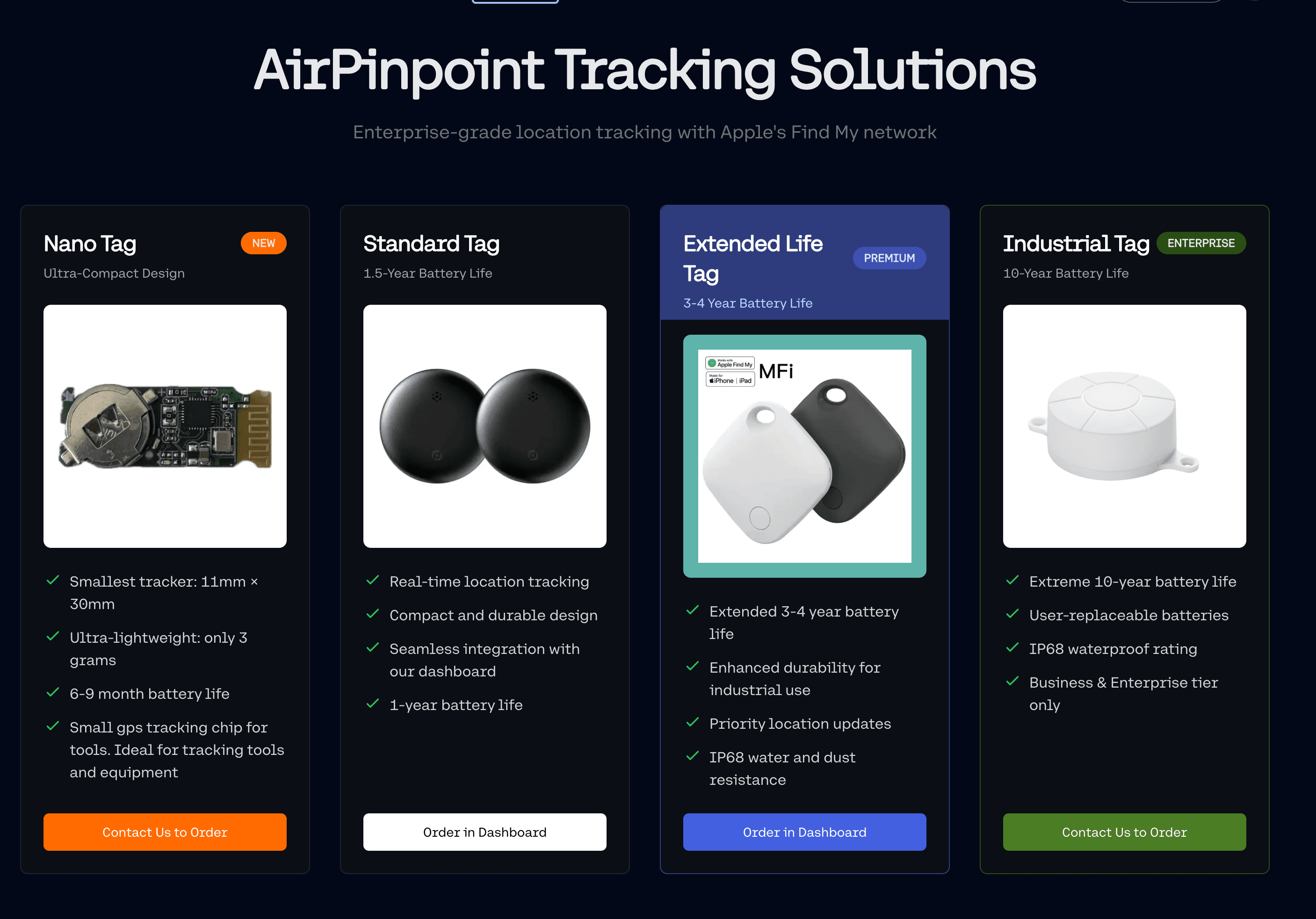
For property managers ready to implement AirTag-based tracking:
Why Airpinpoint Works for Property Management
- Unified dashboard for all AirTag-tracked assets
- Team access for maintenance staff (beyond Apple's 5-person limit)
- Location history for every tagged asset, exportable to CSV or JSON
- Geofence alerts by email, Slack, or WhatsApp when an asset leaves an authorized area. A confirmed alert typically lands 15 to 40 minutes after the asset leaves, because the system waits for consecutive readings rather than firing on a single stray ping
- $11.99 per device per month with no SIM card, no wiring, and no installation, against the $15 to $50 per vehicle per month typical of cellular GPS (volume discounts available for 100+ tags)
And the limits worth knowing before you buy:
- A tag reports when an Apple device passes near it. A van in a suburb updates constantly. A generator behind a vacant property on a quiet road may not report for hours.
- Accuracy is roughly 10 to 30 meters. Address level, not "in the third bay."
- Apple caps each Apple Account at 32 AirTags, which is a real ceiling on large portfolios.
Recommended Starting Points
- Master keys - Highest impact, immediate ROI
- Expensive tools - Pressure washers, generators, specialty equipment
- Fleet vehicles - Backup tracking, theft deterrence
- Common area equipment - Pool tools, fitness equipment keys
Scaling Your System
As your portfolio grows:
- Add AirTags to new properties systematically
- Integrate with property management software
- Combine with smart lockboxes for comprehensive access control
- Consider dedicated GPS for high-value equipment
Conclusion
Property management asset tracking is worth doing when your own arithmetic says so, and you have everything you need to run it. Four documents: last year's locksmith invoices, last year's theft claims plus the losses that fell under your deductible, timesheet hours coded to searching and second trips, and your last fifty work orders split into scheduled and emergency. Total what those four cost you, compare against a year of tags and subscriptions, and the decision makes itself without anyone's ROI percentage.
Start simple with tags on your most critical assets, master keys first, then expensive portable tools. Keep the expectations honest while you do it. A tag tells you where something is, to within roughly 10 to 30 meters, updated whenever an Apple device passes near it. That is enough to end most searches and to turn a theft report into an address. It is not a building sensor network, it does not schedule maintenance, and it will not fix a key handling process that was letting keys walk in the first place.
Ready to start tracking your property management assets? Get started with Airpinpoint and see all your AirTag-equipped keys and equipment in one unified dashboard.
 Our Solution


