
Landscaping Equipment Tracking: The Complete Guide for Lawn Care Businesses
The landscaping industry represents a $153-158.9 billion market with 1.2-1.3 million employees across 726,565 businesses in 2025. Yet this booming industry faces a persistent threat, and the theft data is unusually blunt about who gets hit. In the last full NER/NICB national equipment theft study, riding mowers and garden tractors were 41% of the 11,574 equipment thefts reported to NCIC, the single largest category of stolen equipment in the country. Only 2,442 of those 11,574 machines were recovered, a 21% recovery rate.
If you're running a lawn care or landscaping company, your equipment isn't just tools. It's your livelihood. This guide covers everything you need to know about protecting and tracking your landscaping assets.
The Landscaping Equipment Theft Crisis
Alarming Statistics
Here are the numbers that can be sourced, with who published them and when. Anything you see quoted without that attribution, including on this topic, is usually an estimate that got repeated until it sounded official.
- Mowers rank second among the most targeted equipment types, behind skid steers and ahead of utility vehicles, in NER's Heavy Equipment Theft Trends 2022 from the National Equipment Register, a Verisk business
- 41% of all reported equipment thefts were riding mowers or garden tractors in the NER/NICB national study of 11,574 thefts entered into NCIC, the largest single category ahead of loaders, tractors and utility vehicles
- 21% of stolen equipment was recovered: 2,442 recoveries against those 11,574 reported thefts
- Mowers recover worse than the average. They were 41% of thefts but only 24% of recoveries in the same study, so the category that gets stolen most is also the category that comes back least
- Dealerships, job sites and storage yards are the top three targeted theft locations, in that order (NER, 2022). Texas, Florida and California alone accounted for 46% of reported theft
- Cargo theft hit 3,625 reported incidents in 2024, up 27% from 2023, at an average $202,364 per theft, according to Verisk CargoNet's 2024 supply chain risk analysis. That figure covers freight across the US and Canada rather than landscaping specifically, but it is the number your insurer is watching when a loaded trailer goes missing
What those figures say together: a stolen mower is not a needle in a haystack, it is the most common piece of stolen equipment in America, and the system is not set up to give it back. A car has a VIN that any patrol officer can run against a national database in seconds. A mower has a serial number stamped somewhere under the deck that almost nobody has written down.
Why Landscapers Are Prime Targets
Several factors make landscaping businesses particularly vulnerable:
- Predictable routines - Trailers follow the same routes to the same job sites
- Visible equipment - Branded trucks and trailers are easy to identify and follow
- Overnight storage - Equipment often left in trailers at business locations
- High resale value - Commercial mowers and tools have strong secondary markets
- Seasonal patterns - Thieves know when equipment is in heavy use or storage
- Universal keys - Many mowers use standard keys that are easy to obtain
Peak Theft Seasons
Exposure follows use, and the seasons change where your equipment sits rather than whether it is at risk:
- Spring and summer: Equipment is outdoors, on trailers, and parked overnight at more locations than any other time of year. More places to leave it means more places to lose it
- Overnight and weekends: The gap between the last person leaving and the first person arriving is the whole window. A crew that quits at 5pm Friday and returns at 7am Monday has left a 62 hour hole
- Winter storage: The opposite problem. Everything is in one building, nobody opens the door for weeks, and a theft in early January may not be noticed until March
- Where it sits matters more than when: NER's 2022 data ranks dealerships first, job sites second and storage third among targeted locations. Job sites and storage are the two you control
The useful question is not which week is riskiest. It is how many hours pass between the moment equipment could go missing and the moment somebody would notice. Write that number down for your own operation. For most crews it is longer than they expect.
Understanding Your Equipment Investment
Commercial Zero-Turn Mower Costs
Commercial mowers represent significant capital investment:
| Brand/Type | Price Range | Notes |
|---|---|---|
| Entry commercial ZTR | $6,100 - $7,500 | Quality starting point |
| Mid-range commercial | $7,500 - $15,000 | Most common professional choice |
| Premium commercial | $15,000 - $25,000 | Top-tier Exmark, Scag, Toro |
| High-end commercial | $25,000 - $82,990 | Largest deck sizes, specialty models |
| Commercial walk-behind | $1,000 - $6,000 | Essential for smaller properties |
Leading commercial brands include Exmark (42 zero-turn models, 42-144" decks), Scag, Toro, Husqvarna, Ferris, and John Deere.
Complete Equipment Investment
A typical landscaping operation includes:
| Equipment Category | Cost Range |
|---|---|
| Commercial zero-turn mowers | $6,100 - $25,000+ each |
| Walk-behind mowers | $1,000 - $6,000 each |
| Enclosed trailer | $1,000 - $4,000+ |
| String trimmers | $200 - $600 each |
| Commercial blowers | $300 - $800 each |
| Edgers | $200 - $500 each |
| Hedge trimmers | $300 - $600 each |
| Chainsaws | $300 - $1,200 each |
| Aerators | $1,500 - $5,000 |
| Service truck/van | $25,000 - $60,000 |
| Total startup investment | $15,000 - $50,000+ |
Protecting this investment should be a top priority.
Tracking Solutions for Landscaping Equipment
Apple AirTags: Budget-Friendly Protection
AirTags offer several advantages for landscaping equipment:
Benefits:
- $29 per tag - Affordable to deploy across fleet
- over a billion device network - Apple's Find My network provides extensive coverage
- Affordable tracking - $29 hardware + low monthly subscription, battery lasts ~1 year
- Water-resistant - Survives outdoor conditions
- Compact size - Easy to hide in equipment
Robotic Mower Integration: Some modern robotic mowers have built-in AirTag slots:
- Mammotion LUBA and YUKA models
- Navimow X3 Series
- Designed to work with Apple's Find My network
Placement Recommendations:
- Inside trailer light fixtures
- Under mower deck housings
- Inside equipment compartments
- Behind control panels
- In handlebar tubes (trimmers, blowers)
Limitations to Consider:
- iPhone users (including thieves) receive alerts about unknown AirTags traveling with them
- Rural areas with fewer Apple devices may have gaps in coverage
- Determined thieves who find AirTags can simply discard them
Pro Tip: Use multiple AirTags hidden in different locations, and combine with a hidden GPS tracker for redundancy.
GPS Fleet Tracking Systems
Professional GPS tracking offers more comprehensive features:
Major Providers:
- GPS Trackit - Landscaping-specific solutions with geofencing
- SureCam - Combined GPS and dash cameras
- Top Fleet GPS - Remote starter disable capability
- Azuga - Telematics including mowing pattern tracking
- MiX by Powerfleet - Enterprise-grade fleet management
Typical Features:
- Real-time location tracking
- Geofencing with instant alerts
- Route optimization
- Proof of service (camera footage)
- Maintenance scheduling
- Driver behavior monitoring
- Remote engine disable
Costs:
- Basic GPS tracking: $14-$25/vehicle/month
- Mid-tier solutions: $25-$45/vehicle/month
- Enterprise systems: $45-$250/vehicle/month
- Battery-powered asset trackers: $5-$20/month per device
Hybrid Approach: Best Protection
The most effective strategy combines multiple tracking methods:
- AirTags ($29 each) - Hidden in all major equipment as primary recovery tool
- GPS tracker ($15-40/month) - On trailers and most valuable mowers for real-time alerts
- Dash cameras ($10-30/month) - On service vehicles for proof of service and theft evidence
- Tile trackers (backup) - Hidden separately from AirTags for redundancy
This layered approach ensures that even if thieves find one tracker, others remain hidden.
Physical Security Measures
Trailer Security
Trailers are often the first target. Steal the trailer, get everything inside:
Essential Trailer Security:
- Hitch locks - Prevent quick hookup to thief's vehicle
- Wheel locks/boot - Make towing impossible without removal
- Coupler locks - Block access to trailer ball mount
- Trailer chains - Secure to ground anchors when parked overnight
- Pin locks - Secure trailer to truck during job sites
Parking Strategy:
- Back trailers against walls or fences with minimal clearance
- Position so doors are inaccessible
- Park in well-lit areas with camera coverage
- Vary parking locations to avoid predictable patterns
Equipment Security
For Mowers:
- Wheel locks - Prevent rolling/towing away
- Keyless ignition - Require passcode to start
- Battery disconnect - Remove batteries from stored equipment
- Ground anchors - Cable lock to concrete anchors
For Hand Tools:
- Lockable storage - Secure compartments on trailers
- Tool organization systems - Makes missing items immediately obvious
- Asset tags - Engrave or brand with business info
- Photographic inventory - Document all equipment for insurance
Facility Security
Your storage location needs protection:
- Perimeter fencing - Beyond basic chain link (vulnerable to bolt cutters)
- Motion-sensing lights - Illuminate entire parking/storage area
- Security cameras - 24/7 monitoring with cloud storage
- Alarm systems - Motion detectors for after-hours
- Access control - Limit who can enter facility
Insurance Considerations
Equipment Coverage Options
| Coverage Type | Average Cost | What It Covers |
|---|---|---|
| Inland Marine (Tools/Equipment) | $38/month, $450/year | Mobile equipment, tools in transit |
| General Liability | $51/month, $610/year | Third-party property damage, injuries |
| Business Owner's Policy | $94/month, $1,130/year | Liability bundled with commercial property |
| Commercial Auto | $204/month, $2,452/year | Company vehicle accidents |
| Workers' Compensation | $169/month, $2,029/year | Employee injuries on the job |
| Business Interruption | Varies | Lost income from covered losses |
| Employee Theft | Varies | Internal theft by workers |
Those are median policy costs for landscaping customers as published by Insureon. Your quote will move with payroll, fleet size, claims history and the replacement value of what you are insuring.
Inland Marine Insurance Details
Most landscaping businesses need inland marine coverage for equipment:
- Average cost for landscaping: $38/month, roughly $450/year (Insureon)
- Range across small business generally: Insureon quotes annual premiums from around $150 to over $4,500, averaging $48/month, because the premium tracks insured value
- The $2,500 rule: Insureon notes that any single item worth more than $2,500 may need to be scheduled separately on the policy with its own limit. That threshold catches almost every commercial zero-turn mower you own
- Deductible trade: A higher deductible lowers the premium and raises what you absorb per incident. Contractor programs commonly sit at $1,000 to $2,500. Ask your broker for the same quote at two deductibles and compare the annual saving against one deductible
Insurance Claim Realities
Insurance is a reimbursement mechanism, not a recovery mechanism. Some things it will not do for you:
- It pays the depreciated value unless you bought replacement cost. Actual cash value on a four year old mower is not what a new one costs
- The deductible comes out of every incident, so a run of small tool losses can cost you more in deductibles than the coverage returns
- Scheduled items need a schedule. If a $12,000 mower was never listed with its own limit and your blanket limit is $10,000, the gap is yours
- Replacement takes time. Equipment may not be in stock, and the policy does not buy back the weeks your crew is short a machine
- A claim is a claims history. Whatever it does to next year's premium, it is a conversation you have to have at renewal
Do the arithmetic on your own numbers rather than on anyone's averages: last year's theft and loss write-offs, times your deductible per incident, plus the revenue you lost while short a machine. Set that against the cost of tagging the same equipment. If the first number is zero, you do not need this. Most operations find it is not zero.
Winter Storage Security
Seasonal Storage Challenges
The off-season presents unique risks:
- Equipment sits unattended for months
- Regular checks may be infrequent
- Thieves have more time to plan and execute
- Empty facilities may attract opportunistic theft
Winter Security Protocol
- Remove batteries from handheld equipment (inoperable if stolen)
- Apply wheel locks to all mowers
- Disconnect fuel or add fuel stabilizer
- Ground anchors with cable locks for major equipment
- GPS trackers fully charged or hardwired
- AirTags with fresh batteries
- Security cameras with motion alerts
- Regular check-ins - Visit facility weekly
- Maintain insurance - Don't let coverage lapse
Professional Warehousing Alternative
Some landscaping businesses use professional seasonal warehousing:
- Climate-controlled environments
- 24/7 security monitoring
- Reduced insurance risk
- Frees up on-site storage
- Cost: Varies by region and space needed
Building a Complete Security System
Equipment Protection Checklist
Every Mower:
- Hidden AirTag in secure location
- GPS tracker (high-value units)
- Wheel lock for storage
- Asset tag with business information
- Photographed and documented
Every Trailer:
- Hitch lock
- Coupler lock
- GPS tracker (hardwired or solar)
- Hidden AirTag (separate from GPS)
- Security chains for overnight parking
- Lockable tool storage
Every Service Vehicle:
- GPS fleet tracking
- Dash camera
- Secure tool storage
- Hidden AirTag as backup
Facility:
- Perimeter security beyond chain link
- Motion-activated lighting
- Security camera system
- Alarm with monitoring
- Access control system
Cost Analysis: Protection vs. Loss
Do not take anyone's ROI claim on this, including ours. Build the comparison from numbers you already have.
| Protection Investment | Cost | What it sits against |
|---|---|---|
| 10 tags on Airpinpoint | $290 one time, plus monthly per tag | Replacement cost of the 10 machines you tagged |
| 3 GPS trackers | $45-120/month | Trailers and the two or three highest value mowers |
| Security cameras | $500-2,000 | Your storage yard, once |
| Hitch/wheel locks | $100-300 | The five minutes a trailer takes to hook up and leave |
The four inputs that decide this for you:
- What you wrote off to theft and loss last year, in dollars, from your own books
- Your inland marine deductible, multiplied by the number of incidents you filed
- Hours per week your crews spend looking for equipment that is on another truck, times your loaded labor rate
- The annual cost of tagging the equipment you would actually tag
Add the first three. Compare to the fourth. That is the whole calculation, and it uses no number either of us made up. If line one is zero and line three is under an hour, tracking is not your problem this year.
What to Do If Equipment Is Stolen
Immediate Response (First Hour)
- Check tracking apps - AirTags, GPS, Tile
- Call police - File report immediately
- Document everything - Photos of scene, missing inventory
- Alert employees - Someone may have moved equipment
- Contact insurance - Start claims process early
Recovery Assistance
- Report to Stolen 911 website for equipment recovery network
- Share tracking data with law enforcement
- Monitor online marketplaces - Facebook Marketplace, Craigslist, OfferUp
- Notify local dealers - Thieves may attempt to sell or trade
- Post on industry forums - Landscaper networks often help
Half of Recoveries Happen Within One Week
Recovery is front loaded. In the NICB's 2023 vehicle theft trends data, more than 85% of stolen passenger vehicles came back, 34% of them within a single day and 45% within two days. The curve flattens hard after that. A vehicle still missing at the end of the first week is a vehicle with sharply worse odds.
Equipment starts from a much worse baseline. The NER/NICB national study recorded 2,442 recoveries against 11,574 reported thefts, and for riding mowers and garden tractors the share of recoveries (24%) was well below their share of thefts (41%). But the shape of the curve is the same, and that is the part you can act on.
Here is the mechanism, stated plainly. A tag does not recover anything. What it does is collapse two delays that decide most cases:
- Time to notice. Without tracking, a mower is missing when somebody happens to look for it. That can be Monday morning for a Friday night theft. With location history, the last known position and the time it moved are already recorded.
- Time to a usable police report. A report that says the yard was full Friday and empty Monday gives an officer nothing to act on. A report with a timestamped trail and a current address is a different document. It is still the police who recover the machine, and we have no law enforcement partnerships that change that, but you are handing them something they can work with instead of a description.
Be honest about the limits while you are at it. A Find My tag reports position when an Apple device passes near it, so a machine sitting in a rural outbuilding may not report for a while. Accuracy is address level, roughly 10 to 30 meters, not shelf level. And a tag a thief finds is a tag a thief throws away, which is the whole argument for hiding more than one.
The Airpinpoint Advantage
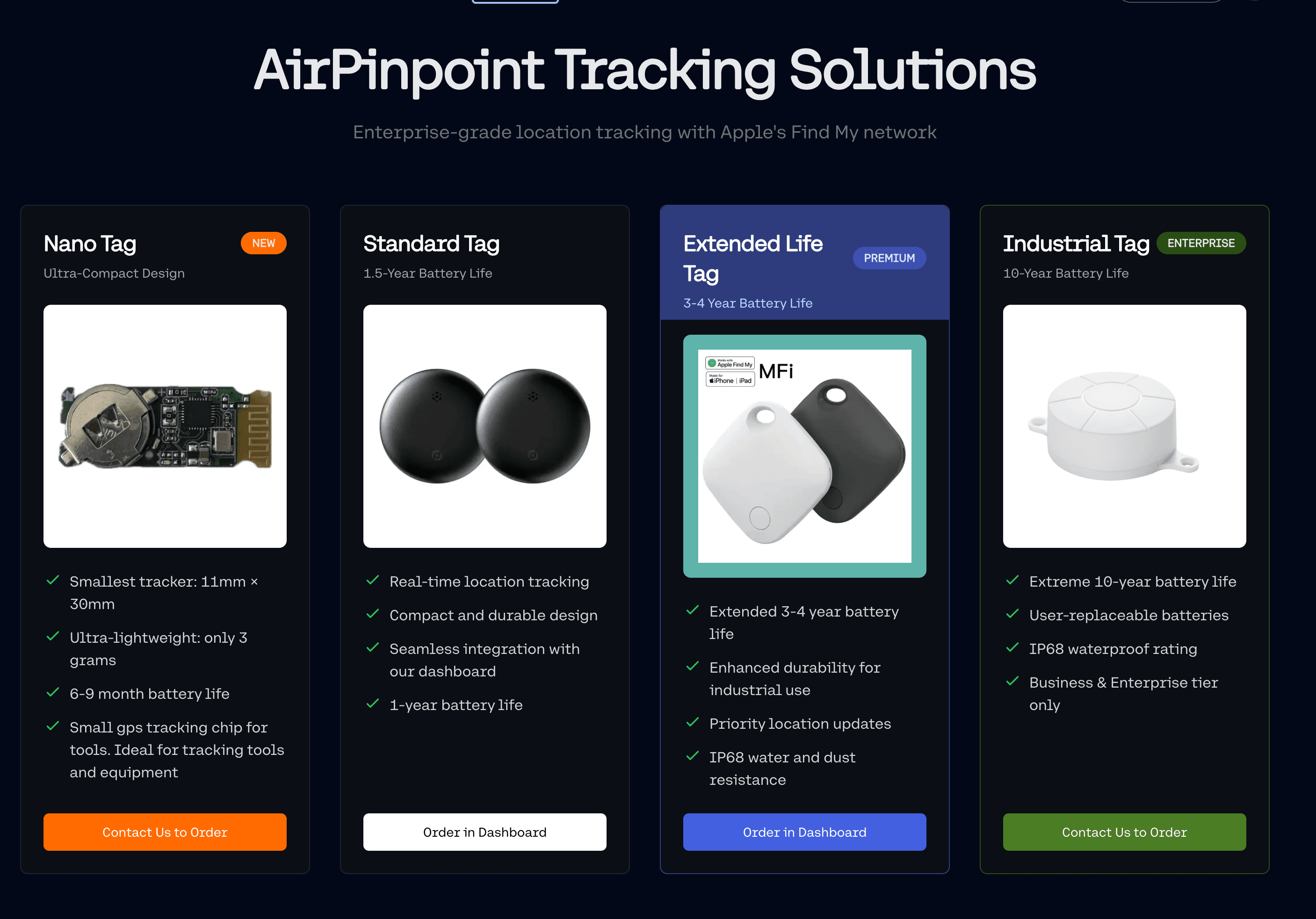
While individual AirTags and GPS trackers work, managing them across a growing fleet becomes challenging. Airpinpoint offers:
- Unified dashboard for all your Apple AirTag-equipped assets
- Team access so all employees can locate equipment
- Movement alerts when equipment leaves designated areas
- History tracking to see where equipment has been
- Simple per-device pricing - Affordable monthly rate per tracker
Perfect for Landscaping Operations
- Track every mower, trailer, and major tool from one interface
- Assign equipment to job sites and crews
- Know the same day if something doesn't return
- Document equipment locations for insurance purposes
- Scale from solo operator to multi-crew enterprise
Getting Started
Minimum Viable Protection (Under $200)
- 5 AirTags ($145) - One per major mower, one in trailer
- Hitch lock ($30-50) - For trailer
- Airpinpoint subscription - Unified management
Recommended Protection (Under $500)
Add:
- GPS tracker for trailer ($100-150 device + $15/month)
- Additional AirTags for hand tools
- Wheel locks for mowers
- Motion-activated camera ($50-100)
Comprehensive Protection ($1,000-2,000+)
Full implementation:
- GPS fleet tracking on all vehicles
- AirTags in every piece of equipment
- Security camera system at facility
- Professional monitoring subscription
- Upgraded fencing and lighting
Conclusion
Two numbers are worth carrying out of this page, and both come from the NER/NICB national equipment theft study. Riding mowers and garden tractors were 41% of reported equipment thefts, the largest category in the country. And 2,442 of 11,574 stolen machines came back, a 21% recovery rate, with mowers recovering at a lower rate than that average. Your equipment is the most stolen category there is, in the category least likely to be returned.
AirTags provide an affordable entry point at $29 per device, leveraging Apple's over a billion device network for coverage that GPS alone can't match. They will not stop a theft, and they do not recover anything by themselves. What they do is turn "the yard was full Friday and empty Monday" into a timestamped trail with an address on the end of it, which is the difference between a police report that gets filed and one that gets worked.
Don't wait until after a theft to implement tracking. The equipment you lose tomorrow could have been protected today.
Ready to protect your landscaping equipment? Get started with Airpinpoint and track all your AirTag-equipped assets from one dashboard.
 Our Solution


