AI Inventory Management: The $27 Billion Industry Built on a Data Problem
The AI inventory management market will hit $27 billion by 2029. Every major platform promises the same thing: predict demand, automate reordering, reduce stockouts, optimize warehouse operations.
There's a problem nobody talks about. Gartner's 2024 survey of 644 organizations found only 48% of AI projects reach production. S&P Global Market Intelligence's 2025 survey of 1,006 IT and line-of-business leaders found 42% of companies had abandoned the majority of their AI initiatives before production, up from 17% the year before. Gartner's own read on why is blunt: it predicts organizations will scrap 60% of AI projects that are not supported by AI-ready data.
AI can't manage inventory it can't see.
What AI Inventory Management Actually Does
Strip away the marketing and AI inventory management breaks into four capabilities:
| Capability | What It Does | What It Needs |
|---|---|---|
| Demand forecasting | Predicts future order volume using historical sales, seasonality, trends | Accurate current stock levels |
| Auto-reordering | Triggers purchase orders when inventory hits threshold | Real-time count of what's on hand |
| Anomaly detection | Flags unusual patterns (shrinkage, misplacement, theft) | Continuous location data |
| Warehouse optimization | Optimizes picking routes, slotting, layout | Knowing where items actually are |
Every single capability assumes accurate, real-time data about where inventory is and how much you have. Every single one breaks when that assumption is wrong.
The Accuracy Gap
The numbers are bad, and where they are published at all they are published by named benchmarking bodies rather than by "industry surveys." Here is what actually exists, with the source for each:
| Metric | Figure | Source |
|---|---|---|
| Inventory count accuracy by location, distribution centers, median | 98.40% (best in class 99.88%, fourth quintile 90-97%) | WERC DC Measures |
| Inventory accuracy, cross-industry median | 95.0% (n=8,660 companies) | APQC Open Standards Benchmarking |
| Inventory accuracy, survey average | 91%, with the lowest performers at 67% | CAPS Research / ISM, 2023 |
| Retail store-level inventory record accuracy before RFID | ~63-65% | Auburn University RFID Lab, GS1 US Project Zipper |
| Retail shrink, FY2022 | 1.6% of sales, $112.1B | NRF National Retail Security Survey 2023 |
| Cost of poor data quality per organization | $12.9M a year on average | Gartner, 2020 (154 reference customers) |
| Cost of bad data as a share of revenue | 15% to 25% | Thomas Redman, MIT Sloan Management Review, 2017 |
| AI projects that reach production | 48% | Gartner, 2024 (n=644) |
| Companies abandoning most AI initiatives before production | 42%, up from 17% | S&P Global Market Intelligence, 2025 (n=1,006) |
Read that table carefully, because the spread between the rows is the actual finding. A well-run distribution center counts its bins at 98% accuracy. A retail store floor, measured independently, runs closer to 63%. The gap is not a technology gap, it is a measurement gap: the DC counts locations, the store counts what the system believes. Nobody publishes a single "average warehouse accuracy" number, and any page that hands you one without naming a benchmarking body made it up. We used to be one of those pages.
Two things follow. First, whatever your real accuracy is, you do not know it unless you have counted, and the honest starting move is to count one zone against the system of record and see what falls out. Second, whatever fraction is wrong propagates: when AI demand forecasting runs on stock counts that are off, it generates predictions that are off, and auto-reordering turns those predictions into purchase orders. You get overstock on items you already own but cannot find, and stockouts on items the system thinks are on the shelf.
The damage from feeding bad data into automated systems is not theoretical. Gartner puts the average cost of poor data quality at $12.9 million per organization per year. Unity Software cut its 2022 revenue guidance by roughly $110 million after two failures in its ad-targeting machine learning stack, one of which its CEO attributed on the Q1 2022 earnings call to losing the value of training data "due in part to us ingesting bad data from a large customer."
One widely repeated claim we will not repeat: that 85% of AI projects fail, and that 70% of those failures are caused by data quality. The 85% traces to a 2018 Gartner prediction that 85% of AI projects would "deliver erroneous outcomes due to bias in data, algorithms or the teams responsible" through 2022. That is a prediction about bias, with an expired horizon, not a measured failure rate. The 70% traces to a 2024 McKinsey finding that 70% of top performers reported difficulties integrating data into AI models, which is close to the opposite of what it gets quoted for.
The AI Inventory Stack (and Its Missing Layer)
Here's what a typical AI inventory management deployment looks like:
| Layer | Tool Examples | Monthly Cost | What It Does |
|---|---|---|---|
| ERP / Inventory Platform | NetSuite, SAP, Fishbowl | $229-$50,000+ | System of record, order management |
| AI Forecasting | Prediko, Blue Yonder, RELEX | $500-$10,000+ | Demand prediction, reorder optimization |
| Warehouse Management | Manhattan, Körber, HighJump | $1,000-$25,000+ | Picking, packing, shipping workflows |
| Physical Location Layer | ??? | ??? | Where assets actually are right now |
That bottom layer is the one most companies skip. They assume barcode scans at receiving and shipping are enough. They're not. Between those two scan points, inventory moves, gets misplaced, gets borrowed by another department, gets loaded on the wrong truck, or disappears entirely.
How Real-Time Tracking Makes AI Inventory Work
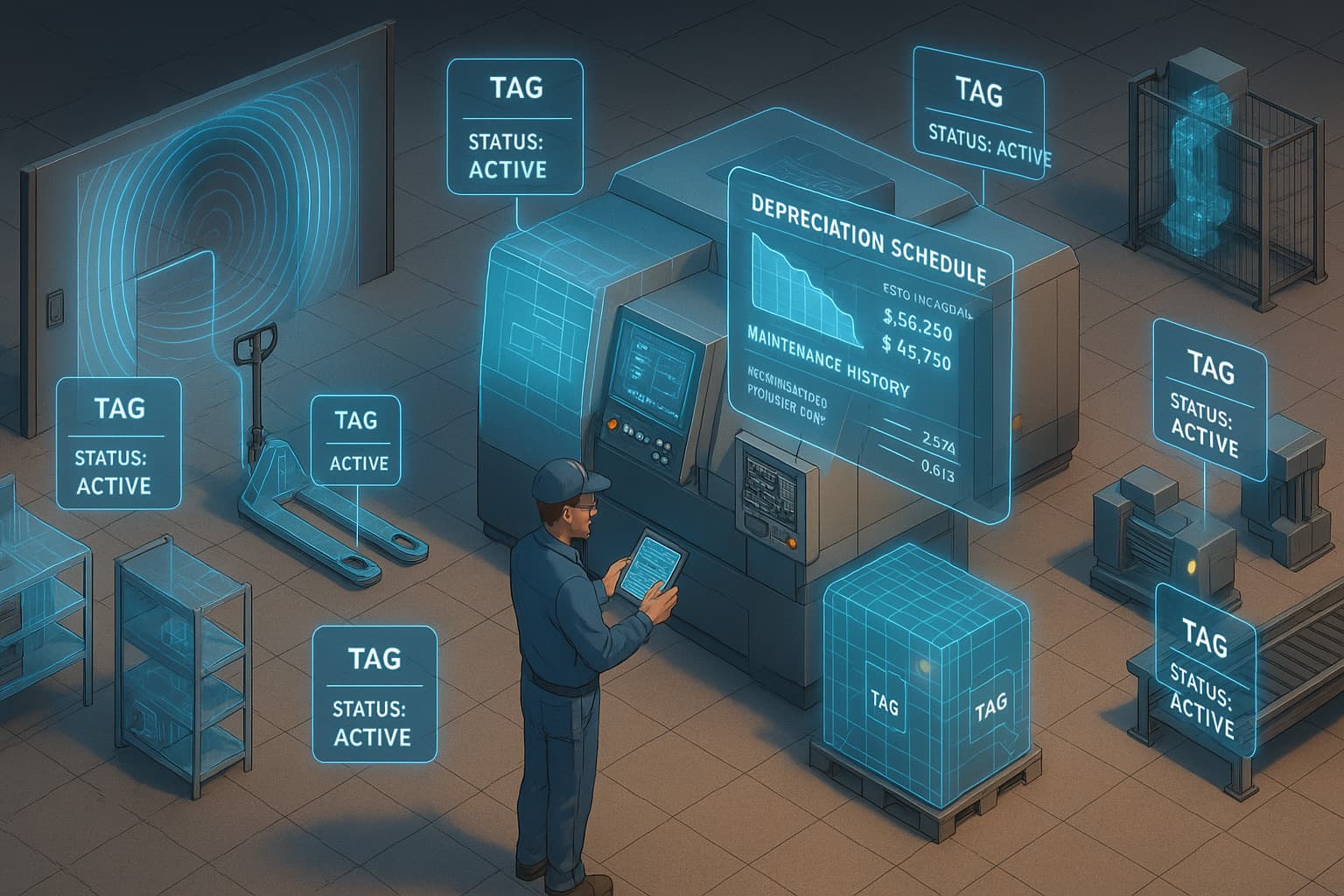
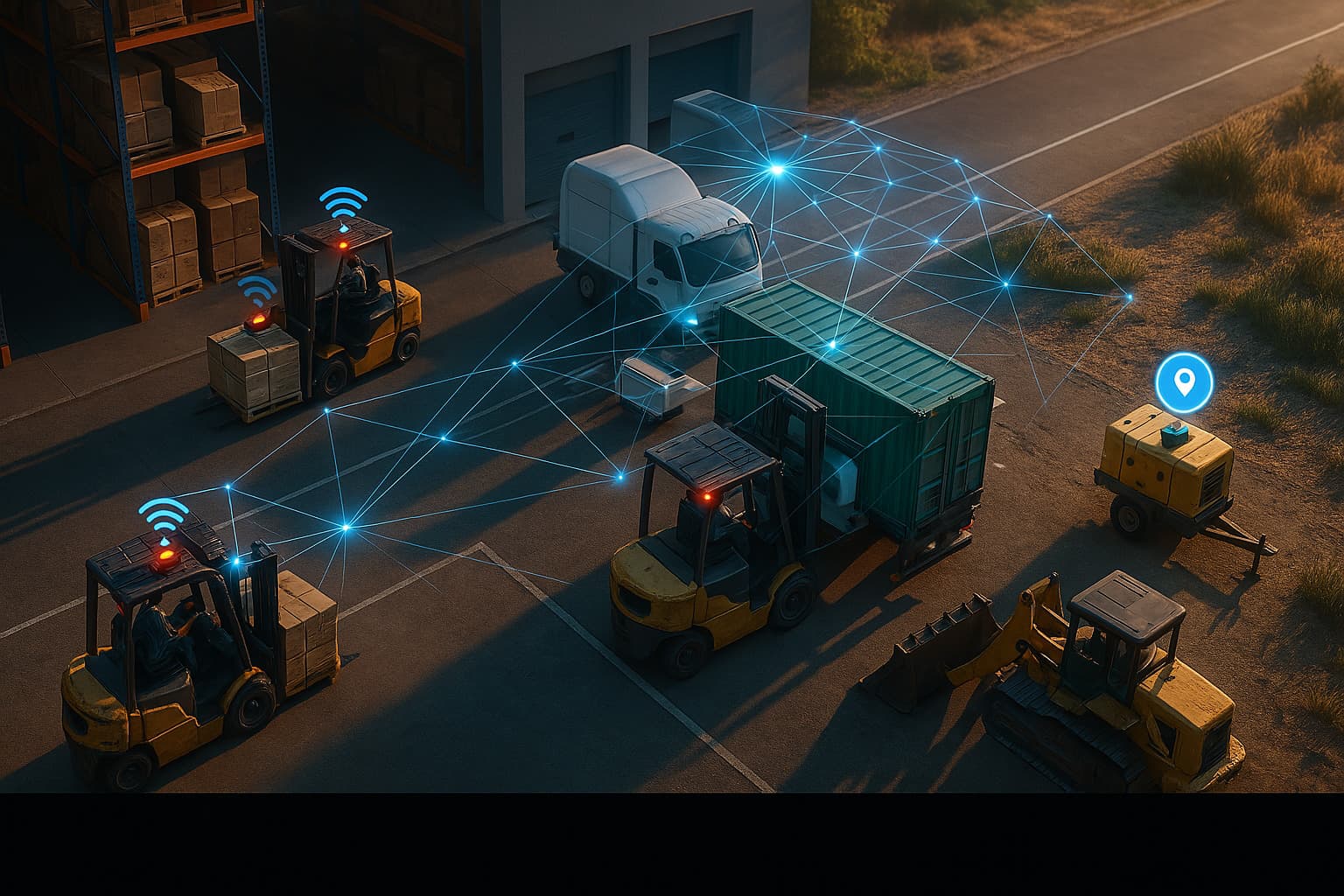
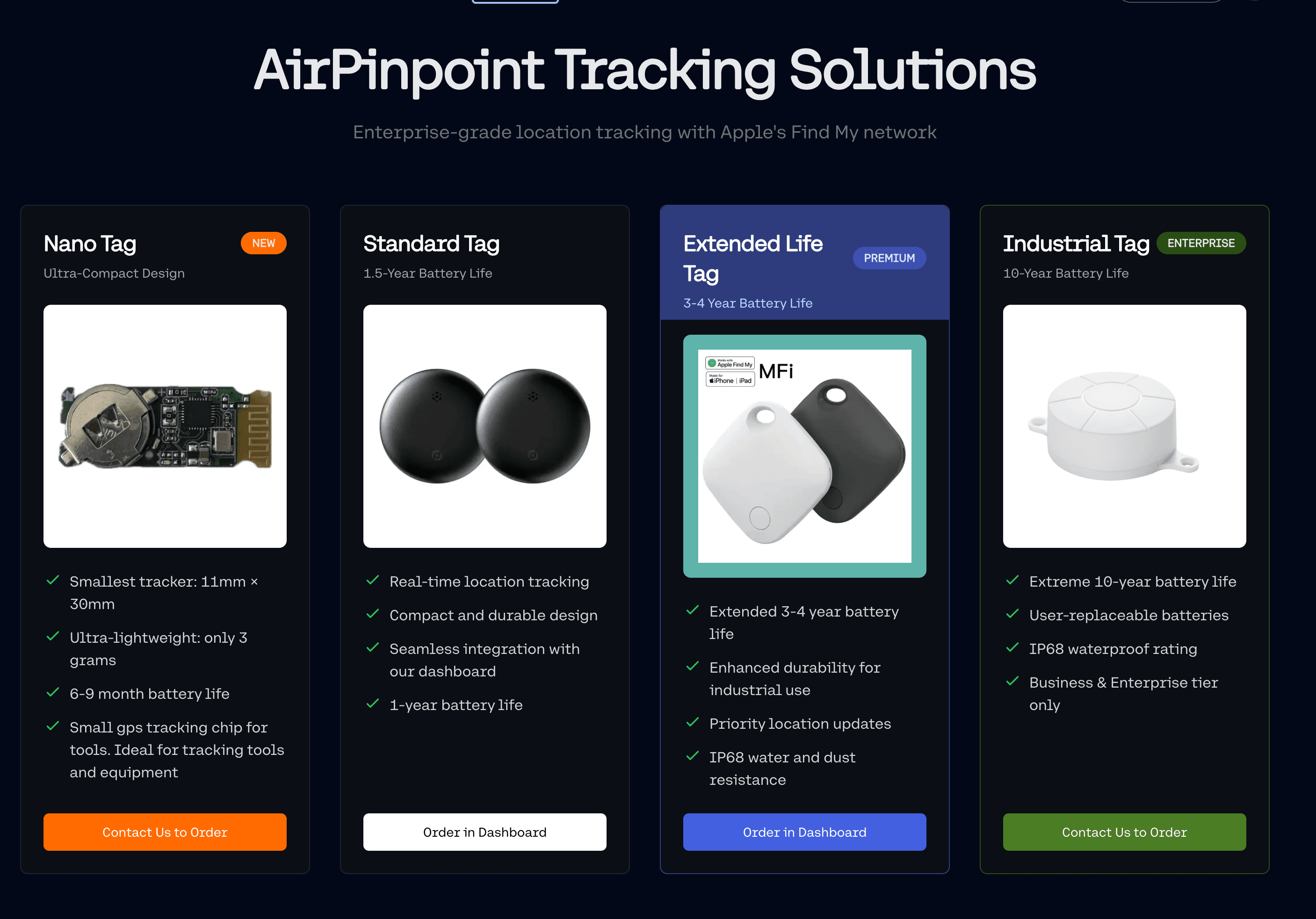
Airpinpoint fills the physical location layer. Every tracked asset reports its position continuously via the Apple Find My network, without manual scans, without fixed infrastructure, without batteries that die every two weeks.
What Changes When AI Has Accurate Location Data
Demand forecasting improves. When the system knows you have 47 units across three warehouses (not 52 units in one warehouse as the ERP claims), it makes better purchasing decisions. No more ordering 20 units you already own but can't find.
Stockouts decrease. A stockout often isn't a supply problem. It's a visibility problem. The item exists in your network but not where you need it. Real-time location data lets the AI system suggest internal transfers instead of new purchase orders.
Shrinkage drops. Anomaly detection works when it has continuous location data. An asset that leaves a geofence at 2am triggers an alert. An asset that hasn't moved in 30 days when it should be in active rotation gets flagged. Without location data, these events are invisible until the next physical count.
Warehouse optimization gets real inputs. You can't optimize a picking route around inventory that isn't where the system says it is. Every misplaced item turns a routed pick into a search. With continuous tracking, slotting algorithms know actual positions, not theoretical ones.
AI Inventory Management Platforms Compared
The major platforms vary in AI capability, pricing, and what they assume about your data quality:
| Platform | AI Features | Starting Price | Location Tracking | Data Assumption |
|---|---|---|---|---|
| NetSuite | Demand forecasting, auto-reorder, supply planning | ~$2,000/mo | None built-in | Trusts ERP counts |
| SAP IBP | ML forecasting, supply chain optimization | ~$5,000/mo | None built-in | Trusts ERP counts |
| Fishbowl | AI reporting, reorder points | $229/mo | Barcode scanning | Trusts scan data |
| Blue Yonder | Deep learning forecasting, allocation | Custom pricing | RFID integration available | Better, but gate-based |
| Prediko | Demand sensing, auto-replenishment | ~$500/mo | None | Trusts Shopify/ERP data |
| Airpinpoint | N/A (location layer, not prediction) | $11.99/device/mo | Continuous, real-time | Measures directly |
None of these platforms solve the physical location problem on their own. The ones with RFID integration get closer, but RFID requires fixed readers at every doorway. Airpinpoint tracks assets anywhere, including between facilities, on trucks, and at customer sites.
Where AirTag Tracking Fits (and Where It Doesn't)
Airpinpoint is not an AI inventory management platform. It's the data layer that makes those platforms accurate.
Good Fit
- High-value assets ($500+ per item): equipment, tools, containers, pallets, vehicles
- Multi-site operations: assets moving between warehouses, job sites, stores, or customer locations
- Mobile inventory: anything that leaves a fixed facility (delivery vehicles, rental equipment, field service tools)
- Theft-prone items: generators, power tools, electronics, copper, catalytic converters
Not the Right Fit
- Individual consumer SKUs: tracking 10,000 individual units of a $15 product isn't practical with AirTags
- Items inside metal containers: AirTag Bluetooth signals don't transmit through solid metal enclosures
- Sub-second real-time tracking: AirTags update every few minutes to hours, not continuously
For individual SKU tracking at the unit level, barcode or RFID remains the right approach. Airpinpoint works at the container, pallet, case, and asset level.
The Cost of Not Knowing Where Things Are
Companies spend millions on AI forecasting software without ever measuring the accuracy of what feeds it. We are not going to hand you a cost of the accuracy gap, because it depends entirely on numbers that sit in your own books. Here are the four lines to pull, and the arithmetic:
| Line to pull | Where to get it | How to compute it |
|---|---|---|
| AI and inventory platform spend | Your contracts | Annual licence and implementation, already known |
| Inventory written off last year | Your GL or last physical count variance | Dollar variance between physical count and perpetual inventory. If you have never counted a zone against the system, count one and extrapolate |
| Emergency and duplicate reorders | Purchasing records | Rush-freight premiums, plus POs for items later found on site |
| Labor spent searching | Ask your pickers, then measure a week | Hours per week searching, times loaded labor rate, times 52 |
For scale on the second line: NRF measured retail shrink at 1.6% of sales in FY2022. Apply your own rate, not that one, because shrink varies enormously by sector and a distribution center is not a store floor. The point of the exercise is that the third and fourth lines are usually the ones nobody has ever costed, and they are frequently larger than the write-off.
Now compare that against the cost of closing the gap:
| Solution | Annual Cost (100 assets) |
|---|---|
| Airpinpoint (100 devices x $11.99/mo) | $14,388/yr |
| AirTags (100 x $29, amortized over 3 years) | $967/yr |
| Battery replacement (100 x $3/yr) | $300/yr |
| Total | $15,655/yr |
Run your four lines against that $15,655. If the sum of write-offs, rush reorders and search labor clears it, the decision makes itself. If it does not, do not buy tags, and we would rather tell you that than quote you a payback period we cannot support.
Implementation: Adding Location Data to Your AI Stack
Phase 1: Tag High-Value Assets (Week 1)
Start with the assets that cause the most pain when they go missing. Equipment over $5,000, frequently moved items, and anything that crosses facility boundaries.
- Purchase AirTags ($29 each)
- Register in Airpinpoint
- Mount on assets (inside cases, compartments, or weatherproof holders)
- Set up geofences around facilities and storage areas
Phase 2: Connect to Your Inventory System (Week 2-3)
Configure Airpinpoint webhooks to push location events to your inventory platform:
- Asset enters facility > update inventory system location
- Asset leaves geofence > flag for review or trigger transfer record
- Asset stationary for X days > flag as potentially idle or misplaced
Phase 3: Let AI Work With Real Data (Week 4+)
With accurate location data flowing into your inventory system, your AI tools start performing as advertised. Demand forecasts improve because current stock counts are correct. Auto-reordering stops creating duplicate orders for misplaced items. Anomaly detection catches real anomalies instead of drowning in noise from bad data.
Honest Limitations
Airpinpoint is not an AI platform. It doesn't forecast demand, optimize reorder points, or automate purchasing. It provides the physical-world data that makes those systems work.
Update frequency varies by location. In urban areas with high iPhone density, updates come every few minutes. In rural or low-traffic areas, updates may be less frequent. For most warehouse and logistics operations in populated areas, this is not a limiting factor.
Not for unit-level consumer goods tracking. Tracking 50,000 individual product units requires barcode or RFID. Airpinpoint works at the asset, container, and equipment level.
Requires Apple ecosystem proximity. AirTags need nearby iPhones (within ~30 feet) to relay location. In any commercial or urban environment, iPhone density is sufficient. Isolated storage locations with zero foot traffic won't get regular updates.
The Bottom Line
The AI inventory management industry is building increasingly sophisticated prediction and optimization tools on top of data nobody has measured. Gartner expects organizations to abandon 60% of AI projects that are not supported by AI-ready data. No amount of machine learning compensates for not knowing where your inventory actually is.
Airpinpoint doesn't compete with NetSuite, SAP, or Fishbowl. It makes them work. For $11.99/device/month, you get the real-time location data layer that closes the accuracy gap between what your system thinks and what's actually happening on the ground.
AI inventory management is only as good as the data feeding it. Start with accurate location data, and the AI works. Skip it, and you're running a $100K/year forecasting engine on garbage inputs.
 Our Solution