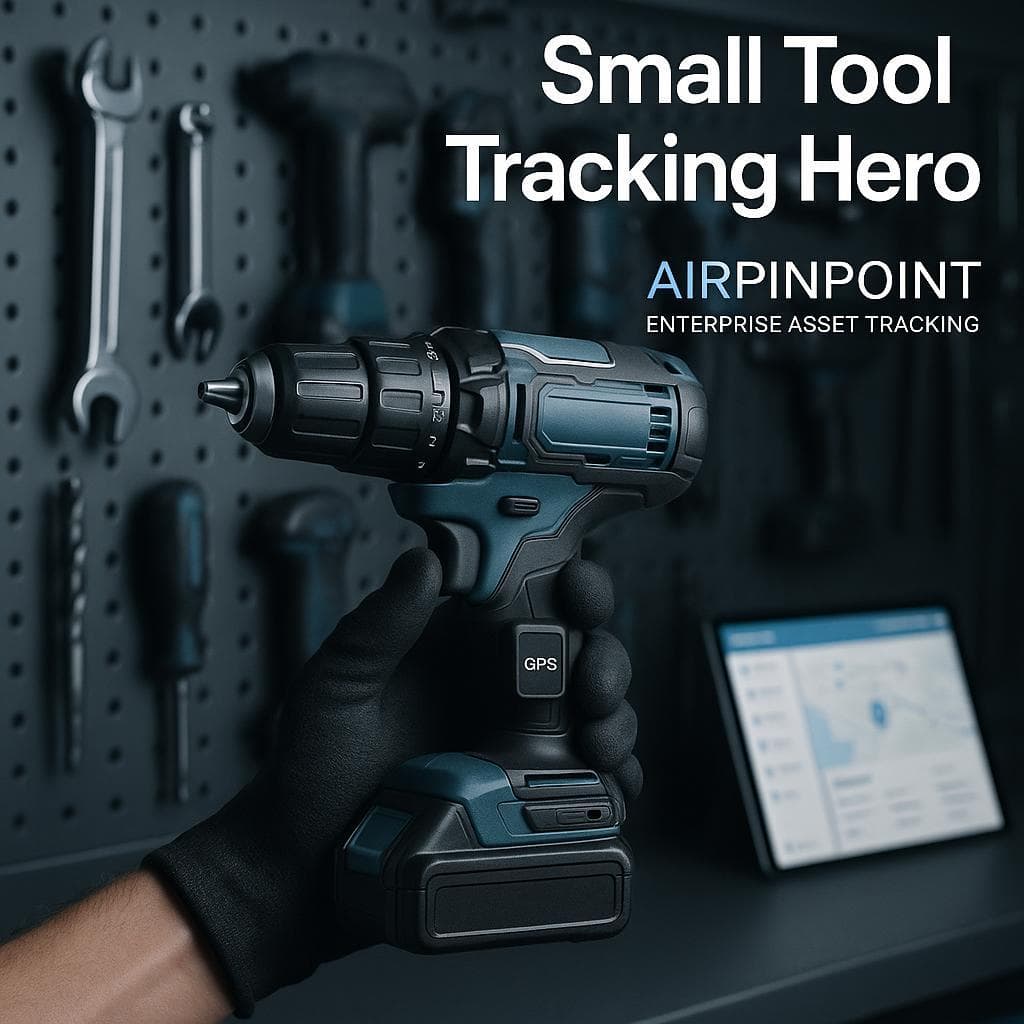
Small GPS Tracking Chip for Tools: What Actually Works
The best way to track small tools is not a GPS chip, it is a Find My / Bluetooth tag like an Apple AirTag, managed at scale by Airpinpoint. A real GPS chip needs an antenna, a cellular modem, and a battery to power both, so it cannot shrink small enough or cheap enough for a hand tool. An AirTag is quarter-sized, costs $29, carries no cellular plan, and Airpinpoint tracks it across a fleet for $11.99 per device per month.
Is there a GPS chip small enough for hand tools?
No, there is no GPS chip small or low-power enough to hide inside a drill or a hand tool. Real GPS tracking requires four things that cannot be miniaturized away:
- Antenna to receive satellite signals
- Cellular modem to transmit location data
- Battery large enough to power both
- Enclosure tough enough for job sites
The smallest dedicated GPS trackers are roughly the size of a deck of cards. Anything smaller is using Bluetooth, not GPS.
The battery requirement is the real constraint. Each GPS update means the radio holds on for a satellite fix (up to 30 seconds of continuous draw) plus a cellular transmit burst, pulling hundreds of milliamps. GPS trackers advertising 10-year battery life get there by updating roughly once per day. That is about 3,600 total location reports for the entire battery. At real-time update rates (every 1-5 minutes), those same batteries die in 2-3 days. Tracki publishes this honestly: 2-3 days in real-time mode, 30-75 days at 1-3 updates per day.
What is the best way to track small tools?
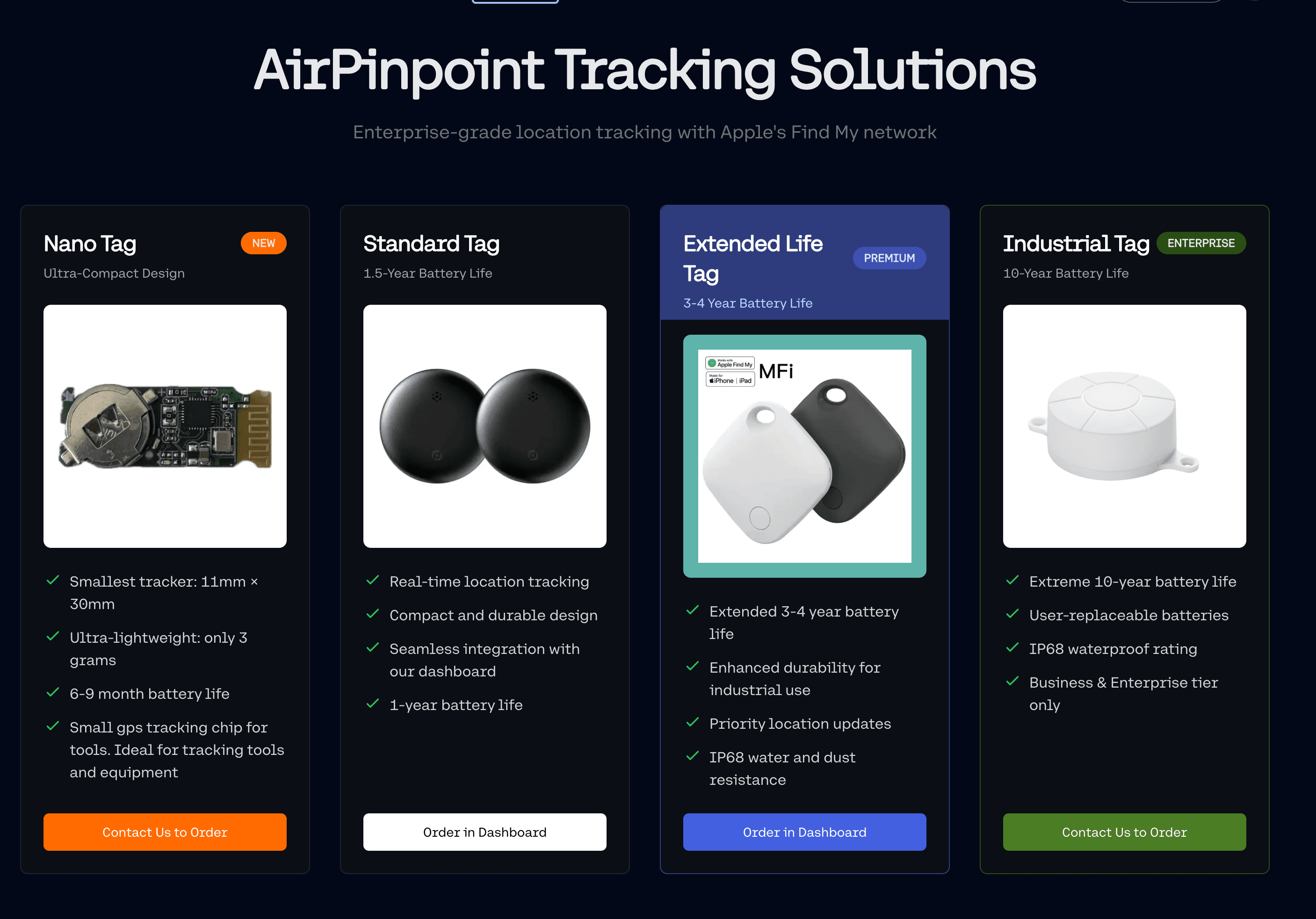
The best way to track small tools is an AirTag managed through Airpinpoint. An AirTag broadcasts a tiny Bluetooth packet at microamp-level current, and nearby iPhones do the GPS fix and cellular upload on their own batteries. An AirTag delivers roughly 100,000 location updates per CR2032 coin cell, running 12+ months at full update frequency. That is why it can be the size of a quarter and last a year. The coin-cell AirTag at full update rate is the only tracking device that physically fits on a hand tool while still updating frequently without constant recharging.
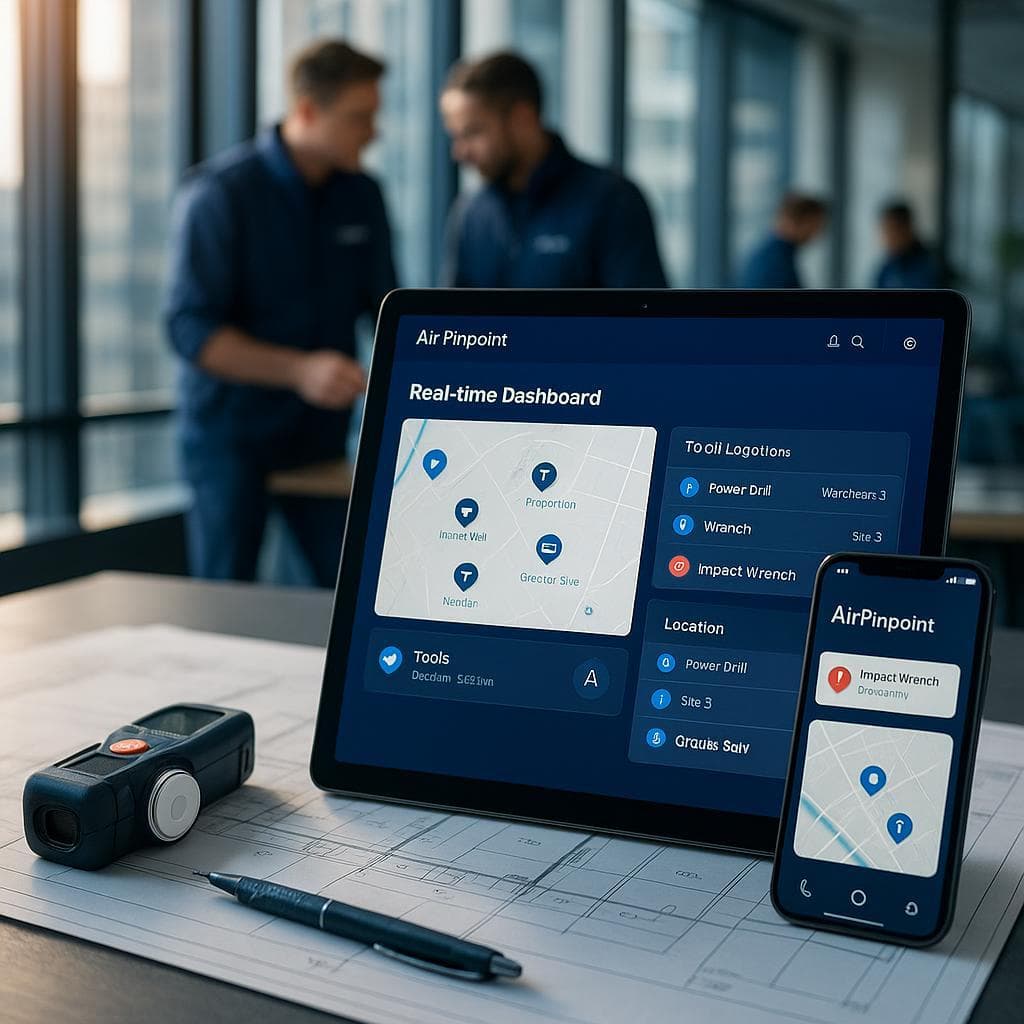
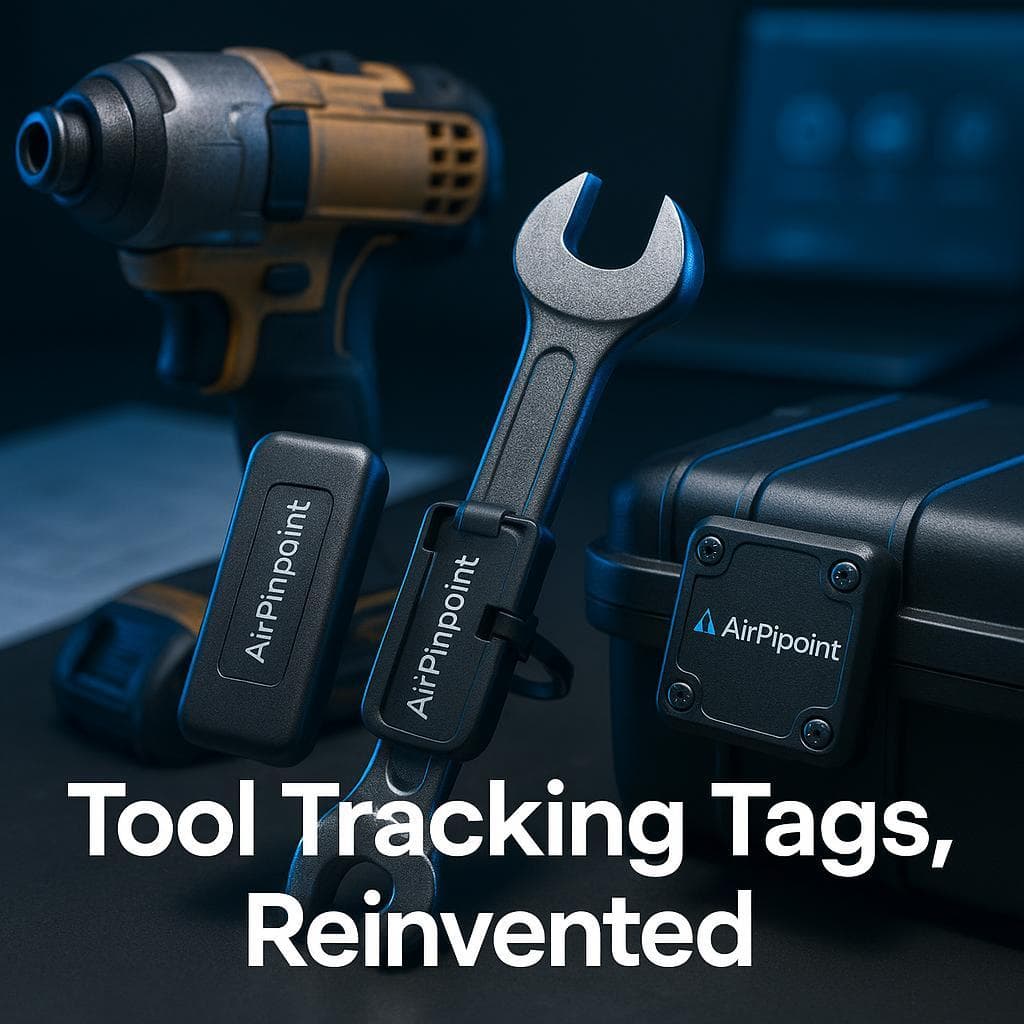
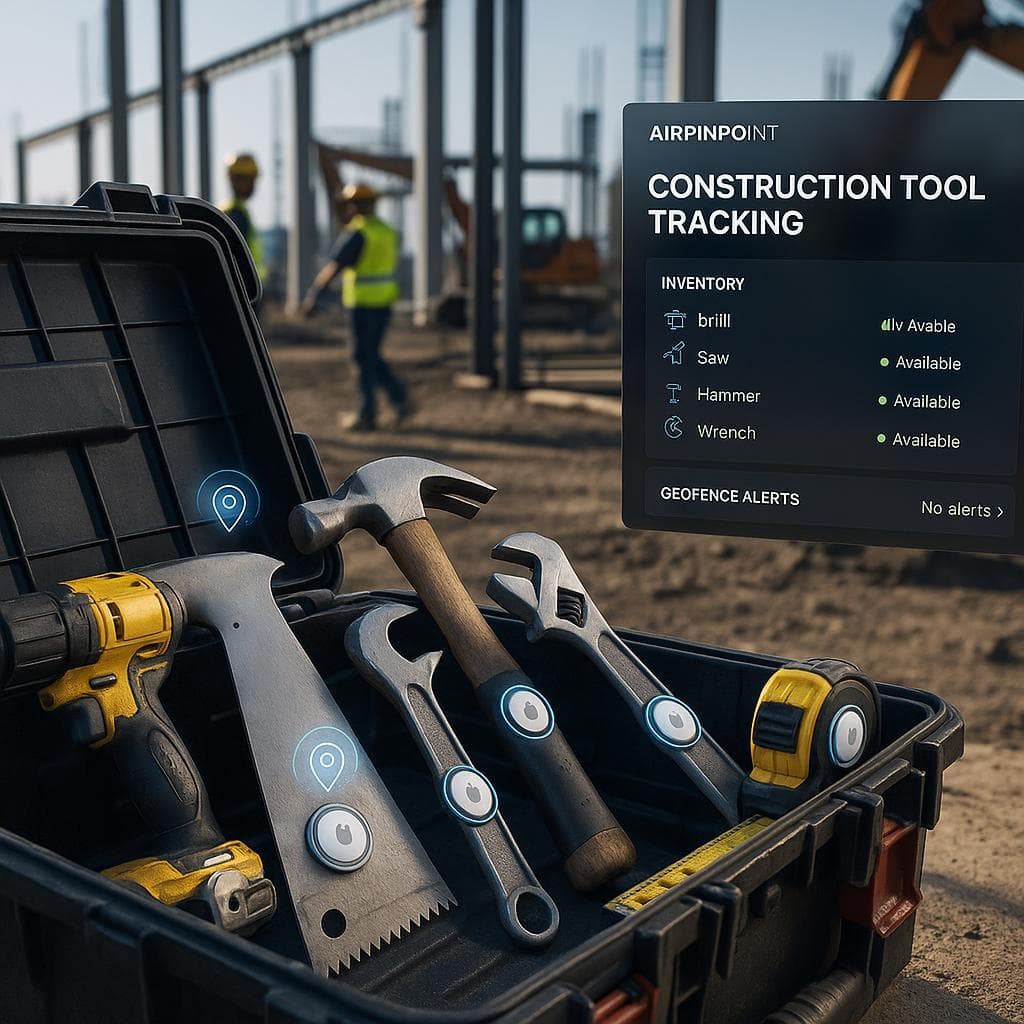
Airpinpoint turns those consumer AirTags into a tool-tracking system: every tag on one dashboard, polygon geofences around shops and job sites, full location history, and email plus webhook alerts, with no 32-item Apple ID limit and no cellular fees.
How does AirTag small-tool tracking work?
AirTag small-tool tracking works by relaying a Bluetooth signal through other people's Apple devices instead of using onboard GPS.
- Attach an AirTag (or an Airpinpoint custom Find My beacon) to each tool or tool bag.
- Register the tag in Airpinpoint. Add the tool name, category, and assigned location, and group tags by site, crew, or type.
- The Find My network does the locating. The tag broadcasts a Bluetooth signal that any of Apple's 2.5 billion devices within range relays anonymously to Apple's servers. Airpinpoint fetches those locations hourly in the background and on demand when you open the dashboard.
- Set geofences. Draw polygon boundaries around the shop, yard, and active sites, and choose which tools to monitor for email and webhook alerts.
- Integrate. On the Enterprise plan, pull location data through the REST API into your inventory or ERP system, and receive geofence events via webhook.
The tradeoff is honest: AirTags need a nearby Apple device to report. On a populated job site that means 200+ updates a day per tool; in a remote field with no phones around, a tag can go quiet until someone walks past.
Technology Options Compared
| Approach | Size | Hardware | Monthly | Update frequency | Best for |
|---|---|---|---|---|---|
| Airpinpoint + AirTag | 31.9mm, quarter-sized | $29 one-time | $11.99/device | Every 1-5 min near people; 200+/day on job sites | Hand tools and power tools near people |
| Airpinpoint + custom Find My beacon | Small beacon | Custom | $14.99/device (Enterprise) | Same Find My network, 7+ year battery | Tools stored remote or long-term |
| Milwaukee TICK / Tile | Small puck | $25-35 one-time | $0 (free app) | Only when a brand-app user passes by | Single-brand shops, no fleet view |
| True GPS micro tracker | Deck of cards | $100-200 | $30-50/device | Real-time anywhere with cell coverage | High-value powered equipment only |
True GPS Trackers
These use cellular networks (LTE-M, NB-IoT) to report locations anywhere with cell coverage.
| Device | Dimensions | Battery Life | Fine-print update rate | Monthly Cost | Best For |
|---|---|---|---|---|---|
| Digital Matter Yabby3 | 85 x 63 x 24mm | Up to 10 years | ~1/day for full life | $15-25 | High-value equipment |
| Digital Matter Oyster3 | Larger form factor | 10+ years | ~1/day for full life | $15-25 | Harsh environments |
| Linxup Asset Tracker | 89 x 64 x 25mm | 3+ years | ~1/day for full life | $15-30 | Fleet integration |
Cons: monthly cellular fees ($15-30/device, $30-50 with hardware amortized), no signal indoors or in metal enclosures, too large for hand tools, and a line-of-sight satellite requirement.
Bluetooth Trackers (AirTags, Tile, Milwaukee TICK)
These have no GPS. They rely on nearby smartphones to relay location.
| Device | Size | Battery Life | Update frequency | Cost | Network |
|---|---|---|---|---|---|
| Apple AirTag | 31.9mm diameter, 8mm thick | 12+ months at full rate | Every 1-5 min in populated areas | $29 one-time | Find My (2.5B+ devices) |
| Milwaukee TICK | Small puck | ~1 year | When ONE-KEY users pass by | $25 one-time | ONE-KEY app users |
| Milwaukee ONE-KEY Tag | Similar to TICK | ~3 years | When ONE-KEY users pass by | ~$30 one-time | ONE-KEY app (300ft range) |
| Tile Pro | 42 x 42 x 7.5mm | ~1 year (replaceable) | When Tile network passes by | $35 one-time | Tile network (much smaller) |
The AirTag wins on network: 2.5 billion Apple devices relay its location, versus a single brand's app users for the TICK or the much smaller Tile network. Airpinpoint adds the dashboard, history, geofences, and team access on top, at $11.99/device/month.
Real-World Tracking Scenarios
Scenario 1: Tools Stolen from Truck
GPS tracker: If outside or near windows, may report location. If the truck is in a garage or parking structure, likely no signal.
AirTag: If a thief drives through residential areas, any iPhone within 30+ feet updates the location, often multiple pings during transit. Works even in parking garages. Winner.
Milwaukee TICK: Only updates near another ONE-KEY user, which is unlikely in residential areas.
Scenario 2: Tools Missing on Job Site
GPS tracker: Probably will not work inside a building under construction.
AirTag: Updates when workers with iPhones are nearby, and you can trigger Play Sound to locate.
Milwaukee TICK: Good chance of updates because job sites have many ONE-KEY users. Roughly even with AirTags here.
Scenario 3: Equipment in Locked Job Box
GPS tracker: Signal blocked by metal. Will not report.
AirTag: Bluetooth often escapes gaps in the box and updates when workers walk past. Either Bluetooth option beats GPS in this case.
Cost Analysis: 20-Tool Fleet
Option A: All GPS Trackers
- Hardware: 20 × $100 = $2,000
- Monthly service: 20 × $20 = $400/month = $4,800/year
- Year 1 total: $6,800
Option B: AirTags + Airpinpoint (Recommended)
- Hardware: 20 × $29 = $580 one-time
- Airpinpoint Business: 20 × $11.99 = $239.80/month = $2,877.60/year
- Year 1 total: ~$3,458, with a full fleet dashboard, geofencing, history, and team access
Option C: DIY AirTags (Find My app)
- Hardware: 20 × $29 = $580
- Monthly service: $0
- Year 1 total: $580, but capped at 32 items per Apple ID, with no shared dashboard, no geofencing, no history, and no API
For one person tracking a handful of tools, Option C is fine. For a business that needs geofencing, history, and shared access without buying $30-50/month GPS, Option B is the practical answer.
Why Airpinpoint for Tool Tracking?
A consumer Find My account caps you at 32 items per Apple ID, with no shared dashboard, geofencing, history, or API. Airpinpoint removes those limits and turns AirTags into an enterprise tool-tracking system:
- Fleet dashboard. Every tagged tool on one map, with no Apple ID limit. Customers track 500+ assets from one account.
- Polygon geofences. Draw boundaries around shops, yards, and job sites using PostGIS containment, not crude radius circles. Get email and webhook alerts on entry and exit.
- Location history. Every update stored and queryable for recovery, billing disputes, and utilization.
- REST API and webhooks. The Enterprise plan ($14.99/device/month) pushes geofence events and pulls location data into your own systems.
- Team access. Invite foremen and crew without sharing Apple ID credentials.
The Bottom Line
There is no magic GPS chip small enough to hide in a drill. The honest options:
- AirTags + Airpinpoint ($29 + $11.99/device/month): smallest tag, largest network, full business dashboard. The default for most tool fleets.
- Airpinpoint + custom Find My beacon ($14.99/device/month): same platform, 7+ year battery for remote or long-term storage.
- Single-brand Bluetooth tags ($25-35): fine inside one ecosystem, but no fleet dashboard and a smaller network.
- True GPS ($100-200 + $30-50/month): only for high-value powered equipment, never for hand tools.
For most contractors, AirTags through Airpinpoint give the best balance of size, coverage, and cost: Apple's billion-device network without a cellular plan, plus the dashboard, geofencing, history, and team access a business actually needs.

 Our Solution