
How to Track High-Value Equipment Rentals: Best Rental Fleet Telematics in 2026
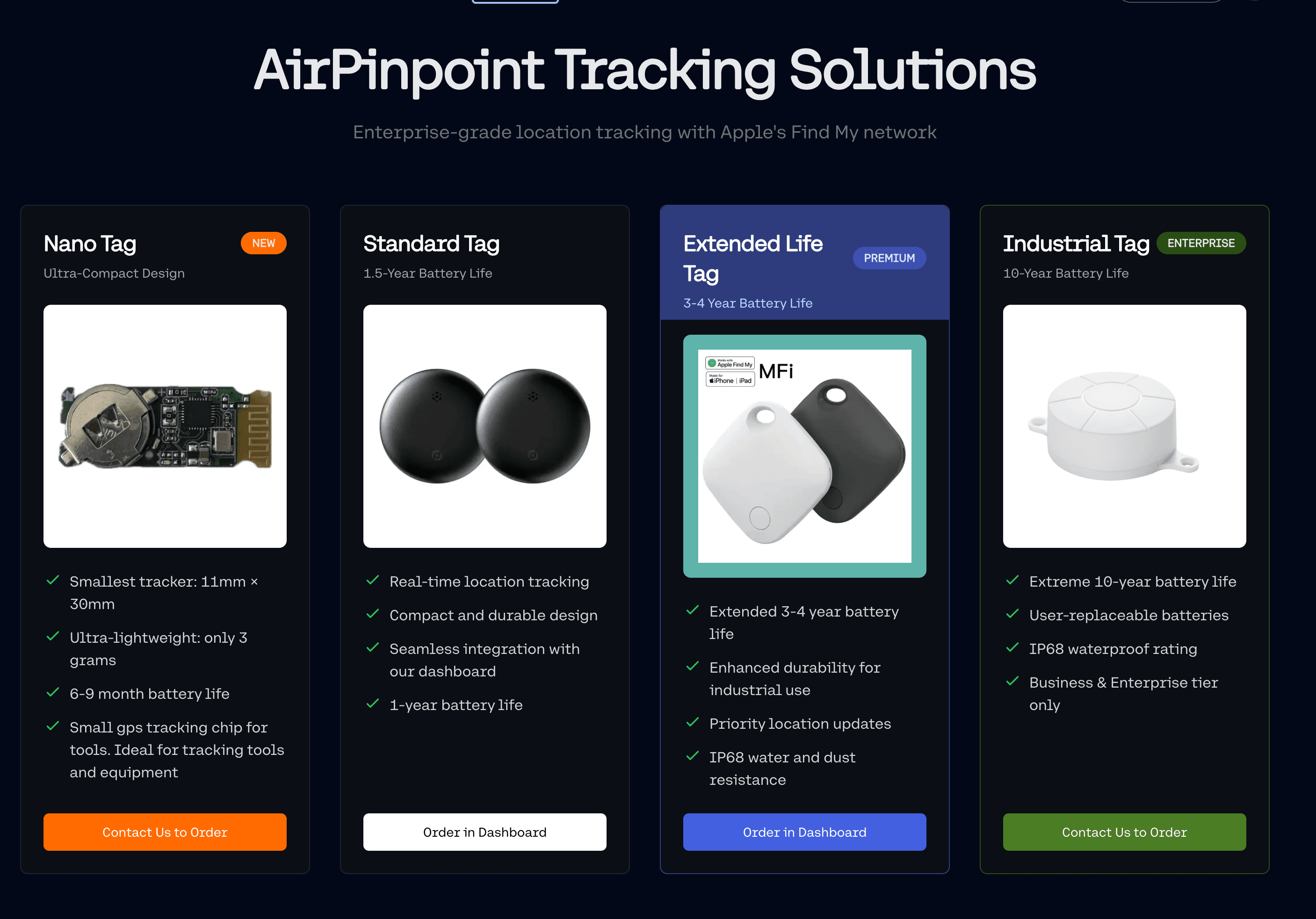
To track high-value rental equipment, put a tracker on every asset, watch them on one dashboard, and geofence your yard so you get an alert the second something leaves. Airpinpoint does this with Apple AirTags at $11.99 per device per month, against $30-50 for GPS. Trailers, tools, and attachments show on one map, location history settles return disputes, and yard-exit alerts arrive by email and webhook. AirTag hardware is $29, not $100-200.
How do you track high-value equipment rentals?
You attach a tracker to each rental and geofence the yard so any exit triggers an alert. Airpinpoint connects Apple AirTags to the Find My network and adds the fleet dashboard, polygon geofencing, and location history that the consumer app leaves out, so every trailer, attachment, tool, and machine sits on one map at $11.99 per device per month. When a customer claims they returned a generator, the location history shows exactly where it is. For powered machines you bill on engine hours, wired telematics GPS still adds usage data a tag cannot capture.
What is the best rental equipment telematics in 2026?
For mixed rental fleets, the best telematics in 2026 is Airpinpoint with AirTags, because it tracks every asset category on one dashboard at $11.99 per device per month, 60-80% less than the $30-50 GPS fleet trackers charge. The honest tradeoff: wired telematics like Samsara or Tenna is the better fit for powered machines that need second-by-second location and engine-hour billing, but it costs more and usually locks you into multi-year contracts. Most rental companies run a mix, with AirTags on trailers, tools, and attachments and wired GPS reserved for the highest-value powered equipment.
| DIY AirTag (Find My app) | Airpinpoint | Wired telematics GPS (Samsara, Tenna) | |
|---|---|---|---|
| Hardware cost | $29/tag | $29/tag | $100-200/unit |
| Monthly cost | $0 | $11.99/device | $30-50/device |
| Asset limit | 32 per Apple ID | Unlimited (500+ on one account) | Unlimited |
| Update frequency | Last location only | 200+/day near people | Real-time (seconds) |
| Location history | No | Full history, exportable | Full history |
| Geofencing | No | Polygon geofences, email + webhook | Yes |
| Return-dispute proof | No | Yes | Yes |
| Engine hours / utilization | No | No | Yes |
| Contract | None | None | Often multi-year |
| Best for | Personal items | Mixed rental fleets | Powered machines billed on hours |
How does AirTag rental tracking work?
An AirTag broadcasts a Bluetooth signal that any of the 2.5 billion Apple devices on the Find My network picks up and relays, so the asset needs no WiFi, cellular, or power of its own. You attach a tag to each rental, register it in Airpinpoint with a name and category, and the network does the location work for free. On active sites, Airpinpoint logs 200+ updates per asset per day, and across the fleet it delivers over 142,000 Find My location updates daily. Draw a polygon geofence around your yard or a customer site, choose which assets to monitor, and configure email alerts and webhook endpoints. The webhook can push yard-exit and overdue events straight into your rental management software.
How much does it cost?
Airpinpoint Business is $11.99 per device per month, with the fleet dashboard, polygon geofencing, location history, team access, and email alerts. Enterprise is $14.99 per device per month and adds REST API access and webhooks for integration with your rental management system. AirTag 2 hardware is $29 per tag, one-time, against $100-200 for a single GPS unit. For 50 assets, Airpinpoint Business is about $599 per month; a comparable GPS deployment runs $2,500-4,000 per month. There are no contracts.
The Rental Industry Tracking Imperative
The equipment rental market reached $82.6 billion in 2025 and is projected to grow to $280 billion by 2030. In this competitive landscape, tracking technology isn't optional. It is the difference between industry-leading margins and struggling to compete.
The visibility gap is real:
- 7 out of 10 rental companies lose time to inefficient processes
- Average rental operation uses 3-4 disconnected systems for fleet management
- Without tracking, 7-21% of stolen equipment is recovered
- Operators estimate utilization at 65%, while actual rates often fall to 40-50%
This guide provides a comprehensive framework for implementing tracking across your rental fleet, optimizing utilization, and joining the companies achieving 40%+ EBITDA margins through data-driven fleet management.
Rental Industry Utilization Benchmarks
The 72-20-8 Standard
The equipment rental industry has established clear utilization targets:
| Status | Target % | Description |
|---|---|---|
| On Rent | 72% | Equipment actively generating revenue |
| Rental-Ready | 20% | In yard, available for immediate rental |
| Non-Rental Ready | 8% | In maintenance, repair, or transit |
Interpreting Your Utilization
| Your Utilization | Diagnosis | Action |
|---|---|---|
| Below 60% | Significant overcapacity | Sell underperformers, reduce fleet |
| 60-70% | Below target | Improve marketing, adjust pricing, rebalance fleet |
| 70-80% | Optimal range | Maintain current strategy, monitor trends |
| Above 85% | Potential constraint | Consider expansion, may be turning away business |
Industry insight: Leading rental companies achieve 40%+ EBITDA margins by optimizing utilization while maintaining enough availability for peak demand periods.
Time vs. Dollar Utilization
Both metrics matter for different insights:
Time Utilization = (Days/Hours on Rent ÷ Available Days/Hours) × 100
- Measures demand and availability
- Target: 70-80%
Dollar Utilization = (Actual Rental Revenue ÷ Potential Revenue at Full Utilization) × 100
- Measures revenue optimization
- Reveals pricing effectiveness
- Accounts for discounts and rate variations
High time utilization with low dollar utilization indicates pricing issues. High dollar utilization with moderate time utilization suggests premium positioning working effectively.
The Equipment Theft Problem
Industry Theft Statistics
Equipment theft costs the rental industry between $100 million and $1 billion annually:
| Metric | Without Tracking | With GPS Tracking |
|---|---|---|
| Recovery rate | 7-21% | 97% |
| Time to recovery | Days to never | Hours |
| Average loss per incident | $30,000 | Minimal (equipment returned) |
High-Theft Categories for Rental
Based on LoJack data, these categories require priority tracking:
- Towables (generators, light towers): 33% of thefts
- Wheeled/tracked loaders: 28% of thefts
- Skid steers: 20% of thefts
- Excavators: 7% of thefts
- UTVs: 6% of thefts
The return on theft prevention alone often justifies tracking costs within months.
Tracking Technology Options for Rental
GPS Telematics (High-Value Equipment)
Best for: Heavy equipment, vehicles, generators, compressors, anything over $10,000 value
| Feature | Benefit for Rental |
|---|---|
| Real-time location | Know where every asset is, always |
| Geofencing | Alert when equipment leaves customer site |
| Engine hours | Accurate usage-based billing and maintenance |
| Idle time monitoring | Identify abuse or improper use |
| Maintenance alerts | Schedule service before failures |
| Historical data | Dispute resolution, usage verification |
Typical cost: $25-45/month per asset plus hardware ($100-300) ROI timeline: Most companies see positive ROI in under 6 months
Battery fine print for unpowered equipment: Wired GPS (hardwired to a vehicle or generator with its own power supply) is genuinely real-time. Battery-powered GPS, which is what most asset trackers for trailers, attachments, and towables use, is a different story. Those advertised 1-3 year battery lives assume roughly one location update per day. At real-time update rates (every 1-5 minutes), the same battery lasts 2-3 days. Tracki publishes this honestly in their own spec sheet. For rental assets that sit unpowered between jobs, once-a-day check-ins mean a geofence alert can fire up to 23 hours after a theft, and a stolen generator is in another state by then. The alternative is a charging routine across your entire fleet, which is its own operational cost.
AirTags sidestep this entirely. They broadcast a microamp Bluetooth signal; the iPhones on your job sites and in your customers' neighborhoods do the location fix and upload on their own batteries. The result is updates every 1-5 minutes in any area with normal foot traffic, for 12+ months on a $3 coin cell with no charging routine. For unpowered rental assets returned to or stored in urban and suburban areas, that is a better outcome than battery GPS at any update frequency.
Documented results from telematics implementation:
- 28% reduction in operating costs
- 17% increase in equipment availability
- Up to 50% reduction in equipment downtime
AirTags and Bluetooth Trackers (Lower-Value Items)
Best for: Tools, accessories, attachments, warehouse inventory
| Advantage | Limitation |
|---|---|
| Low cost ($29 one-time) | 32-device limit per Apple ID |
| No Apple subscription for AirTags; Airpinpoint adds a monthly subscription for business features | No geofencing in Find My without a business platform |
| 1+ year battery life | Coverage gaps in remote areas |
| Large Apple Find My network | Limited to location only, no telematics |
| Easy deployment | Thieves increasingly aware, can detect |
Best use cases for rental:
- Tool inventory in warehouse storage
- Lower-value attachments and accessories
- Backup tracker on high-value equipment (hidden)
- Items that circulate in urban areas with good Apple device density
Not recommended for:
- Primary tracking on equipment over $5,000
- Items sent to remote job sites
- Equipment requiring usage/maintenance data
Hybrid Approach (Recommended)
For most rental operations, combine technologies strategically:
| Equipment Value | Tracking Solution | Cost Structure |
|---|---|---|
| Over $25,000 | Premium GPS + backup AirTag | $35-50/month |
| $10,000-$25,000 | Standard GPS telematics | $25-35/month |
| $1,000-$10,000 | Basic GPS or premium Bluetooth | $15-25/month |
| Under $1,000 | AirTag or similar | $29 one-time |
Note: AirTag hardware is $29. Airpinpoint plans start at $11.99 per tag per month for the business dashboard, team access, location history, and geofencing.
Rental Software Integration
Key Platform Capabilities
Modern rental management software integrates tracking for comprehensive fleet visibility:
Essential features:
- Real-time equipment availability across locations
- Automated utilization calculations
- Customer self-service portal (reservations, payments, extensions)
- Maintenance scheduling from usage data
- Damage documentation with timestamps
- Invoice generation from actual usage
Leading Rental Software Solutions
| Platform | Key Strengths |
|---|---|
| Quipli | 24/7 customer self-service, mobile-friendly, utilization monitoring |
| RentalMan (Wynne) | Full lifecycle management, customer portal, enterprise scale |
| Trackunit | Mixed fleet support, claims 50% downtime reduction |
| Point of Rental | Industry veteran, comprehensive feature set |
| Texada | Heavy equipment focus, telematics integration |
| T3 (EquipmentShare) | Real-time tracking, strong maintenance tools |
Customer-Facing Portals
Self-service portals are becoming table stakes in rental:
Customer portal capabilities:
- Browse equipment and check availability
- Place orders and make payments
- Extend or terminate rentals
- View rental history and invoices
- Track equipment location (optional)
- Request service or report issues
Customers expect this experience. If you don't offer it, competitors will.
Implementation Roadmap
Phase 1: Assessment (Weeks 1-2)
Inventory your fleet:
- List all equipment by category and value
- Document current utilization (even if estimated)
- Identify high-theft-risk items
- Calculate potential loss exposure
Evaluate current systems:
- What software do you use now?
- How many disconnected systems?
- What data do you lack?
- Where are the biggest operational gaps?
Phase 2: Technology Selection (Weeks 2-4)
Choose tracking hardware:
- GPS/telematics for equipment over $10,000
- Bluetooth/AirTag for lower-value items
- Evaluate vendors for coverage, reliability, and integration
Choose software platform:
- Must integrate with your tracking hardware
- Customer portal capability
- Maintenance scheduling
- Financial reporting/utilization metrics
Phase 3: Pilot Deployment (Weeks 4-8)
Start with 10-20% of fleet:
- Focus on highest-value or highest-theft categories
- Install trackers, configure software
- Train operations team
- Document baseline metrics
Validate the system:
- Test location accuracy
- Verify alerts work
- Ensure software integration functions
- Gather user feedback
Phase 4: Full Deployment (Weeks 8-16)
Roll out by priority:
- All high-value equipment (greater than$25,000)
- All equipment sent off-site
- Mid-value equipment
- Low-value items (Bluetooth/AirTag)
Establish processes:
- Pre-rental inspection with photos
- Tracking verification before release
- Return inspection protocol
- Alert response procedures
Phase 5: Optimization (Ongoing)
Use data to improve:
- Review utilization weekly
- Identify underperforming equipment
- Optimize fleet mix based on demand
- Refine maintenance schedules
- Adjust pricing based on actual utilization
Maintenance Scheduling with Telematics
From Calendar-Based to Usage-Based
Traditional approach: Service equipment every 90 days or 500 hours (arbitrary)
Telematics approach: Service based on actual usage data
| Data Point | Maintenance Trigger |
|---|---|
| Engine hours | Oil change at 250 actual hours |
| Cycles completed | Hydraulic service after 1,000 cycles |
| Fault codes | Immediate service for specific issues |
| Operating temperature | Service if outside normal range |
| Idle time patterns | May indicate operator training issue |
Benefits of Predictive Maintenance
Documented results:
- 28% reduction in operating costs
- 17% increase in equipment availability
- Reduced unplanned breakdowns
- Better parts inventory planning
- Service bundling across multiple assets
The key: Maintenance during idle periods, not during rentals. Tracking shows you exactly when equipment is available for service.
Damage Documentation and Dispute Resolution
Pre-Rental Documentation
For every rental, capture:
- Geo-stamped photos of equipment condition
- Date/time verification of release
- Starting engine hours or meter reading
- Customer signature confirming condition
During Rental Monitoring
Telematics provides continuous evidence:
- Location history (equipment was where customer said it was, or was not)
- Operating hours (actual usage matches what customer claims)
- Fault codes (evidence of misuse or abuse)
- Geofence violations (equipment taken somewhere unauthorized)
Return Documentation
At return, capture:
- Updated photos with timestamps
- Ending engine hours
- Any damage with detailed documentation
- Customer acknowledgment
Dispute Resolution
When a customer disputes damage charges:
Without tracking:
- He said/she said argument
- Often write off as cost of business
- Customer relationship damaged
With tracking:
- Timestamped evidence of equipment condition
- Location data showing where damage likely occurred
- Usage data proving operational parameters
- Usually resolves quickly, the evidence is clear
Fleet Right-Sizing with Data
Identifying Underperformers
Tracking data reveals equipment that isn't earning its keep:
| Utilization | Time to Action | Response |
|---|---|---|
| Below 40% for 3 months | Immediate | Sell or auction |
| 40-55% for 6 months | Soon | Consider selling, adjust pricing |
| 55-65% for 12 months | Monitor | May be seasonal, analyze patterns |
Identifying Expansion Opportunities
High utilization signals unmet demand:
- Equipment consistently above 85% utilization
- Frequent "not available" customer interactions
- Long wait lists for specific categories
- Competitors with availability you don't have
Category Analysis
Track utilization by equipment type to guide purchasing:
| Category | Utilization | Trend | Decision |
|---|---|---|---|
| Excavators | 78% | Stable | Maintain or expand |
| Skid steers | 82% | Rising | Expand inventory |
| Light towers | 45% | Declining | Reduce, sell some |
| Generators | 71% | Seasonal | Right-size for off-peak |
Key Performance Indicators for Rental Tracking
Daily Monitoring
- Equipment currently on rent (count and %)
- Equipment returned today (turnaround needed)
- Low battery alerts (for tracked items)
- Geofence violations or after-hours alerts
Weekly Review
- Time utilization by category
- Dollar utilization by category
- Maintenance due/overdue
- Theft or loss incidents
- Customer portal usage
Monthly Analysis
- Overall fleet utilization trend
- Revenue per asset
- Cost per revenue dollar
- Customer lifetime value trends
- Equipment turnaround time averages
Quarterly Strategic Review
- Fleet composition optimization
- Pricing strategy effectiveness
- Competitor positioning
- Technology upgrade needs
- Capital expenditure planning
Common Mistakes to Avoid
1. Tracking Only High-Value Equipment
Mid-range equipment has the highest theft rate. Track everything that could walk away.
2. Installing Trackers in Obvious Locations
Thieves look for trackers. Hide them, or better, use multiple trackers with one visible (decoy) and one hidden.
3. Ignoring the Data
Tracking without analysis is expensive monitoring. Schedule regular reviews of utilization, alerts, and trends.
4. Not Integrating with Rental Software
Standalone tracking creates another disconnected system. Choose solutions that integrate with your rental management platform.
5. Skipping Customer Communication
Let customers know equipment is tracked. Most appreciate the security; it deters misuse and sets expectations.
6. Reactive-Only Maintenance
Don't wait for breakdowns. Use telematics data to predict and prevent failures during idle periods.
7. Undersizing Technology Investment
Cheap trackers with poor coverage cost more in the long run through lost equipment and missed data.
The Bottom Line
Equipment tracking is no longer optional for competitive rental businesses:
- Industry benchmarks are clear: 72% on rent, 20% ready, 8% in maintenance
- Theft recovery improves dramatically: 7-21% without tracking vs 97% with GPS
- ROI is proven: Under 6 months payback, 28% operating cost reduction
- Leading companies achieve 40%+ EBITDA through data-driven optimization
The equipment rental market is growing rapidly. The companies that will capture that growth are those with real-time visibility into their fleet, data-driven utilization optimization, and customer-facing technology that meets modern expectations.
Your fleet is your business. Know where it is, how it's used, and how to make it work harder.


 Our Solution