Shopping Cart Tracking: How Retailers Stop Losing Thousands in Cart Theft and Abandonment
A shopping cart gets stolen every 90 seconds in the United States. Across the industry, that adds up to 2 million carts per year and $800 million in global losses, according to the Food Marketing Institute.
For a single grocery store running 200-400 carts at $100-$300 each, the cart fleet represents $20,000-$120,000 in assets sitting in a parking lot with zero security. Stores typically lose 15-25% of that fleet annually. Some of it is outright theft. Most of it is abandonment: carts pushed home, left at bus stops, dumped in apartment complex breezeways, and scattered across neighboring streets.
Then come the fines. Cities across the country have started billing retailers for every abandoned cart found off-premises. Phoenix charges $25-$50 per cart. Long Beach hits $100. Duarte, California charges $110. A store losing 5 carts per month to abandonment can rack up $6,000-$13,000 in municipal fines alone, on top of the replacement costs.
This page covers the full cost picture, compares prevention and tracking approaches (from coin deposits to electronic containment to AirTag tracking), and explains where low-cost tracking pays for itself versus where it doesn't.
The True Cost of Shopping Cart Loss
Most store managers know carts disappear. Few have calculated the total cost. Here's what a typical 300-cart grocery store actually spends:
| Cost Category | Low Estimate | High Estimate |
|---|---|---|
| Cart replacement (45-75 carts/year at $100-$300) | $4,500 | $22,500 |
| Municipal fines ($25-$110/cart, 3-8 carts/month) | $900 | $10,560 |
| Retrieval service fees ($12-$36/cart) | $1,440 | $3,456 |
| Staff time collecting nearby carts (2-4 hrs/week at $15/hr) | $1,560 | $3,120 |
| Total annual cart-related costs | $8,400 | $39,636 |
These numbers scale with store location. Urban and suburban stores near apartment complexes, bus routes, and homeless encampments lose carts at 3-5x the rate of stores in standalone suburban locations. A downtown grocery store might lose 30-40 carts per month. A suburban Costco might lose 5.
Why Carts Leave the Parking Lot
Understanding the pattern helps target the solution:
Walk-home theft (60-70% of losses). Customers without cars push carts home to carry groceries. The cart gets left on the sidewalk, in a yard, or in an apartment hallway. This is the biggest category by volume, and it clusters around stores near dense residential areas within a 1-2 mile radius.
Repurposing (15-20%). Carts get taken for use as makeshift storage, moving dollies, or collection containers. They rarely come back.
Vandalism and damage (10-15%). Carts pushed into ravines, lakes, or left in conditions that destroy them. Some cities report pulling dozens of carts from waterways during annual cleanups.
Organized theft (under 5%). Groups collecting carts for scrap metal value. This is rare but happens in areas with high scrap steel prices.
Current Solutions and What They Actually Cost
Coin Deposit Systems (The Aldi Model)
Aldi's famous quarter-deposit system achieves a 96% cart return rate, versus the industry average of roughly 55% for stores with free carts. Customers insert a quarter to unlock a cart and get it back when they re-lock the cart in the corral.
Cost: $2-$5 per cart for the coin mechanism. Minimal ongoing maintenance.
Pros: Extremely effective at preventing abandonment. Eliminates the need for cart attendants. Saves an estimated $8,000 per store annually in retrieval and labor costs.
Cons: Creates friction for customers. Doesn't work for stores competing on convenience. Most US grocery chains and big-box retailers have decided the customer experience trade-off isn't worth it. Also does nothing against intentional theft.
Electronic Cart Containment (Gatekeeper, CartManager, Carttronics)
These systems install a buried wire around the parking lot perimeter. Each cart gets a special locking caster that freezes the wheel when the cart crosses the boundary.
Cost breakdown:
- Locking caster per cart: $150-$300 installed
- Perimeter wire installation: $10,000-$30,000 per store (depends on lot size)
- Ongoing maintenance: $3,000-$8,000/year (wheel replacements, wire repairs)
- For a 300-cart store: $55,000-$120,000 in year one, $3,000-$8,000/year after
Pros: 90-95% effective at preventing cart removal. ROI in 6-18 months for high-loss stores.
Cons: High upfront cost puts it out of reach for independent grocers and smaller chains. Locking wheels malfunction and frustrate customers. Maintenance is ongoing. The system does nothing to help you find or retrieve carts that are already off-site. Doesn't track where problem areas are.
Third-Party Cart Retrieval Services
Companies like CartSmart and local operators drive around collecting abandoned carts and returning them to stores.
Cost: $12-$36 per cart per pickup, depending on the city and contract terms.
Pros: No upfront investment. Pay per use.
Cons: Reactive, not preventive. You're paying to fix the problem repeatedly instead of stopping it. At 5-10 retrieved carts per week, costs reach $3,000-$18,000 annually. The retrieval company has no incentive to help you reduce losses because their revenue depends on carts continuing to go missing.
AirTag Tracking with AirPinpoint
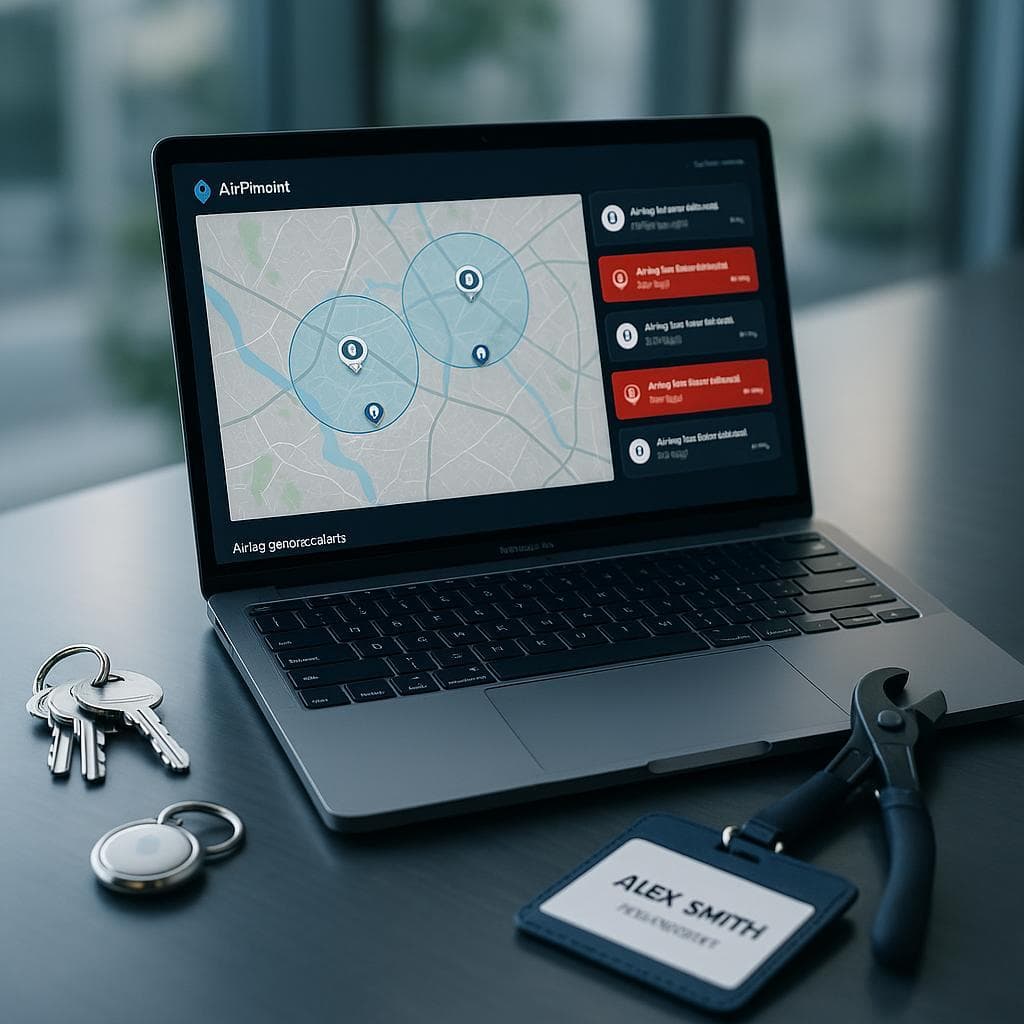
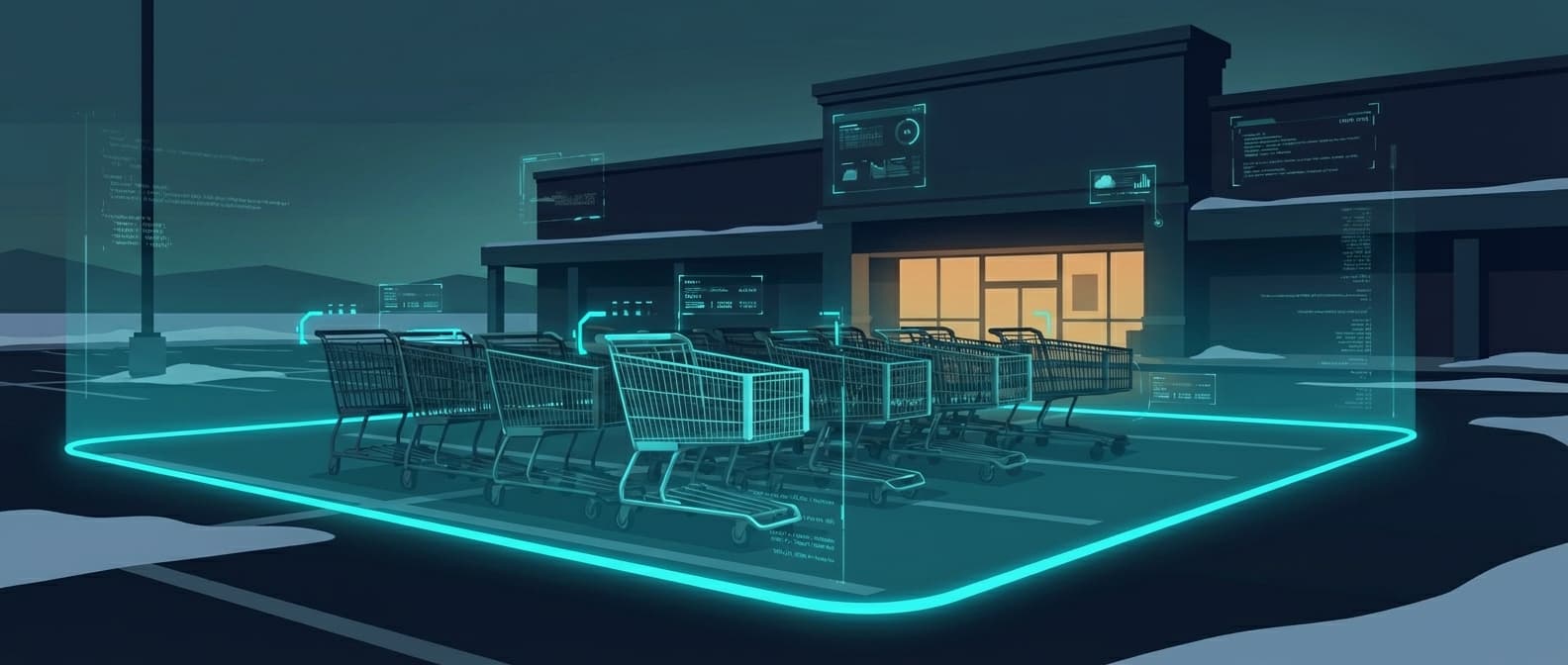
Attach an AirTag ($29) to each cart's steel frame. Set up a geofence around your parking lot in AirPinpoint. Get alerts when carts leave the boundary. Use the dashboard to see where abandoned carts cluster and plan retrieval routes.
Cost for a 300-cart store:
- AirTags: $8,700 (one-time, $29 x 300)
- AirPinpoint Business plan: $43,164/year ($11.99/device/month x 300 x 12)
- AirTag battery replacement: ~$1 per cart/year
- Year one total: $51,864. Year two+: $43,464.
Pros: No infrastructure installation. Works across multiple stores from one dashboard. Shows you exactly where carts go, not just that they left. Enables targeted retrieval instead of driving around searching. Data identifies which exits, neighborhoods, and times of day produce the most losses. Can selectively tag only high-risk carts or corrals.
Cons: At 300 carts, the monthly cost is substantial. Doesn't physically prevent carts from leaving. Requires someone to act on the alerts and retrieve carts. Battery replacement once per year.
Honest Cost Comparison: Where Tracking Pays Off and Where It Doesn't
Let's be direct. Tracking every cart in a 300-cart fleet at $11.99/month per device costs $43,164 per year. For most grocery stores losing $8,000-$25,000 annually in cart-related costs, the tracking subscription alone exceeds the losses it prevents.
Where AirPinpoint cart tracking clearly makes financial sense:
1. High-Loss Urban Stores
Stores losing 75+ carts per year ($7,500-$22,500 in replacement) plus heavy municipal fines ($5,000-$13,000) are spending $12,500-$35,000+ annually on cart losses. Selective tracking of 50-100 carts at the highest-risk corrals (near exits facing residential areas) costs $7,188-$14,388/year. That's a breakeven or positive ROI.
2. Airport and Convention Center Luggage Carts
This is the sweet spot. Airport luggage carts cost $300-$500 each. A terminal with 100 carts has $30,000-$50,000 in mobile inventory. They accumulate at parking garages, rental car counters, and hotel shuttle stops. Tracking 100 carts costs $14,388/year with AirPinpoint. Recovering just 30-40 carts that would otherwise be lost ($9,000-$20,000 in replacement value) plus reducing the labor of manually searching the airport makes this a straightforward win.
Smarte Carte, the dominant airport cart operator, manages luggage carts across 3,400 global locations. Their operations teams spend significant time searching for carts that passengers leave in remote areas of the terminal. AirPinpoint's dashboard turns that search into a directed pickup route.
3. Specialty and High-Value Retail Carts
Warehouse club flatbed carts ($200-$400), garden center carts, motorized shopping carts ($2,000-$5,000), and custom-branded carts are all expensive enough that tracking a smaller fleet makes sense.
4. Multi-Store Chains That Need Data
A 10-store grocery chain might not track every cart. But tagging 20-30 carts per store (200-300 total) gives operations managers data on which stores lose the most carts, which neighborhoods are accumulation hotspots, and what times of day carts leave. That intelligence helps decide where to invest in containment systems, where to station retrieval crews, and which store layouts need redesigned cart corrals.
Cost for 30 tagged carts across 10 stores (300 total): $8,700 in AirTags + $43,164/year in AirPinpoint. The data alone might save a $100,000 containment system installation at a store that turns out not to need one.
Where It Doesn't Make Sense
Low-loss suburban stores. If a store loses 20-30 carts per year ($2,000-$9,000 in losses), the math doesn't work for full-fleet tracking. Consider tagging 10-20 carts to gather location intelligence, then decide.
Stores where coin deposits work. If your customer base tolerates a quarter deposit system (discount grocers, warehouse clubs), that $2-$5/cart solution is 10x cheaper than any electronic alternative.
How to Set Up Cart Tracking
Step 1: AirTag Placement
The AirTag needs to be hidden, secure, and protected from weather and cart washing.
Best locations on a standard grocery cart:
- Inside the handle bar. Most cart handles are hollow tubular steel. Remove the end cap, slide in the AirTag in a thin waterproof capsule, replace the cap. This is the most secure and hidden placement.
- Under the child seat. The fold-down child seat has recessed areas underneath. Use industrial adhesive (3M VHB tape) and a protective case.
- Inside the cart frame. The rear frame legs on many carts have hollow sections or weld joints with recessed areas.
Avoid placing AirTags where they'll be submerged during cart washing or where they could fall out from vibration. A $3 waterproof AirTag holder adds durability.
Step 2: Geofence Configuration
In AirPinpoint, draw a geofence polygon around your store's parking lot. Include the cart corrals but exclude the public sidewalk and street. Set the alert to trigger when any tagged cart crosses the boundary.
Alert settings that work for retail:
- During business hours: Alert after a cart has been outside the boundary for 30+ minutes. This filters out customers loading cars at the lot edge.
- After hours: Immediate alert. No carts should be leaving at midnight.
- Daily summary: Morning report showing all carts currently outside the geofence, with locations. Give this to your retrieval crew.
Step 3: Retrieval Route Planning
The real operational value is the morning dashboard review. Instead of sending a crew to drive random neighborhoods looking for carts, the AirPinpoint map shows exactly where they are.
Common accumulation patterns you'll discover:
- Apartment complexes within 0.5-1 mile of the store (usually 2-3 specific buildings)
- Bus stops along the nearest transit route
- A particular street or intersection where people abandon carts after carrying groceries home
- A neighboring business's parking lot where customers transfer groceries to their car
Once you know the top 3-5 accumulation points, retrieval becomes a 30-minute daily pickup run instead of a 3-hour scavenger hunt.
Beyond Grocery: Other Cart Tracking Use Cases
Airport Luggage Carts
Airports and their cart concessionaires (Smarte Carte being the largest) manage fleets of $300-$500 luggage carts. Passengers take them to parking garages, curbs, rental car centers, and sometimes off-property entirely.
The tracking value: Know in real time where carts are accumulating. Staff can restock high-demand areas (baggage claim, international arrivals) by pulling from overstocked areas (long-term parking levels) instead of buying more carts.
A 100-cart airport deployment costs $14,388/year with AirPinpoint. For an airport managing $30,000-$50,000 in cart inventory, the asset protection and operational efficiency easily justify the cost.
Shopping Center and Mall Carts
Large malls provide customer courtesy carts, strollers, and wheelchairs. These range from $150-$500 each and tend to migrate to anchor stores, parking decks, and loading zones.
Hospital Wheelchairs and Transport Equipment
Hospitals lose wheelchairs constantly. Staff leave them in hallways, patients wheel them to the parking lot, and they accumulate at entrances. A wheelchair costs $150-$800. This overlaps with hospital asset tracking, but the cart-tracking approach (geofence the building exits, track where equipment leaves) is the same.
Distribution Center Dollies and Hand Trucks
Distribution warehouses and big-box stores use hundreds of flatbed dollies and hand trucks. These walk off loading docks and out of receiving areas. At $50-$200 each, the per-unit value is lower, but volume losses add up.
Combining Approaches: Containment + Tracking
Some retailers are discovering that the best approach uses both electronic containment and AirTag tracking:
Electronic containment on the parking lot perimeter prevents 90-95% of cart removal. This handles the high-volume, low-value walk-home theft.
AirTag tracking on a subset of carts provides location intelligence for the 5-10% that still leave (carts lifted over the boundary, broken containment wheels, and carts that leave via loading docks). It also gives operations data about cart movement patterns within the lot, identifying which corrals run low and when.
Cost for a combined approach (300-cart store):
- Electronic containment: $55,000-$120,000 in year one
- AirTags on 50 carts: $1,450
- AirPinpoint for 50 carts: $7,194/year
- Total: $63,644-$128,644 in year one
This is the premium approach. It makes sense for high-traffic stores in urban areas where cart losses are severe and the store plans to operate at that location for 5+ years.
Shopping Cart Loss by Store Type
| Store Type | Typical Cart Count | Annual Loss Rate | Annual Cost of Losses | Best Tracking Approach |
|---|---|---|---|---|
| Grocery (urban) | 200-400 | 20-30% | $10,000-$36,000 | AirTag tracking on high-risk corrals |
| Grocery (suburban) | 300-500 | 10-15% | $4,500-$22,500 | Coin deposit or selective AirTag tracking |
| Big-box retail | 300-600 | 10-20% | $6,000-$36,000 | Electronic containment + AirTag intelligence |
| Airport terminal | 50-200 | 5-15% | $7,500-$15,000 | Full AirTag tracking |
| Shopping mall | 20-50 | 15-25% | $750-$6,250 | Full AirTag tracking |
| Warehouse club | 200-400 | 5-10% | $2,500-$12,000 | Coin deposit (Costco already uses this outside the US) |
Municipal Fine Prevention
Cities are getting more aggressive about abandoned cart enforcement. If your store is in a municipality with cart fines, tracking is a compliance tool, not just an asset protection tool.
How tracking eliminates fines:
- Geofence alerts tell you the moment a cart leaves your lot.
- The dashboard shows the cart's location.
- You retrieve the cart before the city finds it.
- No citation, no fine, no impound fee.
For a store paying $3,000-$13,000/year in municipal fines, tracking 30-50 of the most frequently lost carts ($4,314-$7,194/year with AirPinpoint) can eliminate the fine exposure entirely.
Cities with active cart fine programs include: Phoenix AZ, Long Beach CA, Milpitas CA, Duarte CA, Lancaster CA, San Jose CA, Federal Way WA, and dozens of others in California, Texas, and Florida.
Getting Started
For most stores, the right first step is a pilot, not a full-fleet deployment.
Phase 1: Intelligence gathering (30-50 carts, 2-3 months) Tag 30-50 carts at your highest-loss corrals. Set up geofencing. Watch the data for 2-3 months to learn where carts go, when they leave, and which corrals are the sources. Cost: $870-$1,450 in AirTags + $4,314-$7,194/year in AirPinpoint.
Phase 2: Targeted deployment Based on phase 1 data, decide whether to expand tracking, invest in electronic containment at specific exits, redesign corral placement, or adjust staffing for targeted retrieval runs. The data eliminates guesswork.
Phase 3: Scale or hold If tracking 50 carts proved the ROI (through reduced fines, faster retrieval, or data that prevented a $100K containment installation), expand to more carts or more stores. If losses are manageable without full tracking, keep the intelligence fleet of 30-50 tagged carts as an early warning system.
AirPinpoint's Business plan supports unlimited geofences, multi-user access (give your operations manager, store managers, and retrieval crew each their own login), and fleet-wide dashboards across multiple locations.
 Our Solution