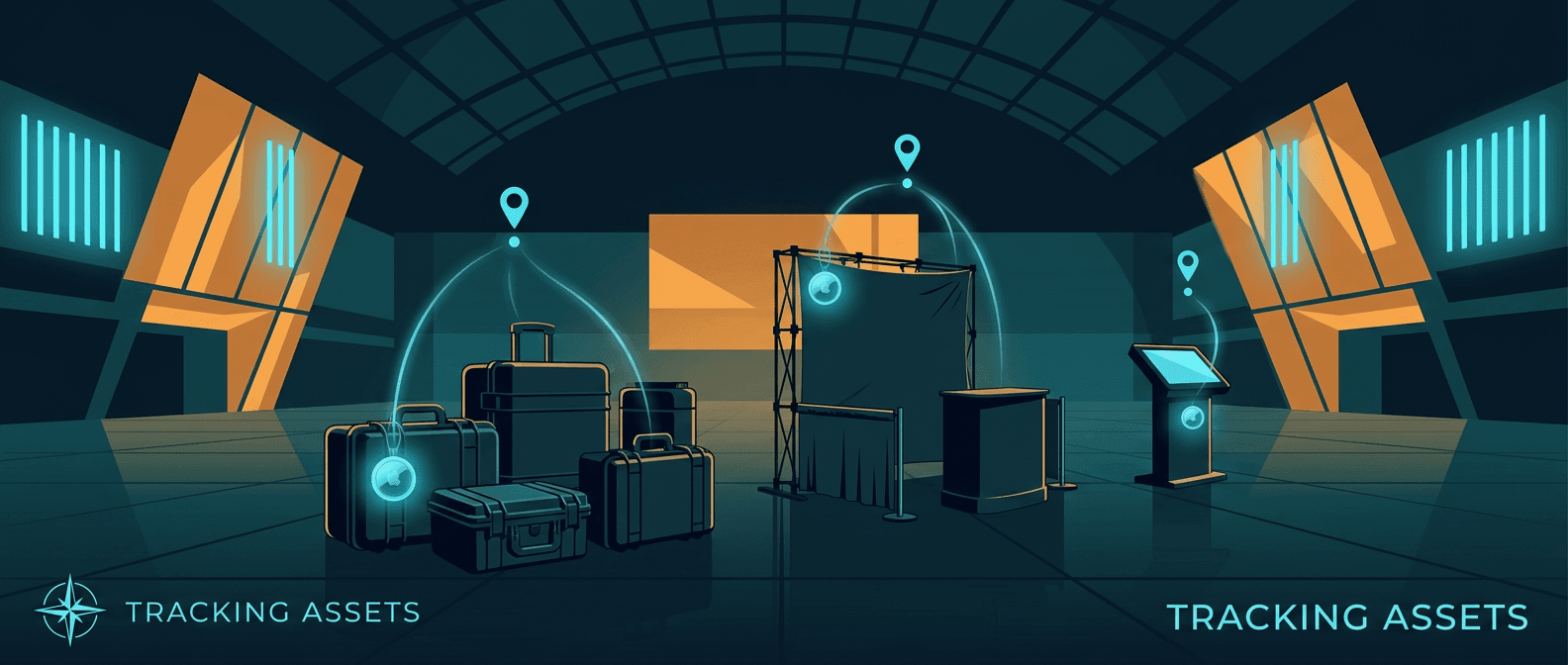
Trade Show Equipment Tracking: Know Where Every Case Is, From Warehouse to Show Floor
Your exhibit is worth $50,000 to $500,000. It ships in a dozen cases to a convention center 2,000 miles away. Then it ships to another city. Then another. Then back to your warehouse. Maybe.
At any point in that chain, a Pelican case can end up at the wrong booth, on the wrong truck, or in the wrong city entirely. Tive's research documents 16 distinct ways trade show freight goes wrong, from entire exhibits lost in transit to crates delivered to the wrong booth number. The costs can run into tens of thousands of dollars per incident.
This guide covers how to track trade show equipment across the full lifecycle: warehouse storage, outbound freight, convention center setup, teardown, and return shipping.
What's Actually at Risk
Trade show equipment isn't cheap, and the numbers stack up fast.
Exhibit Booth Components
A basic 10x10 inline booth runs $12,000 to $15,000. Custom exhibits cost $125 to $325 per square foot, putting a 20x20 custom booth at $50,000 to $130,000. Island exhibits (20x20 and larger) routinely exceed $100,000 in build cost alone.
Those are replacement costs. When your exhibit doesn't arrive, the real damage is the show you miss: booth space you've already paid for ($50 to $200+ per square foot), staff flights and hotels, lost lead generation, and brand damage from an empty booth.
What Ships to a Show
A typical mid-size exhibit (20x20) ships as:
- Exhibit structure: Walls, counters, shelving, graphics, lighting. Usually palletized or in custom crates. Value: $30,000 to $100,000+
- Demo equipment: Kiosks, tablets, product samples, prototype hardware. Often in numbered Pelican cases. Value: $5,000 to $50,000
- AV equipment: Monitors, projectors, sound systems, media players. Fragile and high-value. Value: $10,000 to $40,000
- Marketing materials: Brochures, branded giveaways, signage. Lower value but still needed. Value: $2,000 to $10,000
- Carpet and padding: Heavy, low-value, but missing carpet means scrambling to rent from the convention center at 5x the price
Total shipped value for a single show: $50,000 to $200,000 is common. Companies with large custom exhibits can easily exceed $500,000.
Shipping Costs Per Show
Freight alone costs $2,000 to $10,000 per show depending on weight and distance. Drayage (moving freight from the loading dock to your booth) runs $120 to $185 per 100 pounds, with most exhibitors paying $800 to $7,500. Round-trip shipping and drayage for a mid-size exhibit: $6,000 to $20,000 per show.
If you exhibit at 6 to 10 shows per year, annual shipping and handling costs run $36,000 to $200,000. That's before anything goes wrong.
How Trade Show Freight Goes Wrong
The 16 Ways Visibility Fails
Tive, a freight visibility company, catalogued 16 distinct challenges in trade show shipping. The most damaging for exhibitors:
Loss of an exhibit. An entire booth shipment goes missing. The carrier says it was picked up. The convention center says it never arrived. Nobody knows where it actually is. This is the nightmare scenario, and it happens more often than carriers admit.
Loss of a crate on the show floor. Your freight arrives at the convention center, clears drayage, and then... one crate can't be found in the 500,000+ square foot hall. It could be at the wrong booth number, still sitting in the marshaling yard, or mixed in with another exhibitor's freight.
Portable exhibits missing in action. Smaller displays shipped via small parcel or LTL are particularly prone to going astray. They're easier to misplace than palletized freight, and they don't always get the same tracking attention.
Delivery to the wrong booth. Convention centers are enormous. McCormick Place in Chicago has 2.6 million square feet of exhibit space. Your crate ends up at booth 4523 instead of 4253. The exhibitor at 4523 doesn't realize it isn't theirs. Nobody discovers the error until setup morning.
Theft in transit or onsite. Cargo theft is a billion-dollar problem industrywide, and exhibit equipment, particularly electronics, is a target. During teardown, when the hall is chaotic and hundreds of shipments are staged for pickup, theft risk peaks.
The "it has to be in the warehouse" problem. The carrier's tracking shows delivered, but no one at the convention center can find your freight. It sits in a warehouse somewhere while your team wastes setup hours searching.
Multi-Show Logistics Multiply the Risk
The worst exposure comes from back-to-back shows. A company exhibiting at CES (Las Vegas, January), then MWC (Barcelona, February), then ConExpo (Las Vegas, March) is shipping their exhibit cross-country or internationally every few weeks.
Each transit creates another opportunity for loss, damage, or misrouting. After ConExpo, the exhibit ships back to a warehouse. Did all 14 cases make it back? The typical answer is "we'll find out when we inventory for the next show." By then, filing a freight claim may be too late.
How AirTag Tracking Works for Trade Show Equipment
Convention Center Coverage Is Excellent
Here's the underappreciated advantage of AirTags for trade show use: convention centers during events are among the densest iPhone environments on the planet.
CES draws 138,000+ attendees. NRF brings 40,000+. Even mid-tier regional shows put 5,000 to 15,000 people, most carrying iPhones, inside a single building. Every one of those iPhones is a node in the Find My network.
During setup and teardown, when your equipment is most vulnerable to misplacement, the hall is full of exhibitors, contractors, and labor crews with phones. Coverage is strong exactly when you need it most.
What to Tag
Tag each independently shipped unit. Practical tagging for a typical 20x20 exhibit:
| Item | Quantity | AirTag Placement | Why |
|---|---|---|---|
| Exhibit crates | 2-4 | Inside crate lid pocket | Verify arrival at venue and return to warehouse |
| Pelican cases (demo equipment) | 4-8 | Under foam insert | Track individually shipped cases across carriers |
| Kiosk units | 1-3 | Inside base panel | High-value; often shipped separately |
| AV road cases | 2-4 | Inside case lid | Monitors and projectors are expensive to replace |
| Marketing materials box | 1-2 | Inside box | Low-cost insurance against delayed collateral |
A 15-item setup costs $435 in AirTags (15 x $29) plus $179.85 to $224.85 per month on Airpinpoint ($11.99 to $14.99 per device). Annual tracking cost: $2,593 to $3,133.
Compare that to one lost Pelican case of demo hardware ($5,000 to $20,000), one missed show from lost freight ($30,000+ in sunk costs), or one emergency replacement overnight-shipped exhibit panel ($3,000 to $10,000).
What You Can See
With Airpinpoint's dashboard, your exhibit team gets:
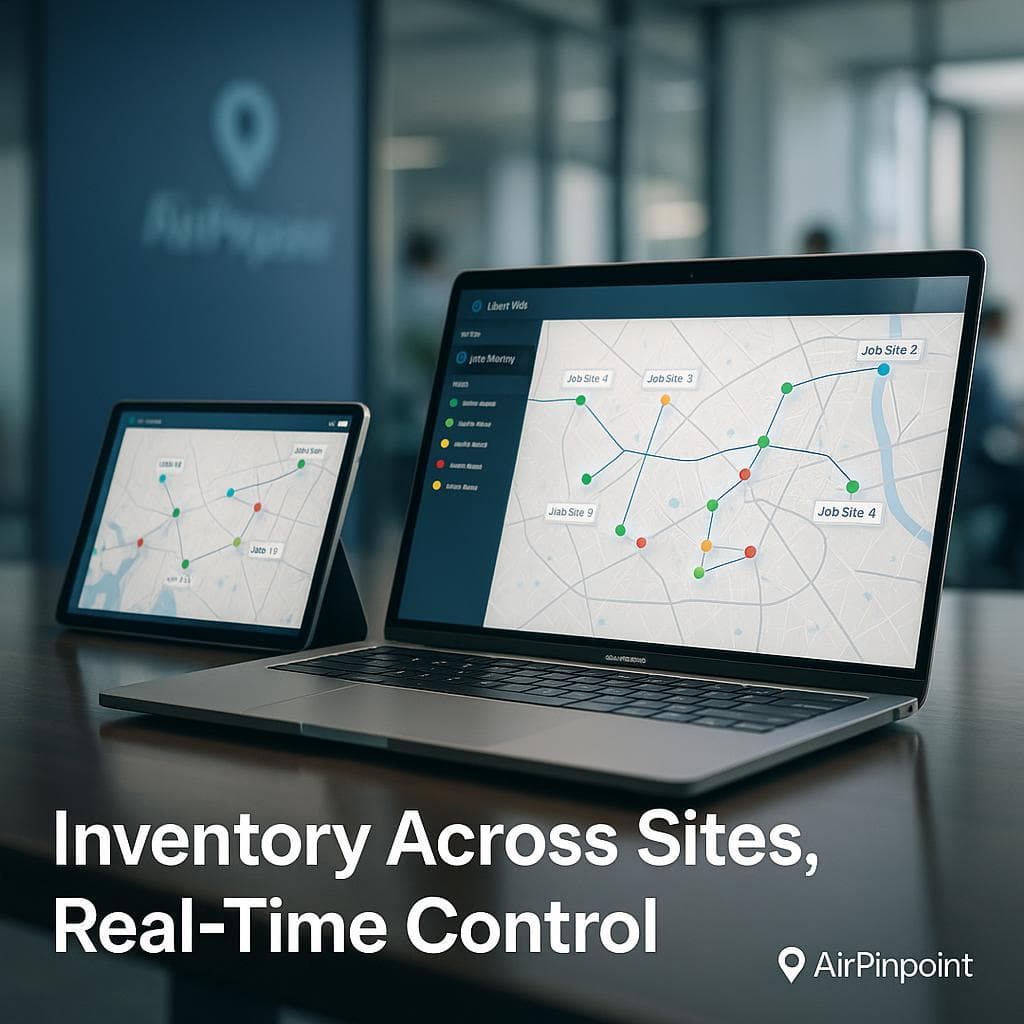
Pre-show freight verification. See all 15 tagged items on a single map. Confirm everything left the warehouse. Track progress toward the convention center. If case #7 isn't moving while the rest are in Phoenix, you know before setup day.
Convention center floor tracking. During setup, verify all items are at your booth, not at booth 4523. Convention center iPhone density means frequent location updates.
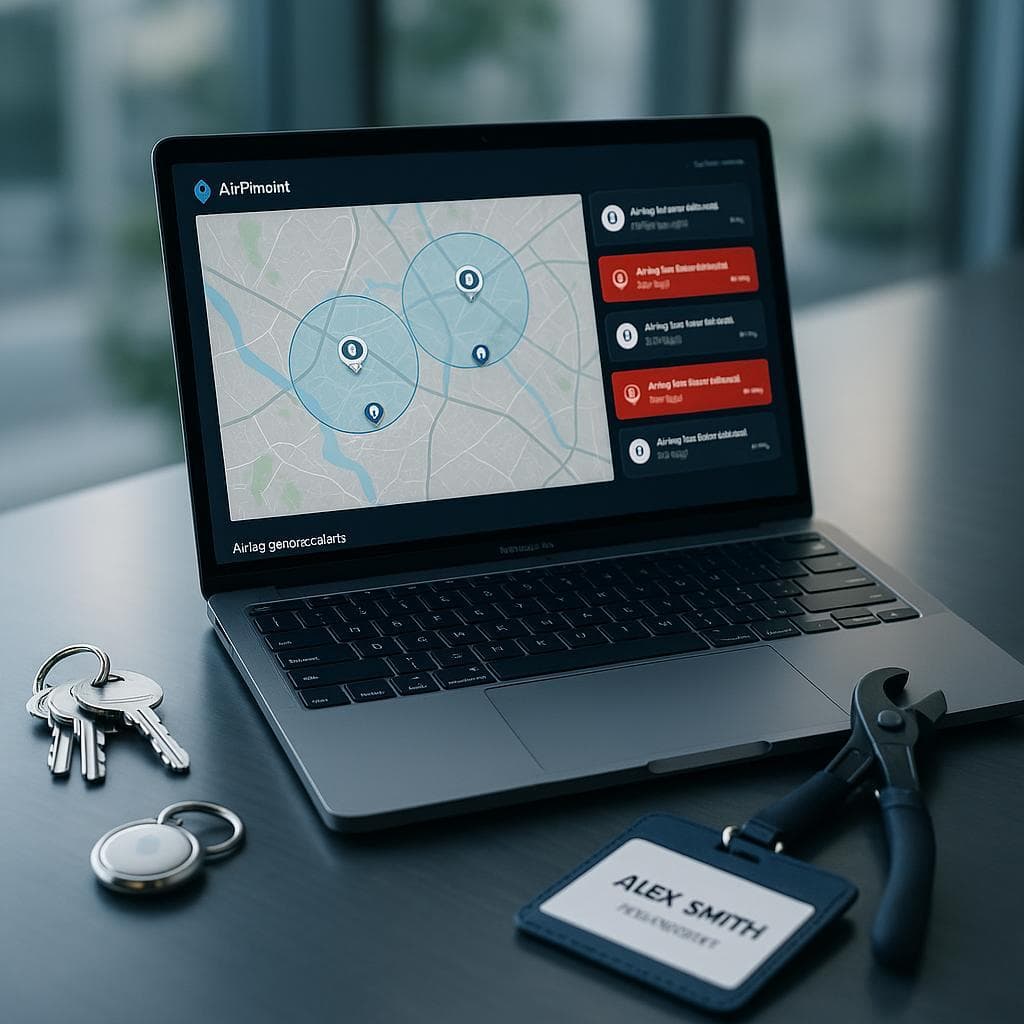
Post-show return tracking. The most overlooked phase. After teardown, cases go to the marshaling yard, then to carriers, then (hopefully) back to your warehouse. Geofence your warehouse. When each case arrives, Airpinpoint logs it. You know exactly which items are still in transit and which made it home.
Multi-show routing. Shipping directly from CES to MWC? Track the full journey. Airpinpoint's location history shows each case's path, so when 13 of 14 cases arrive in Barcelona and one is missing, you can see its last known location and work with the carrier to recover it.
Real-World Tracking Scenarios
The Kit-Based System
Companies that exhibit frequently often organize equipment into numbered kits. Each kit contains everything for a specific function: Kit 1 might be the admin station (laptop, badge scanner, charging cables), Kit 2 the info desk (tablets, brochures, display), and so on.
Airpinpoint tracks each kit as a named asset. When your inventory shows "Kit 4 Admin" at the Las Vegas Convention Center and "Kit 3 Info" still at your San Diego HQ, you know exactly what shipped and what didn't.
Demo Kiosk Tracking
Custom demo kiosks are some of the most expensive items in a trade show inventory. A single interactive kiosk can cost $5,000 to $25,000 to build, and many companies have multiple units that rotate between shows.
Place an AirTag inside the kiosk base. After each show, the kiosk either ships to the next venue or returns to the hardware lab. Set a geofence at your HQ. Airpinpoint alerts you when the kiosk arrives home and logs the return timestamp for your inventory records.
The Pelican Case Problem
Pelican cases are the standard for shipping demo equipment, prototypes, and sensitive electronics. They're designed to be rugged and interchangeable, which is exactly why they get lost. One black Pelican 1510 looks like every other black Pelican 1510 sitting on a convention center loading dock.
Tag each Pelican case with a descriptive name in Airpinpoint: "RX2-A Pelican Case," "RX2-B Pelican Case." During teardown, when 200 exhibitors are all loading black cases onto trucks, your team can verify every case is accounted for before leaving the show floor.
Post-Show Warehouse Reconciliation
The most common inventory loss isn't dramatic theft. It's slow attrition: a case that never made it back from a show, a kiosk left with a freight forwarder, demo hardware that was "definitely shipped" but never arrived. Over a year of 8 to 10 shows, missing a single item per show adds up.
Geofence your warehouse. Airpinpoint's location history gives you a complete picture: what's home, what's in transit, and what's been sitting at a carrier's facility in Memphis for three weeks because nobody filed a trace request.
Cost Analysis: Tracking vs. Not Tracking
The Math for a 10-Show Season
Assumptions: 15 tagged items, exhibiting at 10 shows per year, average round-trip shipping cost of $8,000 per show.
Annual tracking cost:
- 15 AirTags: $435 (one-time, year-one)
- Airpinpoint (15 devices x $11.99/mo x 12): $2,158
- Battery replacement (15 x $3): $45
- Year-one total: $2,638
- Year-two total: $2,203 (no new AirTag purchase)
Cost of common problems without tracking:
- One lost Pelican case of demo hardware: $5,000 to $20,000
- Emergency overnight shipping for replacement booth panels: $3,000 to $10,000
- Missed show from unrecoverable freight (sunk costs): $30,000+
- One misrouted crate requiring reshipment: $1,500 to $5,000
- Staff hours spent calling carriers and searching convention halls: $2,000+ per incident
One prevented incident pays for years of tracking.
Comparison to Freight-Specific Tracking
| Solution | Hardware Cost | Monthly Cost | Best For |
|---|---|---|---|
| Tive (GPS) | $100-250/tracker | Custom pricing | Perishable, high-value LTL with temperature monitoring |
| FreightVerify | Enterprise only | Enterprise pricing | Full supply chain visibility, 3PL integration |
| AirTags + Airpinpoint | $29/tag | $11.99-14.99/device | Trade show exhibit tracking, multi-show logistics |
| No tracking | $0 | $0 | Hope and phone calls |
Dedicated freight trackers like Tive make sense for specific shipments where real-time GPS and condition monitoring (temperature, shock) are critical. For tracking which of your 15 Pelican cases made it to which city, AirTags provide the visibility you need at a fraction of the cost.
Setting Up Trade Show Equipment Tracking
Step 1: Tag Your Inventory
Place an AirTag in or on each independently shipped unit. Best placements:
- Inside Pelican case foam: Cut a small pocket in the foam lining. The case protects the AirTag during transit.
- Crate lid pockets: Most exhibit crates have document pockets on the lid. Tuck the AirTag behind the paperwork.
- Kiosk base panels: Remove a maintenance panel and secure the AirTag inside.
- AV road cases: Inside the lid, secured with adhesive velcro.
Step 2: Name Everything Clearly
In Airpinpoint, name each asset with a system your team will understand: "Pelican-A Demo Unit," "Crate-1 Exhibit Walls," "Kiosk-2 Interactive." Include case numbers or kit designations your freight manifest already uses.
Step 3: Geofence Your Warehouse
Set up a geofence around your HQ, warehouse, or storage facility. After every show, you'll get a clear view of what's home and what isn't. No more "I think everything came back."
Step 4: Pre-Show Verification Checklist
Before each show, check Airpinpoint to confirm:
- All items show current location at your warehouse or staging area
- Nothing is still at a carrier facility from the previous show
- Battery levels are adequate (AirTag batteries last about 12 months, replace before peak show season)
Step 5: Post-Show Reconciliation
After teardown, check Airpinpoint from the airport or hotel. All tagged items should show as either at the convention center (loaded for shipping) or already in transit. If something's missing, you still have time to trace it before the hall closes.
Limitations to Know
Highway transit gaps. AirTags update when iPhones pass nearby. On a highway, that happens at rest stops and fuel stations, not continuously. You'll see freight progress in jumps, not real-time. For most exhibit teams, knowing your freight left Chicago and is now in Kansas City is sufficient. If you need continuous real-time tracking, a dedicated GPS freight tracker is better.
International shows. Find My network coverage varies by country. Major European and Asian cities have strong iPhone adoption and coverage. Developing markets may have gaps. For international shows, AirTags are useful at departure and arrival (airports and convention centers have excellent coverage) but may show fewer updates during overland transit in some regions.
Rural warehouses. If your exhibit storage is in a rural area with limited foot traffic, AirTag updates at the warehouse itself may be infrequent. This matters less than it sounds. You mainly need updates during transit and at the venue, both of which have strong coverage.
Not a replacement for freight insurance. AirTag tracking helps you find lost equipment and catch problems early. It doesn't replace freight insurance. Keep your exhibitor's policy current, and use Airpinpoint's location history as supporting documentation for claims.
The Trade Show Industry Is $24 Billion. Your Exhibit Budget Deserves Visibility.
The US trade show and event planning industry generates $24.2 billion annually. Companies spend $36,000 to $200,000 per year just on exhibit shipping. And yet most exhibitors track their $100,000+ booth the same way they did 20 years ago: calling the carrier and hoping for the best.
Airpinpoint gives exhibit teams what they've been missing: a single dashboard showing every case, crate, and kiosk across every show. Tag your inventory once, and every shipment, every show, every return is visible.
For under $2,700 a year, you can track 15 items across 10 shows instead of discovering something is missing the morning of setup.
That's not a technology investment. That's common sense.
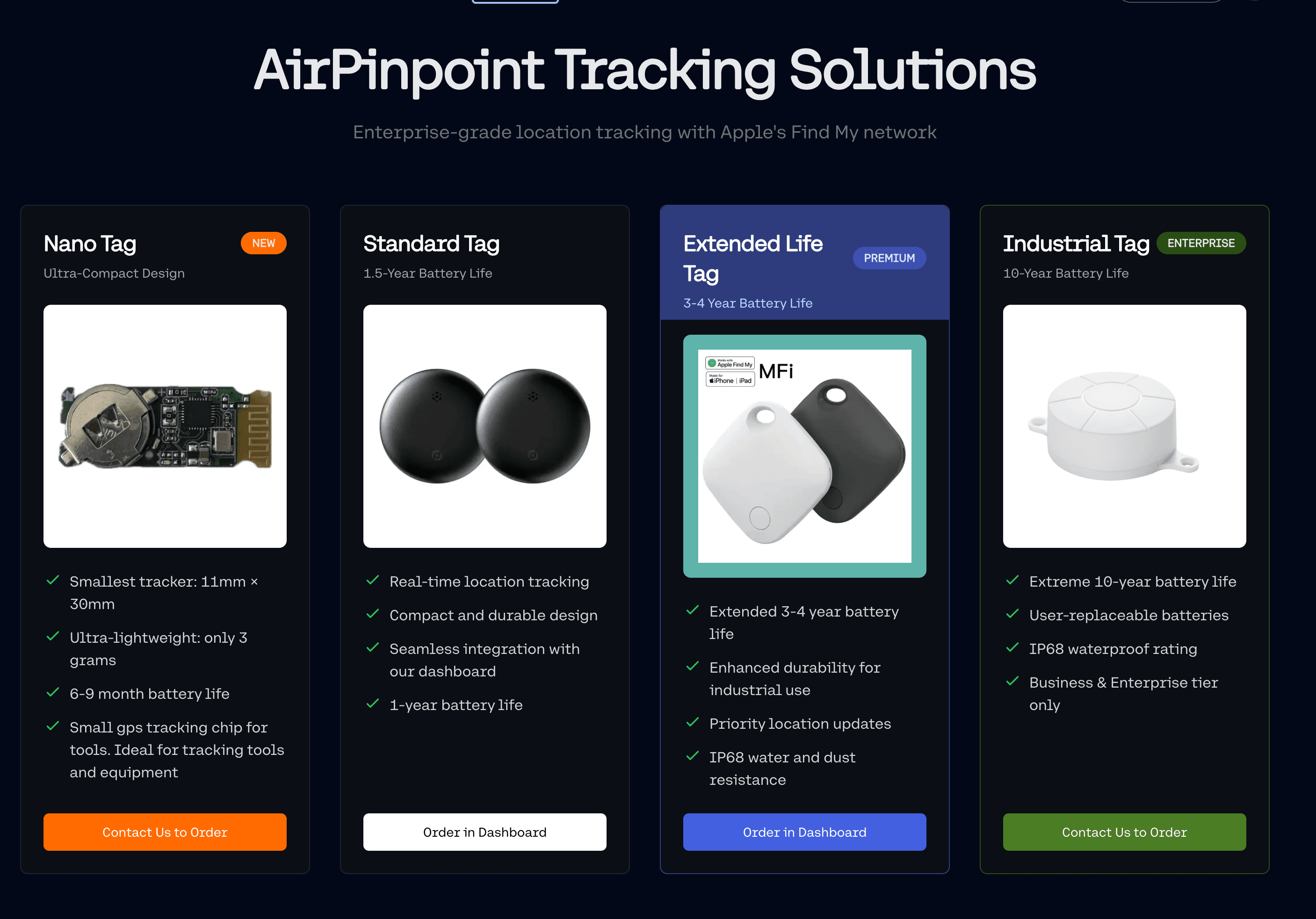
 Our Solution