
Updated
What Is a Geofence? Geofencing for Business 2026: Definition, How It Works, Alerts
A geofence is a virtual boundary drawn around a real-world location. Tracking software compares each position a device reports against that boundary and fires an event, usually an alert, when the device enters or leaves it. Geofencing is the practice of using those boundaries to trigger alerts and actions, and for a business it is mostly used to learn that an asset left a site before a person would have noticed.
What Is a Geofence?
The fence itself is nothing more than stored geometry. A circular geofence is a center coordinate plus a radius, typically 100 to 300 meters for outdoor assets. A polygon geofence is a list of corner coordinates traced around the actual site line, which matters when a yard shares a boundary with a neighbor you do not want inside the fence. Airpinpoint stores fences as PostGIS polygons and runs a point-in-polygon test on every reported position.
Geofences come in two behaviors. A static fence is fixed to a place: a yard, a warehouse, a job site. A dynamic fence moves with a reference object, so the boundary is drawn around a truck and the alert fires when a trailer or attachment separates from it. Fleet and asset platforms overwhelmingly use static fences, because the question they answer is whether something left a site.
Geofence Examples
| Example | Fence drawn around | What the crossing triggers |
|---|---|---|
| Equipment yard | A contractor's storage yard | Alert when an excavator or trailer leaves after hours |
| Job site | An active construction site | Log when tools and generators arrive and leave |
| Delivery zone | A customer's dock or address | Arrival and departure times for a delivery stop |
| Retail store | A shop and its parking lot | App notification or offer when a shopper walks in |
| Home | A house | Smart home routine, such as lights on when a phone arrives |
Geofencing vs Geotargeting vs Geolocation
The three terms travel together in search results and mean different things:
| Term | What it does | Typical precision | Who uses it |
|---|---|---|---|
| Geolocation | Determines where a device is, via GPS, WiFi, cell towers or Bluetooth | 3 to 10 m GPS, 100 to 1,000 m cellular | Every tracking system, as the input |
| Geofencing | Compares a location to a stored boundary and fires an event on entry or exit | Bounded by the location accuracy, so a 100 m minimum radius in practice | Fleet, asset and equipment tracking, retail apps |
| Geotargeting | Serves ads or content to people based on where they are | City, zip code or a radius of several kilometers | Advertising platforms |
A geofence is therefore a rule layered on geolocation. It has no accuracy of its own; the fence inherits whatever error the position stream carries, which is why the radius advice further down matters more than the drawing tool.
Is Geofencing Tracking?
A geofence does not track anything by itself. Tracking is the position stream; the fence is a test applied to it. That distinction matters legally, because a platform can be configured to store only boundary events (entered at 06:12, left at 17:48) rather than a continuous trail, which is the data minimization step regulators ask for when the tracked object is a vehicle a person drives.
What Geofencing Changes for a Business
Geofencing creates virtual boundaries around physical locations. When a tracked device or asset crosses these boundaries (entering or exiting), the system triggers automated alerts, notifications, or workflows.
What a geofence actually changes:
One thing, precisely. It collapses the delay between an asset leaving an authorized area and a human being finding out.
Without a fence, that delay is however long until somebody next looks. On a job site that is usually the next working morning, which for a Friday night theft means Monday. With a fence, it is minutes. On Airpinpoint specifically, a confirmed alert typically lands 15 to 40 minutes after the asset leaves, because we wait for a run of consecutive readings to agree before we page you rather than firing on the first stray position.
Everything else people attribute to geofencing (lower theft losses, better utilization, fewer disputes) is downstream of that one change. Whether it materializes for you depends on what you do in those minutes.
You will find pages in this category quoting reductions of 25%, 40%, or a 400% return inside 18 months. Those numbers come from vendors, not from any study you can read, so they are not on this page.
Whether you're protecting construction equipment or managing delivery routes, geofencing turns a boundary into an event you can act on.
How Geofencing Technology Works
Location Technologies
Geofencing relies on multiple positioning technologies, each with different accuracy and trade-offs:
| Technology | Accuracy | Best Use Case | Limitations |
|---|---|---|---|
| GPS | 3-10 meters (outdoors) | Vehicles, outdoor equipment | Degrades indoors, urban canyons |
| WiFi positioning | 5-20 meters | Indoor tracking, retail | Requires WiFi infrastructure |
| Bluetooth beacons | 1-10 meters | Precise indoor zones | Short range (5-80m), infrastructure needed |
| Cellular triangulation | 100-1,000 meters | Backup, low-battery mode | Low precision |
Modern platforms combine multiple technologies for best results. GPS alone struggles in cities and indoors; adding WiFi and Bluetooth dramatically improves reliability.
How Geofence Alerts Work
- Define boundary: Draw a circle or polygon around a location (job site, warehouse, delivery zone)
- Set trigger conditions: Entry, exit, dwell time, or time-based rules
- Configure actions: Push notification, email, SMS, webhook, or automated workflow
- Monitor and respond: Receive alerts in real-time, review history, take action
Accuracy Considerations
Real-world geofencing accuracy varies significantly:
- Clear outdoor sky: 3-10 meter precision
- Urban canyons (tall buildings): ±20 meters or worse
- Indoor environments: 20-50 meters with WiFi; unreliable with GPS alone
- Cellular-only: 100-1,000 meters, useful only for large zones
GPS drift can cause false alerts. A device might appear to "exit" a geofence while sitting stationary due to signal reflections or satellite geometry changes.
Recommended minimum radius: 100-150 meters for GPS-based geofencing. Smaller zones work with WiFi/Bluetooth augmentation but risk false positives with GPS alone.
Geofencing Use Cases by Industry
Construction and Heavy Equipment
Construction and farm equipment theft is estimated at $300 million to $1 billion annually in the US, and roughly 21% to 23% of stolen heavy equipment is recovered (NICB and National Equipment Register). Recovery of small tools and single-item thefts falls below 7%. Geofencing changes site security in four concrete ways:
After-hours alerts: A notification when equipment crosses the site boundary outside working hours, rather than a discovery at 7am. We do not have a controlled before-and-after theft study to cite here, and neither does anyone else in this category. What we can state is what the alert gives you: a timestamp, a boundary crossing, and a direction of travel, all of which go into the police report.
Automated job site assignment: Equipment automatically associates with projects when entering geofenced sites. No manual logging required.
Unauthorized movement detection: Real-time alerts if equipment moves within restricted areas or leaves during active rentals.
Remote immobilization: Some telematics systems can disable equipment that leaves geofenced areas, a last-resort theft prevention measure.
Fleet Management and Delivery
Fleet operations leverage geofencing for efficiency and customer experience:
Route compliance: Verify drivers follow designated routes and approved stops. Detect unauthorized detours immediately.
Customer ETA notifications: Automatically notify customers when delivery vehicles enter their neighborhood, improves satisfaction and reduces "where's my order" calls.
Fuel and idle monitoring: Track time spent at each location. Excessive dwell times signal inefficiency or potential issues.
A note on fuel and route savings: these belong to the telematics unit, not to the geofence. Reading fuel burn and optimizing a route requires a device wired into the vehicle that can see the ECU. A geofence on its own reports boundary crossings and dwell time and nothing about consumption. Airpinpoint does not do fuel tracking or route optimization at all. If a vendor attributes fuel savings to geofencing specifically, ask which sensor produced the number.
Employee Time Tracking
This is a separate product category from asset tracking, and it is worth being blunt about the boundary. Airpinpoint does not do time tracking. No timesheets, no clock-in, no payroll export, no employee attendance records. Our geofences attach to assets and report that a thing crossed a line, not that a person did.
If time tracking is what you need, buy a tool built for it:
Automated punch-in/out: Dedicated time and attendance apps clock employees in when their phone enters a job site geofence and out when it leaves, which removes the manual entry step and the shared time clock.
GPS-verified time entries: Each punch carries a location stamp, which is what makes these records useful in billing disputes and labor audits.
Multi-site tracking: Field workers moving between locations get time allocated per site without anyone filling in a sheet at the end of the week.
Popular solutions: Buddy Punch (from $5.99/user/month), ClockShark, TimeSheet Mobile, and allGeo specialize in geofence-based construction and field service time tracking.
Why they are not the same tool: employee time tracking follows a person's phone and lands in payroll, which pulls in consent, wage and hour law, and a category of privacy obligation that asset tracking mostly avoids. Tracking a generator raises none of those questions. Keeping the two systems separate is cleaner legally as well as operationally.
Retail and Service Areas
Geofencing enables location-based marketing and service automation:
Customer proximity alerts: Notify customers of promotions when they're near your store.
Delivery zone enforcement: Ensure drivers stay within approved service areas.
Competitor monitoring: Track time your fleet spends near competitor locations (useful for sales analysis).
Setting Up Effective Geofences
Step 1: Define Your Boundaries
Circular geofences work for most applications:
- Simple to configure
- Defined by center point and radius
- Efficient for processing
Polygon geofences offer precision for irregular shapes:
- Match actual property boundaries
- More complex to manage
- Better for large or oddly-shaped sites
Step 2: Choose the Right Radius
| Application | Recommended Radius | Notes |
|---|---|---|
| Large job sites | 200-500 meters | Accounts for site boundaries, GPS drift |
| Warehouses/yards | 100-200 meters | Standard recommendation |
| Urban retail | 50-150 meters | WiFi augmentation helps |
| Parking lots | 150-300 meters | Open areas have more signal issues |
| Precise indoor | 10-50 meters | Requires WiFi/Bluetooth infrastructure |
Android's official guidance: Minimum 100-150 meters for reliable GPS-based geofencing.
Step 3: Configure Alert Rules
Avoid alert fatigue with smart configuration:
| Trigger | When to Use | Alert Recipient |
|---|---|---|
| Exit after hours | Equipment security | Operations manager, security |
| Entry during work hours | Attendance verification | HR, project manager |
| Dwell time exceeded | Delivery efficiency | Dispatch |
| Unexpected entry | Security zones | Security team |
| Extended absence | Lost/stolen equipment | Fleet manager |
Dwell triggers are powerful but underused. Alert when a vehicle stays at a customer site longer than expected, or when equipment sits idle at an unauthorized location for extended periods.
Step 4: Set Trusted Locations and Exceptions
Reduce false alerts by defining:
- Home base locations where equipment normally resides
- Regular service locations (fuel stations, maintenance shops)
- Time-based exceptions for scheduled after-hours work
- Customer sites that should trigger check-in but not security alerts
Step 5: Test Before Deployment
Before going live:
- Walk or drive through geofence boundaries to verify triggers
- Test alert delivery (push, email, SMS)
- Check response procedures are documented
- Verify cellular/GPS coverage within geofenced areas
- Adjust radius if false positives occur
Geofencing Limitations and Workarounds
GPS Drift and False Alerts
Problem: GPS signals reflect off buildings or fluctuate, causing devices to appear outside geofences while stationary.
Solutions:
- Increase minimum radius to 100+ meters
- Use platforms that combine GPS, WiFi, and Bluetooth
- Implement "exit confirmation" delays (don't alert unless outside for 2+ minutes)
- Review alert patterns and adjust boundaries
Indoor Tracking Gaps
Problem: GPS degrades significantly indoors. Standard geofencing won't reliably detect movement within buildings.
Solutions:
- Deploy WiFi positioning (works even without connecting to networks)
- Install Bluetooth beacons for precise indoor zones
- Accept that indoor tracking requires infrastructure investment
- Use geofencing for building perimeter, not interior zones
Device Battery and OS Restrictions
Problem: Continuous GPS tracking drains batteries. Mobile operating systems throttle background location updates to conserve power.
Android behavior: Location updates may occur only every 1-6 minutes when device is stationary.
iOS behavior: Throttles updates based on motion, app state, and system policies.
Solutions:
- Use dedicated tracking devices (not smartphones) for asset tracking
- Accept some latency in consumer device-based tracking
- Choose platforms optimized for background location on mobile
- For fleet vehicles, use hardwired GPS with continuous power
Coverage Gaps
Problem: Remote areas may lack cellular coverage for alert transmission.
Solutions:
- Choose trackers with offline data logging
- Use satellite-capable devices for truly remote assets
- Implement store-and-forward alerting when connectivity returns
- Verify coverage maps before relying on geofencing for critical alerts
Apple Find My and AirTag Geofencing
What AirTags Can Do
A tag is a location beacon, not a rules engine. The geofence lives in whatever software you point it at, so the honest answer splits in two depending on which software that is.
In Apple's own Find My app, there is no geofencing. You cannot draw an arbitrary boundary and get an alert when something crosses it. What you get instead is "Notify When Left Behind":
How it works: Your iPhone alerts you when you move away from an AirTag, helping prevent forgetting items.
Trusted Locations: Set locations (home, office) where you won't receive alerts when leaving items behind.
Customizable radius: Adjust the detection zone to Small, Medium, or Large to tune sensitivity.
Limitation: This is a proximity alert, not a geofence. It triggers based on your iPhone's movement away from the AirTag, not the AirTag crossing a predefined boundary.
What AirTags Cannot Do
On Apple's Find My app alone, an AirTag cannot:
- Alert when it enters or exits a specific location, unless your iPhone happens to be there
- Create a geofence around a job site, warehouse or delivery zone
- Trigger a workflow automatically when an asset arrives somewhere
- Monitor a boundary at all without your phone in proximity
None of that is a hardware limit. The tag broadcasts, nearby Apple devices relay the position, and Apple stores it. What is missing in Find My is the software layer that compares those positions against a boundary you drew. Point the same tag at a platform that has one and every item on the list above becomes possible.
That is what Airpinpoint is. Polygon geofences are stored as PostGIS geometry and evaluated server side against each reported position, so entry and exit fire independently of where your phone is, out to email, Slack and WhatsApp and as outbound webhooks your own systems can act on. The cost of doing it this way is latency rather than capability: a confirmed alert typically arrives 15 to 40 minutes after the asset actually leaves, because several consecutive readings have to agree before it fires.
When to Use GPS Trackers Instead
Cellular GPS still wins a real set of cases, and it is worth being precise about which. Reach for it when you need:
- An alert in seconds or single-digit minutes, not in 15 to 40, because the asset is being driven away right now
- Reporting from somewhere genuinely empty, where no Apple device will pass for hours (a remote pipeline, a rural outbuilding, open water)
- A continuous breadcrumb trail of a moving vehicle rather than periodic positions
- Anything reading the machine itself: engine hours, ignition state, fuel, driver behavior
The pattern most fleets land on is a mix. Put cellular on the handful of assets where minutes matter, and Find My tags on everything else, where the thing you actually need is to know a week later that something left and never came back.
Two things that usually decide it, neither of which is about the fence. Cellular trackers need charging or hardwiring and carry a per-device airtime fee, typically $25 to $45 a month. A Find My tag runs about a year on a coin cell and costs $29 once plus $11.99 a month on Airpinpoint. On a trailer you check monthly, the battery is the whole argument: the cellular unit that died in March told you nothing in April.
Geofencing an AirTag with Airpinpoint
Concretely, what the platform layer adds to the tag:
| Capability | Apple Find My app | Airpinpoint |
|---|---|---|
| Arbitrary boundary you draw | No | Yes, polygons stored as PostGIS geometry |
| Evaluated against the asset's position | No, relative to your iPhone | Yes, server side on every reported position |
| Works with your phone elsewhere | No | Yes |
| Entry and exit events | No | Both |
| Alert channels | iPhone notification only | Email, Slack, WhatsApp |
| Outbound webhooks | No | On entry and exit |
| Location history | Limited | Full, exportable as CSV or JSON |
| Confirmed alert latency | n/a | Typically 15 to 40 minutes |
That last row is the honest cost of the design and worth understanding rather than glossing. Two things add to it. A Find My tag reports when an Apple device passes near it, so the position stream is event-driven rather than scheduled, and in a quiet location the gap between reports can be long. Then we require several consecutive readings on the far side of the boundary before firing, which deliberately trades speed for trustworthiness.
That second part is a choice, and the reasoning behind it is the same as the 100 to 150 meter minimum radius Android's own geofencing documentation recommends: alerting on a single position is how you generate false exits, and a team that has been paged three times for a machine that never moved will ignore the fourth alert, which is the one that mattered.
So size the expectation correctly. This is a system for knowing that something left an area, reliably, on a battery that lasts a year. It is not a system for watching a theft happen in real time.
Legal and Compliance Considerations
Employee Notification Requirements
Most jurisdictions require informing employees about location tracking:
GDPR (EU/UK):
- Location data is personal data requiring explicit consent
- Employees must have access to their data
- Purpose must be specific and documented
CCPA (California):
- Employees have the right to know what data is collected
- Must disclose categories of personal information
General US:
- Few federal restrictions during work hours
- State laws vary: check local requirements
- Written policy disclosure is best practice
Best Practices for Compliance
- Written notification: Include geofencing in employee handbooks and tracking policies
- Purpose limitation: Track only for stated business purposes
- Geographic limits: Use geofencing to limit tracking to work locations
- Time restrictions: Disable tracking outside work hours when possible
- Data minimization: Capture only necessary data (entry/exit events, not continuous trails)
- Retention limits: Set auto-delete schedules; don't store indefinitely
- Access controls: Limit who can view location data
Enforcement Reality
H&M was fined €35.2 million for excessive employee monitoring in Germany. Courts evaluate whether tracking is proportionate, necessary, and properly disclosed.
The safest approach: Track assets rather than people when possible. When employee tracking is necessary, geofencing to work locations actually helps compliance by limiting monitoring scope.
Geofencing ROI by Application
Theft Prevention
The only variable a geofence directly controls is the one at the bottom of this table. Everything above it is a downstream effect whose size depends on your response, not on the software:
| What changes | Without geofencing | With geofencing |
|---|---|---|
| How you learn about a loss | Somebody notices the asset is gone | An alert names the asset, the fence it crossed and the time |
| What the police report contains | "The yard was full Friday and empty Monday" | A boundary crossing at a timestamp plus a location trail |
| Who can act | Whoever happens to be on site | Whoever is on the alert distribution list, from anywhere |
| Detection delay | Until the next time a person looks, often the next working day | Typically 15 to 40 minutes on Airpinpoint, once consecutive readings confirm the move |
On "security savings" percentages: you will see figures like an 18% reduction in security spend attributed to geofencing. We could not find a source for any of them that was not a vendor page, so they are not here. Calculate it from your own side instead: what you currently pay for overnight patrols or guard hours at low-risk sites, against what you would still need if you were paged within the hour.
Work out your own number: multiply your per-incident deductible by incidents per year, add the replacement value of what sits inside the fence overnight, and weigh that against the fence cost. Then apply your own honest discount for the incidents where a faster call would not have changed anything, because there will be some.
Fleet Operations
Be careful here, because most fleet ROI tables in this category credit geofencing with savings that come from a different sensor. Sort the claims by what actually produces them:
| Claimed saving | What actually produces it | Does a geofence do this? |
|---|---|---|
| Fuel reduction | ECU or fuel-card data from a wired telematics unit | No |
| Maintenance cost reduction | Engine hours and fault codes from the ECU | No |
| Route optimization | Continuous GPS breadcrumbs plus a routing engine | No |
| Utilization improvement | Dwell time and site-to-site movement history | Partly, via location history |
| Faster theft response | Boundary crossing alerts | Yes, this is the geofence |
| Less admin chasing assets | A map that answers "where is it" without a phone call | Yes |
Airpinpoint does the last three rows. It does not do fuel, maintenance scheduling or route optimization, and it has no access to a machine's ECU. Any vendor quoting you a blended fleet ROI should be able to say which row each percentage came from.
On the 250-400% figure: it appears across this category with no attributable source. We are leaving it out rather than passing it along.
Time Tracking
Again: this is a different product category, and Airpinpoint does not do it. Included here because readers comparing geofencing platforms will see it bundled in, and should know which vendor to ask.
| What a time tracking geofence does | What you get |
|---|---|
| Clock-in on site entry | Removes the shared time clock and the manual entry step |
| Location-stamped punches | Each entry carries coordinates, which is what makes it defensible |
| Per-site allocation | Hours split across job sites without an end-of-week reconstruction |
| Payroll export | Approved hours flow to payroll rather than being retyped |
Ask the vendor how they handle a phone with location permission denied, or a crew member who forgets to carry it. That edge case is where these systems either hold up or quietly fall back to manual entry.
Implementation Checklist
Week 1-2: Planning
- Inventory assets requiring geofencing
- Map locations for geofence boundaries
- Evaluate technology needs (GPS, WiFi, beacons)
- Review compliance requirements
- Select platform/vendor
Week 3-4: Setup
- Deploy tracking devices
- Configure geofence boundaries
- Set alert rules and recipients
- Define trusted locations and exceptions
- Document response procedures
Week 5-6: Testing
- Test all geofence triggers
- Verify alert delivery
- Train staff on response procedures
- Adjust radius/rules based on results
- Go live with monitoring
Ongoing
- Weekly alert review and optimization
- Monthly boundary adjustments as sites change
- Quarterly ROI assessment
- Annual compliance review
The Bottom Line
A geofence does one thing well: it turns a boundary crossing into an event somebody can act on, instead of a fact somebody discovers later.
What that is worth to you depends on three things we cannot know:
- How long your current detection delay is. Measure it. If you already walk the yard at 6am and again at 6pm, the gap a fence closes is smaller than if nobody looks until Monday.
- Whether anyone is on the other end. An alert at 2:47am that gets read at 8am has bought you nothing. Decide who is on the list and what they do before you turn alerts on.
- What sits inside the fence. Replacement value overnight, times your honest estimate of incidents per year, is the whole upside.
What it will not do: read a machine's ECU, track fuel, schedule maintenance, or tell you anything about a person. Geofence radius below about 100 meters on GPS alone will produce false exits, and those train people to ignore the alerts, which is worse than not having them.
On the AirTag question specifically, since most pages get it backwards: the tag is a location beacon and the fence lives in the software you point it at. Apple's own Find My app provides no geofencing, only a proximity alert relative to your iPhone. Airpinpoint provides real ones, as PostGIS polygons evaluated server side against every reported position, firing on entry and exit to email, Slack and WhatsApp and out through webhooks, whether or not your phone is anywhere nearby. The difference against cellular GPS is latency, not capability: 15 to 40 minutes for a confirmed alert, on hardware that runs a year on one battery.
Start with your highest-value use case: overnight equipment security is the easiest one to measure, because you can write down your detection delay before you start and compare it after. Prove it there on a handful of assets, then expand.
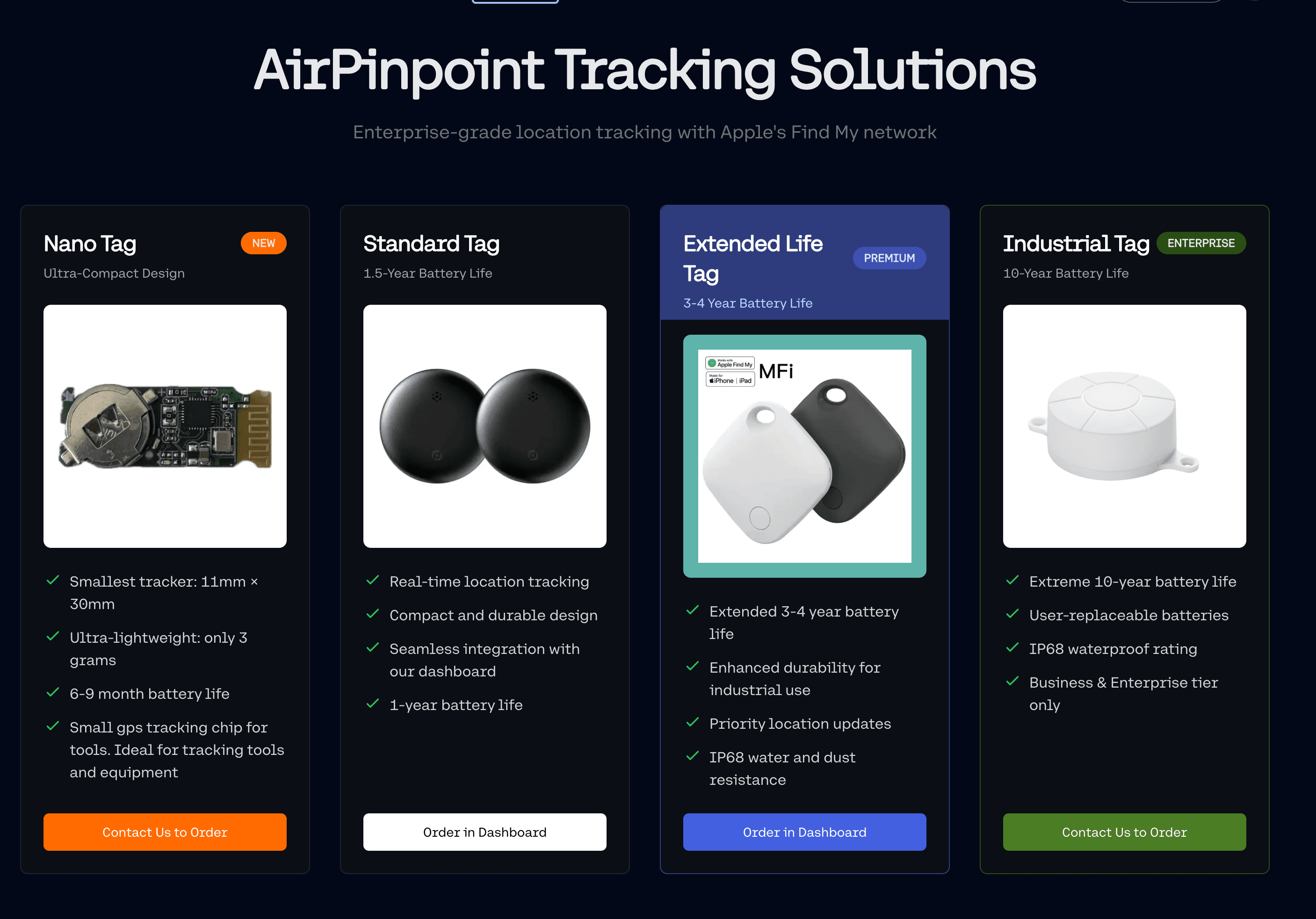


 Our Solution