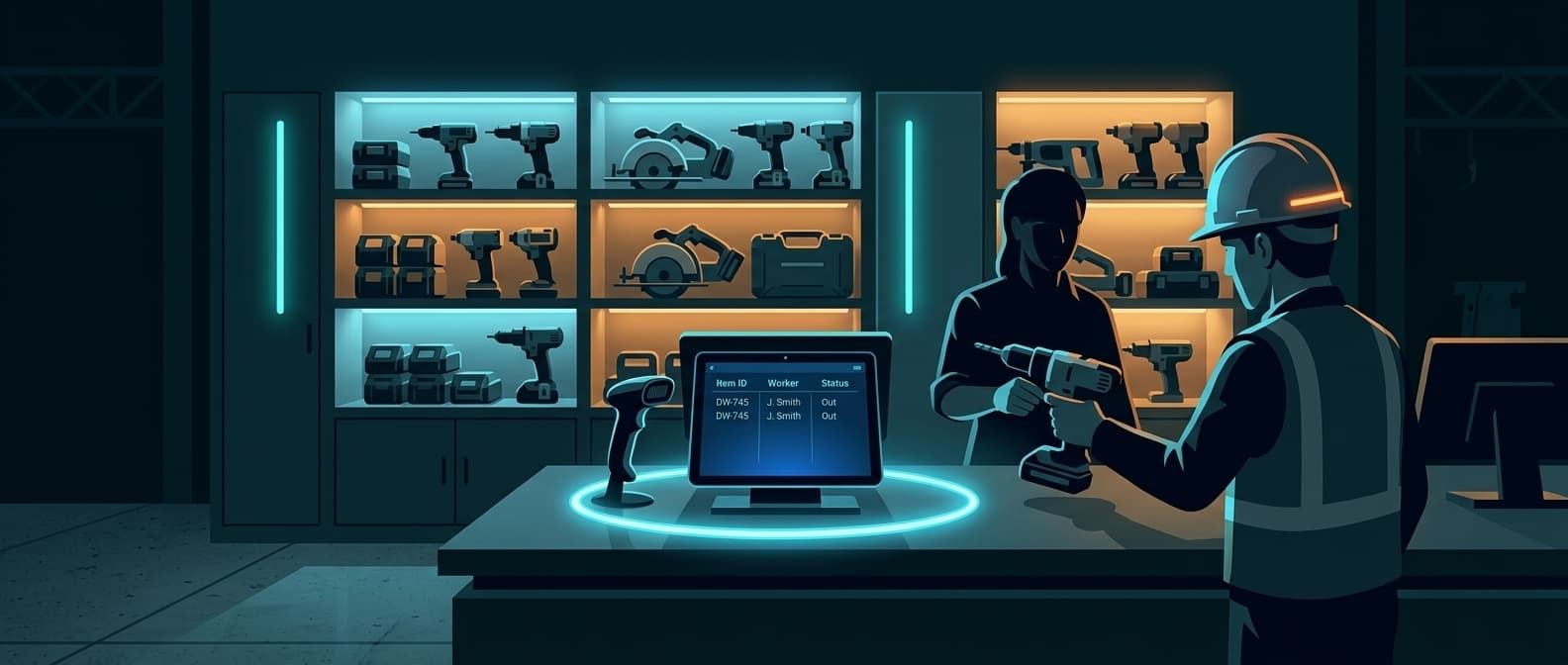
Tool Checkout Systems for Construction
Up to 30% of all tool purchases on a construction project replace tools that were lost, stolen, or "borrowed" and never returned. On a $5 million project, that is $150,000 gone. Not to damage, not to wear. Just gone.
Every superintendent knows the pattern. A $1,200 rotary hammer gets checked out on Monday. By Thursday, nobody knows where it is. The sign-out sheet says "Mike, Job Site B." Mike says he returned it. The tool crib guy was at lunch. The sheet has coffee stains on it. The hammer is now a line item on next month's purchase order.
This is the tool checkout problem, and it has been costing contractors money for decades.
The Real Cost of No System (or a Bad One)
Construction workers spend an average of 38 hours per year looking for tools. That is nearly one full work week per worker, per year, spent walking around asking "have you seen the Hilti?"
For a crew of 10, that is 380 hours of lost productivity. At $45/hour fully loaded, that is $17,100 per year in labor alone, before counting the cost of the missing tools themselves.
Industry-wide, construction site theft accounts for over $1 billion per year in the US. Less than 25% of stolen equipment is ever recovered.
| Cost Category | Annual Impact |
|---|---|
| Tool replacement (loss + theft) | $50,000-$150,000 per large project |
| Productivity loss (searching) | $17,100 per 10-person crew |
| Project delays from missing tools | Varies, often 2-5% of schedule |
| Duplicate rentals for "missing" tools | $5,000-$20,000 per site |
The Clipboard Problem
Most contractors still run some version of the clipboard system. A sign-out sheet in the tool crib. Maybe a whiteboard. The tool crib attendant writes down who took what.
This fails for three predictable reasons:
1. People skip it. When a foreman needs a tool at 6:45am and the tool crib attendant starts at 7:00, the tool just walks out. Nobody writes anything down. A study from CyberStockroom found that 62% of inventory fulfillment errors come from manual process failures.
2. The data is stuck on paper. Even when someone fills out the sheet, that information lives on a clipboard in a trailer. The project manager at the main office has no visibility. If tools move between three job sites, you need three separate clipboards and someone to reconcile them.
3. No return verification. A worker "returns" a tool by dropping it on a shelf. Nobody scans it back in. The sign-out sheet still shows it as checked out. Now the data is wrong in both directions: the system thinks it is out when it is back, or thinks it is back when it is actually in someone's truck.
Four Approaches to Tool Checkout
1. Manual (Paper / Spreadsheet)
The baseline. A sign-out sheet, maybe an Excel file someone updates weekly.
- Cost: Near zero
- Accuracy: 40-60% at best
- Multi-site visibility: None
- Best for: Very small crews (under 5 people) on a single site
The only advantage is simplicity. The disadvantage is that it barely works.
2. Barcode / QR Code Scanning
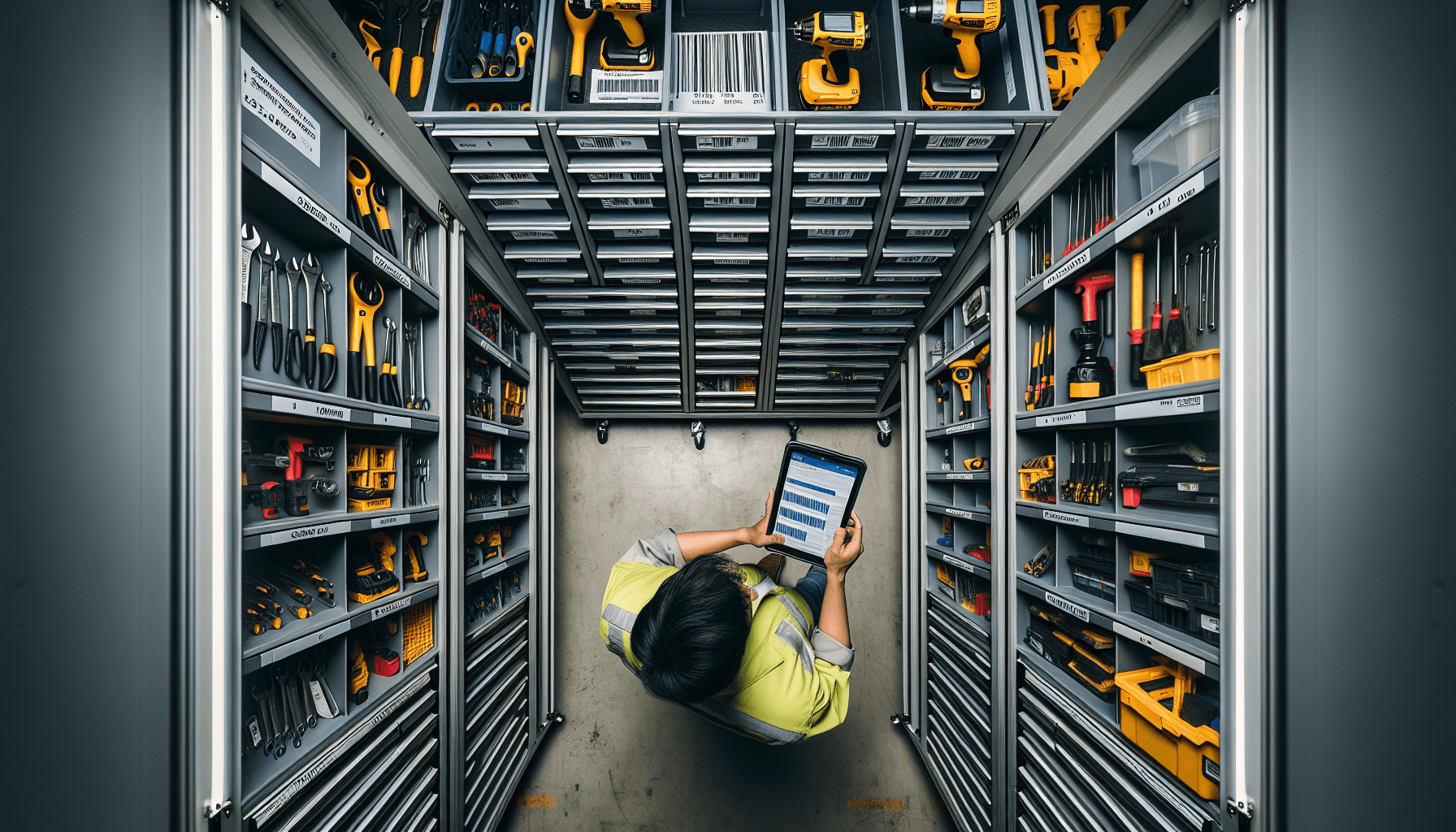
Every tool gets a barcode label. Workers scan with a phone or handheld scanner at checkout and return.
- Cost: $0.10-$0.50 per label, $80-$995/month for software
- Accuracy: 85-95% (depends on compliance)
- Multi-site visibility: Yes, if cloud-based
- Best for: Contractors with dedicated tool crib attendants
Barcode systems are the most common digital upgrade from paper. They work well when someone enforces the scanning. They fail when compliance drops below 90%, because now you have a system that tells you most of your tools are tracked, but you do not know which ones are not.
The compliance trap: Any system that requires a human to do something every single time will eventually have gaps. People are busy. They are cold. They are in a hurry. They skip the scan. One skip is not a problem. Fifty skips per week means your database is fiction.
3. RFID (Radio Frequency Identification)
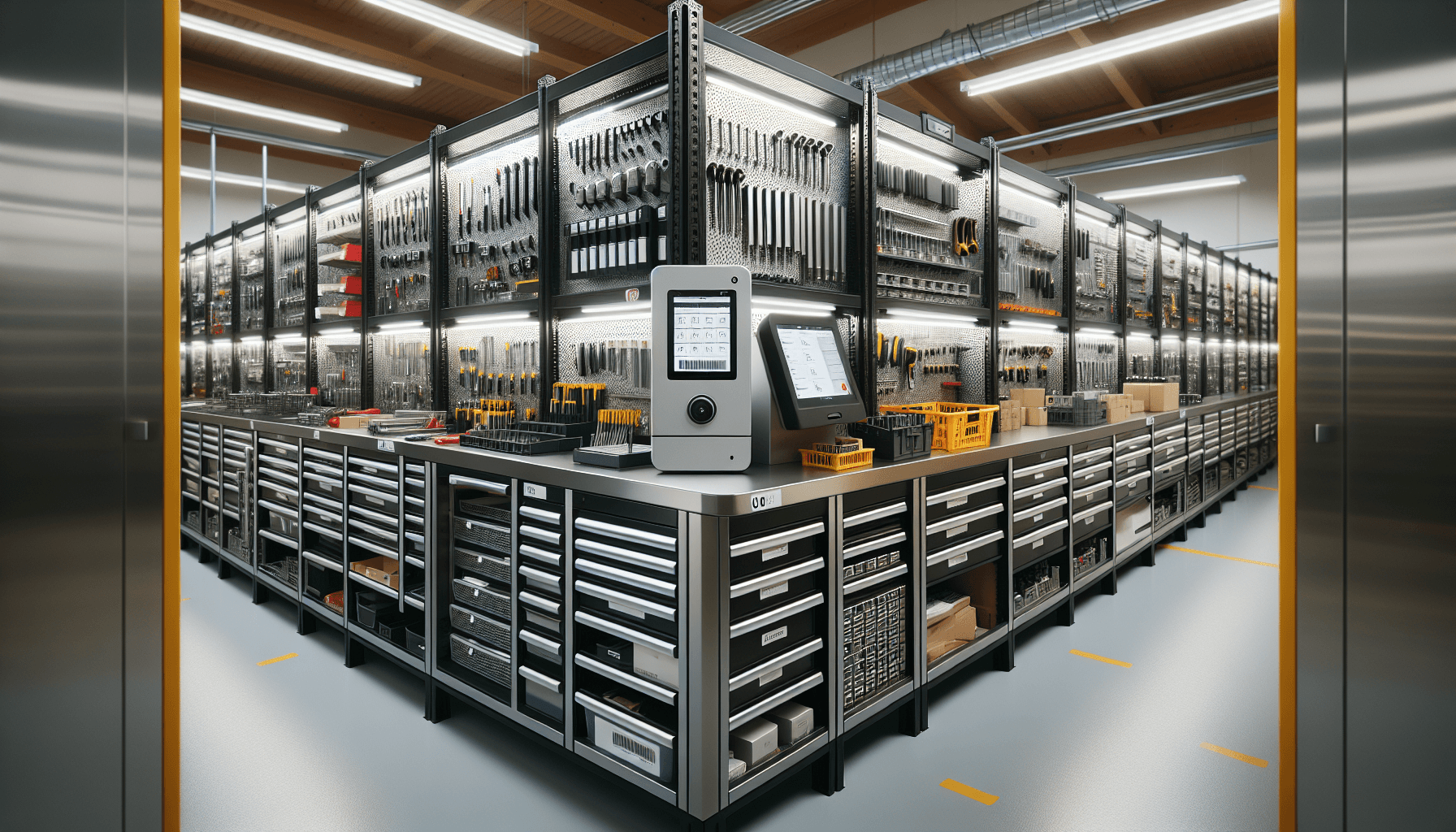
RFID tags on every tool. Fixed readers at doorways or tool crib entrances automatically detect tools passing through.
- Cost: $0.50-$5.00 per tag, $5,000-$20,000+ for readers/gates per location
- Accuracy: 95-99% with proper gate setup
- Multi-site visibility: Yes, but requires readers at every site
- Best for: Large contractors with permanent warehouses and high-value tool inventories
RFID is the gold standard for tool cribs in fixed facilities. A worker walks through the gate with three tools, and the system logs all three without anyone scanning anything. CribMaster (Stanley Black & Decker) and AutoCrib (Snap-on) have built entire businesses around RFID-gated tool rooms.
The catch: RFID works great at the warehouse door. It tells you nothing about where the tool is once it leaves. If a tool gets checked out to Site B, transferred to Site C, and left in someone's truck overnight, the RFID system's last record is "checked out to Site B." The actual location is unknown.
Metal tools can also interfere with RFID reads. Construction sites are full of metal.
4. BLE (Bluetooth Low Energy) Tracking
BLE tags attached to tools broadcast their location continuously via nearby smartphones and gateways.
- Cost: $15-$50 per tag, $0-$15/month per tag for software
- Accuracy: Location within 10-50 feet, continuously updated
- Multi-site visibility: Yes, automatic, no infrastructure needed
- Best for: Contractors who need to know where tools are right now, not just who signed them out
BLE tracking does not replace the checkout process. It makes it less critical. If a tool has a BLE tag, you can see its current location on a dashboard whether or not someone remembered to scan it. The Apple Find My network, with over a billion devices, provides passive location updates without requiring any installed readers or gateways on site.
Tool Checkout Software Compared
| Software | Approach | Starting Price | Users Included | Best For |
|---|---|---|---|---|
| ShareMyToolbox | Barcode/QR | $80/month | 10 users | Small-mid contractors, mobile-first |
| GigaTrak | Barcode/QR/RFID | $995/month | Contact sales | Mid-large contractors, self-hosted option |
| ToolHound | Barcode/RFID | $50/user/month + $1K-$5K setup | Per-user pricing | Multi-site operations, mining, energy |
| ToolWatch (AlignOps) | Barcode/RFID/GPS/BLE | $125/user/month | Per-user pricing | Enterprise contractors, ERP integration |
| CribMaster | RFID + vending machines | Custom quote ($$$$) | Enterprise | Manufacturing, aerospace, fixed facilities |
| Airpinpoint | BLE (Find My network) | $29/tag + $11.99/mo per tracker | Unlimited users | Real-time location across all sites |
ShareMyToolbox
Mobile-first tool tracking with barcode scanning. Free tier available (3 users, 100 tools). The $80/month plan covers 10 users with unlimited tools. Clean interface, easy onboarding. Limited to barcode scanning, so accuracy depends on people actually scanning.
GigaTrak
Full-featured tool and asset tracking with barcode, QR, and RFID support. Cloud or self-hosted. Includes hardware (scanners, printers, labels) in their packages. Starting at $995/month puts it out of reach for smaller contractors, but larger operations get a complete system with US-based support and training.
ToolHound
Built for multi-site operations. $50/user/month for small teams, dropping to $30/user at scale. Implementation runs $1,000-$5,000 for small businesses, up to $20,000+ for enterprise. Offers self-service kiosks where workers check tools in and out via touchscreen. Strong in mining, power generation, and heavy industrial.
ToolWatch by AlignOps
The enterprise play. $125/user/month with integrations into Sage, Viewpoint, Procore, and Autodesk. Supports barcode, RFID, GPS, and Bluetooth. Built for ENR 400 contractors managing millions of dollars in tool inventory. If you are running a $50M+ operation with dedicated tool managers, this is the tier you are looking at.
CribMaster (Stanley Black & Decker)
Industrial vending machines with RFID. Over 12,000 customers in 36 countries. The hardware costs $15,000-$20,000+ per vending unit. This is a manufacturing and aerospace solution that some large contractors adopt for permanent tool rooms. Not practical for distributed construction sites.
The Gap Every Checkout System Has
All of these systems answer the same question: who checked out the tool?
None of them reliably answer a different question: where is the tool right now?
A checkout system records a transaction. "Mike checked out the Hilti TE 70 at 7:12am on March 15, assigned to the Oak Street project." That is useful. But three days later, when the project manager at Elm Street needs that same hammer and it is not in the system as returned, the checkout record does not help locate it. It just tells you to call Mike.
Mike might be on a different site. Mike might have handed it to another worker who did not log the transfer. Mike might have left the company.
This is where location tracking fills the gap.
Where Airpinpoint Fits
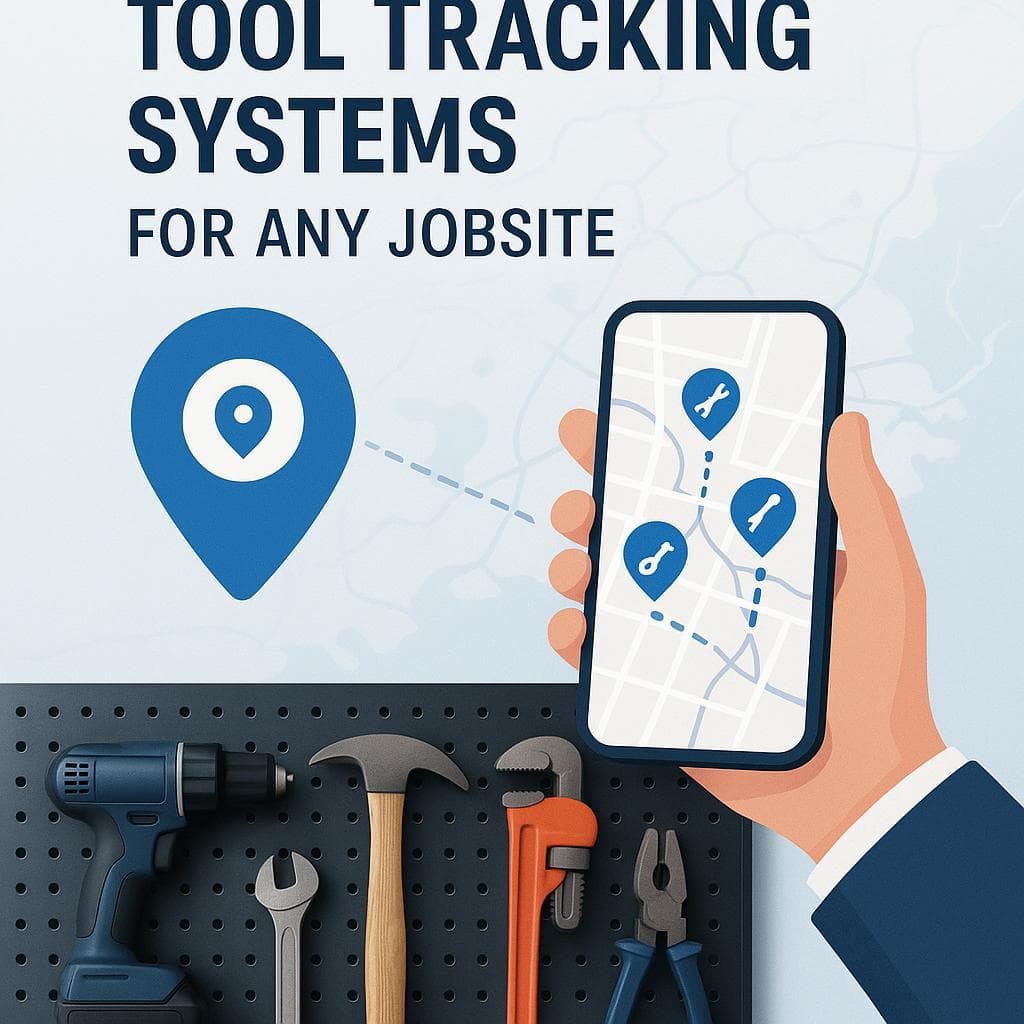
Airpinpoint is not a checkout system. It does not record who scanned what at the tool crib door. It answers the question that checkout systems cannot: where is this tool right now?
How It Works
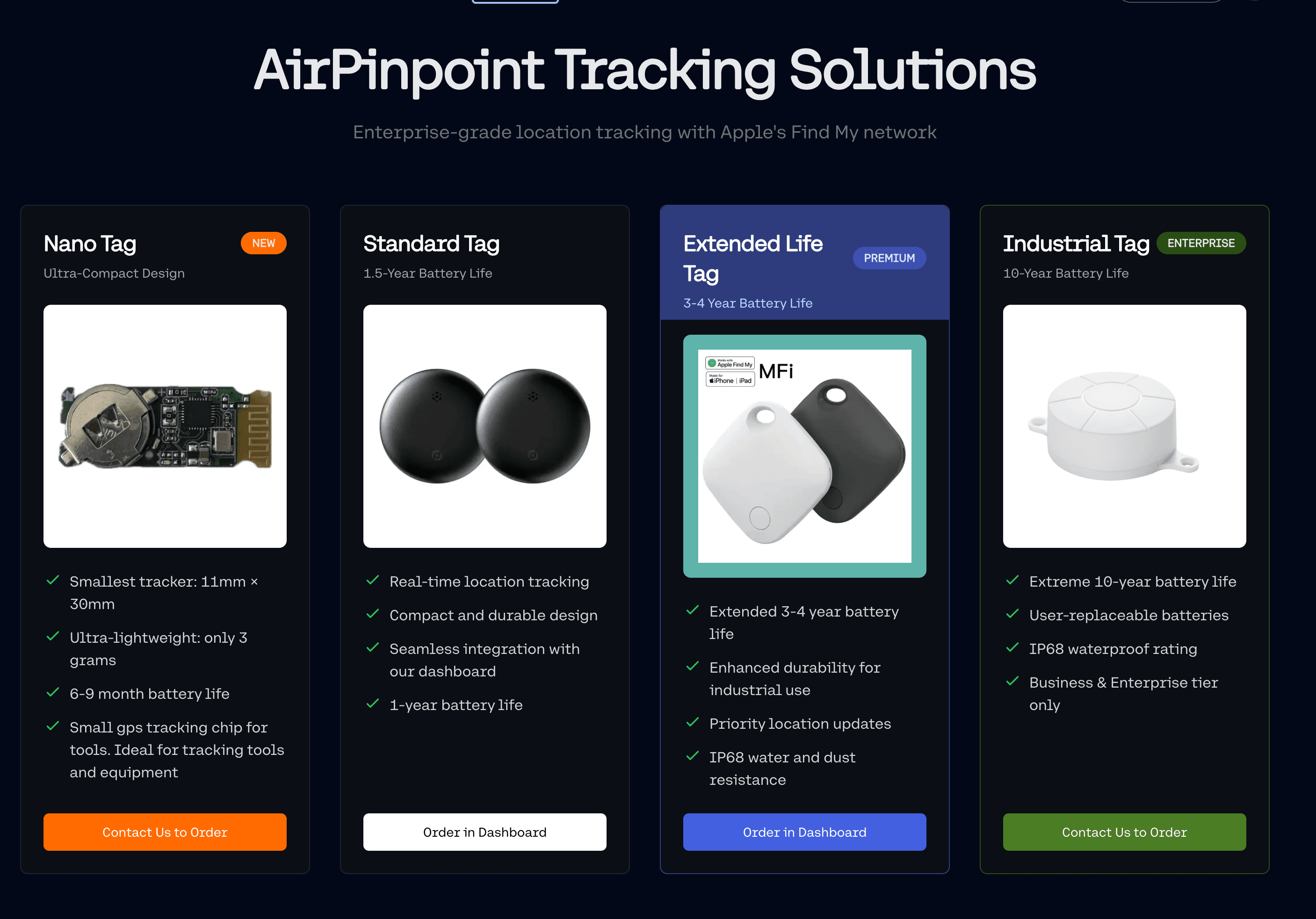
- Attach a tag. A small BLE tag ($29) goes on each high-value tool. Epoxy mount, zip tie, or adhesive, depending on the tool.
- Tools report location automatically. The tag broadcasts via Bluetooth. Any nearby Apple device (there are billions of them) picks up the signal and relays the location to your Airpinpoint dashboard. No gateways to install. No scanners at doors.
- Set geofences for each job site. Draw a polygon around each job site on the map. When a tagged tool leaves that boundary, you get an alert once seven consecutive reports agree it is outside, which on a site with people around is 15 to 40 minutes.
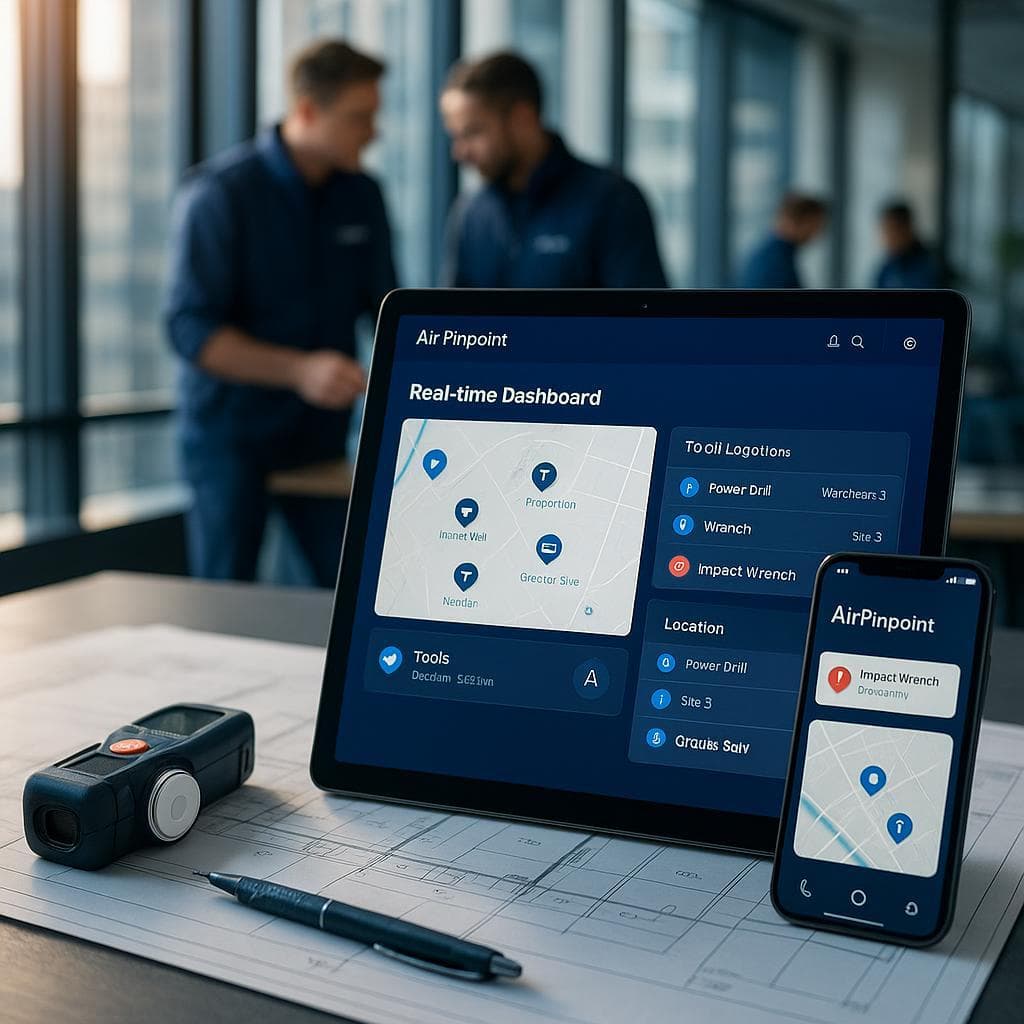
- Check the dashboard. See every tagged tool on a map. Filter by job site, by tool type, by last seen time. No scanning, no compliance requirements, no hoping someone filled out the sheet.
Pricing
- $29 per tag (one-time, bulk discounts available)
- $11.99/month per tracker (location updates, geofence alerts, dashboard access)
- Unlimited users. No per-seat fees. Your entire team can view the dashboard.
For a fleet of 50 high-value tools, that is $1,450 in tags plus $599.50/month. Compare that to $50/user/month for ToolHound with a 20-person crew ($1,000/month) and you are in the same range, except Airpinpoint gives you actual location data instead of checkout records.
Airpinpoint + Your Existing Checkout System
The strongest setup combines both. Your checkout system handles accountability (who has the tool, who is responsible). Airpinpoint handles verification (is the tool actually where the checkout system says it is).
When ToolHound says the rotary hammer is at Site B and Airpinpoint confirms it is at Site B, everything is good. When ToolHound says Site B and Airpinpoint shows it at Site C, you caught a problem before it became a loss.
Choosing the Right Approach
You have under 20 tools and one job site: A spreadsheet is fine. Do not overthink it.
You have 20-100 tools across 2-3 sites: ShareMyToolbox ($80/month) for checkout plus Airpinpoint tags on your 20 most expensive tools. Total cost under $400/month.
You have 100-500 tools across multiple sites: ToolHound or GigaTrak for checkout, Airpinpoint for location verification on everything over $500 in value. The checkout system handles daily accountability. Airpinpoint catches what the checkout system misses.
You have 500+ tools, enterprise operations: ToolWatch for full ERP integration and checkout workflows. Airpinpoint for continuous location monitoring and geofence alerting across every site. At this scale, even a 5% reduction in tool loss pays for the entire system in the first quarter.
Getting Started
The fastest path from "tools keep disappearing" to "I know where everything is":
- Tag your top 20 most expensive tools. These are the ones that hurt when they vanish. Rotary hammers, total stations, laser levels, generators. Order Airpinpoint tags here.
- Set up geofences. Draw boundaries around each job site and your warehouse. Takes 5 minutes per site in the dashboard.
- Turn on alerts. Get notified when any tagged tool leaves a geofenced area outside of work hours.
- Expand from there. Once you see the dashboard working, tag the next tier of tools. Most contractors tag everything over $300 in value within the first month.
You will never eliminate every lost tool. But you can go from 30% loss rates to under 5%. On a $5 million project, that is the difference between $150,000 in replacement costs and $25,000. The system pays for itself before the first tool goes missing.
 Our Solution