
Power Tool Tracking: Stop the $400M Bleed
First, about that number in the headline. The $300 million to $1 billion annual US theft estimate, which gets rounded to $400M all over the internet, comes from the National Equipment Register and it covers heavy equipment: excavators, loaders, skid steers, backhoes. It is not a power tool figure. There is no US power tool figure, because federal crime reporting has no tools category to produce one from. This page also used to claim that a DeWalt kit walks off a site every four minutes and that 7% of stolen tools are recovered. Neither figure has a source anywhere, ours included, so both are gone. The "every X minutes" framing is real but it is British, it comes from police Freedom of Information data, and the published range runs from 12 to 23 minutes depending on the year and the survey.
Here is what is actually documented, and why it still makes the case.
A $29 AirTag hidden in each tool case pays for itself the first time it doesn't disappear.
The Power Tool Theft Problem
The best hard data on power tool theft comes from the UK, because British police forces answer Freedom of Information requests and insurers fund surveys. It is not US data, and we are labelling it as such rather than quietly converting the currency.
- 32,067 powered hand tools were stolen in the Metropolitan Police area between January 2019 and May 2021, against 2,993 non-powered hand tools. Thieves were 10 times more likely to take a powered tool (Construction Index, from a police FOI request)
- 1% of those powered tools were recovered. Building materials, which are harder to fence, came back 4% of the time
- 0.3% of London tool thefts resulted in a charge, across 34,712 tools reported in 2021 to 2022 (Met Police data)
- 25,525 tool thefts were recorded across 29 UK police forces in 2024, roughly 70 a day, totalling about £40 million, averaging £1,565.02 per theft plus £622.72 in lost business per incident (Direct Line for Business, FOI to 45 forces)
- 89% of UK tradespeople have experienced theft or crime (NFU Mutual); 83% of UK builders have been tool theft victims (FMB)
The one US-weighted measure we can point to comes at it from the budget side rather than the crime side. Samsara's 2026 State of Connected Operations report, a survey of more than 1,500 senior executives at organizations of 500-plus employees, found 25% of new equipment budget goes to replacing stolen or lost items and that 72% of the operational cost of theft and loss sits in assets worth under $10,000. It is vendor-published, but it names its sample and its fieldwork dates, which most numbers in this category do not.
Why power tools specifically: they're portable, valuable, and easy to resell. A cordless drill kit fits in a backpack. A rotary hammer fits in a duffel bag. Both sell for half retail on Facebook Marketplace within hours. The London figures put a number on exactly that asymmetry, a 10 to 1 preference for powered over non-powered, and a 1% chance of seeing it again.
| Tool Category | Typical Value | Annual Loss (per tool) |
|---|---|---|
| Cordless Drill/Driver Kit | $200-$400 | $600-$1,200 |
| Circular Saw | $200-$500 | $400-$1,000 |
| Rotary Hammer | $300-$1,200 | $600-$2,400 |
| Impact Driver Kit | $150-$350 | $300-$700 |
| Reciprocating Saw | $150-$400 | $300-$800 |
| Miter Saw | $300-$800 | $600-$1,600 |
| Total Station | $5,000-$20,000 | $5,000-$20,000 |
Annual loss includes replacement cost, downtime, rush shipping, and productivity impact.
Why Existing Tracking Falls Short
Milwaukee ONE-KEY
ONE-KEY only tracks Milwaukee tools. It relies on other ONE-KEY app users walking within 300 feet with Bluetooth enabled. On a busy downtown site, that might work. On a rural site or in a pawn shop parking lot? The network is too thin.
DeWalt Tool Connect
Same problem, different brand. Tool Connect tracks DeWalt tools only, through the Tool Connect app's Bluetooth network. Most contractors run mixed fleets (DeWalt drills, Milwaukee impacts, Makita saws). You'd need three separate apps tracking three separate ecosystems.
The Network Problem
Both systems depend on users of that specific brand's app being nearby. Apple's Find My network has over a billion active devices. An AirTag in a parking lot gets pinged by dozens of iPhones every hour without anyone doing anything. That's the difference between "last seen 3 days ago" and "last seen 4 minutes ago."
How Airpinpoint Tracks Power Tools
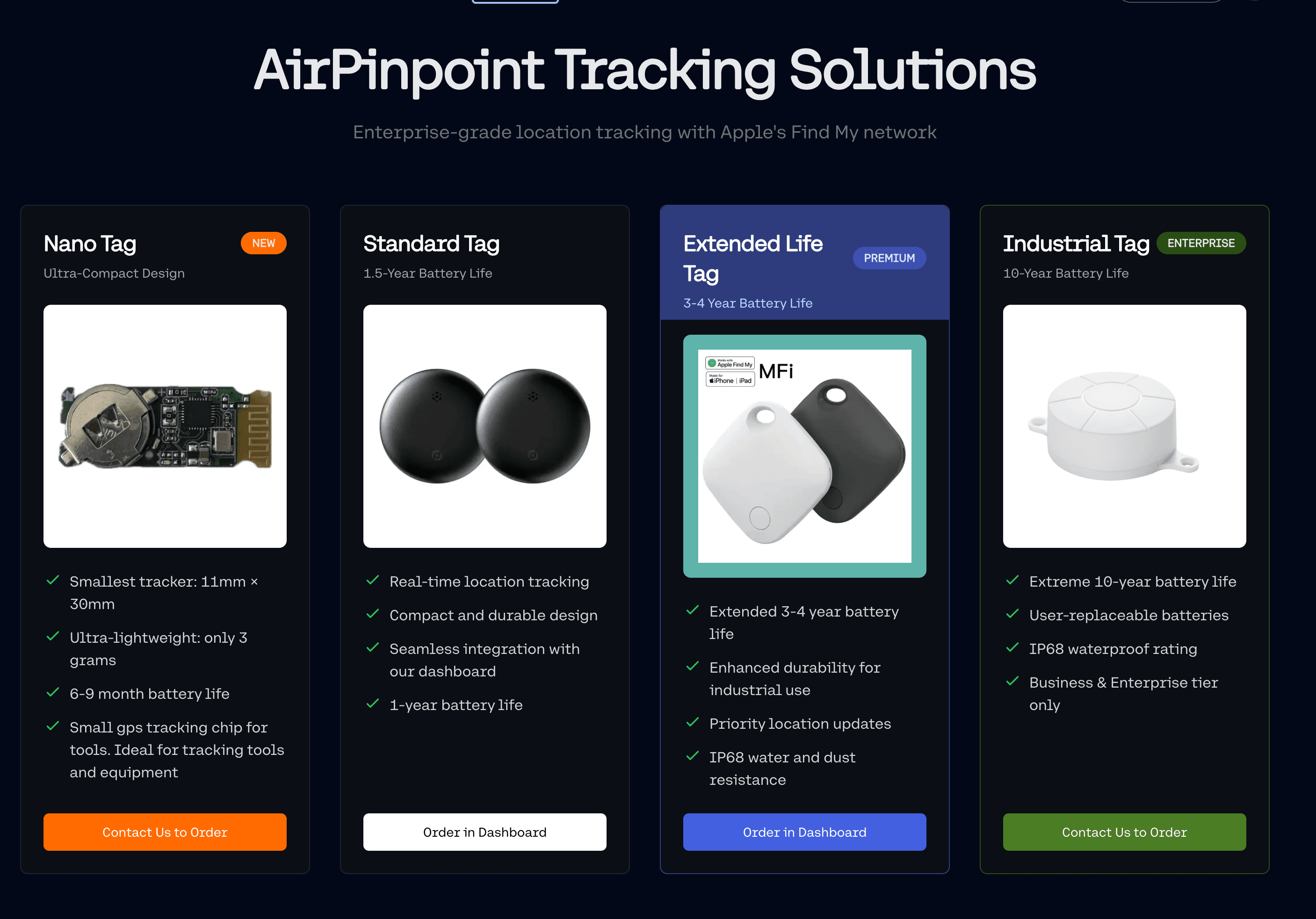
Airpinpoint turns AirTags and Find My compatible trackers into a fleet-wide power tool tracking system.
Tag each tool. Attach an AirTag to every power tool worth more than the $29 tag costs. That covers almost everything except hand tools.
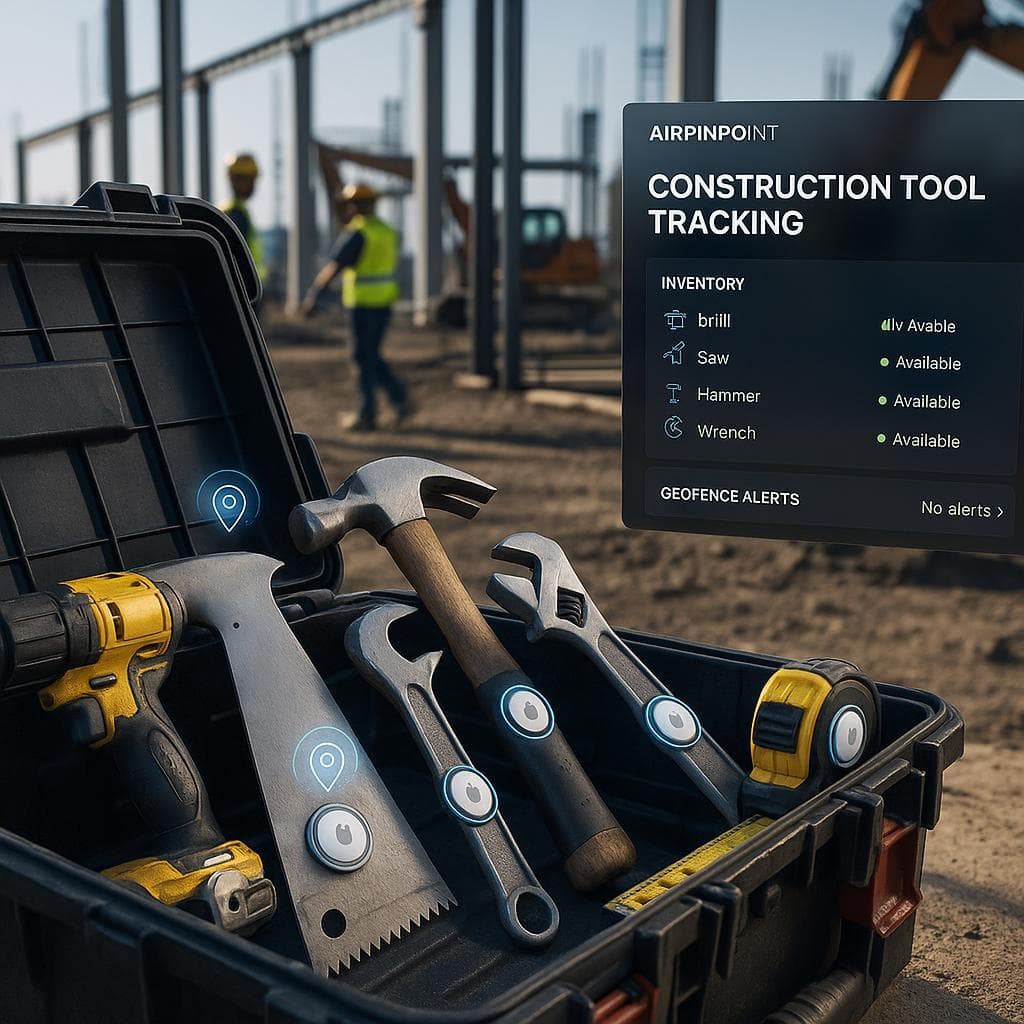
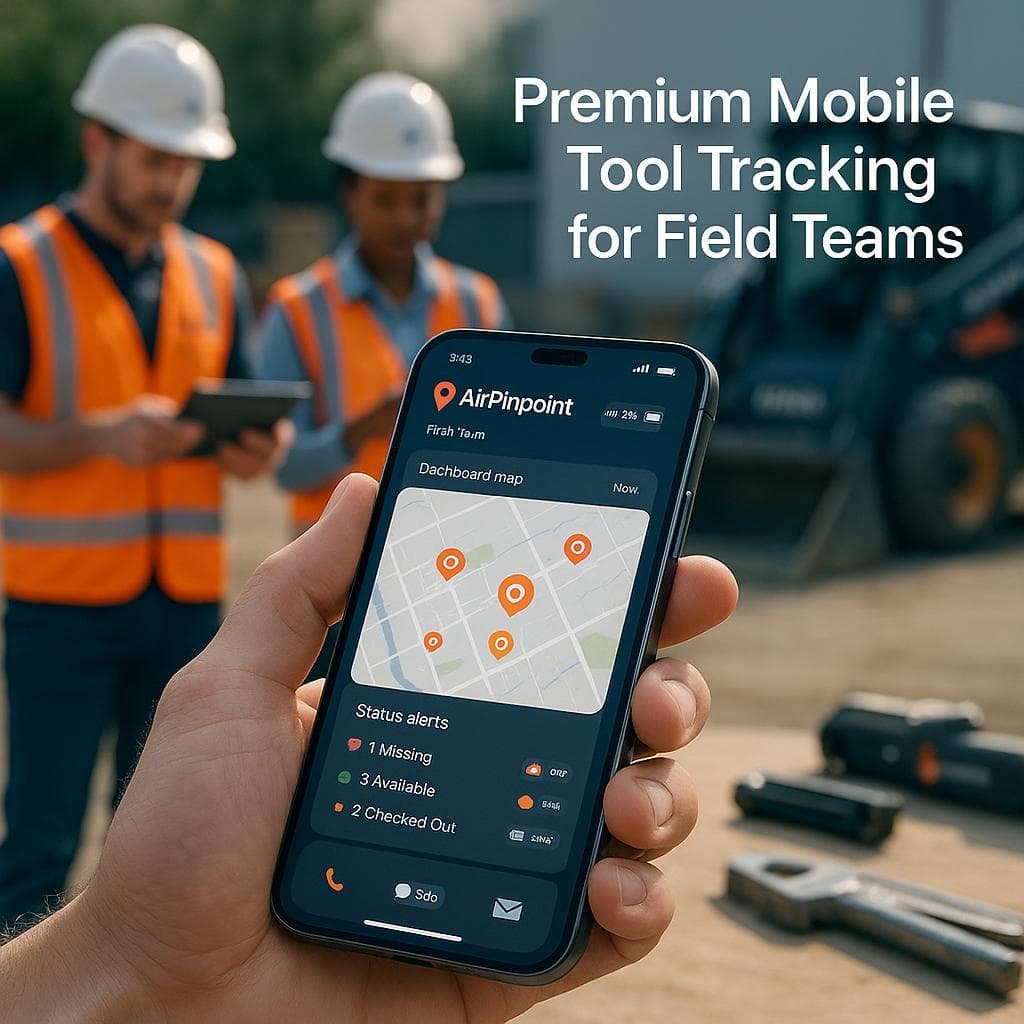
See everything on one dashboard. Every tagged tool shows up on a map with its last known location, assigned job site, and movement history. No per-brand silos.
Get alerts that matter. Set geofences around each job site. If a tool leaves after hours, you get a notification before it reaches the highway. Set up check-out tracking so you know which crew has which tools.
Recover stolen tools. When a tool goes missing, the Find My network keeps reporting its location as it moves past iPhones, iPads, and Macs everywhere. Share the location with law enforcement. Most recoveries happen within 48 hours.
Where to Put AirTags on Power Tools
Placement matters. You want the AirTag hidden (so a thief doesn't remove it), protected (so it survives job site conditions), and accessible (so you can replace the battery yearly).
| Tool Type | Best Placement | Why It Works |
|---|---|---|
| Cordless Drill/Impact Driver | Inside the hard-shell case, under the foam insert | Hidden, protected from drops, easy battery access |
| Circular Saw | 3D-printed mount on the base plate or inside the blade guard housing | Out of sight, doesn't interfere with cuts |
| Rotary Hammer | Inside the carrying case or adhesive mount inside the depth stop cavity | Deep cavity hides the tag completely |
| Miter Saw | Inside the dust port or taped behind the fence | Protected from sawdust, invisible during use |
| Reciprocating Saw | Inside the case or adhesive mount in the battery compartment area | Compact tools need compact placement |
| Gang Box / Tool Chest | Adhesive mount on the inside lid | Tracks the whole box, not just one tool |
Tips for better placement:
- Use IP68-rated AirTag cases for any exposed mounting. Standard silicone sleeves aren't enough for job sites.
- 3D-printed brand-specific mounts exist for DeWalt and Milwaukee tools. They clip into existing screw holes without modifying the tool.
- For high-value tools ($500+), consider two AirTags: one obvious (deters casual theft) and one hidden (catches determined thieves who remove the first).
- Inside the tool case is almost always better than on the tool itself. It avoids vibration damage and is harder to spot.
Mixed Fleet Tracking
Most contractors don't run a single brand. A typical crew might have DeWalt drills, Milwaukee impacts, Makita saws, and a Bosch rotary hammer. Brand-specific tracking means four apps, four logins, four separate inventories.
Airpinpoint tracks everything in one place. Tag a $200 DeWalt drill and a $15,000 total station with the same $29 tracker. See both on the same dashboard. Set the same geofence alerts. Run the same check-out system.
The ROI Math
For a contractor with 50 power tools across 3 job sites:
| Line Item | Cost |
|---|---|
| 50 AirTags | $1,450 ($29 each) |
| Airpinpoint annual plan | $600/year |
| Total first-year cost | $2,050 |
The other side of that table is the part we cannot fill in for you. Nobody publishes an annual loss rate for power tool fleets. We checked ABAX, Milwaukee's ONE-KEY research, NFU Mutual, Direct Line, Simply Business and Rhino Trade Insurance. Every one of them reports per-tradesperson or per-incident figures, never a percentage of fleet per year. Milwaukee, which has more reason than anyone to publish one, says plainly in its own material that "solid data on the true cost of this specific phenomena is nearly impossible to come by."
So work it from your own books. Three lines, all of which you already have:
- Tool purchases last year, split into new capacity and replacements. The replacement column is your loss, and it is the number most contractors have never separated out
- Deductibles paid, plus any claim you chose not to file because the tool was worth less than the excess
- Downtime, at whatever a crew standing around costs you. Direct Line's UK data puts lost business at £622.72 per theft on top of the tool, which is roughly 40% again on the hardware
Compare that against the $2,050 in the table. If your replacement column clears it, tag the fleet. If it does not, do not, and we would rather say that than sell you a payback period we made up.
Getting Started
- Audit your tools. List every power tool worth over $100. Note the brand, model, and which job site or crew it's assigned to.
- Tag everything. One AirTag per tool or tool case. Use the placement guide above.
- Set up Airpinpoint. Import your tool list, assign to job sites, configure geofence alerts for each site.
- Train your crews. Show them the check-out system. When people know tools are tracked, casual "borrowing" drops to near zero.
- Review weekly. Check the dashboard for tools that haven't moved (possible loss) or tools that moved to unexpected locations.
The $29 per tool is insurance that actually works. Unlike engraving (thieves don't care) or sign-out sheets (nobody fills them out), tracking gives you a live location when something goes missing.


 Our Solution