
Updated
Fleet Manager's Complete Tracking Guide 2025: KPIs, Technology & ROI
The State of Fleet Management in 2025
Fleet management has never been more complex, or more data-driven. Rising costs, driver shortages, regulatory pressures, and technology proliferation have transformed what was once a straightforward logistics role into a multifaceted discipline requiring sophisticated tools and analytics.
The current landscape, from the one source in this field that publishes its methodology:
The American Transportation Research Institute's Operational Costs of Trucking analysis found for 2025:
- $2.336 per mile average marginal operating cost, the highest in the report's history, up 3.4% year over year
- $1.854 per mile excluding fuel, up 4.2%
- Which puts fuel at roughly $0.482 per mile, about 21% of the total
- Costs rose in every major line item, with the largest gains in tolls (13.2%), repair and maintenance (8.6%), driver benefits (6.6%) and tires (6.4%)
- Driver cost was $1.028 per mile, split between wages ($0.818) and benefits ($0.210)
You will find other pages in this category opening with adoption percentages: 83% of fleets use telematics, 62% of managers find the job harder, 82% experienced downtime. We could not trace those to studies you can read, so they are not on this page. ATRI publishes its method and its sample. Prefer it.
This guide covers what the technology costs, what each tier actually does, where ELD rules apply, and how to build an ROI case from your own numbers rather than a vendor's.
Key Fleet Metrics and Benchmarks
Essential KPIs Every Fleet Manager Should Track
| Metric | Benchmark | Why It Matters |
|---|---|---|
| Cost per mile | $2.336 average, 2025 (ATRI) | Primary profitability indicator |
| Fleet utilization | 95% target | Asset ROI measurement |
| Maintenance ratio | 70% scheduled / 30% unscheduled | Operational health indicator |
| Fuel cost per gallon | Track vs. regional average | Cost control baseline |
| Driver safety score | Company-specific targets | Risk and insurance management |
| Idle time | <25% of operating time | Fuel waste indicator |
| Vehicle downtime | <8.7 days/vehicle/year | Productivity measurement |
Cost Benchmarks by Category
From ATRI's 2025 per-mile figures, which are the ones worth anchoring on:
| Cost Category | ATRI 2025 (per mile) | Share of $2.336 | Notes |
|---|---|---|---|
| Driver wages | $0.818 | ~35% | Largest single line item |
| Fuel | ~$0.482 | ~21% | Note this is well below the 22-39% quoted elsewhere in this category |
| Driver benefits | $0.210 | ~9% | Up 6.6% year over year |
| Repair and maintenance | Up 8.6% YoY | One of the fastest-rising line items | |
| Insurance | Telematics enrollment may affect it; get your carrier to quote it both ways rather than trusting a published range |
On that last row: the "telematics cuts premiums 15-35%" figure is repeated constantly in this category and we could not source it. The crisp percentages that get quoted (up to 40%, up to 30%) belong to personal auto usage-based insurance programs like SmartRide, Drive Safe & Save and Snapshot, which price how a named individual drives their own car. Different product. Ask your commercial carrier to quote your fleet with and without telematics enrollment and use that number.
Utilization Targets
What good utilization looks like:
- 95%+: Excellent, assets fully deployed
- 80-95%: Acceptable, room for optimization
- Below 80%: Investigate, potential over-capacity or operational issues
For maintenance specifically:
- 70%+ scheduled maintenance: Best practice
- 30% or less unscheduled: Target threshold
- Higher unscheduled ratio: Indicates reactive vs. proactive operations
Technology Landscape: What's Available
Fleet Telematics Platforms
The enterprise telematics market offers sophisticated solutions with varying capabilities and price points:
| Platform | Monthly Cost (per vehicle) | Key Strengths | Contract |
|---|---|---|---|
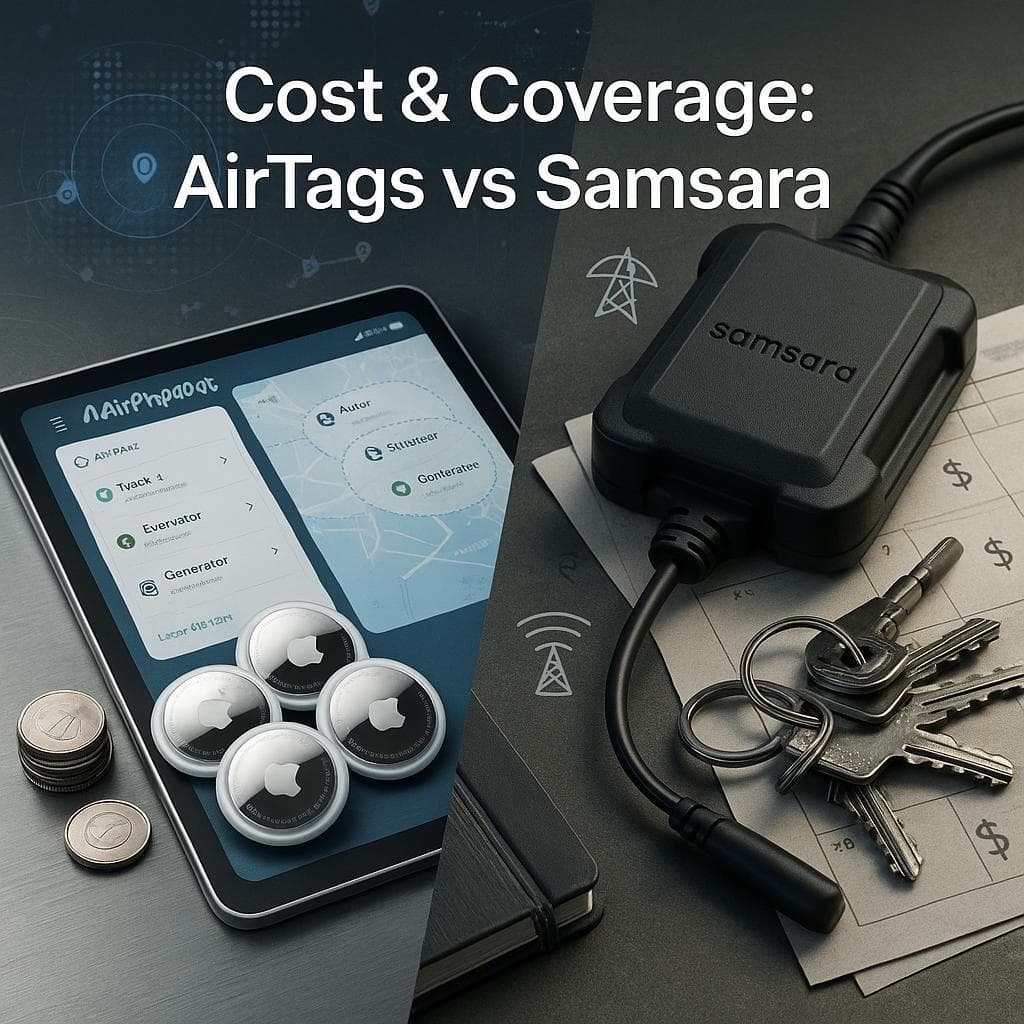
| Samsara | $30-50 | AI dash cams, EV support, comprehensive features | 3-year |
| Verizon Connect | $23.50-40 | Network integration, enterprise analytics | 3-year |
| Geotab | $30-40 (reseller) | Open platform, 430+ marketplace integrations | 3-year |
| Teletrac Navman | $25-45 | Fleet benchmarking, compliance focus | 2-3 year |
Industry rankings (ABI Research 2025):
- Geotab (top implementation, #2 innovation)
- Samsara (jumped from #9 to #2 overall)
- Verizon Connect (#4 overall)
What Telematics Platforms Provide
Standard features across platforms:
- Real-time GPS tracking (15-30 second refresh)
- Driver behavior monitoring
- ELD compliance
- Fuel management
- Maintenance scheduling
- Route optimization
- Geofencing alerts
- Reporting and analytics
Premium features (additional cost):
- AI-powered dash cameras
- Predictive maintenance
- EV fleet management
- Advanced safety scoring
- Integration APIs
Alternative Tracking Approaches
Not every asset requires $30+/month enterprise tracking:
| Solution | Cost | Best For | Limitations |
|---|---|---|---|
| AirTags | $29 one-time | Trailers, equipment, tools | No real-time, 32 per Apple ID limit |
| Basic GPS | $10-20/month | Simple location needs | Limited features |
| OBD-II devices | $15-25/month | Vehicle diagnostics | Installation required |
| Bluetooth beacons | $5-15/unit | Indoor/yard tracking | Short range |
Hybrid approach: Many fleet managers use enterprise telematics for vehicles requiring real-time dispatch and ELD compliance, while deploying AirTags or basic GPS on trailers, equipment, and non-DOT assets.
Driver Safety and Monitoring
The Impact of Driver Monitoring
A correction first, because this page previously carried the error and it is worth naming.
The claim that "fleets using telematics for driver monitoring see a 22% reduction in crashes and a 52% decrease in speeding violations, per IIHS" is reprinted across this entire category. We went looking for the IIHS publication behind it and could not find one. What exists on vendor blogs is the same two sentences citing each other.
IIHS has done real work here. A joint study with the US DOT's Volpe National Transportation Systems Center followed nine fleets deploying intelligent speed assistance, and reported results per carrier rather than as a single industry percentage: one carrier reported a 22% reduction in weather-related incidents from geofencing, another a 30% reduction in preventable collisions, another close to a 90% reduction in bridge strikes. Those are specific fleets in specific conditions, which is both more honest and more useful than an averaged claim. Read the IIHS material directly rather than the summaries.
The mechanism is not in dispute and does not need a fabricated statistic to support it. Telematics makes a specific behavior visible, attaches it to a specific driver, and creates the conversation that changes it. Fleets that collect the data and never coach on it see nothing, which is the part the percentages never mention.
Airpinpoint does not do any of this. No driver monitoring, no speeding alerts, no safety scoring, no dash cameras, no ELD. This section describes the enterprise telematics category so you can tell which problems need that category and which do not.
What Driver Monitoring Tracks
| Behavior | Why It Matters | Typical Coaching Response |
|---|---|---|
| Hard braking | Indicates following distance issues | Increase following distance training |
| Rapid acceleration | Fuel waste, vehicle wear | Smooth driving education |
| Speeding | Safety risk, tickets, fuel waste | Speed policy enforcement |
| Harsh cornering | Load damage risk, rollover potential | Route familiarity review |
| Seatbelt non-compliance | Legal liability, injury risk | Policy enforcement |
| Phone use | Distraction, crash risk | Strict policy enforcement |
| Fatigue indicators | FMCSA notes fatigue in 13% of truck crashes | HOS compliance, scheduling review |
Driver Monitoring Adoption
Adoption survey percentages in this category come from vendor research and we are not going to reprint them. The operationally useful observation needs no statistic: collecting the data is the easy part, and the fleets that get nothing from telematics are almost always the ones that never built step 4 below into somebody's job.
The coaching cycle:
- Collect: Telematics records driving events
- Score: System calculates driver safety scores
- Identify: Flag patterns requiring attention
- Coach: Targeted feedback based on data
- Measure: Track improvement over time
Fuel Management
Why Fuel Management Matters
Fuel is the largest controllable expense for most fleets, though it is smaller as a share than this category usually claims.
ATRI's 2025 figures put fuel at roughly $0.482 of a $2.336 average marginal cost per mile: about 21% of total operating cost. Driver wages, at $0.818 per mile, are the larger line item, and they are far less controllable.
That matters for how you price a fuel initiative. A 10% cut in fuel is roughly a 2% cut in total operating cost. Real money across a large fleet, and not the transformation it gets sold as.
The 22-39% range that appears on most pages in this category is higher than ATRI's published data supports. Where a page quotes it without a source, treat the rest of its numbers with the same caution.
Documented Fuel Savings
The savings percentages attached to each of these levers are vendor figures. Rather than reprint them, here is what each lever actually does and the sensor it needs, so you can work out which ones are even available to you:
| Strategy | What it changes | What it requires |
|---|---|---|
| Route optimization | Fewer miles driven for the same work | Continuous GPS breadcrumbs plus a routing engine |
| Idle time reduction | Engine hours burned going nowhere | An ECU connection that can tell idling from parked |
| Driver behavior coaching | Acceleration and braking habits | Accelerometer plus a coaching process somebody owns |
| Maintenance optimization | Rolling resistance and engine efficiency | Fault codes and a PM schedule |
| Fuel card integration | Fraudulent and off-route purchases | Fuel card data matched against position |
How to size it for your fleet: take your actual annual fuel spend, pick one lever, estimate conservatively what share of that spend it touches, and run the number. Do it lever by lever rather than accepting an aggregate "20-30% with comprehensive telematics" figure, because aggregates in this category double-count. Route optimization and idle reduction both claim the same idling gallons.
Note that every lever in that table needs a device wired into the vehicle. Airpinpoint does none of them. A position-only tag cannot see fuel.
The True Cost of Idling
| Vehicle Type | Hourly Idling Cost | Annual Cost (2 hours/day idle) |
|---|---|---|
| Light-duty truck | $9.90 | ~$5,000 |
| Medium-duty truck | $15-25 | ~$7,500-12,500 |
| Heavy-duty truck | $40-97 | ~$20,000-50,000+ |
Idling cost figures vary enormously by engine, load, accessory draw and local fuel price, so treat any table like this one as a starting estimate rather than your number. Calculate yours: fuel burn per idle hour for your engine, times your fuel price, times measured idle hours. The measurement is the part that requires the telematics unit, because idle hours are read from the vehicle, not from a position feed.
Maintenance Management
The Cost of Poor Maintenance
The costs below are commonly quoted ranges rather than figures we can attribute to a primary source. Use them to structure your own calculation, not as your answer. Your inputs: days down per vehicle last year, and what a day down actually costs you in lost revenue, substitute rental and crew time.
| Metric | Impact |
|---|---|
| Average unplanned downtime | 8.7 days per vehicle per year |
| Downtime cost (light vehicle) | $448-760 per day |
| Downtime cost (heavy equipment) | $500-2,500+ per day |
| Maintenance cost reduction with telematics | Commonly claimed at 30%; we could not source it |
| Preventive vs reactive maintenance saving | 12-18% (US DOE / PNNL O&M Best Practices) |
Preventive vs. Reactive Maintenance
Best practice benchmark: 70% scheduled / 30% unscheduled maintenance
| Approach | Characteristics | Outcome |
|---|---|---|
| Reactive | Fix when broken | High downtime, expensive repairs |
| Preventive | Service at intervals | Reduced breakdowns, predictable costs |
| Predictive | Data-driven forecasting | Optimal timing, minimal waste |
Implementing Predictive Maintenance
Modern telematics enables predictive maintenance through:
- Engine diagnostics: Monitor fault codes in real-time
- Usage tracking: Service based on actual hours/miles
- Pattern recognition: AI identifies failure precursors
- Alert automation: Notify before problems occur
On the numbers: the "reduces breakdowns by 35%" figure attached to AI predictive maintenance has no source we could trace. The best-sourced benchmark in this field comes from the US Department of Energy's O&M Best Practices Guide, maintained by Pacific Northwest National Laboratory: preventive maintenance is estimated to save 12% to 18% over reactive, predictive a further 8% to 12% over preventive, with a return on a predictive program of roughly 10 to 1. Those are program-level estimates across facility equipment rather than fleet-specific claims, which is exactly why they are more honest than the fleet percentages.
And the capability boundary: all four items above require a device reading the vehicle's ECU. Airpinpoint has no ECU access, no engine hours, no fault codes, no predictive models and no maintenance scheduling. It reports position. Anything on this page about diagnostics belongs to the enterprise telematics tier.
ELD Compliance
Who Must Comply
The ELD mandate applies to commercial drivers required to maintain records of duty status (RODS). This includes:
- Interstate commercial motor vehicles
- Commercial buses and trucks
- Canada and Mexico-domiciled drivers operating in the US
Exemptions
| Exemption | Details |
|---|---|
| Short-haul drivers | May continue using timecards |
| Infrequent paper users | 8 or fewer days of paper logs per 30-day period |
| Driveaway-toway | When vehicle being driven is the commodity |
| Pre-2000 vehicles | Manufactured before model year 2000 |
Compliance Requirements
- ELDs must connect directly to the vehicle's engine
- Data retention: 6 months minimum
- Malfunction repairs: 8 days from discovery
- During malfunctions: Manual paper logs required
Recent Updates (2025-2026)
- FMCSA removed several ELD providers (PREMIERRIDE LOGS, DSGELOGS, others) for failing minimum requirements
- Affected fleets must transition to registered ELDs by March 15, 2026
- Wisconsin mandated intrastate ELD adoption by April 1, 2025
- Additional states expected to follow with similar requirements
Carrier responsibility: Motor carriers must verify their ELD provider is registered on the FMCSA list.
ROI Calculation Framework
Documented ROI Statistics
The "percentage of fleets achieving ROI in N months" tables that appear across this category come from vendor surveys with undisclosed samples. There is no independent study we could find, so there is no table here. What follows is the structure to build your own.
ROI Components
Direct cost reductions. For each, the question is not "what percentage do fleets save," it is "what is my spend on this line, and what share of it does this lever actually touch?"
| Category | Your input | The honest question |
|---|---|---|
| Fuel | Your annual fuel spend | ATRI puts fuel at about 21% of cost per mile. What share of your burn is idle and avoidable miles, specifically? |
| Maintenance | Your annual R&M spend | DOE/PNNL estimate 12-18% for preventive over reactive. How much of your work is reactive today? |
| Insurance | Your current premium | What will your carrier actually quote with telematics enrollment? Get it in writing before counting it |
| Theft and loss | Deductible times claims, plus uninsured write-offs | How many incidents would faster information genuinely have changed? |
Indirect savings. Real, and much harder to quantify honestly. Measure rather than assume:
| Category | How to measure it |
|---|---|
| Administrative time | Log the hours your team spends locating assets and answering "where is it" for two weeks |
| Downtime | Days down per vehicle last year, times your own cost per day |
| Compliance | Your violation count and what each one costs you |
| Customer satisfaction | Your rate of missed delivery windows, before and after |
Use conservative figures throughout. If the case only closes on optimistic assumptions, it does not close.
For compliance paperwork like DOT filings, driver qualification files, and IFTA reports, tools like DocMods use AI to automate document editing, turning hours of manual form completion into minutes.
Sample ROI Calculation
Here is the template with the cost side filled in, because we can price that exactly, and the benefit side left blank, because we cannot.
50-vehicle fleet, enterprise telematics:
| Line Item | Calculation | Annual |
|---|---|---|
| Investment | ||
| Hardware | 50 x $100 | -$5,000 one time |
| Monthly service | 50 x $35 x 12 | -$21,000 |
| Total cost | -$26,000 first year | |
| Savings (you fill these in) | ||
| Fuel | Your fuel spend x your estimated recoverable share | |
| Maintenance | Your R&M spend x your reactive share x 12-18% | |
| Insurance | The difference your carrier actually quoted | |
| Admin | Your logged hours x loaded rate | |
| Net |
The same fleet, location-only on non-DOT assets:
| Line Item | Calculation | Annual |
|---|---|---|
| Hardware | 50 x $29 | -$1,450 one time |
| Subscription | 50 x $11.99 x 12 | -$7,194 |
| Total cost | -$8,644 first year |
The second table buys you location, location history, geofence alerts and exports. It buys you no fuel data, no engine diagnostics, no driver scoring and no ELD compliance. Which means it is not a substitute for the first table on DOT vehicles, and it is often a better deal than the first table on trailers, yard equipment and non-DOT assets where all you needed was "where is it."
Implementation Guide
Phase 1: Assessment (Weeks 1-2)
Current state analysis:
- Inventory all vehicles and assets
- Document current tracking methods (if any)
- Identify pain points and priorities
- Calculate baseline metrics
Requirements gathering:
- Real-time tracking needs
- ELD compliance requirements
- Integration with existing systems
- Reporting requirements
- Budget constraints
Phase 2: Technology Selection (Weeks 2-4)
Evaluation criteria:
| Factor | Weight | Questions to Ask |
|---|---|---|
| Features | 25% | Does it meet all requirements? |
| Ease of use | 20% | Will drivers/staff adopt it? |
| Integration | 15% | Works with existing systems? |
| Support | 15% | Quality of customer service? |
| Price | 15% | Total cost of ownership? |
| Scalability | 10% | Grows with the fleet? |
Demo and trial:
- Request demos from 2-3 vendors
- Pilot with 5-10 vehicles
- Test all required features
- Evaluate reporting capabilities
Phase 3: Deployment (Weeks 4-8)
Installation best practices:
- Schedule during off-peak hours
- Train installers on your fleet specifics
- Document installation locations and configurations
- Test each device before releasing vehicle
Driver communication:
- Explain benefits (not just monitoring)
- Provide clear usage instructions
- Address privacy concerns directly
- Establish feedback channels
Phase 4: Training (Weeks 6-10)
Stakeholder training:
| Audience | Training Focus | Duration |
|---|---|---|
| Drivers | Device use, ELD compliance, safety features | 2-4 hours |
| Dispatchers | Real-time tracking, communication tools | 4-8 hours |
| Managers | Reporting, analytics, coaching tools | 8-16 hours |
| Maintenance | Diagnostic alerts, scheduling | 4-8 hours |
Phase 5: Optimization (Ongoing)
Weekly:
- Review driver safety scores
- Monitor fuel consumption trends
- Check for maintenance alerts
- Address compliance flags
Monthly:
- Analyze fleet performance reports
- Compare against benchmarks
- Identify training opportunities
- Review cost metrics
Quarterly:
- Calculate ROI progress
- Assess technology effectiveness
- Plan feature expansions
- Benchmark against industry
Top Fleet Manager Challenges 2025
Challenge Rankings (Survey Data)
The ranked survey percentages usually printed here come from vendor research with undisclosed samples, so they are not reproduced. What is documented is the cost pressure underneath all of them. ATRI's 2025 analysis found every major line item rose:
| Line item | 2025 change (ATRI) |
|---|---|
| Tolls | Up 13.2% |
| Repair and maintenance | Up 8.6% |
| Driver benefits | Up 6.6% |
| Tires | Up 6.4% |
| Total marginal cost | Up 3.4%, to $2.336 per mile |
| Non-fuel cost | Up 4.2%, to $1.854 per mile |
Driver compliance, technician shortages, vehicle pricing and the EV transition are all real. They are also all harder to absorb in a year when cost per mile hit its highest level in the report's history.
Addressing Each Challenge
Driver compliance:
- Implement telematics-based coaching
- Use gamification for positive reinforcement
- Establish clear, fair policies
- Provide regular feedback
New vehicle pricing/availability:
- Extend existing fleet life with better maintenance
- Explore used vehicle options
- Consider lease vs. purchase analysis
- Build relationships with multiple dealers
Safety:
- Deploy dash cameras
- Implement driver scorecards
- Use predictive analytics for risk identification
- Invest in training programs
Technician shortage:
- Partner with trade schools
- Offer competitive compensation
- Invest in diagnostic technology
- Consider outsourcing specialized repairs
Technology Trends to Watch
Emerging Capabilities
| Trend | Current Adoption | 2025-2026 Outlook |
|---|---|---|
| AI dash cameras | Growing, driven by litigation exposure | Increasingly offered as standard |
| Predictive maintenance | Growing, gated on sensor coverage | Expected as a premium tier feature |
| EV fleet management | Early adoption | Accelerating due to regulations |
| Automated dispatching | Early stage | Gaining traction |
Electric Vehicle Considerations
Fleet managers transitioning to EVs face unique tracking needs:
- Range monitoring: Track charge levels and range anxiety
- Charging optimization: Route planning around charging infrastructure
- Battery health: Monitor degradation over time
- Cost comparison: Track EV vs. ICE operating costs
Current challenges:
- Charging infrastructure availability
- Higher upfront vehicle costs
- Technician training for EV maintenance
- Range limitations for certain applications
The Bottom Line
Cost per mile is at its highest recorded level and rising in every line item (ATRI, 2025). That is the real argument for better data, and it does not need a vendor statistic propping it up.
What to hold on to from this page:
- ATRI's $2.336 per mile, with fuel at about $0.482 of it, is the benchmark worth anchoring on. It publishes its method
- The widely quoted 22-39% fuel share, 15-35% insurance discount, 22% crash reduction and "45% see ROI in 11 months" figures could not be sourced. Treat any page quoting them as unreliable on the rest of its numbers too
- Build the ROI case from your own spend, conservatively, lever by lever. If it only closes on optimistic assumptions, it does not close
Implementation keys:
- Define clear objectives and KPIs
- Select technology matching your needs (not overshooting)
- Invest in training and change management
- Monitor metrics and optimize continuously
- Consider hybrid approaches (enterprise + basic tracking)
The hybrid approach for cost-conscious fleets:
- Deploy enterprise telematics on vehicles requiring ELD, real-time dispatch, driver coaching or fuel data. Nothing cheaper substitutes for these
- Use AirTags or basic GPS on trailers, yard equipment and non-DOT assets, where the only question anyone asks is "where is it"
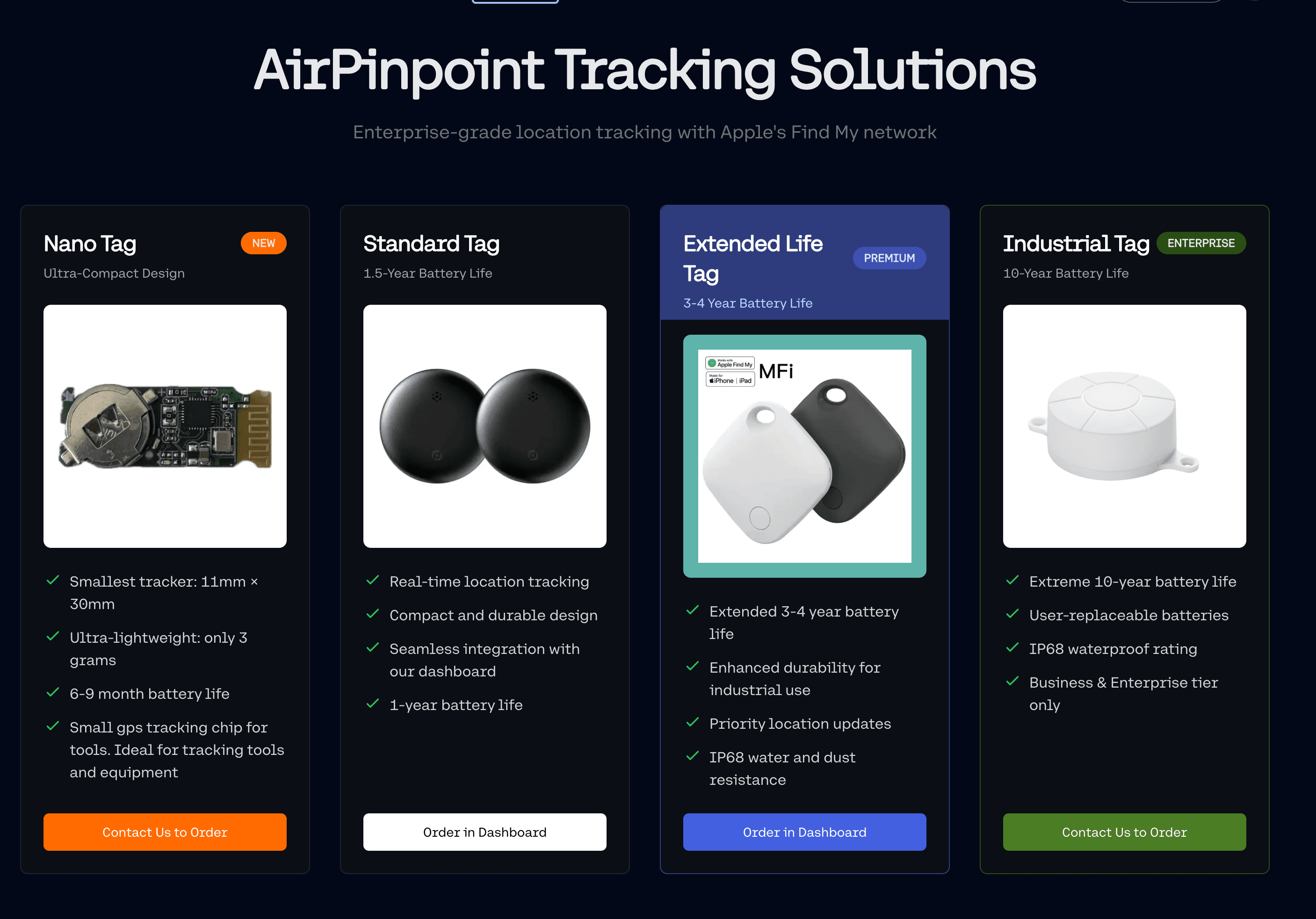
- Be clear about the boundary. Airpinpoint is the second tier: location, location history, geofence alerts with email, Slack and WhatsApp notifications, outbound webhooks on geofence entry and exit, a REST API, and CSV and JSON export. It does not do ELD, driver monitoring, fuel, engine diagnostics, predictive maintenance or maintenance scheduling, and it has no pre-built connector to any telematics platform
- Know its limits too: roughly 10 to 30 meters of accuracy, and a tag reports when an Apple device passes near it, so a trailer in a remote yard may report less often than one in a city
Fleet management technology has matured significantly. Whether you manage 10 vehicles or 10,000, the tools exist to improve safety, reduce costs, and optimize operations. The question isn't whether to implement tracking. It's how quickly you can start capturing the benefits.
Your fleet data is valuable. Start collecting it.


 Our Solution