Updated
Commercial Vehicle GPS Tracker: The Small Fleet Pricing Problem
Advertisers pay over $200 per click on "commercial vehicle GPS tracker." That's not a typo. Samsara, Geotab, and Verizon Connect bid that much because a single enterprise fleet contract is worth $50,000+ over three years.
The problem: those enterprise solutions price out the people who actually search this term. A plumbing company with 12 vans. A property management firm with 20 vehicles. A regional distributor with 35 delivery trucks. They need location, geofencing, and trip history. They get pitched dashcams, AI driver coaching, and 36-month contracts at $35-50 per vehicle per month.
The commercial vehicle tracking market has a gap between "consumer tracker for my car keys" and "enterprise fleet management for 500 trucks." This page is about that gap.
What Commercial Fleet Operators Actually Need
Before comparing solutions, it helps to separate what small and mid-size fleet operators use daily from what enterprise sales teams convince them to buy.
Features worth paying for
Real-time location. Where is each vehicle right now? This is the core value proposition. Whether it's a dispatcher routing a service call or an owner checking if crews left the yard, location is the feature that gets opened 10 times a day.
Geofence alerts. Draw a boundary around your depot, job sites, client locations, or restricted areas. Get notified when vehicles enter or leave. This replaces phone calls, manual check-ins, and guesswork about crew arrivals. A fleet manager with 6 active job sites saves 30+ minutes a day by not calling each crew.
Trip history and location logs. Where was Vehicle 14 last Thursday at 2pm? Did the delivery truck actually stop at the customer's address? How long was the service van parked at each job? Trip history turns "he said, she said" disputes into verifiable data.
After-hours movement alerts. If Vehicle 09 leaves the parking lot at 11pm on a Sunday, you want to know. Whether it's theft, unauthorized use, or a key left in the ignition, after-hours alerts are the most cost-justified feature in fleet tracking. One recovered vehicle pays for years of tracking.
Features most small fleets don't use
AI dashcams and driver coaching. Samsara's marquee product. Valuable for long-haul trucking and large delivery fleets where driver safety is a material insurance cost. For a pest control company with 15 vans driving local routes, the $15-20/vehicle/month dashcam add-on collects dust.
ELD/HOS compliance. Mandatory for vehicles over 10,001 lbs GVWR in interstate commerce. Irrelevant for the vast majority of commercial vehicle fleets (service vans, company sedans, light trucks under GVWR limits). If you don't need ELD, you're paying for compliance features that don't apply to you.
OBD engine diagnostics. DTC codes, fuel consumption data, engine temperature monitoring. Useful for fleets with dedicated maintenance teams. Overkill for a company where "maintenance" means taking the van to the shop when the check engine light comes on.
Predictive maintenance algorithms. Enterprise GPS companies promote machine learning models that predict breakdowns before they happen. The data shows these features are used actively by fewer than 15% of accounts that have them. Most fleet managers rely on mileage-based service schedules, not AI predictions.
Route optimization. If you're running a delivery operation with 100+ stops per day, route optimization software saves fuel and time. If your crews drive to the same 3-5 job sites each day, the suggested route from Google Maps does the job.
The pattern: enterprise GPS companies bundle every possible feature into one subscription to justify $35-50/vehicle/month. Small fleet operators use 3-4 features and pay for 30.
The Real Cost of Commercial Vehicle GPS Tracking
Here's what five representative solutions actually cost for commercial vehicle fleets of different sizes.
10-Vehicle Fleet: Annual Cost
| Solution | Hardware | Monthly | Annual Total | Contract |
|---|---|---|---|---|
| Samsara | $0 (leased) | $350-500 | $4,200-6,000 | 36 months |
| Verizon Connect | $0 (leased) | $250-450 | $3,000-5,400 | 36 months |
| Geotab | $1,500 | $250-400 | $4,500-6,300 | 12-36 months |
| Bouncie | $770 | $80 | $1,730 | None |
| AirTag + Airpinpoint | $290 | $119.90 | $1,729 | None |
25-Vehicle Fleet: Annual Cost
| Solution | Hardware | Monthly | Annual Total | Contract |
|---|---|---|---|---|
| Samsara | $0 (leased) | $875-1,250 | $10,500-15,000 | 36 months |
| Verizon Connect | $0 (leased) | $625-1,125 | $7,500-13,500 | 36 months |
| Geotab | $3,750 | $625-1,000 | $11,250-15,750 | 12-36 months |
| Bouncie | $1,925 | $200 | $4,325 | None |
| AirTag + Airpinpoint | $725 | $299.75 | $4,322 | None |
50-Vehicle Fleet: Annual Cost
| Solution | Hardware | Monthly | Annual Total | Contract |
|---|---|---|---|---|
| Samsara | $0 (leased) | $1,750-2,500 | $21,000-30,000 | 36 months |
| Verizon Connect | $0 (leased) | $1,250-2,250 | $15,000-27,000 | 36 months |
| Geotab | $7,500 | $1,250-2,000 | $22,500-31,500 | 12-36 months |
| Bouncie | $3,850 | $400 | $8,650 | None |
| AirTag + Airpinpoint | $1,450 | $599.50 | $8,644 | None |
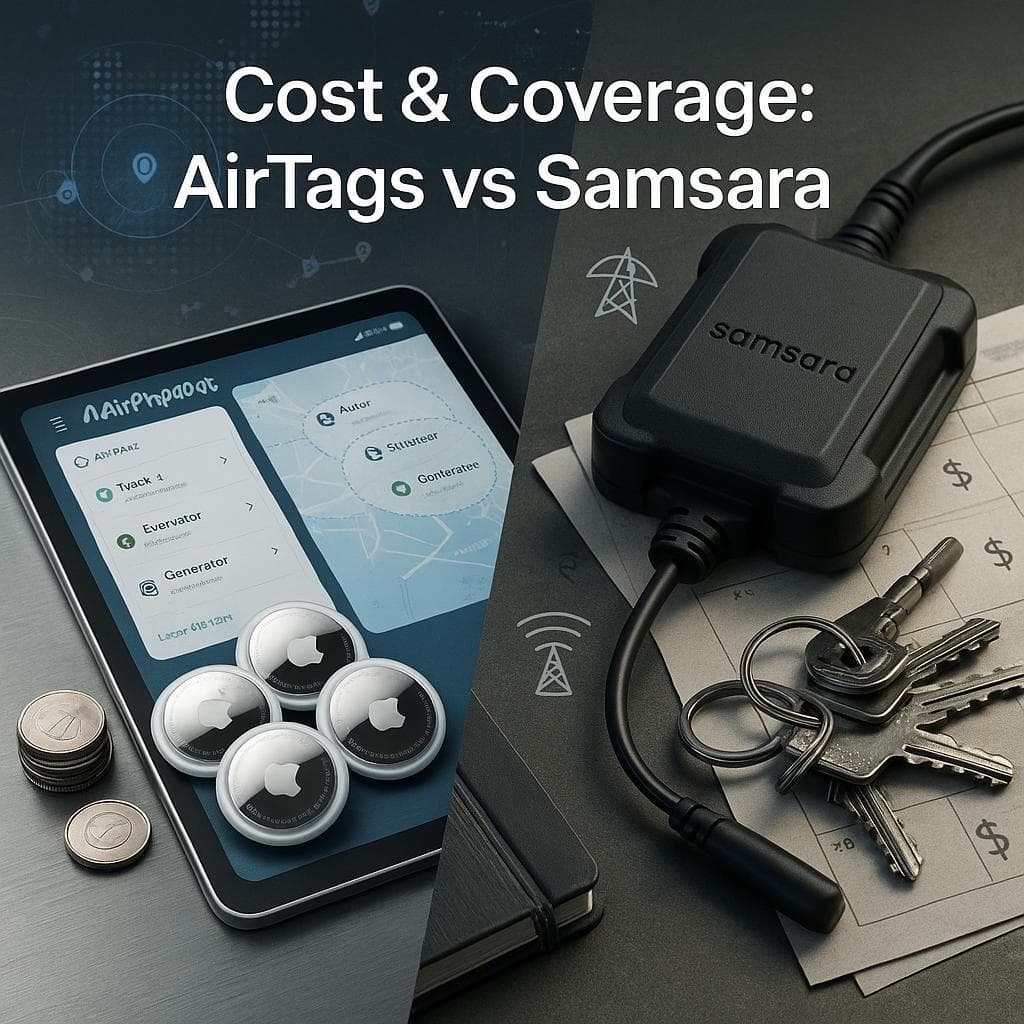
The numbers tell the story. Enterprise solutions cost 2x-3x more than no-contract alternatives, and the premium buys features most small fleets never activate.
The Small Fleet Pricing Problem
The commercial vehicle tracking industry has a structural issue. The economics of enterprise GPS companies don't work well for small customers.
Sales costs are fixed regardless of fleet size. It costs Samsara roughly the same amount to close a 10-vehicle deal as a 500-vehicle deal. A sales rep spends 3-6 calls, a demo, a proposal, and contract negotiation. The company recovers that acquisition cost by locking customers into 36-month contracts with high per-vehicle pricing. A 10-vehicle fleet generates $15,000 over 3 years. A 500-vehicle fleet generates $750,000. The sales process is identical.
Professional installation requires scheduling. OBD or hardwired GPS trackers need physical installation on each vehicle. For enterprise fleets, a technician visits the depot and installs 50 units in a day. For a 10-vehicle fleet spread across 3 locations, the same tech makes 3 trips. Installation cost per vehicle goes up as fleet size goes down.
Support is tiered by contract value. Enterprise customers get a dedicated account manager. A 10-vehicle fleet gets the general support queue. Same monthly rate per vehicle, different service level.
Minimum viable features require the enterprise stack. You can't buy "just location and geofencing" from Samsara. The platform is one bundle. You're paying the same rate as the customer using ELD, dashcams, route optimization, and maintenance scheduling.
The result: small fleet operators face a choice between overpaying for enterprise solutions or cobbling together consumer products that weren't designed for fleet management.
Hidden Costs in Enterprise GPS Contracts
The per-vehicle monthly rate is the visible cost. Here's what shows up later.
Early termination fees. A 36-month Samsara contract for 25 vehicles at $40/vehicle carries an implied commitment of $36,000. Cancel in year two, and you owe the remaining balance. If you sell 5 vehicles and don't need tracking anymore, you still pay for 25 vehicles until the contract ends.
Hardware that you don't own. Samsara and Verizon Connect "include" hardware for free, but it's leased. Cancel the contract, and the hardware goes back. You paid $0 upfront and own nothing after 3 years.
Price increases at renewal. Year one is the competitive rate. Year four (when the initial contract renews) often comes with a 10-20% increase. By this point, switching costs are high: your historical data is in their system, your team is trained on their interface, and migration takes time.
Add-on creep. The base rate covers GPS tracking. Dashcams are extra ($15-20/vehicle/month). Advanced analytics are extra. API access for integration with your dispatch software may require a higher tier. The $35/vehicle quote becomes $55/vehicle once you add what you actually need.
Training and onboarding. Enterprise platforms are complex. Samsara's admin interface has hundreds of settings. Budget 4-8 hours of manager time to configure the system properly, plus ongoing time to train new employees on the platform.
For a 25-vehicle fleet, the true 3-year cost of an enterprise GPS system typically runs 30-40% higher than the quoted monthly rate once you account for these factors.
The AirTag-Based Alternative for Commercial Fleets
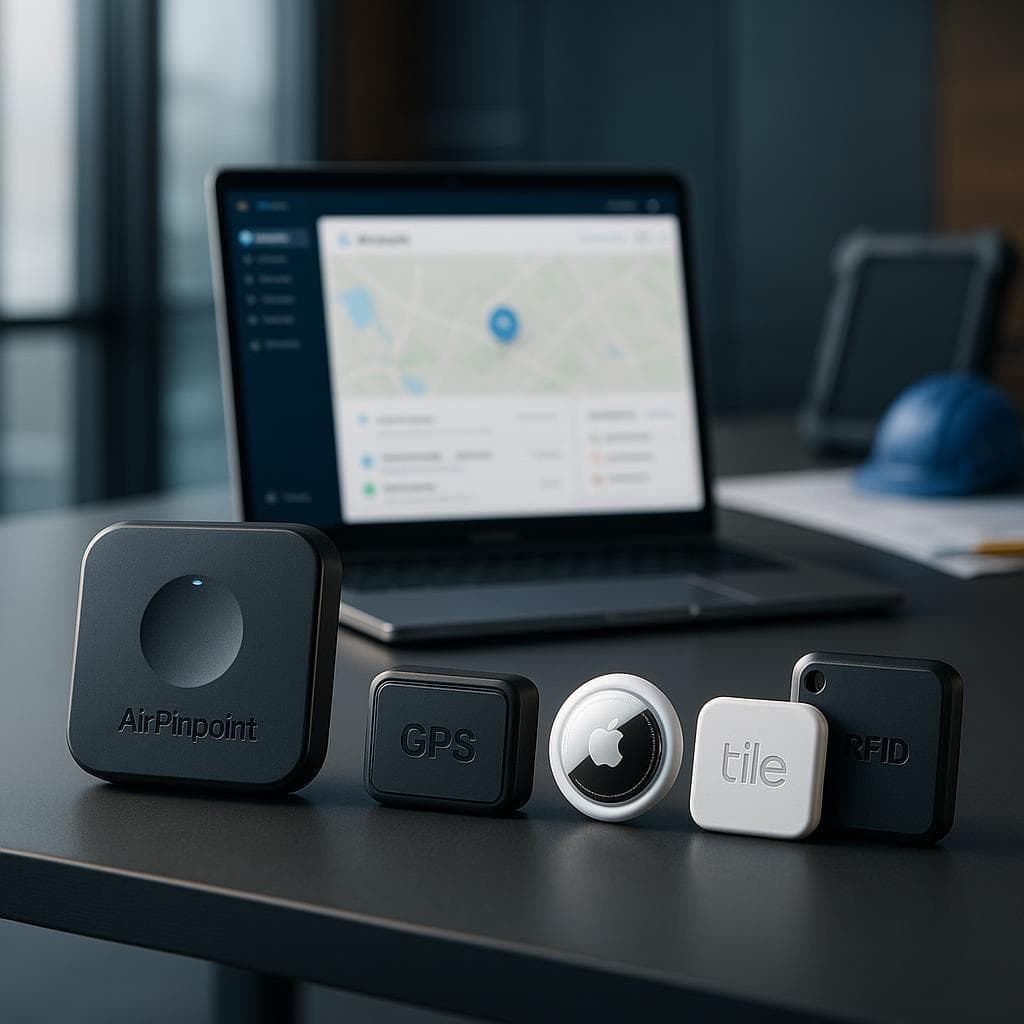
AirTag tracking isn't for every fleet. But for the specific use case of "I need to know where my commercial vehicles are, get alerts when they move unexpectedly, and have trip history for accountability," it covers the requirement at a fraction of the cost.
How it works
- Buy AirTags. $29 each, or $24.17 each in a 4-pack from Apple.
- Place in each vehicle. Glovebox, center console, or under a seat. No wiring. No OBD port. No tools.
- Connect your Apple ID to Airpinpoint. One dashboard shows every vehicle.
- Set geofences. Draw boundaries around depots, job sites, and parking areas.
A 25-vehicle fleet takes about 2 hours to set up completely, including account creation and geofence configuration. Compare that to 2-3 weeks of scheduling professional GPS installations across your fleet.
What you get
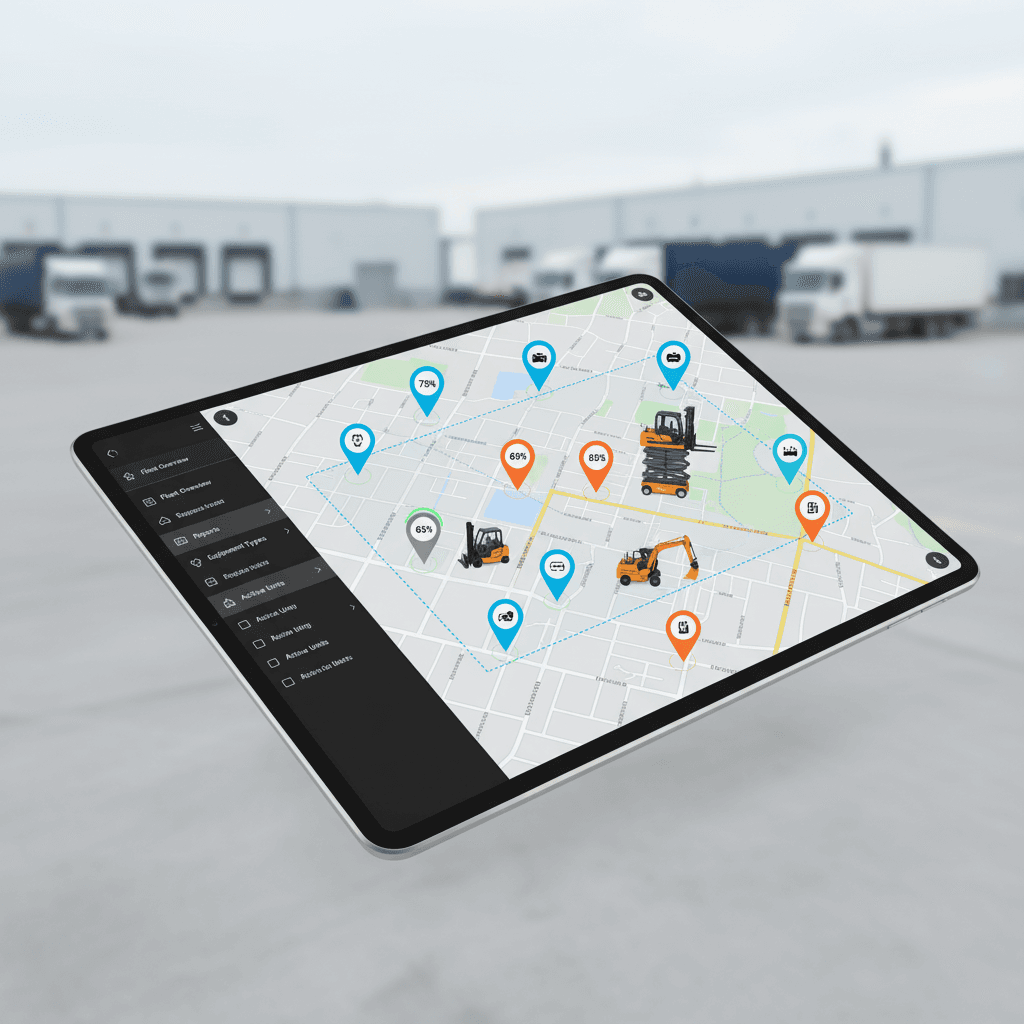
Live location map. All vehicles on one screen. Click any vehicle to see its current location, last update time, and recent movement.
Geofence alerts. Automatic notifications when vehicles enter or leave defined areas. Set up your depot, client sites, and after-hours parking zones.
Location history. Full movement trail for every vehicle. See where Vehicle 14 was at any point in time. Export data for your records.
Multi-site management. If you operate from 3 locations with 8 vehicles at each, the dashboard shows everything. No per-site licensing or separate logins.
No contracts. Month-to-month billing. Add or remove vehicles anytime. If you sell 5 vehicles, your next month's bill drops by $59.95. Try that with a 36-month enterprise contract.
What you don't get
Real-time speed and driving behavior. AirTags don't connect to the vehicle's OBD port. No speed alerts, harsh braking events, or idle time monitoring.
Engine diagnostics. No DTC codes, fuel level, or engine health data.
ELD compliance. AirTags are not FMCSA-registered devices. If you need Hours of Service logging, you need an ELD-compliant system.
Second-by-second GPS breadcrumbs. AirTag location updates every few minutes via the Apple Find My network (passing iPhones). In suburban and urban areas, this is frequent enough for fleet management. In remote rural areas, gaps may stretch longer.
Dashcam integration. No video recording, no AI driver coaching, no collision detection.
This is intentional. Every feature adds cost. Airpinpoint covers the 80% use case at 30% of the enterprise price by not bundling features that most small fleets don't use.
ROI Calculator: Is It Worth Switching?
The math is straightforward. Take your current tracking spend, subtract what Airpinpoint costs, and the difference is your savings. But there are secondary ROI factors worth quantifying.
Direct cost savings
| Fleet Size | Enterprise GPS (avg) | Airpinpoint | Annual Savings |
|---|---|---|---|
| 10 vehicles | $4,800/yr | $1,729/yr | $3,071 |
| 25 vehicles | $12,000/yr | $4,322/yr | $7,678 |
| 50 vehicles | $24,000/yr | $8,644/yr | $15,356 |
Theft recovery value
The FBI reports over 700,000 vehicle thefts per year in the US, with commercial vehicles increasingly targeted. A tracked vehicle is 2-3x more likely to be recovered. For a fleet of 25 vehicles where the average vehicle value is $35,000, a single recovery more than pays for 10 years of Airpinpoint tracking.
Unauthorized use reduction
Fleet studies consistently show 5-15% of commercial vehicle mileage is unauthorized (personal errands, off-route driving, after-hours use). For a 25-vehicle fleet averaging 25,000 miles per year at $0.67/mile IRS rate, even a 5% reduction in unauthorized mileage saves $20,938 annually. Geofence alerts and location visibility reduce unauthorized use simply by making it visible.
Time savings
A fleet manager spending 30 minutes a day on phone calls to verify vehicle locations saves 130 hours per year. At a loaded labor cost of $45/hour, that's $5,850 in recovered productivity. Multiply across multiple managers or dispatchers if applicable.
Combined ROI: 25-vehicle fleet
| ROI Category | Annual Value |
|---|---|
| Subscription savings vs enterprise GPS | $7,678 |
| Avoided contract termination exposure | $12,000 (36-month commitment eliminated) |
| Theft recovery (probability-adjusted) | $3,500 |
| Unauthorized use reduction (conservative 3%) | $12,563 |
| Manager time savings | $5,850 |
| Total first-year ROI | $41,591 |
Against a $4,322 annual cost, this represents a 9.6x return. Even using only the direct subscription savings, the payback period is immediate for fleets switching from enterprise GPS.
When to Use Enterprise GPS Instead
Airpinpoint is the right solution for a specific segment of commercial fleet operators. Enterprise GPS is the right solution for a different segment. Here's the honest breakdown.
Use enterprise GPS (Samsara, Geotab, Verizon Connect) when:
- Your vehicles exceed 10,001 lbs GVWR and need ELD compliance
- You run a delivery operation where second-by-second route optimization saves meaningful fuel costs
- Insurance discounts for dashcam and telematics programs exceed the cost of the add-ons
- You have a dedicated fleet manager who will actively use driver coaching, maintenance scheduling, and analytics features
- Your fleet exceeds 100 vehicles and you need enterprise support with a dedicated account manager
Use Airpinpoint when:
- You operate 5-50 commercial vehicles and need location, geofencing, and trip history
- Your vehicles don't require ELD compliance (under 10,001 lbs GVWR or not in interstate commerce)
- You want month-to-month billing with no contract commitment
- Installation needs to be fast (drop in glovebox, done)
- You also track non-vehicle assets (trailers, equipment, tools) and want everything on one dashboard
- Your budget per vehicle is under $15/month
Some operators run both. Enterprise GPS on the 10 heavy trucks that need ELD, Airpinpoint on the 30 service vans and company cars that just need location. One dashboard per system, each covering the use case it fits.
Setup for a 25-Vehicle Commercial Fleet
Total time: about 3 hours. No technicians, no scheduling, no OBD port hunting.
Step 1: Order hardware (5 minutes). Buy 25 AirTags from Apple. Six 4-packs ($99 each) plus one single ($29). Total: $623.
Step 2: Name and register (45 minutes). Open the Find My app on an iPhone registered to your company Apple ID. Add each AirTag and name it to match your vehicle numbering (Van 01, Truck 12, Car 08).
Step 3: Place in vehicles (30 minutes). Glovebox or center console for each vehicle. No adhesive, no wiring. For vehicles where the glovebox is accessible to passengers, place inside a locked compartment or under the seat.
Step 4: Connect to Airpinpoint (15 minutes). Sign up, link your Apple ID, and all 25 devices appear on the dashboard.
Step 5: Configure geofences (60 minutes). Draw geofence boundaries around your depot, branch offices, regular client sites, and after-hours parking locations. Set alert preferences (email, push notification, or both).
Step 6: Invite team members (15 minutes). Add dispatchers or managers who need dashboard access. Set permissions for who can view location data.
By end of day one, your entire fleet is visible on a map with geofence alerts active. The next morning, you'll see where every vehicle was parked overnight. By end of week one, you'll have trip history data showing daily patterns for every vehicle.
Making the Switch from Enterprise GPS
If you're currently on an enterprise GPS contract, the transition path depends on your contract terms.
If your contract is expiring in the next 6 months: Start a parallel test. Put AirTags on 5 vehicles alongside your existing GPS. Run both for 30 days and compare the data you actually use. If Airpinpoint covers your needs, let the enterprise contract expire and scale up.
If you're mid-contract: Check your early termination clause. Calculate the termination fee against the monthly savings. For a 25-vehicle fleet, Airpinpoint saves roughly $640/month compared to enterprise GPS. If the termination fee is under $5,000, the math favors switching early. If it's higher, ride out the contract and switch at renewal.
If you're not currently tracking: Skip the enterprise evaluation entirely. Start with Airpinpoint, learn what you actually need from a tracking system, and upgrade later if the use case demands it. Starting with the cheapest viable solution and upgrading is always cheaper than starting with the most expensive solution and paying for features you discover you don't need.
The worst-case scenario with Airpinpoint is you use it for 3 months, decide you need ELD or dashcams, and cancel. Your total investment: $1,080 for a 25-vehicle fleet. The worst-case scenario with Samsara is you sign a 36-month contract, discover you only use the location feature, and pay $36,000 before you can leave.
Month-to-month beats long-term contracts when you're still figuring out what your fleet actually needs.





 Our Solution