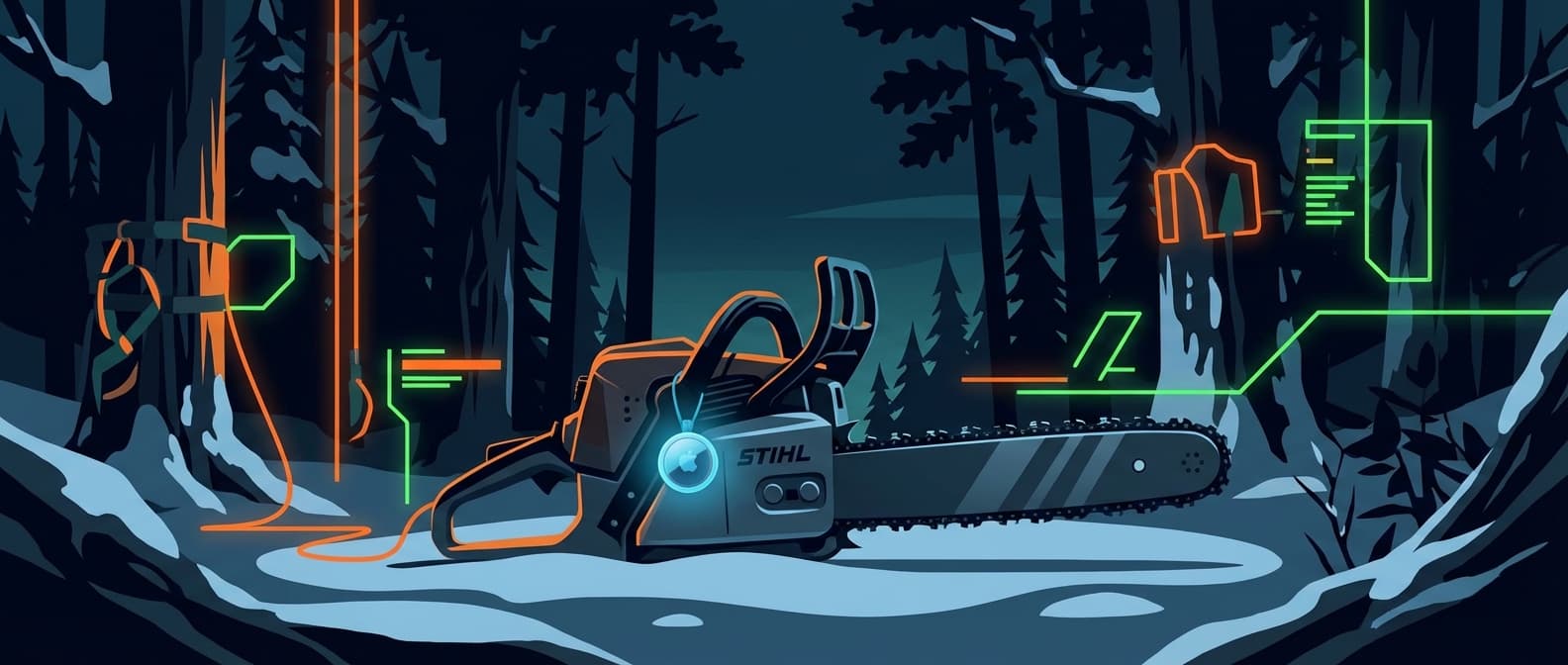
Chainsaw Tracking: How Tree Service Companies Manage Chainsaw Fleets Across Crews and Job Sites
A three-crew tree service company puts 12-15 chainsaws on trucks every morning. A seven-crew utility line clearance contractor dispatches 25-35. By the end of the week, saws have moved between crews, been left at job sites, gone to the shop for service, or disappeared entirely.
Most tree service companies track this with a clipboard, a whiteboard, or nothing at all. The result: $5,000-$10,000 per year in lost and stolen chainsaws, arguments about which crew had the MS 500i last, and a maintenance schedule that exists only in the shop foreman's head.
This page covers how AirTag-based tracking solves the chainsaw inventory problem for tree service companies, arborist firms, forestry operations, and utility line clearance contractors.
The Chainsaw Fleet Problem
What a Typical Fleet Looks Like
Professional tree service operations carry a mix of chainsaw sizes and types for different tasks:
| Chainsaw Type | Common Models | Retail Price | Use Case |
|---|---|---|---|
| Top-handle climbing saw | Stihl MS 201 TC-M, Husqvarna T540i XP | $700-$900 | In-tree limbing and pruning |
| Mid-range ground saw | Stihl MS 261, Husqvarna 562 XP | $700-$850 | General felling and bucking |
| Professional ground saw | Stihl MS 362, Husqvarna 572 XP | $1,000-$1,200 | Heavy felling and storm work |
| High-performance saw | Stihl MS 500i | $1,300-$1,800 | Large-diameter felling, production cutting |
| Pole saw | Stihl HT 135, Husqvarna 525iDEPS | $600-$900 | High limb removal from the ground |
A single crew typically carries 3-5 chainsaws: one or two climbing saws, a mid-range ground saw, and a larger felling saw. Add a pole saw and you're at five units per crew.
Fleet value by company size:
| Company Size | Crews | Chainsaws | Fleet Value |
|---|---|---|---|
| Small (owner-operator + 1 crew) | 1-2 | 5-10 | $4,000-$10,000 |
| Mid-size | 3-5 | 15-25 | $12,000-$30,000 |
| Large tree service | 6-10 | 25-50 | $20,000-$60,000 |
| Utility line clearance contractor | 10-30+ | 50-150+ | $40,000-$180,000+ |
Companies like Asplundh, Davey Tree, and regional utility vegetation management contractors operate hundreds of crews. Their chainsaw inventories are worth hundreds of thousands of dollars.
Where Chainsaws Go Missing
Professional chainsaws disappear in four ways:
1. Theft from trucks and job sites. A tree crew's truck bed is an open display case for $5,000+ in chainsaws. Crews stop for lunch, walk to the backyard of a property, or leave tools at the curb while loading brush. It takes 10 seconds to grab a chainsaw from an unattended truck. The ArboristSite forum has an entire subforum dedicated to lost and stolen equipment, with new posts every week.
2. Left behind at job sites. A crew finishes a removal, loads the chipper and large equipment, drives to the next job, and realizes 20 minutes later that someone left the MS 362 in the backyard. Sometimes they go back and it's still there. Sometimes they don't notice until the next morning.
3. Inter-crew "borrowing." Crew A borrows Crew B's Stihl MS 500i for a big removal and never returns it. Without tracking, nobody can prove who had it last. The saw enters a gray zone where it belongs to everyone and no one.
4. Gradual attrition. A saw breaks down and gets tossed in a corner of the shop. A new guy puts the wrong saw in the wrong truck. Over 12 months, the fleet shrinks by 3-5 saws and nobody can account for exactly how or when.
The Real Cost of Missing Chainsaws
The replacement cost is only part of it:
| Cost Category | Impact |
|---|---|
| Replacement chainsaw | $700-$1,800 depending on model |
| Downtime waiting for replacement | Lost revenue while crew is short a critical tool |
| Insurance deductible | $500-$1,000 per claim (many companies self-insure small tools) |
| Insurance premium increase | Multiple claims raise commercial policy rates |
| Crew productivity loss | Wrong saw for the job means slower work |
| Management time | Hours spent investigating, arguing, filing claims |
A mid-size tree service losing 4 chainsaws per year at an average replacement cost of $1,000 loses $4,000 in direct costs. Add the indirect costs (downtime, management time, crew friction) and the real number is closer to $8,000-$12,000.
Chainsaw Theft: How Bad Is It?
Chainsaws are among the most targeted outdoor power equipment for theft. The characteristics that make them attractive to thieves:
- High resale value. A used Stihl MS 362 sells for $500-$700 on Facebook Marketplace or Craigslist. A stolen one sells for $300-$400 cash, no questions asked.
- Portable. Even a large chainsaw weighs under 15 pounds. One person can carry two.
- No registration. Unlike vehicles, there's no title or registration system. Serial numbers exist but are rarely recorded by owners and almost never checked by buyers.
- Easy to resell. High demand from homeowners, small operators, and rural property owners. Stolen chainsaws move within hours.
- Common targets. Open truck beds, unlocked trailers, unattended job sites, and equipment yards with poor lighting.
Construction equipment theft costs the US economy approximately $1 billion annually according to the National Equipment Register. Single-item tools and small equipment have a recovery rate below 7% without any tracking. With tracking, recovery rates jump above 90%.
What Arborists Actually Say
The ArboristSite.com forum is the largest online community for professional tree workers. Theft is a constant topic. Common threads:
- "Saws stolen out of the truck while we were in the backyard doing a removal"
- "Showed up Monday morning and 3 saws were gone from the trailer"
- "Had a guy quit and take two company saws with him"
- "Left the MS 500i on a job site Friday, gone by Saturday morning"
Forum members recommend recording serial numbers, marking saws with UV paint or engraving, and photographing equipment regularly. The recurring frustration: none of these help you find a stolen saw. They only help prove ownership if police happen to recover it.
AirTag tracking changes this. Multiple forum threads on ArboristSite discuss hiding AirTags under chainsaw top covers for theft recovery. The consensus: it works, but individual AirTags through Find My are limited to tracking a few items. For a full fleet, you need a management platform like AirPinpoint.
How AirPinpoint Works for Chainsaw Fleets
Setup
-
Attach an AirTag to each chainsaw. The best placement is inside the top engine cover (cylinder cover). Most professional chainsaws have enough cavity space near the air filter housing. Secure the AirTag with an adhesive silicone mount or a small bracket. The plastic cover protects it from rain, sawdust, and debris.
-
Register each AirTag in AirPinpoint. Name them by model and inventory number (e.g., "MS362-007" or "572XP-crew3"). Add any notes about the saw: serial number, purchase date, assigned crew.
-
Set up geofences. Draw boundaries around your equipment yard and any long-term job sites. Configure alert schedules so you get notified if a chainsaw moves outside the fence after hours.
-
Invite crew leaders. Give foremen read access to the dashboard so they can check what equipment is assigned to their crew each morning.
What You See on the Dashboard
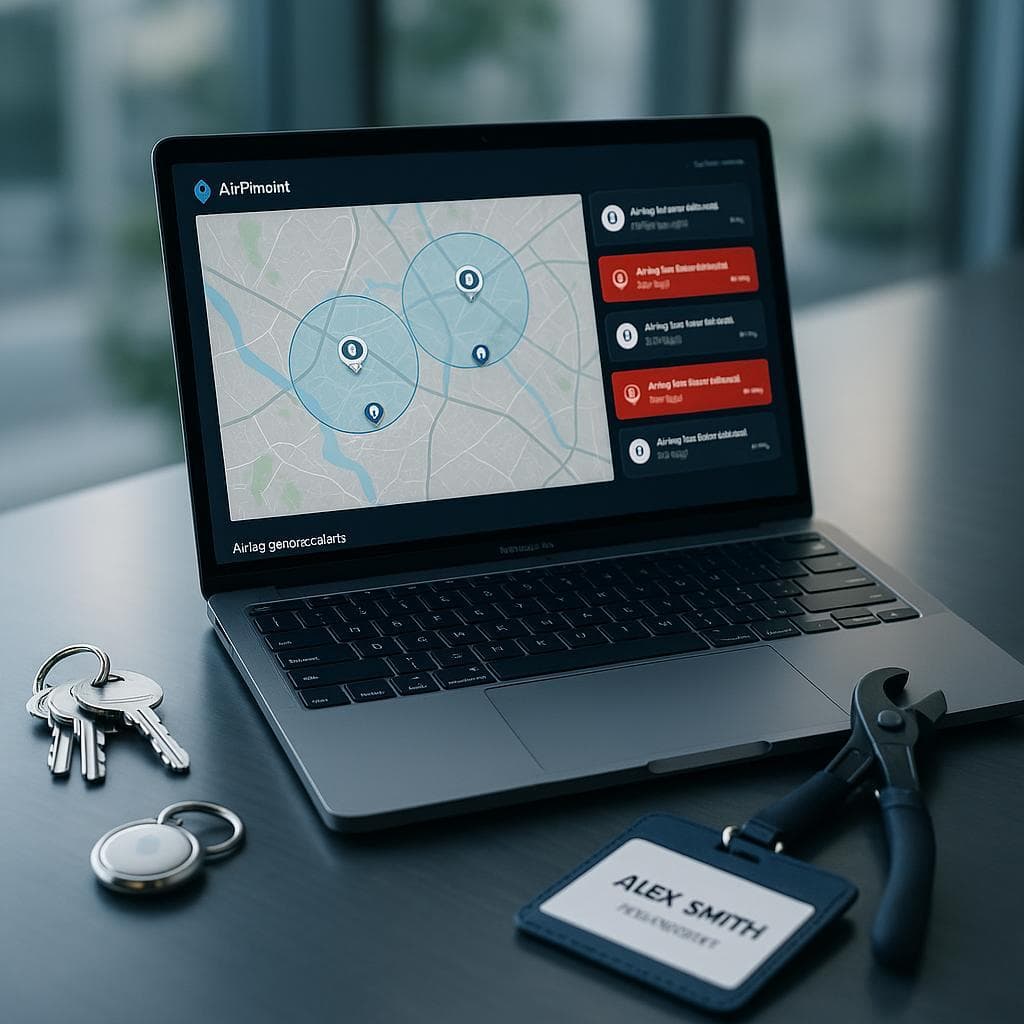
Open AirPinpoint and you see every chainsaw on a map. The dashboard answers the questions tree service owners ask every day:
- Where is every saw right now? All 30 chainsaws on one map. Zoom into a job site and see which saws are there.
- Which crew has which saws? Filter by assigned crew. See instantly if Crew B still has the MS 500i they borrowed Tuesday.
- Are any saws missing? A chainsaw that hasn't reported a location in 48 hours stands out immediately. Investigate before it's gone for good.
- Did everything come back to the yard? Friday afternoon: check the dashboard to confirm all saws are at the yard before the weekend. A saw still showing at Thursday's job site? Send someone to grab it.
- Where was the saw when it was last seen? If a saw goes missing, you have a location history showing where it's been. This is the difference between filing a police report with "it was on one of our trucks somewhere" and "it was at 142 Oak Street at 3:47 PM."
After-Hours Alerts
Configure geofence schedules to match your operations:
- Equipment yard geofence: Alert if any chainsaw leaves between 7 PM and 5 AM on weekdays, or anytime on weekends.
- Job site geofence: For multi-day projects, geofence the site and alert if equipment leaves outside work hours.
- Movement alerts: Get notified when a chainsaw that's been stationary at the yard suddenly starts moving at 2 AM.
These alerts don't prevent theft, but they compress the response window from "noticed it was missing Monday morning" to "got a notification at 2:17 AM Saturday night." A 48-hour head start for the thief versus a 15-minute head start makes the difference between recovery and a write-off.
Crew Accountability
Tracking solves the most common management headache in tree service operations: figuring out who had what and when.
Before tracking:
- "Who has the MS 500i?" Nobody knows.
- "Where's the pole saw?" "I thought Crew C had it."
- A saw is missing. Everyone points at someone else. No resolution.
After tracking:
- The dashboard shows the MS 500i is at the job site on Elm Street, where Crew B is working today.
- The pole saw is at the shop, where it went for service Tuesday.
- A saw went missing. Location history shows it was at the yard Friday at 5:30 PM and was last seen at 11 PM heading south on Route 9. File a police report with the exact location data.
This isn't about surveillance or mistrusting your crews. It's about removing ambiguity. When everyone knows the tools are tracked, the "it fell off the truck" excuse stops happening. The crew that borrowed a saw returns it the next day because they know you can see they have it.
Maintenance and Compliance
Chainsaw Maintenance Reality
Professional chainsaws require regular maintenance to operate safely and efficiently:
| Maintenance Item | Frequency | What Happens If Skipped |
|---|---|---|
| Chain sharpening | Every 2-3 hours of use | Increased kickback risk, slower cutting, overheating |
| Air filter cleaning | Every 8-10 hours | Engine runs lean, potential seizure |
| Bar inspection and rotation | Every 20-30 hours | Uneven wear, chain derailment |
| Spark plug replacement | Every 100 hours | Hard starting, power loss |
| Fuel filter replacement | Every 200 hours | Stalling, inconsistent performance |
| Full service (decarbon, bearings) | Annually or 300+ hours | Catastrophic engine failure |
When saws move between crews without tracking, maintenance schedules fall apart. A saw that's due for service gets sent to a job instead because nobody checked. The climbing saw that needs a new bar goes out with a crew that doesn't know about the issue.
Tracking creates a single source of truth for each saw's location and status. When it's time for the MS 362 to come in for service, you can see which crew has it and tell them to drop it at the shop.
OSHA Compliance
OSHA standard 1910.266 (Logging Operations) and the general Tree Care and Removal inspection guidance require:
- Pre-shift inspection of each chainsaw before use. Employers must verify that handles, guards, and safety devices are in place and functioning.
- Maintenance records documenting inspections and service history.
- Training verification with written certification records.
For utility line clearance contractors working under 29 CFR 1910.269, requirements are even stricter. Equipment used near energized lines must be maintained and inspected to documented standards.
Knowing where each saw is and maintaining a service history per unit helps demonstrate compliance during OSHA inspections. It's not a substitute for the actual inspections and record-keeping, but it's the foundation: you can't inspect a saw you can't find.
STIHL Connected vs. Husqvarna Fleet Services vs. AirPinpoint
Two chainsaw manufacturers offer their own tracking solutions. Here's how they compare:
| Feature | STIHL Connected | Husqvarna Fleet Services | AirPinpoint |
|---|---|---|---|
| Hardware cost | ~$30-50/connector | ~$15-25/sensor | $29/AirTag |
| Monthly cost | Free (basic) | ~$2/asset/mo | $11.99/device/mo (Business) |
| Brand compatibility | Stihl only | Husqvarna only | Any brand |
| Location tracking | Last Bluetooth location | GPS via gateway | Apple Find My network (2B+ devices) |
| Range | Bluetooth range (~30 ft) | Bluetooth + gateway | Anywhere an iPhone passes |
| Run time tracking | Yes | Yes | No |
| Maintenance scheduling | Yes (based on run time) | Yes (based on engine hours) | Manual via notes |
| Fleet dashboard | STIHL Connect Pro portal | Husqvarna web portal | AirPinpoint web + mobile |
| Geofence alerts | No | No | Yes |
| After-hours movement alerts | No | No | Yes |
| Works without internet gateway | Limited (phone only) | No | Yes (passive Find My network) |
Where the OEM solutions fall short for fleet managers:
Most tree service companies run mixed fleets. You might have Stihl ground saws, Husqvarna climbing saws, and Echo pole saws. Neither STIHL Connected nor Husqvarna Fleet Services can track equipment from other manufacturers. That means running two or three separate dashboards to see your full fleet, and your Echo equipment isn't tracked at all.
The OEM solutions also focus on Bluetooth proximity rather than true location tracking. STIHL Connected shows where a saw was the last time a paired phone was nearby. AirPinpoint uses the entire Apple Find My network, which means your chainsaw's location updates whenever any iPhone passes within Bluetooth range, not just your own phone.
Where the OEM solutions win: Run time tracking and engine-hour-based maintenance alerts. If maintenance scheduling is your primary need and you run a single-brand fleet, STIHL Connected or Husqvarna Fleet Services may be sufficient. If you need to know where your saws are across multiple crews and job sites, AirPinpoint is the better fit. You can run both: OEM tracking for maintenance data, AirPinpoint for location and theft protection.
Cost Analysis
What AirPinpoint Costs for a Chainsaw Fleet
| Fleet Size | AirTags (one-time) | Annual AirPinpoint (Business) | Total Year 1 | Year 2+ Annual |
|---|---|---|---|---|
| 10 chainsaws | $290 | $1,439 | $1,729 | $1,439 |
| 20 chainsaws | $580 | $2,878 | $3,458 | $2,878 |
| 30 chainsaws | $870 | $4,316 | $5,186 | $4,316 |
| 50 chainsaws | $1,450 | $7,194 | $8,644 | $7,194 |
Enterprise pricing: For fleets over 50 devices, AirPinpoint offers custom pricing that brings per-device costs down. Contact sales for volume rates.
ROI: When Does Tracking Pay for Itself?
For a 30-chainsaw fleet spending $5,186 in year one:
- Preventing 4 chainsaw thefts per year at an average of $1,000/saw saves $4,000 in direct replacement costs.
- Eliminating 2 "lost" chainsaws per year that were actually left at job sites or in crew members' personal trucks saves another $2,000.
- Reducing management time spent tracking down equipment: 2-3 hours per week at a manager's hourly rate adds up to $3,000-$5,000/year.
Total savings: $9,000-$11,000/year against a $5,186 cost. The system pays for itself before the end of year one.
For utility line clearance contractors with 100+ chainsaws, the math is even more favorable. The per-device cost drops with enterprise pricing while the loss prevention value scales linearly.
Getting Started
For a Small Tree Service (5-15 Chainsaws)
- Buy AirTags ($29 each). Apple sells 4-packs for $99.
- Mount one inside each chainsaw's top cover with a silicone adhesive case.
- Create an AirPinpoint account and register each tag with a descriptive name.
- Geofence your equipment yard.
- Check the dashboard each morning to verify all saws are accounted for.
Time to set up: about an hour for a 10-saw fleet.
For a Large Operation (25+ Chainsaws)
- Buy AirTags in bulk. For 50 units, that's $1,450.
- Assign AirTag mounting to your shop mechanic during routine service. Takes 5 minutes per saw.
- Set up AirPinpoint with crew assignments and geofences for your yard and any recurring job sites.
- Give crew foremen dashboard access so they can verify their equipment before leaving the yard each morning.
- Establish a weekly check: review the dashboard for any saws that haven't reported a location in 48+ hours.
What Else to Track
Once you have AirPinpoint set up for chainsaws, consider tagging the rest of your high-value equipment:
- Stump grinders ($5,000-$30,000): a single tag protects a five-figure asset
- Climbing gear ($500-$1,500 per set): saddles, ropes, and rigging hardware
- Chippers ($15,000-$60,000): already tagged with GPS by some fleet management systems, but AirPinpoint provides backup tracking
- Blowers and hedge trimmers ($300-$800): lower value but frequently walked off
- Trailers ($3,000-$15,000): geofence your trailer lot and get alerts on unauthorized movement
Tree service companies that track their full equipment inventory through a single platform eliminate the "where is it?" question entirely. Every asset, every crew, every job site, one dashboard.
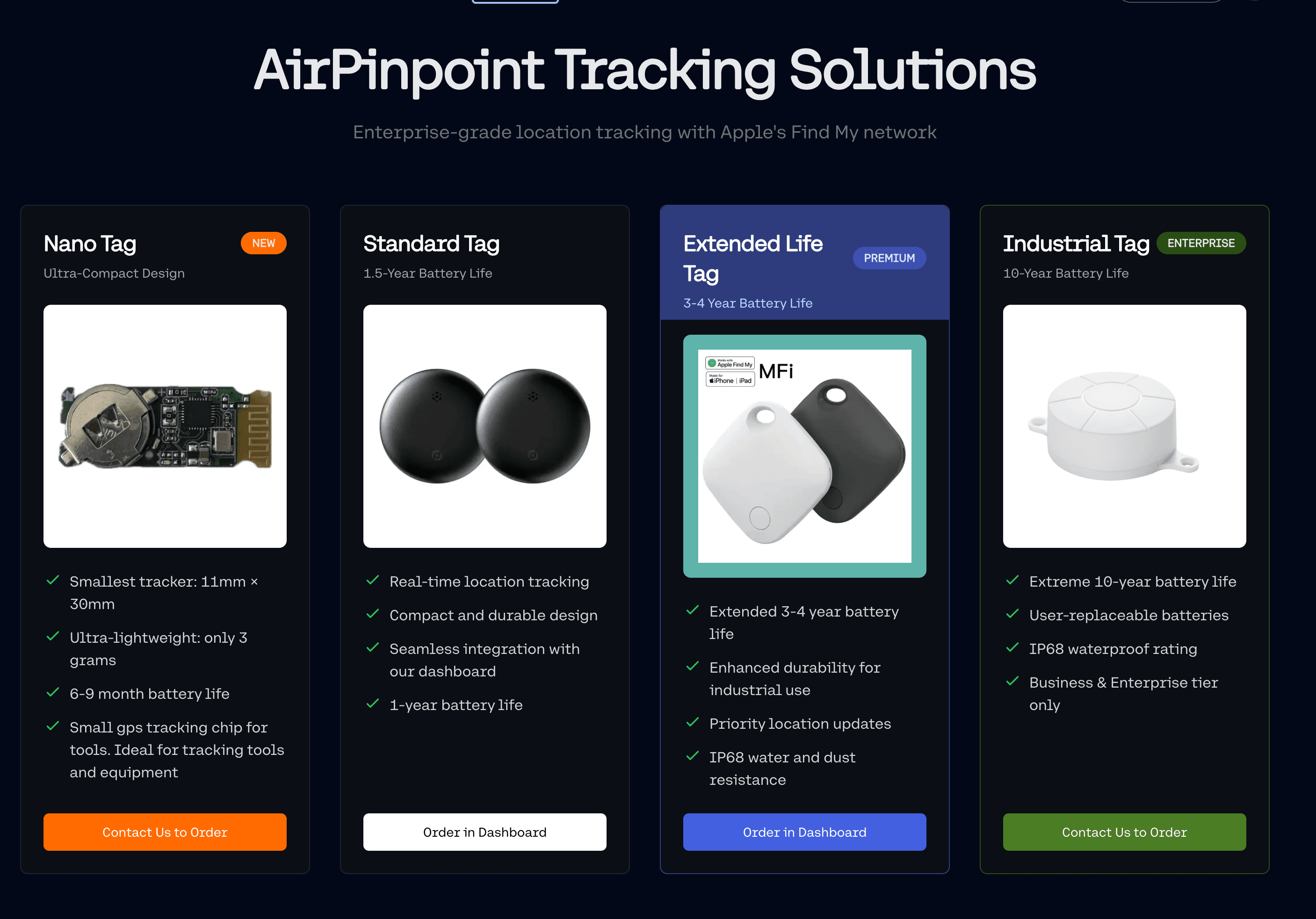
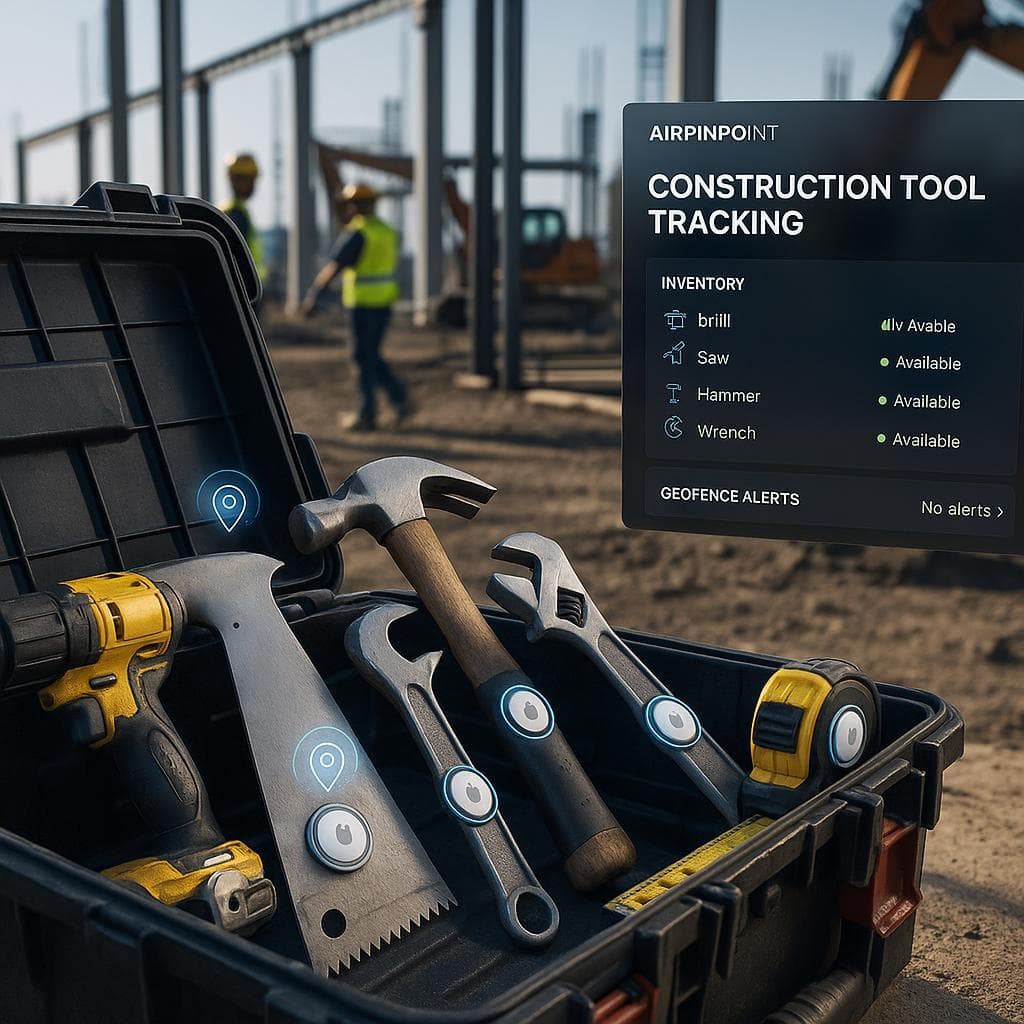
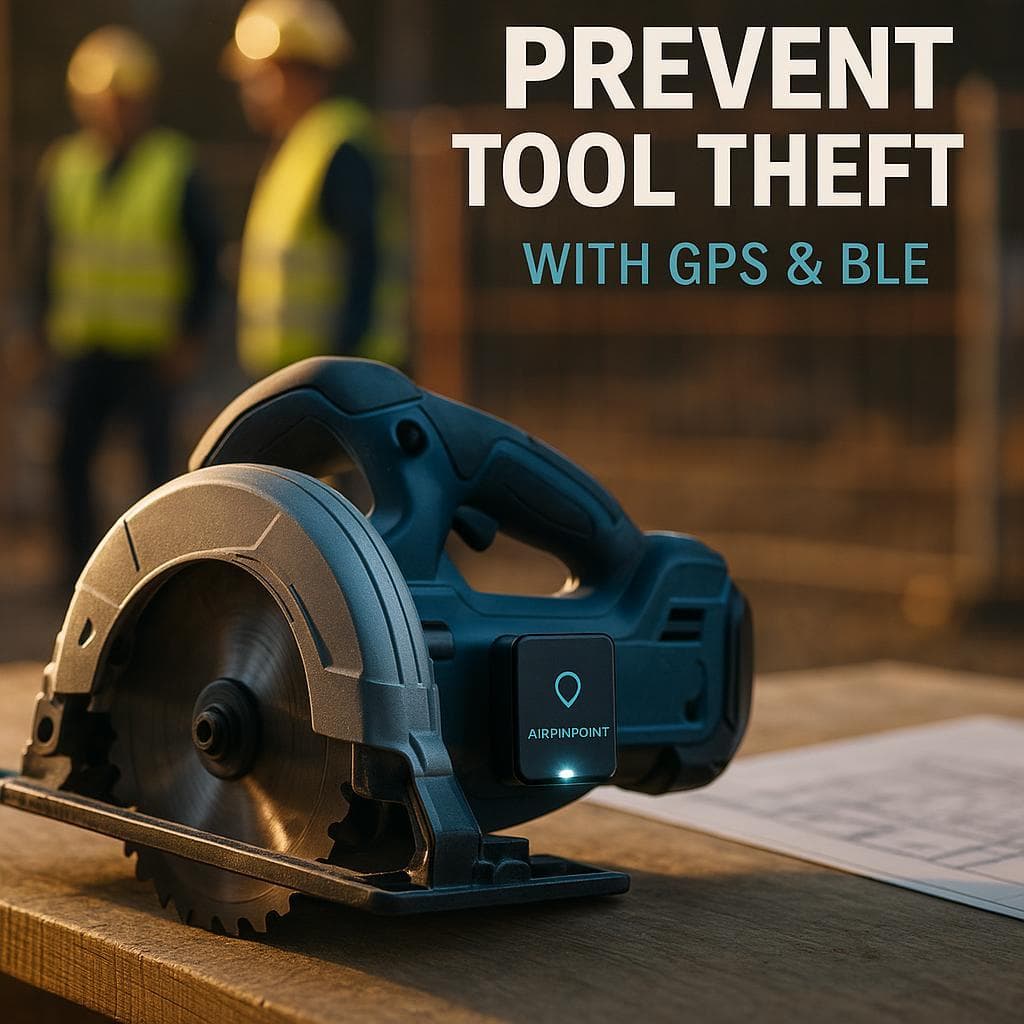

 Our Solution