Updated
AirTags vs Spireon: Enterprise GPS vs Simple Fleet Tracking
The Short Version: 57% Cheaper, No Contracts
A 50-asset fleet on Spireon costs roughly $53,750 over three years. The same fleet on AirTags with Airpinpoint costs $23,282. That $30,000+ difference buys a truck, funds a new hire, or just stays in your account. And you're not locked into a multi-year contract to get it.
Spireon is a capable enterprise platform, and there are specific use cases where it's the right choice. But most businesses are overpaying for GPS capabilities they never use.
Two Very Different Tracking Philosophies
Spireon (now part of Solera/CalAmp) operates FleetLocate, one of the largest commercial fleet tracking platforms in North America. With 4+ million connected vehicles, Spireon provides real-time GPS, OBD diagnostics, ELD compliance, driver behavior monitoring, and fuel management. Their customer base skews toward large fleets, car dealerships (via Kahu), and insurance companies (via GoldStar). Pricing requires a custom quote, typically $20-35 per vehicle per month with multi-year contracts.
AirTags use Apple's Find My network of over a billion devices to report location passively. No wiring, no OBD connection, no cellular SIM card. Airpinpoint adds a business dashboard with location history, geofencing, team access, and export capabilities at $11.99/device/month (Business) or $14.99/device/month (Enterprise). No contracts, cancel anytime.
Spireon gives you a full fleet management system with compliance tools. AirTags give you fleet-wide location visibility at a fraction of the cost. For most operations, location visibility is what actually drives decisions.
Spireon Product Lineup
Spireon isn't a single product. It's a family of connected vehicle platforms:
FleetLocate (Fleet Tracking)
The core fleet management product. Real-time GPS tracking, geofencing, driver behavior monitoring, maintenance scheduling, fuel management, and compliance tools. Targets commercial fleets from 50 to thousands of vehicles. Includes ELD compliance for FMCSA hours-of-service regulations.
Kahu (Dealer Lot Management)
GPS tracking for car dealerships. Tracks inventory on the lot, manages test drives, monitors sold vehicles during financing, and provides stolen vehicle recovery. Over 4,500 dealer partners use Kahu.
GoldStar (Stolen Vehicle Recovery)
Insurance-focused product. Tracks vehicles for recovery after theft. Used by insurance carriers to reduce total loss claims.
NSpire (Connected Vehicle Platform)
The underlying IoT platform that powers Spireon's products. Handles device management, data processing, and integration APIs for partners and enterprise customers.
For this comparison, we're primarily looking at FleetLocate since that's the product competing for fleet tracking dollars against AirTags.
Spireon Pricing (What We Know)
Spireon does not publish pricing. This is common among enterprise fleet GPS providers. Based on customer reports, industry analysis, and competitive positioning:
| Cost Component | Estimated Range |
|---|---|
| Monthly subscription | $20-35/vehicle |
| Hardware | $50-200+ per device (sometimes waived with contract) |
| Installation | $50-150/device for hardwired units |
| Contract length | 2-3 years typical |
| Early termination | Remaining contract balance or penalties |
| Activation fees | Varies by agreement |
The total cost depends heavily on fleet size, hardware mix, and negotiation. Larger fleets get better per-unit pricing. A 200-vehicle fleet will get a different quote than a 30-vehicle fleet.
Why the Pricing Opacity Matters
When a vendor won't publish pricing, it usually means the price is high enough to require a sales pitch to justify. The process takes weeks: request a demo, schedule a call, get a proposal, negotiate terms. For a fleet manager evaluating options, this consumes significant time before you even know if the budget works. Airpinpoint publishes pricing on its website: $11.99/device/month (Business) or $14.99/device/month (Enterprise). No sales calls required. You can start tracking today.
True Cost Comparison
We'll use $25/vehicle/month as a conservative midpoint for Spireon, plus $100/device for hardware and $75 for installation on hardwired units.
10-Vehicle Fleet Over 3 Years
Spireon FleetLocate:
- Monthly subscription: 10 x $25 x 36 = $9,000
- Hardware: 10 x $100 = $1,000
- Installation: 10 x $75 = $750
- Total: ~$10,750
AirTags + Airpinpoint:
- AirTags: 10 x $29 = $290
- Airpinpoint subscription: 10 x $11.99 x 36 = $4,316
- Battery replacements: ~$50
- Total: ~$4,656
Savings with AirTags: ~$6,094 (57%)
25-Vehicle Fleet Over 3 Years
Spireon FleetLocate:
- Monthly subscription: 25 x $25 x 36 = $22,500
- Hardware: 25 x $100 = $2,500
- Installation: 25 x $75 = $1,875
- Total: ~$26,875
AirTags + Airpinpoint:
- AirTags: 25 x $29 = $725
- Airpinpoint subscription: 25 x $11.99 x 36 = $10,791
- Battery replacements: ~$125
- Total: ~$11,641
Savings with AirTags: ~$15,234 (57%)
50-Vehicle Fleet Over 3 Years
Spireon FleetLocate:
- Monthly subscription: 50 x $25 x 36 = $45,000
- Hardware: 50 x $100 = $5,000
- Installation: 50 x $75 = $3,750
- Total: ~$53,750
AirTags + Airpinpoint:
- AirTags: 50 x $29 = $1,450
- Airpinpoint subscription: 50 x $11.99 x 36 = $21,582
- Battery replacements: ~$250
- Total: ~$23,282
Savings with AirTags: ~$30,468 (57%)
Volume discounts for 100+ tags, contact us for a quote.
The savings percentages are stark because Spireon's costs compound three ways: higher monthly fees, upfront hardware, and installation labor. AirTags eliminate two of those three entirely.
What Spireon Offers (Enterprise Features Most Fleets Don't Need)
Spireon is a mature enterprise platform with capabilities beyond basic tracking. Whether your operation actually needs these features is the question worth asking:
Real-Time GPS Tracking
- Continuous GPS with configurable update intervals (10 seconds to 5 minutes)
- Live map view for dispatch and fleet operations
- Historical trip replay with breadcrumb trails
- Multi-view dashboards for fleet managers
ELD Compliance
- FMCSA-certified electronic logging device
- Hours-of-service tracking and management
- DVIR (Driver Vehicle Inspection Reports)
- Automatic duty status recording
If you operate FMCSA-regulated commercial motor vehicles, ELD compliance is mandatory and AirTags don't provide it. But only a fraction of fleet vehicles fall under these regulations. Most businesses tracking vans, pickups, trailers, and equipment don't need ELD at all.
Driver Behavior Monitoring
- Speeding detection and alerts
- Harsh braking and acceleration scoring
- Idle time monitoring with cost attribution
- Seatbelt detection (with compatible hardware)
- Driver scorecards for coaching and accountability
Vehicle Diagnostics
- OBD-II engine code reading
- Fuel level monitoring
- Battery voltage alerts
- Maintenance scheduling based on mileage and engine hours
- Predictive maintenance alerts
Trailer and Asset Tracking
- Solar-powered trailer trackers
- Battery-powered asset trackers (fine print: multi-year battery claims assume ~1 update/day; at AirTag update rates those batteries hold 2-4 days)
- Reefer temperature monitoring for cold chain
- Cargo sensors for load detection
Enterprise Integration
- Open API for fleet management system integration
- Dispatch system connectivity
- Fuel card integration
- Custom reporting and business intelligence
Scale and Reliability
Spireon has been operating since 2002 with 4+ million connected vehicles. That said, Apple's Find My network runs on over a billion active devices, making it the largest location detection network on the planet. Both platforms are proven at scale.
What Customer Feedback Says About Spireon
The Positives
- Scale and stability: Spireon works reliably across large fleets. Companies with hundreds or thousands of vehicles depend on it daily.
- Compliance tools: ELD and DVIR capabilities keep trucking fleets legal without separate compliance software.
- Dealer partnerships: Kahu is deeply embedded in the dealer ecosystem. Over 4,500 dealers use it for lot management.
- Hardware variety: Wired, OBD, solar, and battery-powered options cover most tracking scenarios.
The Negatives
Based on review platforms and industry feedback:
- Dated user interface: Multiple reviews note that Spireon's dashboard feels older compared to Samsara or Motive. Navigation can be unintuitive for new users.
- Customer support: Mixed reviews on support responsiveness. Some users report long wait times and difficulty reaching technical support.
- Contract rigidity: Multi-year contracts with auto-renewal clauses catch some customers off guard. Cancellation can be difficult.
- Pricing transparency: The quote-based model frustrates fleet managers who want to compare costs quickly.
- Consolidation concerns: The CalAmp/Solera acquisition has raised questions about product roadmap priorities and long-term focus.
Where AirTags Beat Spireon (For Most Businesses)
These aren't edge cases. For the typical business tracking fleet assets, these advantages apply across the board:
1. Total Cost
The math is clear. At $11.99/device/month vs $20-35/device/month (plus hardware and installation), Airpinpoint costs 50-65% less than Spireon. For a 50-asset fleet, that difference is $30,000+ over three years. That's not a rounding error. That's a truck.
2. No Contracts, No Lock-In
Spireon typically requires 2-3 year commitments. If your needs change, if the product doesn't perform, if you get acquired and the new parent company has a different vendor, you're still paying. Airpinpoint is month-to-month. Cancel anytime.
3. Unpowered Asset Simplicity
Spireon offers solar and battery trackers for unpowered assets, but they carry the same monthly subscription cost and require periodic maintenance (recharging batteries, cleaning solar panels, replacing units). Spireon's battery asset trackers also carry the same fine print as every battery-powered cellular GPS: their multi-year battery claims assume roughly one location update per day. A trailer tracker that pings once a day tells you where the trailer was yesterday, not where it is now.
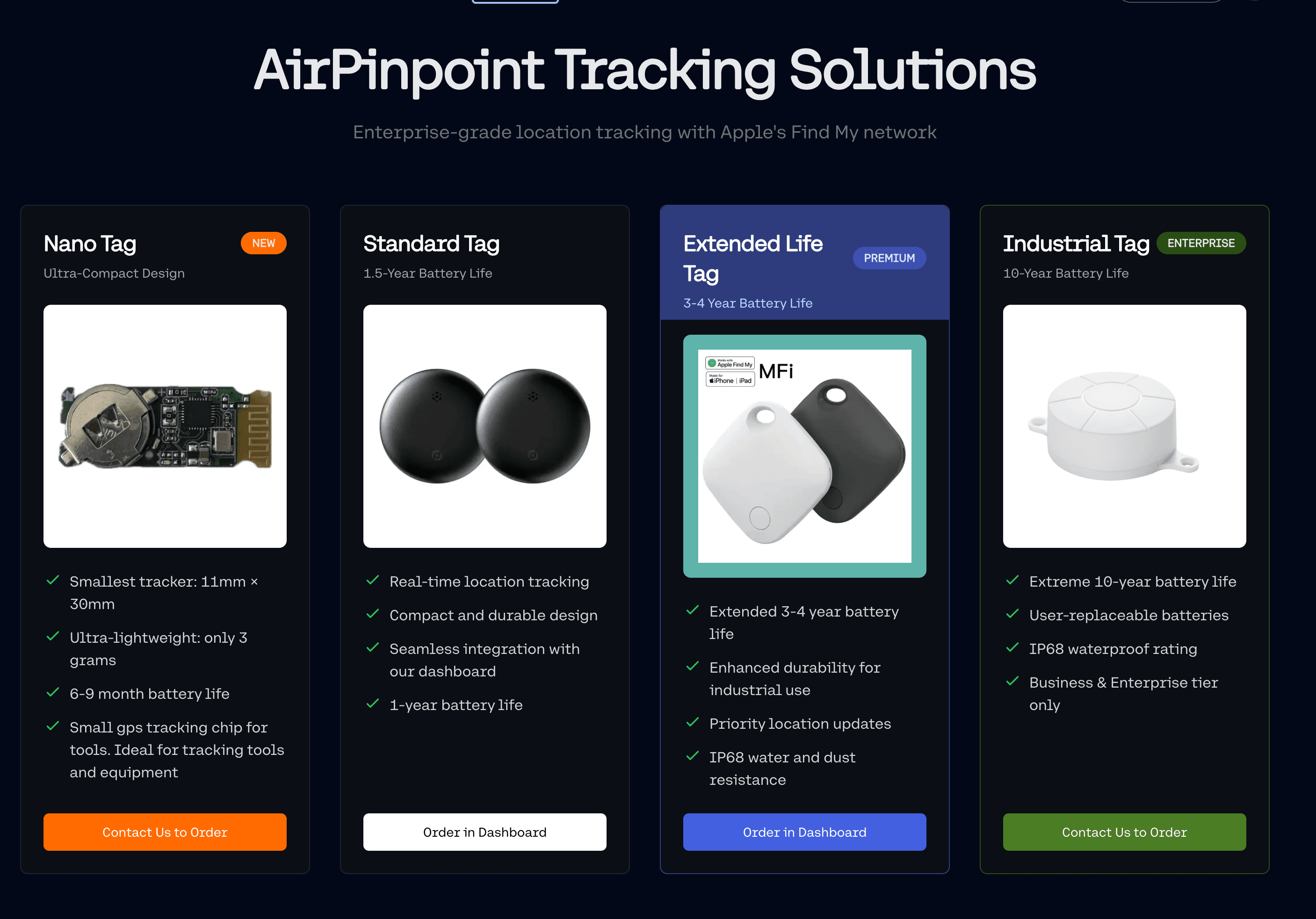
An AirTag costs $29, lasts a year on a $3 coin cell at full update rate (every 1-5 minutes in populated areas), and fits inside a toolbox or strapped to a trailer tongue. No charging schedule, no hardware management, and roughly 100,000 location updates per battery instead of 365.
4. Zero Installation
Every Spireon GPS device needs some form of installation. OBD plugins are simple, but hardwired units require a technician. For a 50-vehicle fleet, installation alone can cost $3,750+ and take vehicles offline for hours. AirTags deploy in seconds: peel the backing off an adhesive holder, stick it somewhere hidden, done. You can deploy 50 AirTags in an afternoon without taking a single vehicle out of service.
5. Indoor and Dense Urban Coverage
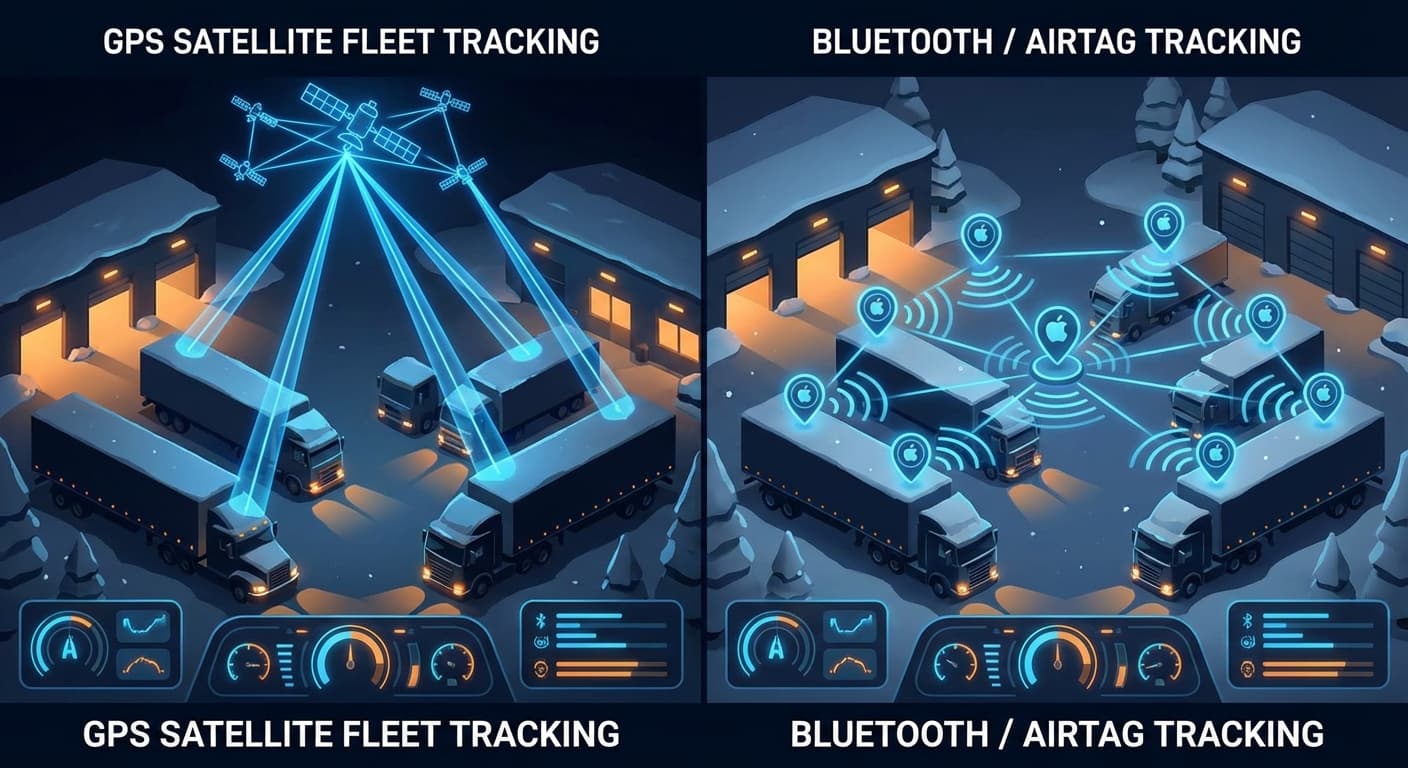
AirTags leverage over a billion Apple devices as a passive detection network. They work inside warehouses, parking garages, and buildings where GPS signals degrade. Spireon's GPS hardware needs satellite visibility to report position accurately. In dense urban canyons or indoor environments, GPS accuracy drops significantly.
6. Time to Deploy
Getting started with Spireon means: request a quote, attend a demo, negotiate terms, sign a contract, schedule installation, wait for hardware delivery, install devices. That process takes weeks to months.
Getting started with AirTags: buy them at any Apple Store or Amazon. Sign up for Airpinpoint. Attach tags. Open the dashboard. You're tracking within an hour.
Where Spireon Still Wins (Niche Use Cases)
There are specific scenarios where Spireon's enterprise capabilities matter. These tend to apply to a subset of fleet assets, not the entire fleet.
Real-Time GPS for Active Dispatch
If you run a delivery or service fleet where dispatchers route vehicles based on live location, Spireon's sub-minute GPS updates are genuinely useful. Most fleets don't dispatch this way, but for those that do, AirTags' variable update frequency (5-15 minutes in commercial areas) isn't sufficient.
ELD Compliance for Regulated Trucks
FMCSA-regulated commercial motor vehicles need an ELD. AirTags don't do this. But ELD requirements apply specifically to commercial trucks over 10,001 lbs in interstate commerce. Most business fleets consist of vans, pickups, and light trucks that are exempt.
Vehicle Diagnostics
Spireon reads engine codes, monitors fuel levels, and supports maintenance scheduling based on vehicle data. This is useful for fleets with aging vehicles or high-mileage trucks. For newer vehicles that already surface diagnostics through their own apps, the value is less clear.
Driver Behavior Monitoring
Speed monitoring, harsh braking, and driver scorecards require connected GPS hardware. If your insurance carrier offers telematics discounts, this can offset the cost. Otherwise, it's data most small and mid-sized operations don't act on.
Remote Starter Disable
Spireon can remotely disable ignition for theft recovery. AirTags locate stolen assets but can't immobilize them. This matters if vehicle theft is a significant risk in your operating area.
Reefer Temperature Monitoring
Cold chain operations moving food or pharmaceuticals need temperature sensors. This is a specialized need that applies to a small percentage of fleets.
When Spireon Might Be Worth the Premium
Spireon makes sense in a narrow set of scenarios:
-
You have FMCSA-regulated trucks: If your fleet includes heavy commercial vehicles that legally require ELD compliance, you need a solution like Spireon for those specific trucks. Note: this doesn't mean every vehicle in your fleet needs it.
-
You run 100+ vehicles with full-time fleet managers: At enterprise scale with dedicated optimization staff, the deeper data can drive improvements that offset the higher cost.
-
Your insurer requires telematics: Some insurance carriers offer discounts for driver behavior monitoring. If the discount exceeds the cost difference, it makes financial sense for those vehicles.
-
You dispatch based on live GPS: Delivery and logistics operations that route drivers in real-time based on current position need sub-minute GPS updates.
-
You haul temperature-sensitive cargo: Food and pharma cold chain compliance requires sensor-equipped trackers.
For everyone else, the $30,000+ in savings over three years (at 50 assets) is hard to justify giving up.
When to Choose AirTags (Most Businesses)
AirTags with Airpinpoint are the better fit for the majority of fleet operations:
-
You track mixed asset types: Vehicles, trailers, equipment, tools, containers. Spireon charges $20-35/month per asset. At 100 assets, that's $24,000-$42,000/year. Airpinpoint tracks the same 100 assets for $14,388/year.
-
You need location awareness, not fleet telemetry: "Where is it?" is the question that drives 90% of fleet decisions. Airpinpoint answers it at half the cost. You don't need engine diagnostics on a trailer.
-
Your fleet is under 100 vehicles: Spireon's enterprise sales process, multi-year contracts, and pricing structure are built for companies with procurement departments. If you're a fleet manager Googling "Spireon vs alternatives," Airpinpoint is almost certainly the better fit.
-
Budget drives decisions: 57% savings is $30,000+ on a 50-asset fleet over three years. That capital goes further invested in your business than in GPS subscriptions.
-
You own unpowered assets: Trailers, construction equipment, containers, generators, tools. These are the assets most likely to get lost or stolen, and they're the most expensive to track with GPS. AirTags cost $29 per unit with no wiring and no installation.
-
You want to start today, not next quarter: No sales calls, no contract negotiations, no installation scheduling. Buy AirTags, sign up for Airpinpoint, and your fleet is visible in an hour. Spireon's procurement cycle takes weeks to months.
-
You refuse to be locked in: Month-to-month pricing. Scale up or down instantly. No early termination penalties. Your tracking costs match your actual fleet size, not a contract signed two years ago.
The Hybrid Strategy
The most cost-effective approach for mid-sized fleets combines both technologies:
Put Spireon (or similar GPS) On:
- Regulated commercial vehicles that require ELD compliance
- Dispatch vehicles where real-time routing improves service delivery
- High-value trucks where driver behavior monitoring reduces insurance premiums
- Refrigerated trailers requiring temperature monitoring
Put AirTags On:
- Dry van trailers and flatbeds (the largest unpowered asset most fleets own)
- Construction equipment at job sites
- Tools and portable assets
- Vehicles that don't need real-time tracking or compliance
- Backup tracking on GPS-equipped vehicles for redundancy
Example: A 50-asset operation with 15 regulated trucks, 20 trailers, and 15 pieces of equipment. Put GPS on the 15 trucks that need ELD ($375/month with Spireon). Put AirTags on the 35 trailers and equipment ($29 x 35 = $1,015 one-time, plus $419/month via Airpinpoint). Total monthly cost: ~$794/month instead of ~$1,250/month for Spireon on everything. Annual savings of ~$5,472, and your trailers and equipment are actually tracked instead of being GPS blind spots.
Spireon vs. the Competition
| Platform | Est. Monthly Cost | Contract | Hardware | Key Strength |
|---|---|---|---|---|
| Spireon FleetLocate | $20-35/vehicle | 2-3 years | $50-200+ | Enterprise scale, ELD, Kahu dealer network |
| Samsara | $27-33/vehicle | 3 years | $99-148 | AI dashcams, modern UX, developer API |
| Verizon Connect | $23.50-45/vehicle | 3 years | $100-300+ | Enterprise integration, brand trust |
| Geotab | $20+/vehicle | Varies | $100+ | Open platform, marketplace, data analytics |
| One Step GPS | $13.95/vehicle | None | Free (leased) | Cheapest GPS, no contract |
| AirTags + Airpinpoint | $11.99-14.99/device | None | $29/tag | Lowest total cost, no installation, no SIM |
Spireon competes at the enterprise tier alongside Samsara, Verizon Connect, and Geotab. For operations that need those enterprise capabilities, the comparison should be between those four platforms. AirTags compete on a different axis entirely: simple, affordable asset visibility without the overhead of enterprise fleet management software.
Making the Transition
If your Spireon contract is expiring and you're evaluating options:
Step 1: Audit Your Fleet
List every tracked asset. For each one, ask: "Do we need real-time GPS, diagnostics, or compliance data from this specific asset?" Be honest. Most fleets discover that only 20-40% of their tracked assets genuinely need enterprise GPS.
Step 2: Pilot AirTags on Non-Critical Assets
Buy 10-20 AirTags. Deploy them on trailers, equipment, and vehicles that don't require compliance monitoring. Use Airpinpoint for 30 days. Evaluate whether the location data meets your operational needs.
Step 3: Right-Size Your GPS Spend
Renew GPS tracking only on vehicles that proved they need it during your audit. Move everything else to AirTags. The savings fund themselves.
Step 4: Track the ROI
Compare your total tracking spend before and after. Most fleets that right-size their GPS deployment and supplement with AirTags reduce tracking costs by 40-60% while maintaining the same level of fleet visibility.
Our Recommendation
For most businesses, AirTags with Airpinpoint is the clear choice. The 57% cost savings, zero installation, no contracts, and instant deployment make it the practical option for fleets under 100 assets. You get fleet-wide visibility from a real business dashboard with geofencing, team access, location history, and webhook integrations, all backed by the largest location network on earth (1B+ Apple devices).
Spireon exists for a specific niche. If you run FMCSA-regulated trucks that legally require ELD compliance, or you operate a large enterprise fleet with dedicated fleet managers and insurance telematics requirements, Spireon (and similar platforms like Samsara or Geotab) serves that need. But that describes a small subset of businesses searching for fleet tracking.
The smart play: start with Airpinpoint, add GPS selectively. Deploy AirTags on every trailer, piece of equipment, tool, and vehicle in your fleet. Get complete visibility in an afternoon. Then, if specific vehicles genuinely need real-time dispatch or ELD compliance, add GPS trackers to those 5-10 vehicles only. You'll spend 40-60% less than Spireon across everything while getting better coverage on the assets that enterprise GPS ignores entirely (trailers, equipment, tools).
Stop paying enterprise prices for simple location tracking. Start with Airpinpoint today and see your entire fleet from one dashboard.
 Our Solution