
AirTag 2 vs Airpinpoint: Why Consumer Trackers Don't Cut It for Construction
Apple launched the AirTag 2 in January 2026 with meaningful upgrades: 50% longer Precision Finding range, a 50% louder speaker, item sharing with up to 5 people, and a tamper-resistant design. It's the best personal item tracker on the market.
But personal and business are different problems. A construction company with 200 tools, 15 trailers, and 3 crews doesn't need a better AirTag. It needs a tracking platform.
The Core Difference
AirTag 2 is a consumer product designed for individuals tracking personal items: keys, wallets, luggage, bikes. It works through the Find My app on your iPhone, and every AirTag is tied to a single Apple ID.
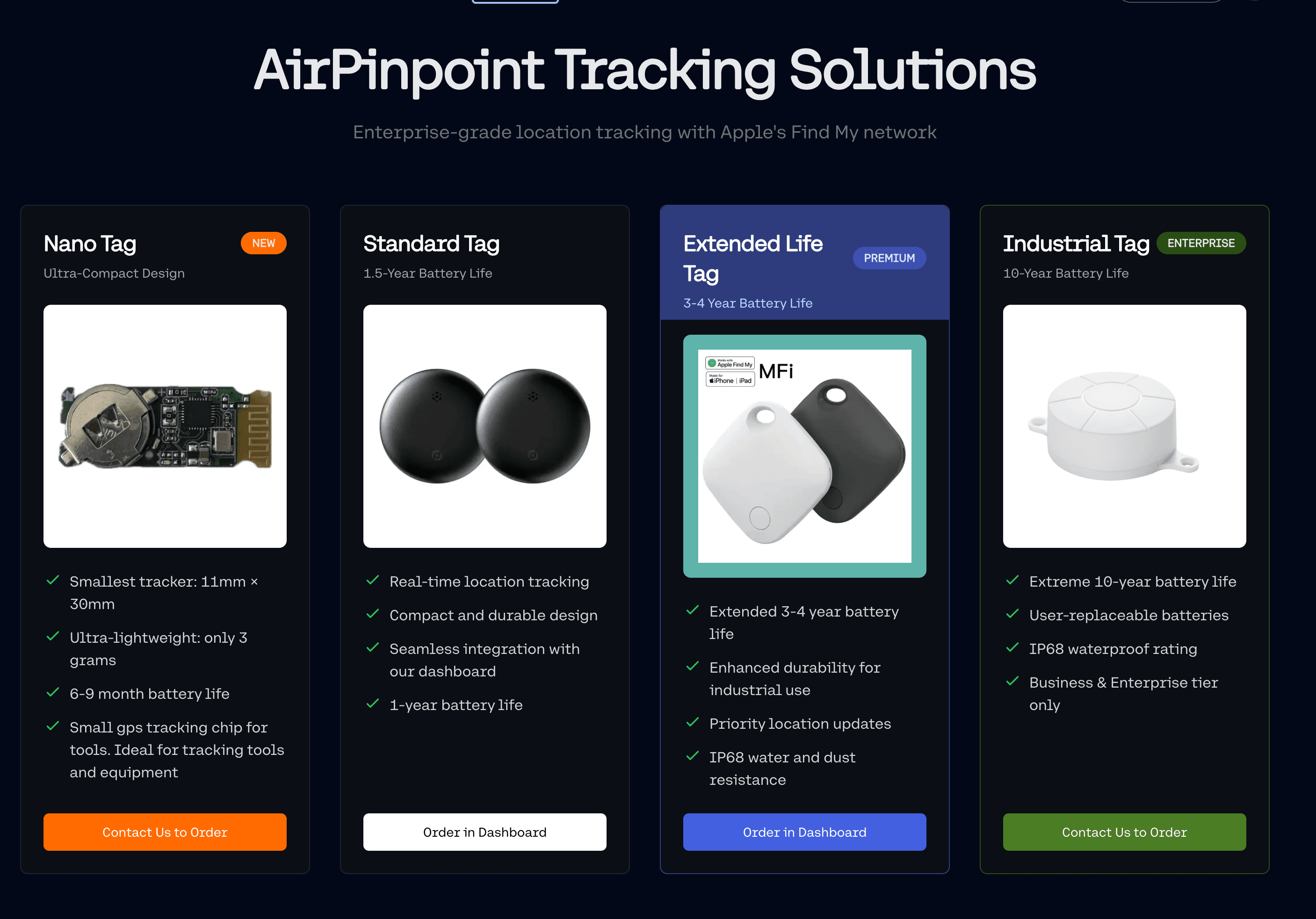
Airpinpoint is a business platform designed for organizations tracking fleets of assets across teams. It provides a centralized dashboard, multi-user access, movement alerts, location history, and reporting, all on top of the same Apple Find My network.
Same network. Same coverage. Completely different management layer.
Head-to-Head Comparison
| Feature | AirTag 2 | Airpinpoint |
|---|---|---|
| Price | $29 per unit | $11.99/device/mo |
| Device limit | 32 per Apple ID | Unlimited |
| Battery life | ~1 year (CR2032) | 7 years (custom beacon) |
| Dashboard | Find My app only | Web dashboard + API |
| Team access | Share with 5 people per item | Unlimited team members |
| Movement alerts | Left Behind alerts only | Geofence + after-hours + custom |
| Location history | None | Full history with reporting |
| API access | None | REST API + Zapier |
| Precision Finding | Yes (UWB) | No (not needed for asset tracking) |
| Form factor | Coin-sized, consumer design | Industrial beacons, multiple form factors |
| Tracking network | Apple Find My | Apple Find My |
The Scale Problem
Here's where the consumer vs. business gap becomes obvious. Consider a mid-size construction company with 200 trackable assets.
Scenario: 200 Assets with AirTags
- Hardware cost: 200 x $29 = $5,800
- Apple ID management: Need 7 Apple IDs (32 AirTags each), each with its own iCloud account
- Battery replacement: 200 batteries per year at ~$3 each = $600/year
- Management: Check 7 separate Find My accounts to locate assets. No unified view
- Team access: Each AirTag shared with max 5 people. 15 crew members? Multiple sharing configurations per item
- Alerts: Left Behind notifications only. No "equipment moved at 2 AM on Saturday" alerts
- Reporting: None. No utilization data, no movement history, no insurance documentation
Scenario: 200 Assets with Airpinpoint
- Hardware cost: 200 beacons at $12-25 each = $2,400-5,000
- Monthly cost: $11.99/device/month (Business) or $14.99/device/month (Enterprise), volume discounts available for 100+ tags
- Battery replacement: None for 7 years
- Management: One dashboard, one login, all 200 assets visible
- Team access: Add every crew member. Role-based permissions
- Alerts: Geofence, after-hours movement, boundary exit, custom schedules
- Reporting: Full location history, utilization metrics, exportable for insurance claims
Year 1 total cost: AirTags = $6,400 | Airpinpoint = $31,176-33,776 (hardware + $28,776 subscriptions) Year 2 total cost: AirTags = $600 (batteries only) | Airpinpoint = $28,776 (subscriptions) Year 7 total cost: AirTags = $9,400 (initial + 6 years batteries) | Airpinpoint = $203,832-206,432 (hardware + 7 years subscriptions, zero battery changes)
At 200 assets, Airpinpoint costs more in raw subscriptions than consumer AirTags, but the management capabilities make it worth it.
The cost story favors Airpinpoint, but the real difference is operational. Managing 200 assets across 7 Apple IDs with no dashboard, no alerts, and no reporting isn't tracking. It's chaos.
What AirTag 2 Does Better
To be fair, AirTag 2 has advantages in specific scenarios:
Precision Finding
AirTag 2's UWB chip enables directional guidance on iPhone and Apple Watch: "3 meters, that direction." This is genuinely useful for finding a lost item in a room or parking lot. Airpinpoint beacons don't support UWB.
For construction asset tracking, though, you rarely need sub-meter accuracy. Knowing which job site or which part of the yard holds your equipment is the problem, not which shelf it's on.
Speaker Volume
The 50% louder speaker makes AirTag 2 easier to find by sound. Useful for personal items buried in a bag. Less useful for a generator on a 20-acre job site.
Apple Ecosystem Integration
If you live in the Apple ecosystem and want seamless, zero-configuration tracking for a handful of items, AirTag 2 is plug-and-play. No account to create, no dashboard to learn. Just tap and go.
Consumer Form Factor
AirTag 2 is polished, compact, and fits standard accessories (keychains, loops, card holders). For personal use cases, the industrial form factor of business beacons is unnecessary.
What Airpinpoint Does Better
Unlimited Scale
No arbitrary device caps. Track 10 assets or 10,000 assets on a single account. Add beacons as your business grows without hitting walls.
Multi-User Team Management
Add every supervisor, crew lead, and office manager to the same account. Role-based access controls let you decide who sees what. No sharing limitations.
Actionable Alerts
Configure alerts based on your actual operations: equipment leaving a geofence, movement during non-work hours, assets not seen in 24 hours. These aren't generic Find My notifications. They're business rules.
Location History and Reporting
Every location update is stored and searchable. Generate reports for insurance claims, document equipment utilization, prove chain of custody, and identify patterns in asset movement.
API and Integrations
Connect tracking data to your existing systems through REST API or Zapier. Feed location data into your project management software, ERP, or custom workflows.
7-Year Battery Life
Airpinpoint's custom NRF52810 beacons are engineered for longevity. Attach them once and forget about battery management for years. On a fleet of 200 assets, this eliminates 200 battery changes per year.
Who Should Use What
Use AirTag 2 if:
- You're tracking fewer than 30 personal or business items
- You don't need a dashboard or reporting
- You're the only person who needs to see locations
- You want Precision Finding for locating items in close range
- You're okay replacing batteries annually
Use Airpinpoint if:
- You're tracking more than 30 assets across a business
- Multiple team members need access
- You need movement alerts and geofencing
- Location history and reporting matter for your operations
- You want to deploy once and not think about batteries for years
- You need API access or integration with other systems
Making the Switch
If you're currently using AirTags for business tracking and hitting limitations, transitioning to Airpinpoint is straightforward:
- Sign up at airpinpoint.com (takes 2 minutes)
- Order beacons: they ship within days
- Deploy: peel-and-stick installation, no tools required
- Add your team: invite crew members from the dashboard
- Set alerts: configure geofences and movement notifications for your sites
Your AirTags can continue working alongside Airpinpoint beacons during the transition. Both use the Find My network, so there's no coverage change, just better tools to manage what you're tracking.
The Bottom Line
AirTag 2 is an excellent consumer tracker. Apple improved nearly every aspect of the hardware, and for personal use, it's the best option available.
But construction companies don't have consumer problems. They have fleet-scale problems: hundreds of assets, multiple crews, after-hours theft risk, insurance documentation requirements, and zero tolerance for lost equipment delaying a project.
Airpinpoint solves the business problem. Same Find My network, fraction of the cost at scale, and the management platform that turns raw location data into operational value.
 Our Solution


