Welding Equipment Tracking: Why Contractors Lose Thousands in Machines Every Turnaround Season
If you run a welding or pipe-fitting contractor, you know the pattern. You mobilize 20-50 welding machines, pipe cutting saws, and specialty tools for a 45-day refinery turnaround. Your equipment spreads across laydown yards, work zones, and break areas inside a plant that covers two square miles. When the turnaround ends, you demobilize. And 2-3 machines don't come back.
Nobody stole them. They're sitting in a connex box at the wrong laydown yard, loaded onto another contractor's trailer by mistake, or left behind in a work zone that's now locked inside a process unit. You won't find them until the next turnaround, if you find them at all.
This problem repeats every cycle, and it costs welding contractors thousands of dollars per event. A single lost engine-driven welder represents $6,000-$15,000. A portable TIG unit runs $2,000-$5,000. Specialty equipment like electro-fusion welders can cost $3,000-$8,000. Multiply by the 3-8% annual loss rate that's common in the industry, and a 50-machine fleet bleeds $15,000-$60,000 per year in missing equipment.
What Makes Welding Equipment So Hard to Track
Welding contractors face a tracking challenge that's different from most industries. The problem isn't that equipment is small or easy to steal (though it is). The core issue is that every machine moves constantly between sites that the contractor doesn't own or control.
The Turnaround Cycle
Refineries and petrochemical plants schedule major turnarounds every 3-5 years. A typical turnaround mobilizes 500-3,000 contract workers for 30-60 days of intensive maintenance, inspection, and repair work. Welding contractors bring their own equipment into the plant, use it for the duration, and take it out when the work is complete.
During turnaround season (typically spring and fall along the Gulf Coast), a single contractor might have equipment deployed at 3-5 active job sites simultaneously: one turnaround wrapping up in Memphis, another just starting in Plaquemines Parish, a third at a Westlake facility, and spot work at two other plants.
Equipment moves between these sites based on schedule changes, crew reassignments, and project demands. A Maxstar 210 that started a turnaround in Memphis might get pulled mid-project and shipped to Dow St. Charles because the schedule slipped and they need more TIG capacity. The foreman at Memphis knows it left. The foreman at St. Charles knows it arrived. But the office? They find out a week later when someone updates a spreadsheet.
Multi-Contractor Chaos
Turnaround sites have 5-20 welding and pipefitting contractors working simultaneously. Everyone's equipment looks similar. Miller blue, Lincoln red, ESAB yellow, all sitting in the same laydown yard. Mix-ups happen constantly. Your Maxstar ends up on another contractor's skid. Their wire feeder ends up in your connex box. These cross-contamination losses often don't surface until weeks or months later during a physical inventory.
Paper-Based Systems Don't Scale
Most welding contractors track equipment with some combination of spreadsheets, checkout forms, and tribal knowledge. A foreman signs out a machine. The serial number goes on a clipboard. When the machine moves to another site, the new foreman is supposed to update the sheet. This breaks down in practice because:
- Foremen are running crews, not updating spreadsheets
- Equipment moves mid-shift when the office is closed
- Checkout forms get soaked, lost, or filled out with illegible handwriting
- Nobody tracks the distinction between "checked out to Site A" and "currently at Site A"
By turnaround's end, the spreadsheet says 15 machines are at the Memphis site. A physical count finds 12. The three missing machines are... somewhere.
What Welding Equipment Costs to Replace
Understanding the real financial exposure helps justify tracking costs. These are new equipment prices from major manufacturers:
| Equipment Type | Common Models | Price Range |
|---|---|---|
| Portable TIG Welder | Miller Maxstar 210, Dynasty 210 | $2,500-$5,000 |
| Portable MIG/Multi-Process | Miller Multimatic 220, Lincoln Power MIG 260 | $2,500-$4,500 |
| Engine-Driven Welder/Generator | Lincoln Ranger 305G, Miller Big Blue 400 | $6,500-$15,000 |
| Electro-Fusion Welder | Various (HDPE pipe joining) | $3,000-$8,000 |
| Pipe Cutting/Beveling Saw | Various portable models | $1,500-$4,000 |
| Wire Feeder Unit | Miller SuitCase, Lincoln LN-25 | $1,000-$3,000 |
| Welding Positioner | Various bench and floor models | $2,000-$8,000 |
These are per-unit costs. A fully equipped turnaround crew running 3 welders, a pipe saw, and a feeder carries $15,000-$40,000 in mobile welding equipment alone, not counting hand tools, leads, gas bottles, and consumable supplies.
For specialty contractors in pipe joining and fabrication, the equipment gets more expensive. Electro-fusion welders for HDPE pipe systems cost $3,000-$8,000 each. Orbital welding systems for pharmaceutical or semiconductor piping can run $15,000-$50,000. Losing even one of these machines wipes out months of profit on a contract.
The Real Cost of Missing Equipment
The per-unit replacement price understates the total damage:
Replacement cost. You buy a new machine. That's the obvious one.
Rental cost while waiting. If you can't find a machine and need one for the current job, you rent. Engine-driven welder rentals run $250-$500/day. A two-week rental while you source a replacement costs $2,500-$5,000, on top of the replacement cost.
Downtime cost. A crew of 4 welders standing idle at $85-$120/hour each because their machine is missing costs $340-$480/hour. If it takes half a day to locate a replacement, that's $1,360-$1,920 in labor downtime.
Contract penalties. Turnaround contracts often include milestone penalties. Missing equipment that delays work on a critical-path weld can cascade into schedule overruns costing $10,000-$50,000/day for the plant owner, and your company eats the liquidated damages.
Insurance deductibles. Most contractors carry inland marine insurance for equipment, but deductibles of $1,000-$5,000 per claim make filing on a single missing welder uneconomical.
Add it up: a "lost" $3,000 TIG welder actually costs $5,000-$10,000 when you include rental, downtime, and administrative time to file insurance, process POs for replacements, and update your asset register.
Why Welding Equipment Gets Stolen
Beyond the honest losses from multi-site confusion, welding equipment is a prime theft target. The combination of high resale value, easy portability, and outdoor job site storage creates perfect conditions for theft.
High resale value. Welding machines hold value well. A 3-year-old Maxstar 210 resells for 50-70% of new price on Craigslist, Facebook Marketplace, or at pawn shops. Engine-driven welders hold even more value because they double as generators.
Easy to move. A portable TIG welder weighs 20-50 lbs. One person can carry it to a truck in 30 seconds. Engine-driven welders mount on trailers and can be towed away. On a busy construction site with dozens of trucks coming and going, nobody questions someone loading equipment.
Outdoor exposure. Construction sites and plant laydown yards are open-air storage. Equipment sits on trailers, in open connex boxes, or on the ground. Fencing and security guards help, but they can't watch every piece of equipment 24/7, especially during shift changes at 5 AM and 5 PM.
Low recovery rates. Only 7-25% of stolen construction equipment is recovered. Welding machines rarely have built-in GPS (unlike excavators and backhoes), serial numbers get ground off, and machines are generic enough to blend into any welding shop inventory.
Miller's own welding forum has threads dating back years with welders discussing theft prevention. The consensus: lock everything, etch serial numbers on every surface, and assume anything visible will eventually disappear.
How Airpinpoint Solves Multi-Site Welding Equipment Tracking
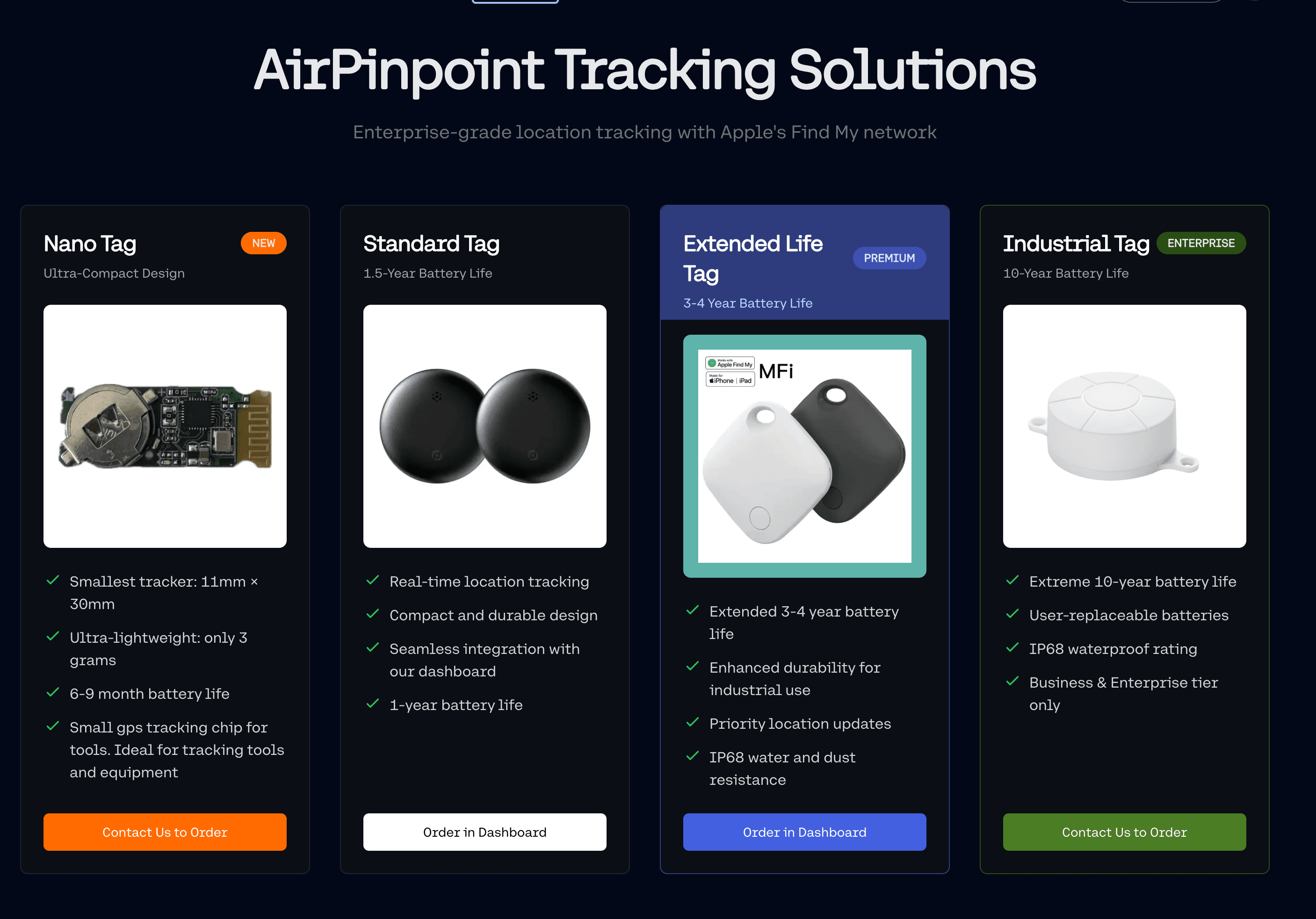
Airpinpoint uses Apple AirTags and the Find My network (over a billion Apple devices worldwide) to provide continuous location tracking for every tagged machine. No cellular hardware to install, no monthly GPS tracker fees of $25-$45/device, no batteries to charge every two weeks.
Real-Time Dashboard Across All Sites
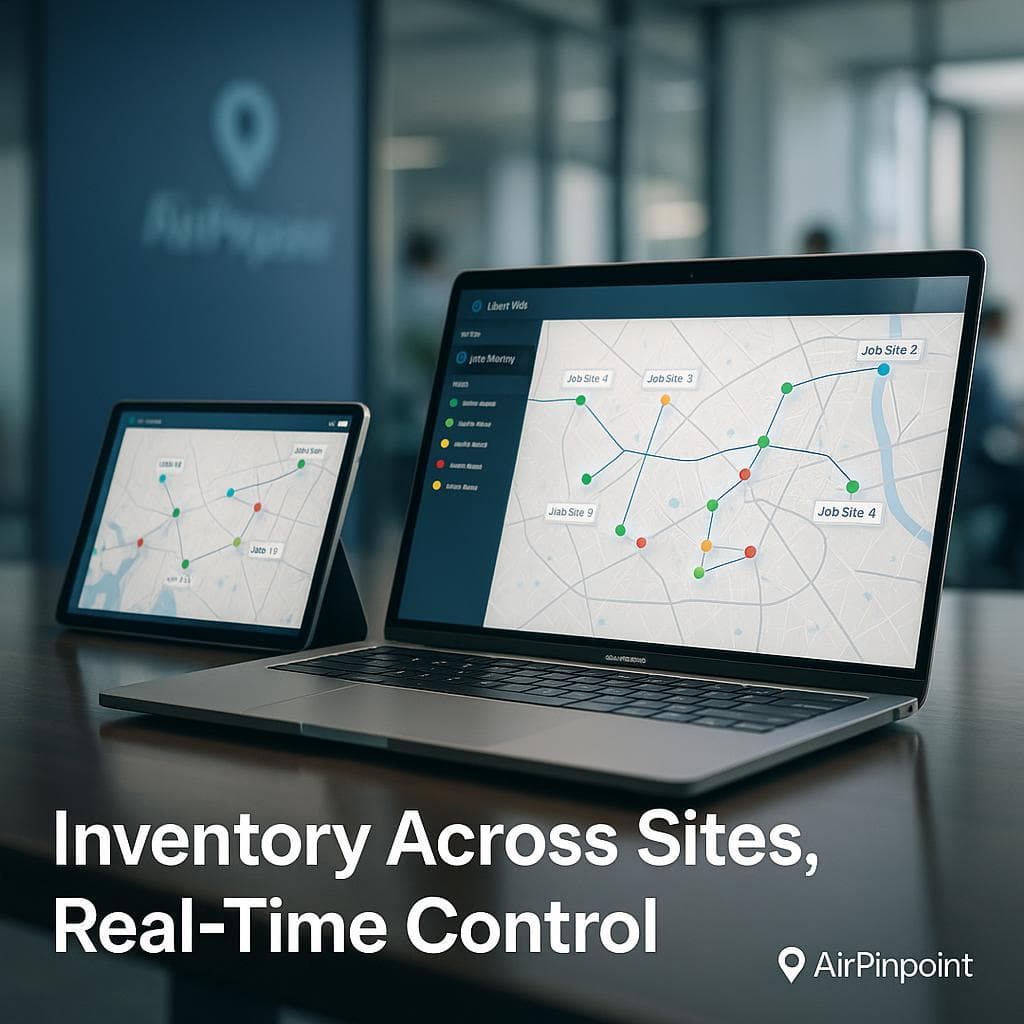
Open the Airpinpoint dashboard and see every tagged machine plotted on a map. Your 4-pack welders at Valero Memphis. Your electro-fusion welder at Dow Plaquemines. Your Maxstar 210 at the Westlake facility. Your feeder boxes staged at the warehouse. All in one view.
Filter by equipment type, job site, or status. When a project manager asks "how many TIG units do we have available?", you have the answer in seconds instead of spending an hour calling foremen.
Geofence Alerts for Every Job Site
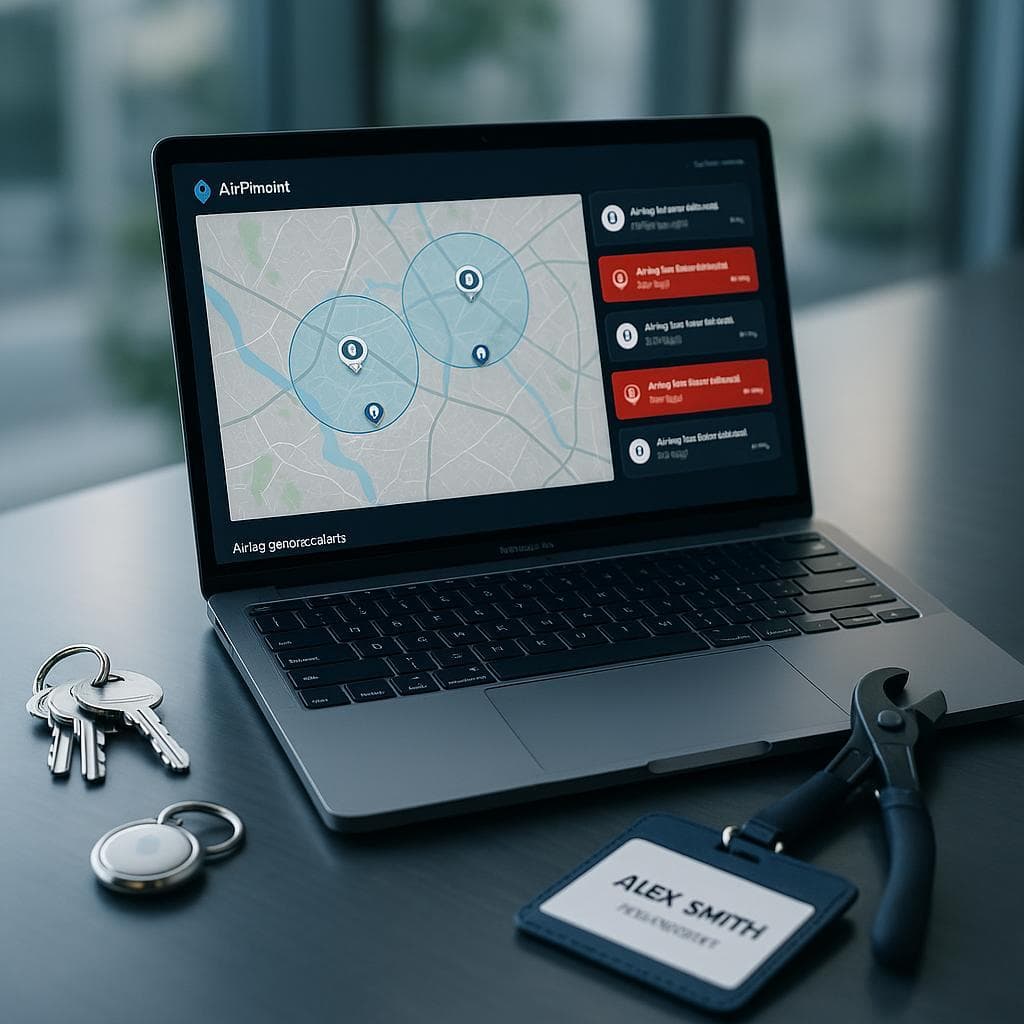
Draw polygon geofences around each active site: the refinery gate perimeter, your laydown yard, your warehouse. When a machine leaves a geofenced area, you get an alert. This catches:
- Equipment loaded onto the wrong contractor's trailer during demobilization
- Unauthorized removal from a site (theft or "borrowing")
- Machines that should have shipped to the next job but are still at the last one
- Equipment moved off-site for unauthorized personal use
Movement History and Audit Trail
Every location update is logged. When a customer or plant owner asks "was your equipment on-site on March 15?", you have GPS-timestamped records. This protects you in contract disputes about equipment availability, helps with insurance claims if equipment is stolen, and gives you data to optimize equipment deployment.
Team Access Across Crews and Sites
Your office manager, project managers, and foremen all access the same dashboard. The PM at the Memphis turnaround sees the equipment at their site. The office sees everything company-wide. No more "I'll call the foreman and get back to you" delays.
Cost Comparison: Airpinpoint vs. GPS Trackers for Welding Equipment
GPS trackers designed for construction equipment cost $25-$45/month per device with cellular data fees. They require charging every 1-4 weeks (depending on update frequency) and installation of hardware on each machine.
| Airpinpoint | Cellular GPS Tracker | |
|---|---|---|
| Hardware cost | $29 (AirTag) | $80-$200 per device |
| Monthly cost | $11.99/device | $25-$45/device |
| Battery life | ~12 months (CR2032) | 1-4 weeks (rechargeable) |
| Charging required | No (battery swap) | Yes, every 1-4 weeks |
| Installation | Drop in case/mount on frame | Wire-in or magnetic mount |
| 20 machines, Year 1 | $3,456 | $7,600-$12,800 |
| 20 machines, Year 3 | $9,208 | $19,600-$34,400 |
| 50 machines, Year 1 | $8,641 | $19,000-$32,000 |
| 50 machines, Year 3 | $23,021 | $49,000-$86,000 |
For a 50-machine fleet over 3 years, Airpinpoint saves $25,979-$62,979 compared to cellular GPS trackers. That's the cost of 5-10 replacement welding machines.
The charging burden alone is significant. A GPS tracker on 50 machines that needs charging every 2 weeks means someone is collecting, charging, and redeploying 25 trackers every week. That's 1,300 charge cycles per year, each taking 15-30 minutes of labor. Airpinpoint requires 50 battery swaps per year, each taking 30 seconds.
Where GPS Beats Airpinpoint (Honest Assessment)
Cellular GPS provides real-time continuous tracking with updates every 30-120 seconds. Airpinpoint updates when a nearby iPhone relays the location, which ranges from every 1-5 minutes in populated areas to hours in truly remote locations.
If your primary concern is tracking a machine being driven away on a trailer in real time, a cellular GPS tracker gives you a live breadcrumb trail. Airpinpoint gives you location snapshots that are accurate enough to know which job site has which machine, but won't show you the exact route a thief took.
For most welding contractors, the question isn't "what road is my welder on right now?" It's "which of my 5 job sites has my Maxstar 210?" Airpinpoint answers that question at a fraction of the cost.
Deployment for Welding Contractors
Where to Mount AirTags on Welding Equipment
Portable TIG/MIG welders (Maxstar, Dynasty, Multimatic): Inside the carrying case if the machine ships in one, or in the wire feeder compartment. Alternatively, mount inside the handle recess using a silicone holder.
Engine-driven welders (Ranger, Big Blue): Inside the generator panel access door, behind the fuel tank skirt, or inside the battery compartment area. These machines have plenty of protected cavities.
Electro-fusion welders: Inside the carrying case's accessory pocket or cable storage compartment.
Pipe cutting saws with stands: Zip-tie a silicone AirTag holder to the stand frame, inside the frame tube if hollow, or inside the transport case.
Wire feeders (SuitCase, LN-25): Inside the wire spool compartment or taped to the interior back panel.
For all placements: keep the AirTag away from direct arc exposure, heavy vibration sources, and areas that reach sustained temperatures above 60C (140F). The machine body near the arc gets hot during welding, but internal compartments and cases stay well within range.
Phased Rollout
Phase 1 (Week 1): Tag high-value equipment. Start with engine-driven welders, specialty machines (electro-fusion, orbital), and any machine worth over $3,000. This covers your highest financial exposure with the smallest deployment.
Phase 2 (Week 2-3): Tag mobile equipment. Add portable TIG/MIG units, pipe saws, and wire feeders that regularly move between sites. Set geofences on your warehouse, active job sites, and any long-term storage locations.
Phase 3 (Ongoing): Calibration and specialty tools. If you track calibrated inspection equipment (torque wrenches, welding gauges, temperature sticks for preheat verification), add those. These items have both replacement cost and compliance value.
Industry-Specific Considerations
Turnaround Contractor Optimization
For contractors who follow the turnaround circuit, Airpinpoint provides value beyond theft prevention:
Mobilization planning. Before sending equipment to a new turnaround, check the dashboard to see what's already deployed, what's in the warehouse, and what's still at a previous site waiting for pickup. This prevents over-mobilization (renting machines you already own but can't find) and under-mobilization (arriving short because 3 machines are still sitting at the last job).
Demobilization verification. When a turnaround ends, verify that every tagged machine leaves the plant. Set a deadline geofence alert: "if this machine is still inside the Valero Memphis geofence 48 hours after our contract end date, alert me." This catches the machines that get forgotten in connex boxes and break areas.
Equipment utilization data. Over time, location history shows which machines sit idle at one site while another site rents replacements. This data helps you right-size your fleet and reduce unnecessary capital expenditure.
Fabrication Shop Operations
For shops that send equipment out with field crews, Airpinpoint bridges the gap between shop inventory and field deployment. Machines checked out to a crew show their field location. When the job ends, you can verify they returned to the shop, not to someone's garage.
Rental Equipment Tracking
If you rent welding machines to other contractors, Airpinpoint provides proof of where your rental equipment sits. This supports late-fee enforcement (the customer says they returned it, but the tracker shows it's still at their yard), damage claims (you can prove the machine was at the customer's site when the damage occurred), and recovery if a rental customer goes dark.
How a Pipe Joining Contractor Would Track 60+ Assets
Consider a pipe joining contractor running roughly 60 tracked assets across a refinery corridor: 4-pack welders, electro-fusion units, TIG machines, chop saws with stands, and feeder boxes, all cycling between plant turnarounds.
The setup is a polygon geofence around each plant they work in. When a machine moves from one site to another, the dashboard records the transition once seven consecutive Find My reports agree it crossed, which on an active plant site means the same shift.
The daily routine is the part that pays: an equipment coordinator opens the dashboard each morning and confirms that field equipment matches the project plan. A machine that should be at one plant and shows up at another gets caught that day rather than at the next physical inventory.
The result: near-zero unexplained equipment losses since deployment, reduced rental spending (they stopped renting machines that turned out to be sitting in their own warehouse), and faster mobilization because they always know what's available and where.
Getting Started
A welding contractor with 30-50 machines can deploy Airpinpoint in a single maintenance day:
- Order AirTags in bulk ($29 each, available in 4-packs for $99)
- Mount AirTags on each machine during a routine check-out or inventory day
- Register machines in Airpinpoint with type, model, serial number, and assigned crew
- Set geofences on your warehouse, laydown yards, and active job sites
- Brief your foremen on the dashboard so they can check equipment locations themselves
40-machine fleet cost breakdown:
- AirTags: $1,160 (40 x $29)
- Airpinpoint Year 1: $5,756 (40 x $11.99/mo x 12)
- Total Year 1: $6,916
- CR2032 battery replacements per year: ~$40
Compare that to losing 2-3 machines per turnaround cycle. One prevented loss of a $3,000 TIG welder pays for 17 months of tracking the entire fleet.
 Our Solution