Inspection Equipment Tracking: NDT Instrument Management for Industrial Service Companies
An NDT technician finishes a turnaround at a refinery and drives to the next job. The Olympus 45MG thickness gauge that was in his truck yesterday is gone. Nobody knows if it's still at the refinery, in another tech's vehicle, or back at the office. The instrument coordinator spends half a day making phone calls.
This happens constantly in inspection companies. And when the missing instrument is a $45,000 XRF analyzer or a $25,000 flaw detector, the stakes are more than inconvenience.
The Inspection Equipment Problem
Instruments Are Expensive, Portable, and Always Moving
NDT and inspection companies operate fundamentally differently from fixed facilities. Instruments travel to the work (refineries, power plants, pipelines, construction sites, manufacturing floors), and the same instrument may visit three different job sites in a week.
| Instrument | Typical Cost | Common Models | Deployment Pattern |
|---|---|---|---|
| XRF analyzers | $30,000-60,000 | Bruker S1 TITAN, Olympus Vanta | Field analysis: alloy verification, lead paint, soil contamination |
| UT flaw detectors | $15,000-25,000 | Olympus EPOCH 650, Zetec TOPAZ | Weld inspection at refineries, pipelines, structural steel |
| UT thickness gauges | $3,000-5,000 | Olympus 45MG, Dakota MVX | Corrosion surveys, wall thickness measurement |
| Borescopes / videoscopes | $5,000-30,000 | Olympus IPLEX, Zetec | Internal inspection of turbines, boilers, heat exchangers |
| Portable hardness testers | $2,000-8,000 | Proceq Equotip, GE MIC 10 | Field hardness verification for heat-treated components |
| Eddy current instruments | $10,000-20,000 | Olympus Nortec, Zetec MIZ | Surface crack detection in aerospace, tubing inspection |
| Phased array UT (PAUT) | $25,000-60,000 | Olympus OmniScan X3, Zetec TOPAZ64 | Advanced weld inspection, corrosion mapping |
A mid-size NDT service company carries $1-5 million in portable instruments. A large firm with 200+ technicians may have $10-20 million deployed across dozens of simultaneous job sites.
The "Where Is It?" Problem
Every inspection company has the same workflow breakdown:
- Instrument coordinator assigns instruments to jobs
- Technician picks up equipment from the office or receives it via courier
- Instrument moves between job sites, vehicles, hotel rooms, and the shop
- Coordinator loses visibility the moment the instrument leaves the building
The result: instrument coordinators spend 30-50% of their time on logistics calls, tracking down who has what, where it is, and when it's coming back. During turnaround season (spring and fall in refining), this becomes a full-time crisis management role.
Common scenarios:
- Tech finishes a job, instrument stays in his truck for a week before returning
- Instrument loaned between techs at a job site without updating the spreadsheet
- Equipment left in a contractor trailer at a refinery, discovered months later
- Two coordinators assign the same instrument to different jobs
The Scale Problem
| Company Size | Technicians | Instruments | Simultaneous Job Sites | Coordination Complexity |
|---|---|---|---|---|
| Small | 5-15 | 20-50 | 3-8 | Manageable with spreadsheets |
| Mid-size | 15-50 | 50-200 | 10-30 | Spreadsheets break down |
| Large | 50-200+ | 200-1,000+ | 30-100+ | Requires dedicated systems |
| Enterprise | 500+ | 1,000-5,000+ | 100+ | Multiple regional hubs |
At 50+ instruments, spreadsheet-based tracking becomes unreliable. At 100+, it's functionally broken.
The Calibration Compliance Crisis
Lost instruments are expensive. Out-of-calibration instruments are dangerous.
How Calibration Works in Inspection
Every measurement instrument has a calibration interval, typically 6 or 12 months, after which its measurements are no longer considered traceable to national standards. The calibration cycle:
- Instrument calibrated by an ISO 17025 accredited lab
- Calibration certificate issued with due date
- Instrument deployed to field work
- Calibration expires → instrument must be pulled from service and recalibrated
If an instrument is used past its calibration due date, every measurement taken after expiration is technically invalid.
What Goes Wrong
Scenario 1: Pipeline Inspection A UT thickness gauge's calibration expired two weeks ago. The tech didn't notice (the sticker was worn). He completed a corrosion survey on 200 pipe segments. When the calibration lapse is discovered during data review:
- 200 measurements are invalid under API 570
- Re-inspection cost: $40,000-100,000 (200 segments x $200-500 per weld/measurement)
- Schedule delay: 1-2 weeks to re-mobilize and re-inspect
- Client relationship: Damaged. The refinery may question all prior work.
Scenario 2: Aerospace Component Inspection An eddy current instrument used for turbine blade inspection at an MRO facility goes overdue on calibration. NADCAP auditors discover the gap:
- Audit finding issued against the inspection company
- All inspections performed during the gap period must be reviewed
- Potential aircraft grounding if affected inspections can't be validated
- Accreditation risk: repeat findings can result in NADCAP suspension
Scenario 3: XRF Alloy Verification An XRF analyzer used for positive material identification (PMI) at a petrochemical plant goes out of calibration. Alloy verification results for piping components are called into question:
- Material traceability for installed components is compromised
- ASME code compliance may be affected
- Potential shutdown of affected systems until materials are re-verified
The Tracking-Calibration Connection
The root cause in most calibration failures isn't negligence. It's that the company can't physically locate the instrument to pull it from service before calibration expires.
A calibration manager may know that serial number XRF-2847 is due for recalibration in two weeks. But if they don't know that it's currently at a refinery turnaround in Beaumont, Texas, with a tech who's working 12-hour shifts, that instrument stays in service past its due date.
This is the problem tracking solves. Not scheduling: location.
Standards and Regulatory Requirements
ISO 17025 (Calibration Lab Accreditation)
ISO 17025 Section 6.4 requires:
- All measuring equipment that can affect results must be calibrated
- Records must include calibration status, dates, and traceability
- Equipment must be labeled or identified to show calibration status
- Out-of-tolerance equipment must be isolated and labeled
Implication for tracking: You must be able to demonstrate that instruments were within calibration at the time of each measurement. If you can't prove where an instrument was (and therefore which measurements it produced), you have a documentation gap.
ASNT SNT-TC-1A (NDT Personnel Qualification)
The American Society for Nondestructive Testing's recommended practice requires:
- Documentation of equipment used for examinations
- Equipment must be maintained and calibrated per manufacturer requirements
- Records must be traceable to specific equipment serial numbers
API 510 / 570 / 653 (Pressure Equipment Inspection)
American Petroleum Institute codes for pressure vessel, piping, and tank inspection require:
- Calibrated instruments for all thickness measurements
- Instrument calibration records available for review
- Traceability from measurements to specific instruments
NADCAP (Aerospace Special Processes)
National Aerospace and Defense Contractors Accreditation Program:
- Rigorous equipment calibration verification during audits
- Gap analysis for calibration lapses
- Potential findings for any period where instrument status is uncertain
How Airpinpoint Solves Instrument Tracking
Passive Location Without Technician Effort
The critical requirement for inspection companies is zero additional work for field technicians. NDT techs are billable at $75-150/hour. Any system that requires them to check in, scan, or update adds cost and gets ignored.
Airpinpoint works passively:
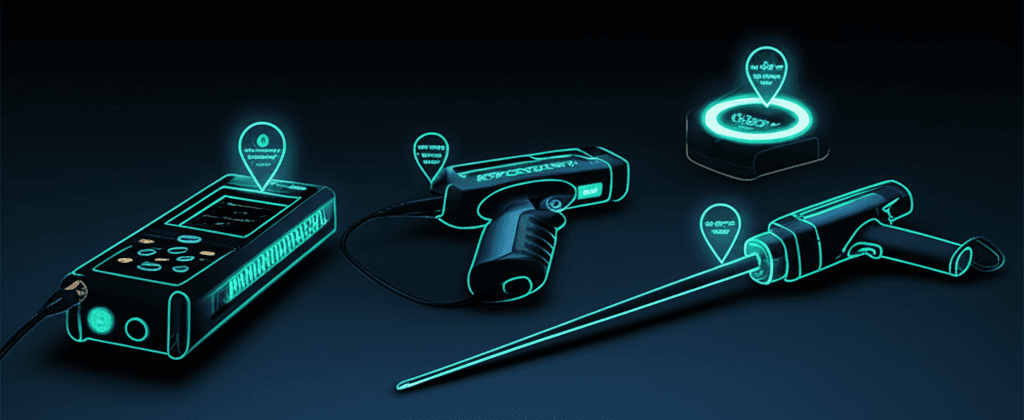
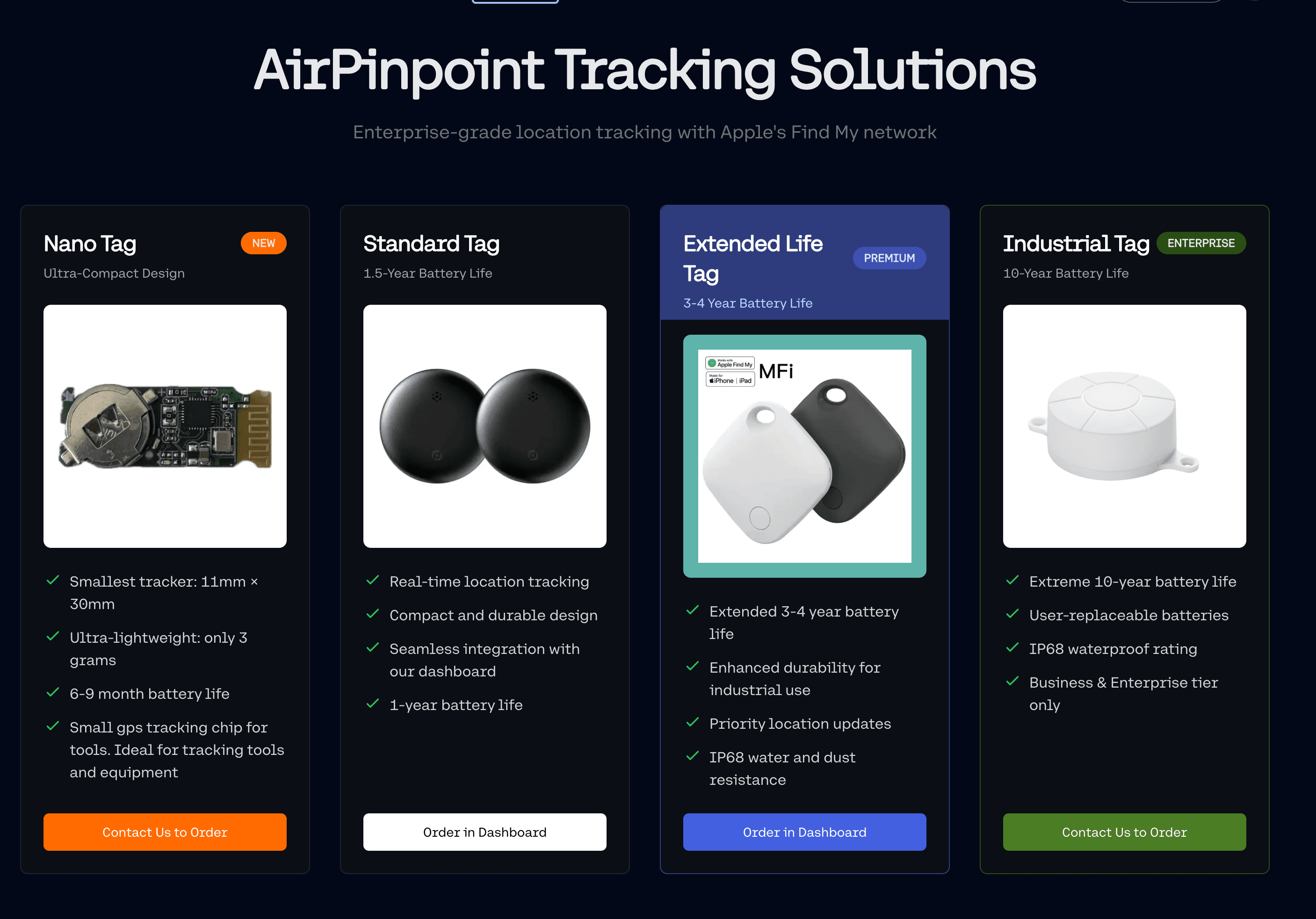
- Attach an AirTag to each instrument case or carrying bag
- Instruments appear on the dashboard automatically as they move
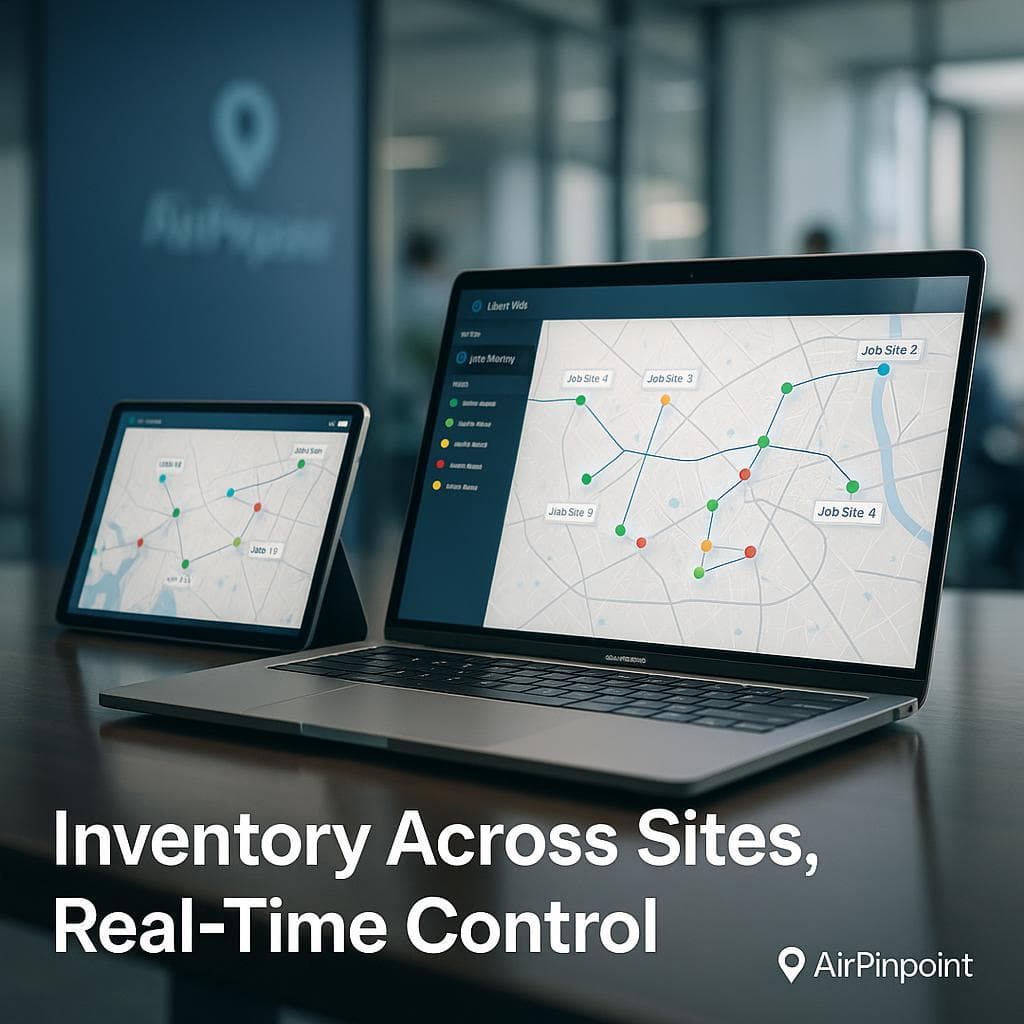
- Coordinator sees every instrument's location on a single map: which job site, which city, which building
- No technician action required: the over a billion Apple devices in the Find My network handle location updates
Multi-Site Visibility
For an inspection company with 30 active job sites:
- Map view shows every instrument across all sites
- Filter by instrument type: see all XRF analyzers, all UT gauges
- Filter by job site: see everything deployed to a specific refinery
- Location history: trace where an instrument has been over the past weeks
Calibration Recall Support
When the calibration manager identifies instruments due for recall:
- Open Airpinpoint dashboard
- See the instrument's current location (e.g., "Chevron Richmond Refinery")
- Know which technician to contact for retrieval
- Coordinate pickup or swap before calibration expires
Without tracking, this process involves calling multiple techs, checking spreadsheets, and hoping someone remembers who had it last.
Geofence Alerts for Job Site Management
Set up geofences around:
- Your office/warehouse: alert when instruments leave or return
- Active job sites: know when equipment arrives on site
- Storage facilities: detect unauthorized removal
Learn more about setting up geofence alerts for your inspection operation.
Team Access for Distributed Operations
Inspection companies typically need multiple people tracking equipment:
- Instrument coordinator: primary logistics role
- Calibration manager: tracks calibration status and recall
- Regional managers: visibility into their territory
- Project managers: know what's available for upcoming jobs
Airpinpoint supports multiple users on the same dashboard, eliminating the single-point-of-failure problem with one person's spreadsheet.
Industry Use Cases
Oil & Gas Inspection Companies
Environment: Refineries, pipelines, offshore platforms, tank farms
Key instruments:
- UT thickness gauges for corrosion surveys (API 570/653)
- XRF analyzers for positive material identification (PMI)
- Phased array UT for weld inspection
- Magnetic particle and liquid penetrant kits
Tracking challenges:
- Instruments enter controlled refinery areas where phone calls and visits require escort
- Turnaround season creates chaotic instrument movement across multiple units
- Instruments shipped between regional offices for project coverage
- Contractors and sub-contractors may handle instruments
ROI driver: Preventing a single calibration lapse during a turnaround avoids $50,000-100,000 in re-inspection costs.
Aerospace MRO and Manufacturing
Environment: Engine overhaul shops, airframe MRO, component repair stations
Key instruments:
- Eddy current instruments for crack detection
- UT instruments for composite inspection
- Borescopes for turbine inspection
- Coordinate measuring machines (portable arms)
Tracking challenges:
- NADCAP auditors verify instrument calibration status during unannounced audits
- Instruments shared between multiple work cells and shifts
- Strict FOD (foreign object damage) controls require knowing what's in the hangar
ROI driver: A NADCAP finding for calibration gaps can delay customer deliverables and risk accreditation.
Power Plant NDE
Environment: Nuclear, fossil fuel, and renewable generation facilities
Key instruments:
- UT instruments for boiler tube inspection
- Eddy current for heat exchanger tubing
- Radiographic equipment (managed separately due to radiation safety)
- Visual inspection tools (borescopes, cameras)
Tracking challenges:
- Nuclear facilities have strict material accountability requirements
- Outage windows are tight: instruments must be available on schedule
- Multiple contractor teams may share instruments during an outage
ROI driver: A missed inspection window during a planned outage can cost $500,000+/day in delayed return to service.
Structural Steel and Construction Inspection
Environment: Fabrication shops, construction sites, bridges, buildings
Key instruments:
- UT flaw detectors for weld inspection (AWS D1.1)
- Magnetic particle inspection equipment
- Coating thickness gauges
- Concrete testing equipment
Tracking challenges:
- Construction sites are temporary: instruments move as projects progress
- Multiple inspectors may work the same project on different shifts
- Equipment left at completed project sites
ROI driver: Locate and redeploy instruments to new projects faster, reducing rental needs.
Environmental Testing
Environment: Contaminated sites, construction demolition, industrial facilities
Key instruments:
- XRF analyzers for lead paint and soil contamination
- Air monitoring equipment
- Water quality instruments
- Soil sampling equipment
Tracking challenges:
- Field techs cover large geographic areas
- Instruments may be at a site for days or weeks during remediation projects
- Chain of custody documentation required for regulatory submissions
ROI driver: XRF analyzers ($30K-60K) are the most commonly stolen instrument category in environmental consulting.
Cost Analysis: Inspection Equipment Tracking
What It Costs to NOT Track
| Loss Category | Annual Cost (50-instrument company) |
|---|---|
| Instrument loss/theft (1-2 instruments/year) | $15,000-60,000 |
| Coordinator time on logistics calls (20 hrs/week) | $40,000-60,000 |
| Calibration compliance violations (1 incident/year) | $10,000-100,000 |
| Rental costs for "missing" owned instruments | $5,000-20,000 |
| Technician downtime waiting for instruments | $10,000-30,000 |
| Total annual cost of not tracking | $80,000-270,000 |
Airpinpoint Investment
| Item | Cost |
|---|---|
| AirTags (50 instruments x $29) | $1,450 |
| Airpinpoint subscription (50 instruments) | $7,200-9,000/year |
| Ruggedized cases (optional, for harsh environments) | $500-1,500 |
| Total Year 1 | $9,150-11,950 |
ROI
- Prevent one XRF loss: Saves $30,000-60,000 (pays for 3-6 years of tracking)
- Prevent one calibration incident: Saves $10,000-100,000
- Reduce coordinator logistics time by 50%: Saves $20,000-30,000/year
- Payback period: Under 2 months based on coordinator time savings alone
Complementary Systems
Airpinpoint handles the location problem: where is this instrument right now? Other systems handle different aspects of instrument management:
Calibration Management Software
| System | Focus | Price Range |
|---|---|---|
| Fluke CalTrak | Calibration scheduling, certificates | $2,000-10,000/year |
| Beamex CMX | Calibration workflow, documentation | $5,000-25,000/year |
| IndySoft | Calibration + asset management | $3,000-15,000/year |
| ProCalV5 | Validation and calibration | Custom pricing |
Relationship to Airpinpoint: Calibration software tells you when an instrument needs service. Airpinpoint tells you where it is so you can actually retrieve it. The two systems solve different problems and work together.
Enterprise Asset Management (EAM)
Larger inspection companies may use SAP PM, IBM Maximo, or similar EAM platforms for:
- Asset lifecycle management
- Maintenance scheduling
- Depreciation tracking
- Procurement integration
Airpinpoint fills the location gap that EAM systems don't address, knowing the real-time physical location of mobile assets in the field.
Implementation Guide for Inspection Companies
Phase 1: High-Value Instruments (Week 1-2)
Start with the instruments you worry about most:
- Tag all XRF analyzers: highest individual value, most commonly lost
- Tag phased array and advanced UT equipment: $25K-60K instruments
- Tag borescopes and videoscopes: fragile, expensive, easy to leave behind
- Set up the Airpinpoint dashboard with instrument names matching your asset IDs
Phase 2: Full Fleet (Week 3-4)
Expand to all portable instruments:
- Tag all UT thickness gauges and flaw detectors
- Tag hardness testers, eddy current instruments
- Tag calibration reference standards (step blocks, test specimens)
- Create geofences around your office, warehouse, and key client sites
Phase 3: Operational Integration (Month 2+)
Build tracking into your daily workflow:
- Calibration manager reviews dashboard weekly for instruments approaching due dates
- Instrument coordinator uses map view for job site assignments instead of calling techs
- Project managers check instrument availability before committing to proposals
- Location history exports support calibration audit documentation
Frequently Overlooked: Tracking Calibration Standards
Inspection companies don't just track instruments. They also need to track calibration reference standards:
- Step blocks and reference specimens for UT calibration verification
- Certified test blocks for hardness testers
- Reference samples for XRF analyzers
- IQI/penetrameters for radiographic inspection
These items are less expensive individually ($100-2,000) but losing them stops work. A tech without their calibration verification block can't perform inspections that day.
Track all your portable assets across sites with a single dashboard.
The Bottom Line
Inspection equipment tracking solves three problems that cost NDT companies real money:
- Location visibility: Know where every instrument is, across every job site, without phone calls
- Calibration compliance: Locate and recall instruments before calibration expires, avoiding $10K-100K re-inspection costs
- Loss prevention: A single recovered XRF analyzer pays for years of tracking
The inspection industry runs on precision and traceability. Your instruments should be tracked with the same rigor you apply to the measurements they produce.
Start with your highest-value instruments: XRF analyzers, phased array systems, advanced flaw detectors. At $29 per AirTag and subscriptions starting at $11.99/month, you can track a 50-instrument fleet for less than the cost of one lost thickness gauge.
Calculate your tracking ROI with our asset tracking ROI guide, or get started with Airpinpoint to see every instrument on one map.
 Our Solution