
Updated
The Bait Equipment Playbook: How Construction Companies Set GPS Traps to Catch Thieves
A contractor based in Sterling, Virginia got tired of losing tools. Not misplacing them. Losing them to whoever kept breaking into his work van, twice in short order, thousands of dollars each time. So he bought a handful of Apple AirTags, hid them inside the larger tools he still owned, and went back to work on the assumption there would be a third time.
There was. On January 22, 2024, after another theft, he drove around the Maryland suburbs of Washington DC for hours following an intermittent blip on his iPhone, until the signal settled on a storage facility in Howard County. He called Howard County Police, who obtained a search warrant. The locker held far more than one contractor's tools (WTOP).
That one warrant led to eleven more. Over four months, detectives searched twelve locations and recovered roughly 15,000 tools, later reported at more than 18,600, valued between $3 million and $5 million. Generators, compressors, laser levels, cordless kits. More than 80 victims were identified across Maryland, Virginia and Pennsylvania, most of whom had written the equipment off (Howard County Police Department).
Total cost of the tags that started it: about $120.
One thing to hold onto before reading the playbook below. The tags cost $120. What turned $120 of hardware into a twelve-warrant investigation was four months of detective work that nobody could have guaranteed in advance. Tracking gives police an address. It does not give you a police department.
The Theft Problem in Numbers
Construction equipment theft is one of the most underreported and under-prosecuted property crimes in the United States.
| Metric | Value |
|---|---|
| Annual U.S. losses | $300M to $1B (NER estimate) |
| Reported incidents per year | 12,000+ |
| Recovery rate (without tracking) | 7-25% |
| Single-item recovery rate | Less than 7% |
| Average loss per incident | $6,000 to $30,000 |
| Added project cost from theft | 1-5% of total budget |
The recovery rate for individual tools, the stuff that actually walks off job sites every day, is less than 7%. If someone steals your $800 rotary hammer, you have a 93% chance of buying a new one.
Insurance helps, but deductibles on inland marine policies run $1,000 to $25,000. For anything under the deductible, you eat the loss. For anything above it, you eat the deductible plus the premium increase plus the project downtime.
You will see recovery rates of 85% or 90% quoted for tracked equipment on vendor pages, including by our competitors. We are not going to print one, because we have not seen a study behind those numbers and neither has anyone quoting them. What is defensible is the mechanism: a tracked item gives police an address to apply for a warrant on, and an untracked item gives them a date range. The gap between those two is where recovery happens.
The math favors prevention. And the most aggressive prevention tool is bait equipment.
What Is a Bait Equipment Operation?
The concept comes from law enforcement. Police have used bait cars since the 1990s: park an unlocked vehicle with a GPS tracker in a high-theft area, wait for someone to steal it, follow the signal, make an arrest. Bait car programs have been credited with reducing auto theft in the cities that run them consistently, though published effect sizes vary widely by department and methodology, so treat any single percentage you see with suspicion.
Bait packages apply the same idea to porch piracy: a GPS-tracked package left on a porch in a neighborhood with a theft pattern, and officers following the signal when it moves. Several departments across the country have run these programs.
The construction version is identical in concept. You place tracked equipment on a job site, let it get stolen, and hand the live location data to police. The tracker does two things that cameras and fences cannot: it follows the equipment after it leaves your site, and it leads investigators to the storage location where they usually find a lot more than just your stuff.
Law Enforcement Bait Programs
Several police departments run formal bait equipment programs in partnership with contractors.
How they work:
- The department identifies a high-theft area (usually based on reported incidents in a ZIP code or corridor)
- A contractor or the department supplies bait equipment, typically generators, power tools, or copper wire
- Officers or detectives install GPS trackers and AirTags, sometimes both
- The bait is placed at a site with known theft activity
- When the bait moves, the tracker feeds location data to a dispatcher in real time
- Officers follow the tracker to the destination, usually a residence, storage unit, or chop shop
- They obtain a search warrant based on probable cause (the tracked stolen property is inside)
- Execution of the warrant frequently uncovers additional stolen property from other victims
The warrant is the critical step. A single bait item provides the probable cause to search a location. What investigators find behind that door is almost always bigger than the bait itself.
Case Studies: Bait Operations That Worked
Howard County, Maryland: $3-5M Recovery
This is the case that made national news, and it is the only one in this guide, because it is the only one we can point you at and say: go read the police department's own page about it.
A contractor from Sterling, Virginia, repeatedly hit at his work van, planted Apple AirTags inside the larger tools he still owned. After the next theft, on January 22, 2024, he followed the intermittent signal himself for hours across the Maryland suburbs of Washington DC until it resolved to a storage facility in Howard County, then called police rather than opening the unit himself.
Detectives obtained a search warrant. Serial number cross-referencing against other reported thefts produced probable cause for more warrants, and over the following four months police searched twelve locations, eleven of them in Howard County. They recovered roughly 15,000 tools, later reported at over 18,600, valued between $3 million and $5 million. More than 80 victims were identified across Maryland, Virginia and Pennsylvania, and Howard County Police set up a public claims process so contractors could identify their own property (Howard County Police Department, Police Magazine).
Two details usually get left out when this case is quoted on tracking vendor pages, and both matter to you.
First, the arrests were not immediate. When police announced the case in May 2024, months after the initial warrant, no one had been arrested. Detectives said they were looking at several suspects. A Maryland man was indicted later. If your mental model of a bait operation ends with handcuffs the same night, adjust it: this took a long time, and the recovery came well before the charges.
Second, the case demonstrated something isolated theft reports never could. Dozens of contractors had each filed a separate report about a separate break-in. None of those reports, individually, was ever going anywhere. It took one tracked item to reveal they were all the same ring, which is the real argument for tagging: not that your tools come back, but that your report stops being a statistic and becomes a thread someone can pull.
Why There Is Only One Case Study Here
You will find other bait operation stories on tracking vendor pages: the bait trailer in Texas that produced four recovered trailers and two arrests, the municipal bait package program that generated dozens of arrests in its first year, the anonymous contractor who caught his own crew stealing from gang boxes. We had several of those on this page. We removed them, because we could not put a source under any of them, and an unsourced case study is indistinguishable from a made-up one.
That is a real cost to this page and we are paying it deliberately. One verified case is worth more to you than five that evaporate when you check.
If you want more real ones, the productive search is local rather than national. Property crimes units publish results, and county police departments issue press releases when a bait operation works. Your own department's public information officer can tell you whether they run a program and what has come of it, which is more useful than anything on a vendor page anyway.
The Internal Theft Variant
Not all equipment theft comes from outsiders. The National Equipment Register estimates that up to 20% of construction theft involves insiders: employees, subcontractors, or delivery drivers with legitimate site access.
This changes the operation in specific ways, and it is worth thinking through before you start, because the internal case has consequences the external one does not.
The pattern that suggests it. Losses concentrated on particular crews, particular shifts, or particular projects, while comparable sites stay clean. Equipment that disappears without any sign of forced entry. Items that go missing during working hours rather than overnight.
Why tracking fits this case well. You are not trying to catch someone in a parking lot. You are trying to replace a suspicion with a location history that has dates on it, which is the difference between an accusation you cannot support and a matter you can hand to police or to counsel.
What to do differently:
- Talk to your employment lawyer before you deploy, not after. Tracking your own equipment is lawful. How you act on what you find, who you tell, and what happens to the employee involves employment law that varies by state, and getting that sequence wrong can convert a theft case into a wrongful termination case.
- Track the equipment, never the person. Placing a tracker on someone's vehicle or belongings is illegal in most jurisdictions and is a bright line. The tag goes in the gang box.
- Do not confront. The same rule as external theft, for the same reasons plus one more: a confrontation is where a clean evidentiary record turns into two conflicting accounts.
- Hand it to police. Let them conduct the interview. It protects you, it protects the chain of evidence, and it keeps the decision about charges with the people whose job that is.
Set expectations on alert timing. A confirmed geofence alert typically lands 15 to 40 minutes after equipment leaves the boundary, because Airpinpoint requires consecutive readings outside the geofence before it treats a crossing as real. For an internal case that is usually fine: you are building a pattern over weeks, not intercepting a truck. If you need doorway-second precision, you need gate hardware, not tags.
The Legal Framework: When Is a Bait Operation Legal?
Bait operations by private citizens and companies are legal in all 50 states under certain conditions. The legal principles are well-established.
You Can Track Your Own Property
In the United States, you have the legal right to place a GPS tracker on property you own. This is settled law. The Supreme Court's ruling in United States v. Jones (2012) addressed government tracking of a suspect's vehicle, not an owner tracking their own property. You do not need a warrant to track your own generator.
Bait Is Not Entrapment
Entrapment is a defense that applies only to government agents, not private citizens. Even when police are involved, entrapment requires the government to induce someone to commit a crime they were not predisposed to commit.
Leaving a generator on a job site does not induce anyone to steal it. The equipment is not advertised. No one is told to take it. No one is offered money or incentives. The thief makes an independent decision to steal.
Courts have consistently upheld bait operations against entrapment challenges. The legal standard is whether the defendant was "predisposed" to commit the crime. Serial thieves hitting construction sites are, by definition, predisposed.
Coordination With Law Enforcement Is Essential
The line between a legitimate bait operation and a vigilante operation is police involvement. When you coordinate with law enforcement:
- Evidence is admissible. Police follow proper chain-of-custody procedures during recovery.
- Search warrants are obtainable. The tracked stolen property inside a location provides probable cause.
- You are protected. If something goes wrong during the recovery, police handle it.
- Prosecution is viable. District attorneys are far more likely to pursue charges when police conducted the investigation.
Without police coordination, you might recover your equipment but you probably will not get a prosecution. Worse, you might put yourself in physical danger.
What Is Not Legal
- Tracking someone else's property. You can only track equipment you own.
- Trespassing to recover equipment. Even if your tracker shows your stolen generator inside a building, you cannot enter that building yourself. That is what search warrants are for.
- Confronting suspects. This is not a legal issue (in most states, you have the right to demand return of your property) but a safety and evidence issue. Confrontation risks violence, and anything recovered without police presence may be challenged in court.
- Planting trackers on a person. Placing a tracker on a vehicle or person you do not own is illegal in most jurisdictions.
How to Set Up Your Own Bait Tracker Program
Step 1: Select the Bait Equipment
Choose items that match your site's theft pattern. If you are losing generators, use a generator. If hand tools are walking off, use a tool kit.
Good bait characteristics:
- Commonly stolen on your sites (matches the pattern)
- Worth $200-$2,000 (attractive but not devastating to lose permanently)
- Easy to carry or load onto a truck (thieves prefer grab-and-go targets)
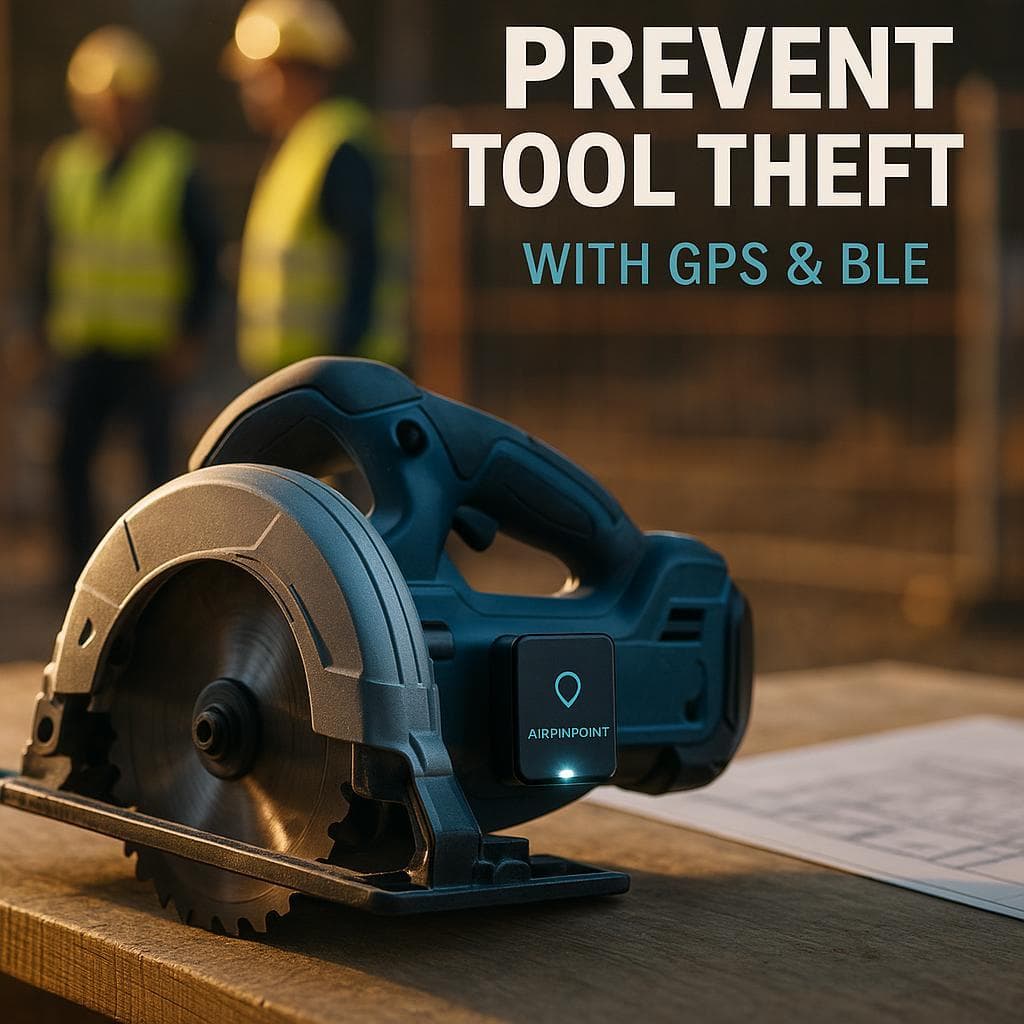
- Has a compartment or cavity where a tracker can be hidden
- Older or surplus equipment you would not miss from active rotation
Common bait items: generators, compressors, power tool kits, copper wire spools, welding machines, laser levels, concrete saws.
Step 2: Install Trackers
The tracker must be hidden well enough that a thief will not find it during a casual inspection, but accessible enough for you to check the battery.
AirTag placement options:
| Equipment | Hiding Location | Notes |
|---|---|---|
| Generator | Inside fuel tank (in waterproof bag), behind control panel | Fuel tank placement survives disassembly attempts |
| Tool kit | Inside handle cavity, under foam liner | Foam liner hides the bulge |
| Compressor | Inside air filter housing, behind motor shroud | Remove and replace filter cover to check battery |
| Welder | Inside wire feed compartment, taped behind electronics panel | Most thieves never open the wire feed housing |
| Trailer | Inside frame tube (weld a cap over it), behind license plate light | Frame tube is nearly impossible to detect without a metal detector |
For high-value bait or remote sites, use dual trackers: an AirTag for passive tracking via the Find My network, and a cellular GPS tracker for real-time location in areas with low Apple device density. The redundancy also protects against the possibility that a thief finds and removes one tracker.
Anti-detection measures:
AirTags have an anti-stalking feature: if an AirTag is separated from its owner's iPhone for 8-24 hours, it will emit a sound and send a notification to any nearby iPhone. This is designed to prevent someone from secretly tracking a person, but it also means a thief with an iPhone may get a "Unknown AirTag Found Moving With You" alert.
Mitigations:
- Hide the AirTag where the sound is muffled (inside a sealed compartment, wrapped in foam)
- Use the Airpinpoint dashboard to monitor the AirTag's status remotely, so you know if it has been detected
- Deploy multiple tracker types (AirTag + Tile + cellular GPS) so that even if one is found, the others continue tracking
Step 3: Set Up Geofence Alerts
A tracker without alerts is just a tracker. You need to know the same day your bait moves, not at the next inventory count.
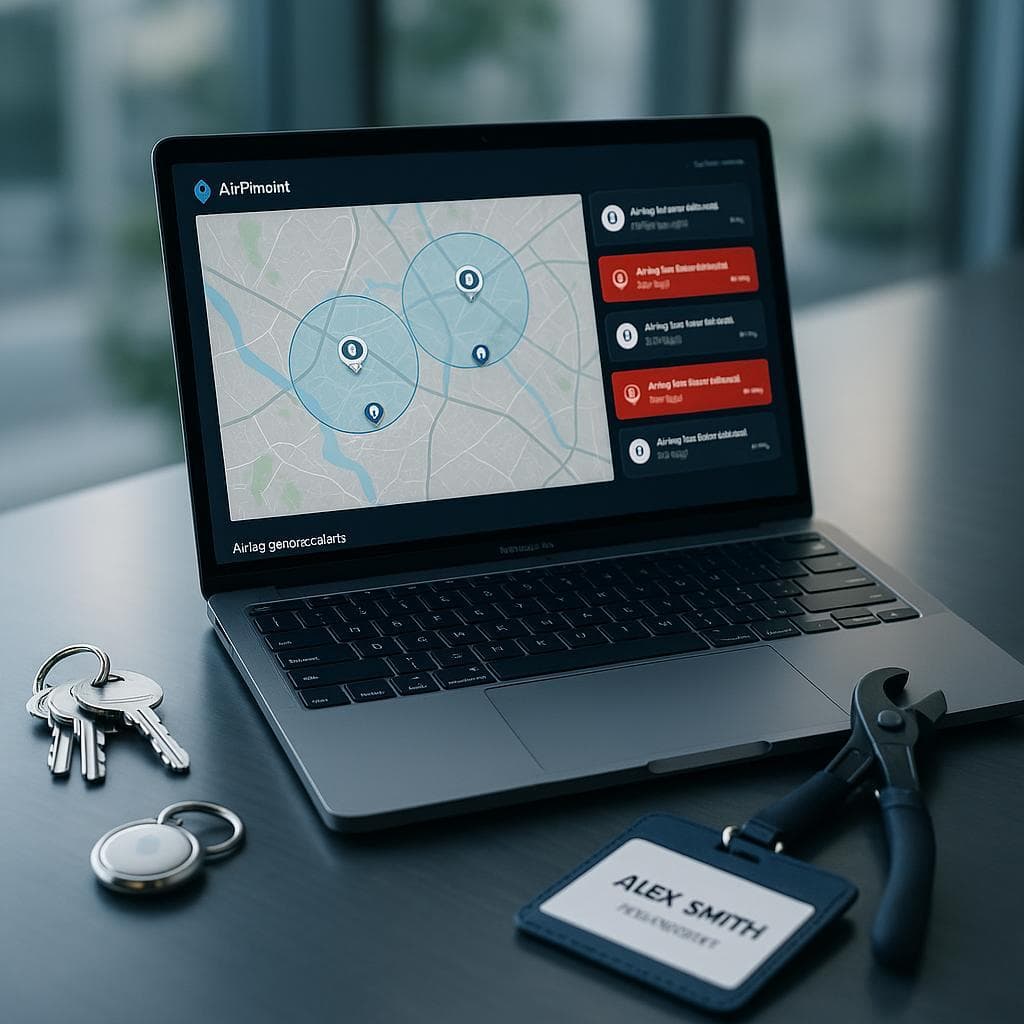
In Airpinpoint, draw a geofence around your job site perimeter. Configure it to send alerts when any tracked item exits the boundary outside of working hours. Set the alert to go to both you and the law enforcement contact assigned to your case.
Alert configuration:
- Working hours exception: 6 AM to 7 PM Monday through Saturday (adjust to your schedule). Movement during these hours is normal.
- After-hours trigger: Any movement outside working hours sends an immediate push notification and email.
- Consecutive pings threshold: Set to 2-3 pings outside the geofence to avoid false alarms from GPS drift. Airpinpoint's geofence system uses a consecutive count threshold before changing alert state.
Step 4: Coordinate With Law Enforcement
Before you deploy bait equipment, take these steps:
- File a police report. Report the ongoing theft problem at your site. Note that you intend to deploy tracked bait equipment. Get a case number.
- Request a detective. Ask for the report to be assigned to a property crimes detective. Patrol officers respond to active calls. Detectives investigate and build cases.
- Share tracker access. Give the detective read-only access to your Airpinpoint dashboard. If they want a different format, export location history as CSV or share the real-time tracking link.
- Agree on the protocol. When the bait moves, you call the detective (not 911, unless it is an in-progress crime you are witnessing). Provide the real-time location. The detective coordinates the response.
- Document everything. Screenshot the tracker location history before, during, and after the theft. This becomes evidence.
Step 5: Wait
This is the hardest part. Bait operations can take days, weeks, or months to trigger. Resist the temptation to check on the bait equipment visibly. Do not draw attention to it. Treat it like any other piece of equipment on the site.
When the alert fires, follow the protocol: call the detective, provide the live location, and let law enforcement handle the recovery.
Why AirTags Are the Ideal Bait Tracker
| Feature | AirTag | Cellular GPS Tracker |
|---|---|---|
| Cost | $29 one-time | $25-$100 + $15-$45/month |
| Battery life | 12+ months (CR2032) | 1-4 weeks (rechargeable) |
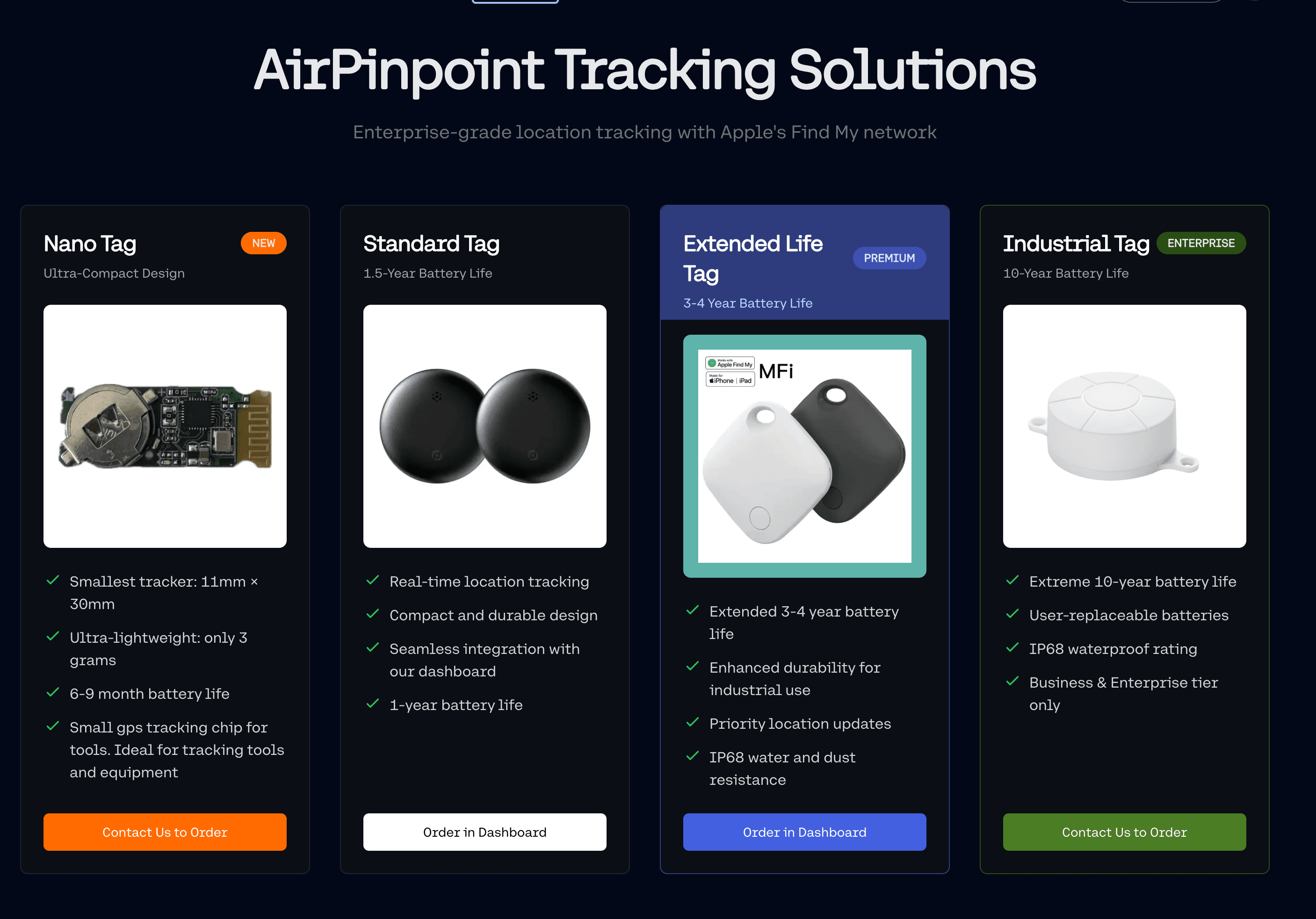
| Size | 31.9mm diameter, 8mm thick | Typically 2-4x larger |
| Monthly fee | None | $15-$45/month |
| Network | Over a billion Apple devices globally | Cellular towers |
| Detection risk | Low (small, no visible antenna) | Higher (larger, antenna visible on inspection) |
| Real-time tracking | Near real-time in urban areas | Yes |
| Rural coverage | Limited (depends on nearby iPhones) | Good (cellular coverage) |
For bait operations specifically, the AirTag advantage is cost and concealability. You can deploy 5 AirTags across 5 pieces of bait equipment for $145 total and no monthly cost. A cellular tracker setup for the same coverage runs $125-$500 upfront plus $75-$225 per month.
The AirTag's weakness, reliance on nearby Apple devices for location updates, is rarely a problem for bait operations. The equipment is being stolen and transported through populated areas where iPhone density is high. The thief drives through traffic, past neighborhoods, through commercial districts. Every iPhone they pass pings the AirTag's location anonymously and reports it to Apple's Find My network.
Airpinpoint makes AirTag-based bait operations viable at business scale by providing a centralized dashboard where you can monitor all tagged equipment, set geofence alerts, view location history, and share access with law enforcement or insurance adjusters.
The Insurance Angle
Equipment insurers are paying attention to bait operations and GPS tracking programs.
Premium discounts: Some equipment insurers credit tracked fleets and some do not. We are not going to print a percentage we cannot source, and you should be skeptical of pages that do. The action item is concrete and costs you one phone call: ask your broker whether your specific carrier offers a credit for GPS or BLE tracking on scheduled equipment, and get the answer in writing before you build it into any business case. If the answer is yes, that is real recurring money. If it is no, you have lost fifteen minutes.
Deductible waivers: Ask the same question about deductibles while you have the broker on the phone. Inland marine deductibles run $1,000 to $25,000, so a reduction or waiver on a single theft claim can be worth more than years of subscription. Same rule: in writing, before you count it.
Claim processing speed: Tracking data (location history, timestamps, geofence alert logs) provides the documentation that adjusters need to process a claim. Without tracking data, claims take weeks and involve extensive back-and-forth about when and where the equipment was last seen. With tracking data, the timeline is objective and verifiable.
Subrogation support: When police recover stolen equipment and arrest the thief, your insurer can pursue subrogation against the convicted party. Tracking data strengthens the subrogation case.
The pattern worth knowing is that these credits are rarely advertised on a rate sheet. They tend to surface only when a broker asks the underwriter directly, which means the contractors who get them are the ones who thought to ask. Make the call specific: name the tracking system, say what percentage of scheduled equipment carries a tag, and ask what documentation the underwriter would want to see.
Mistakes That Tank Bait Operations
Confronting Thieves Yourself
This is the most dangerous and most common mistake. You get the alert at 2 AM, you see your equipment moving, and your first instinct is to drive to the location and confront the thief. Do not do this. People who steal construction equipment are sometimes armed. They are always desperate. A $2,000 generator is not worth your life.
Call the detective. Provide the location. Stay home.
Not Coordinating With Police Before Deployment
If you deploy bait without filing a police report first, several problems arise:
- There is no case number to reference when the bait triggers
- There is no assigned detective to call
- The response defaults to 911 dispatch, which may not prioritize a stolen generator
- The evidence chain is weaker without a pre-existing police record
Filing a report before deployment establishes that the operation was planned, legal, and cooperative. This matters in court.
Using Only One Tracker
AirTags can be detected by iPhones after 8-24 hours of separation from the owner. Cellular GPS trackers can be found with a sweep. If a thief finds your single tracker and removes it, the operation is over.
Use at least two trackers of different types on high-priority bait. Hide them in different locations on the same piece of equipment. If the thief finds one and stops looking, the second one continues transmitting.
Placing Bait That Does Not Match the Theft Pattern
If your site is losing copper wire and you bait with a generator, you are fishing in the wrong pond. Study what has been stolen from your sites in the past 6 months. Bait with the same category of equipment. Thieves have preferences and routines. Match the bait to the pattern.
Poor Tracker Placement
If the tracker is visible, loosely attached, or in the first place a thief would look when inspecting stolen equipment, it will be found and discarded. Spend the extra time to conceal the tracker in a location that requires tools to access. Welded enclosures, sealed compartments behind screwed panels, inside structural cavities.
Setting Up a Bait Program: Cost Summary
| Item | Cost | Notes |
|---|---|---|
| AirTags, 5 at $29 | $145 | One per bait item |
| Rugged enclosures | $75-$150 | Waterproof, screw-mount or adhesive |
| Bait equipment | $0 (surplus) to $500 | Use older tools and equipment from your inventory |
| Airpinpoint, 5 tags at $11.99/month | $719/year | Geofence alerts, location history, shared access |
| Police report filing | $0 | Free, takes 30 minutes |
| Total first-year cost | $939-$1,514 | Compare to a theft loss of $6,000-$30,000 per incident |
Run the arithmetic rather than taking it from us. Ongoing cost after year one is $719 a year for five tags. Against a $6,000 incident, that is roughly eight years of the program covered by one prevented theft. Against a $30,000 incident, forty. Those numbers are just division, and you can check them.
The caveat that keeps this honest: they assume the tracking actually prevents or recovers a theft, and that is the assumption doing all the work. A tag improves your odds. It does not create a guarantee, and a thief who finds and discards the tag has cost you the whole bet.
What Happens After a Successful Bait Operation
When the operation works and police recover your equipment and make arrests, several things follow:
- Evidence processing. Police will hold recovered equipment as evidence until the case is resolved. This can take weeks to months. Ask the detective for an estimated timeline.
- Insurance notification. If you have filed an insurance claim, notify your adjuster of the recovery. Your policy may require you to return any claim payout for recovered items.
- Prosecution support. The district attorney may request your tracking data, timestamps, and testimony. Cooperate fully. Successful prosecution creates a public record that deters future theft.
- Publicize the bust. With the detective's permission, share the outcome with your industry network. Local contractor associations, trade publications, and even social media posts about successful bait operations create a deterrent effect that extends far beyond your own sites. Thieves read the news too.
- Continue the program. One bust does not end the threat. Redeploy bait equipment, rotate locations, and keep the trackers active. The best deterrent is uncertainty: any piece of equipment on any site might be tracked.
Start Your Bait Equipment Program Today
The hardware is cheap and the legal framework is settled. What varies, and what you should find out before building a program around it, is whether your local property crimes unit has the appetite to work a bait case. Call them and ask. Some departments run formal programs with contractors. Some will take your tracking data and act on it without any program at all. Some will file the report and nothing more. That answer shapes what a bait operation is worth to you far more than the price of a tag.
Get started with Airpinpoint and set up geofence alerts on your equipment. Whether you run a formal bait program or simply want to know within the hour that something left your site at 2 AM, a confirmed geofence alert on a tracked asset is the foundation.
$29 per AirTag, $11.99 per tag per month for the dashboard. Set expectations accordingly: a confirmed geofence alert lands 15 to 40 minutes after the move, accuracy is roughly 10 to 30 meters, and recovery still runs through your local police. Within those limits, $120 of tags once cracked a $3-5 million ring in Maryland.


 Our Solution