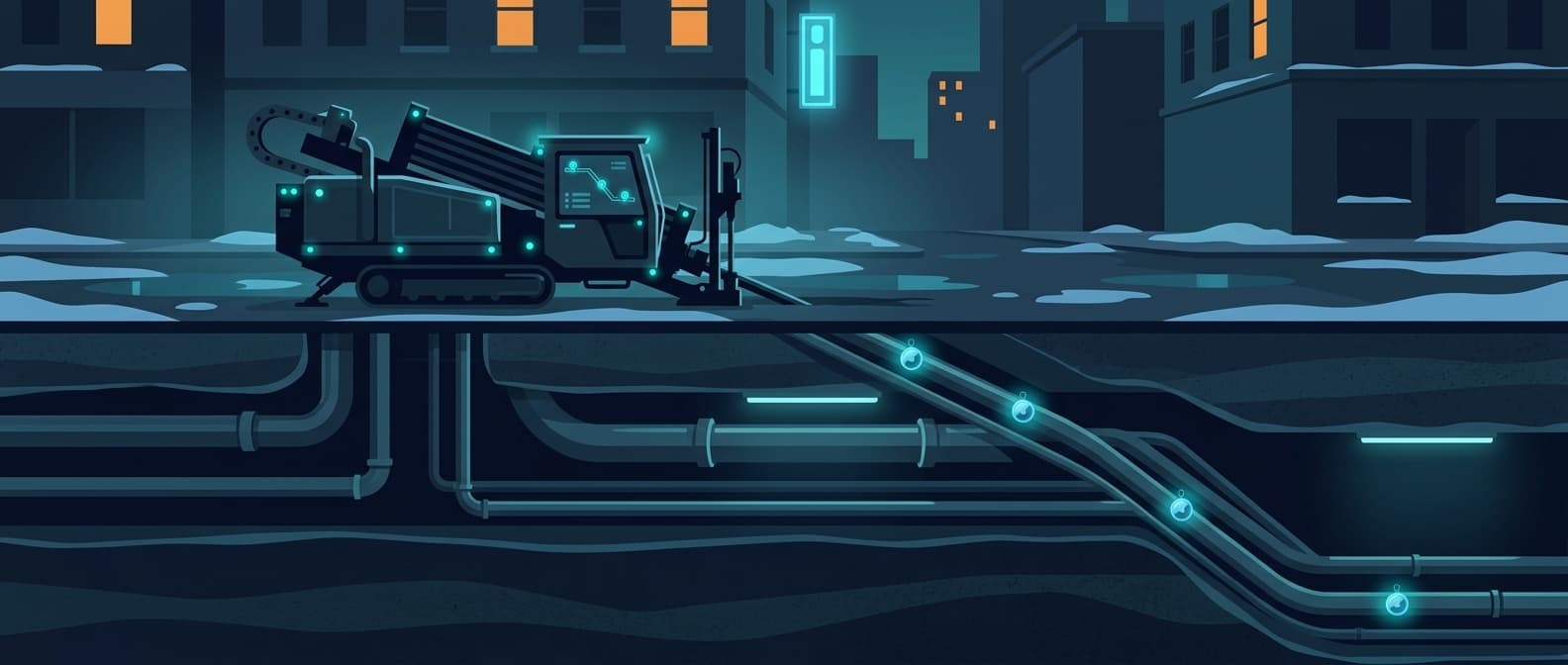
Trenchless Equipment Tracking: Managing Fleets Across Municipal Rehab Projects
A trenchless pipe rehabilitation contractor typically runs 20-30 municipal projects at the same time. Each project is small: a few blocks of sewer lining here, a water main replacement there, a directional bore under a highway interchange. The equipment list for each site changes weekly. HDD rigs, CIPP lining trucks, vacuum excavators, CCTV inspection crawlers, pipe bursting machines, fusion equipment, generators, and trailers. All of it scattered across a metro area.
The dispatcher is supposed to know where every asset is. In practice, they spend the first two hours of every morning calling crew leads. "Do you still have the D24x40?" "Which site has the second camera crawler?" "Did the vac truck come back from the Elm Street job?" A single HDD rig mobilized to the wrong site wastes $3,000-$10,000 in trucking and crane costs.
This page covers how AirTag-based tracking works for trenchless contractors, pipe rehab specialists, and municipal infrastructure companies.
The Trenchless Equipment Management Problem
What a Typical Fleet Looks Like
Trenchless contractors operate specialized, high-value equipment that conventional construction companies don't touch. A mid-size municipal rehab contractor's fleet often includes:
| Equipment Category | Examples | Value Per Unit | Typical Fleet Count |
|---|---|---|---|
| HDD rigs | Vermeer D24x40, Ditch Witch JT40, American Augers | $200K-$2M | 3-8 |
| CIPP lining trucks | Self-contained cure-in-place pipe systems | $150K-$500K | 2-6 |
| Vacuum excavators | Vac-Con, VACMASTERS, Vactor HXX | $150K-$500K | 3-8 |
| CCTV inspection crawlers | Envirosight ROVVER X, RedZone SOLO, Aries | $50K-$150K | 3-8 |
| Pipe bursting equipment | Hydraulic bursting units, pulling heads | $30K-$80K | 2-5 |
| Fusion machines | Butt fusion, electrofusion for HDPE | $15K-$60K | 3-6 |
| Support trailers | Equipment trailers, pipe trailers, lowboys | $5K-$50K | 8-15 |
| Generators & pumps | Bypass pumps, dewatering pumps, generators | $2K-$30K | 10-25 |
Total fleet value for a mid-size trenchless contractor: $5M-$20M. For a large regional operator, $30M-$80M+.
Why Trenchless Rehab Is Different
Trenchless contractors face equipment management problems that other construction trades don't have.
Dozens of small projects instead of a few large ones. A general contractor might run 5 big jobs. A trenchless rehab contractor runs 20-30 small municipal projects across multiple municipalities and counties. Each site needs a different equipment mix depending on the rehab method: HDD for new installations, CIPP for sewer lining, pipe bursting for replacements. Equipment rotates between sites constantly.
Municipal contract timelines create cascading scheduling. Cities issue work orders in batches. A contractor might win rehab contracts for 15 neighborhoods in the same county, each requiring different equipment at different times. When the CIPP crew finishes on Oak Street, they need to mobilize to Maple Avenue. But the CCTV inspection crew needs to finish pre-lining inspection at Maple first. Tracking where each crew's equipment actually is prevents scheduling collisions.
Equipment sharing between crews and subcontractors. Trenchless work is specialized enough that contractors frequently share equipment between crews or lend assets to subcontractors. A vacuum excavator might support the HDD crew in the morning and the pipe bursting crew in the afternoon. Without tracking, nobody knows who had it last.
High-value equipment in residential areas. Trenchless projects happen in neighborhoods, not fenced construction sites. A $150K CCTV inspection system sitting on a residential street overnight is a theft target. Equipment theft in construction exceeds $1 billion annually in the US, and trenchless equipment parked on open municipal sites is vulnerable.
Equipment Categories and Tracking Approaches
HDD Rigs
Horizontal directional drilling rigs are the highest-value mobile assets in a trenchless fleet. A mid-size Vermeer D40x55 or Ditch Witch JT40 costs $400K-$800K. Large-diameter rigs from American Augers push past $1.5M.
These rigs sit on the surface while the drill string bores underground. The AirTag mounts on the rig itself, not the tooling.
Placement: Inside the operator station, in the toolbox, or in a protected compartment on the frame. HDD rigs generate significant vibration during boring operations, but AirTag battery life is unaffected since Bluetooth Low Energy transmission is the same regardless of movement.
Some larger HDD rigs have OEM telematics. AirTags still add value as a backup that works when the engine is off. An idle rig waiting for its next mobilization doesn't report through engine-dependent telematics.
CIPP Lining Trucks
CIPP (cured-in-place pipe) lining trucks are self-contained mobile workshops worth $150K-$500K. They carry resin mixing equipment, liner material, inversion drums or pull-in winches, and curing systems (hot water, steam, or UV). These trucks are the backbone of sewer rehabilitation.
A busy rehab contractor runs 2-6 lining trucks simultaneously across different municipal projects. Each truck is committed to a specific project for days or weeks, then mobilizes to the next site.
Placement: Inside the cab or in a storage compartment on the truck body. CIPP trucks park curbside on residential streets during lining operations, surrounded by iPhone-carrying residents and passing traffic. Location updates are frequent.
Vacuum Excavators
Vacuum excavators ($150K-$500K) are the Swiss army knife of trenchless work. They pothole for utility locates before HDD bores, excavate access pits for pipe bursting, clean up after CIPP jobs, and handle dewatering. Every crew needs one, and there are never enough.
The classic trenchless scheduling conflict: two crews both need a vac truck tomorrow morning. Without tracking, the dispatcher has to call both crews, figure out which truck is where, and arrange the logistics manually.
Placement: Inside the cab or in the pump compartment. Vac trucks move between sites daily and are easy to track because they operate exclusively in populated areas with infrastructure.
CCTV Inspection Crawlers
Pipeline inspection cameras ($50K-$150K per system) are critical for pre-rehab assessment and post-rehab verification. Systems like the Envirosight ROVVER X or RedZone SOLO include the crawler robot, control unit, cable reel, and transport van or trailer.
The AirTag goes on the transport case or vehicle, not the crawler robot that enters the pipe.
Tracking value: Municipal contracts require pre-lining CCTV inspection and post-lining verification. If a crawler system is tied up on one project when another project needs its post-rehab inspection to close out, the contractor loses billable days. Knowing exactly which crew has which crawler system eliminates scheduling confusion.
Pipe Bursting Equipment
Pipe bursting replaces existing pipes by pulling a larger pipe through the old one while simultaneously fracturing the host pipe. The equipment includes hydraulic pulling units ($30K-$60K), bursting heads, and rod systems.
This equipment moves between projects frequently because each pipe bursting job takes 1-3 days. A pulling unit might visit 4 different municipal sites in a single week.
Placement: Mount the AirTag on the hydraulic unit's frame or inside its transport case. Bursting heads are small enough to lose in a truck bed, but too expensive ($5K-$15K) to replace without searching.
Fusion Machines and Support Equipment
HDPE fusion machines ($15K-$60K) join pipe sections for HDD installations and pipe bursting replacements. These machines rotate between HDD and bursting crews depending on which projects need them.
Generators ($2K-$15K), bypass pumps ($5K-$30K), and dewatering pumps round out the support fleet. Individually, none justify a $25-$45/month GPS tracker. At $11.99/month with Airpinpoint, tracking every support asset becomes economical.
Multi-Site Operations: The Core Challenge
The Monday Morning Problem at Scale
A trenchless contractor with 25 active municipal projects faces a coordination problem that most construction companies don't experience. Equipment needs shift daily as projects progress through phases:
- CCTV inspection (pre-rehab assessment)
- Cleaning and prep (jetting, root cutting)
- Rehabilitation (CIPP lining, pipe bursting, or HDD)
- Post-rehab inspection (CCTV verification)
- Restoration (surface repair)
Each phase requires different equipment. When 25 projects are at 5 different phases, the dispatcher is managing 125 equipment-to-site assignments that change weekly.
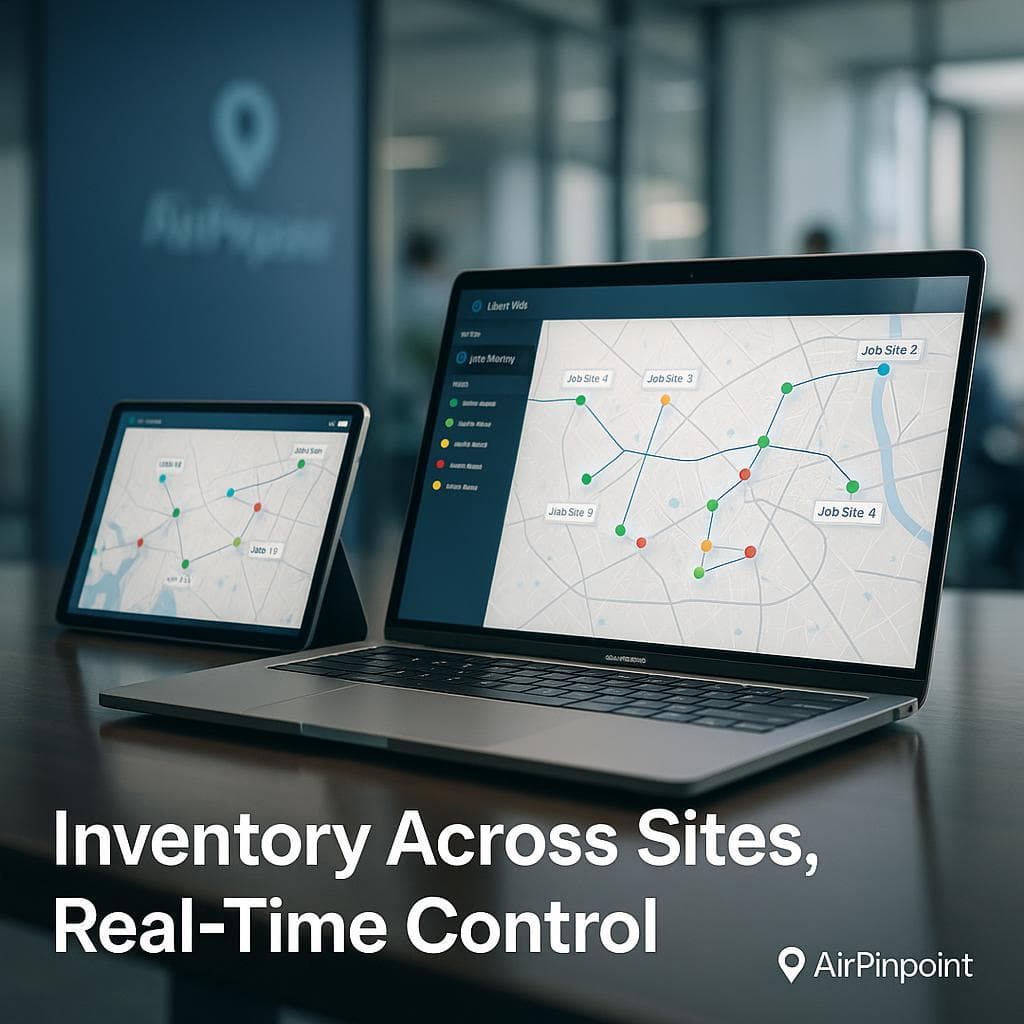
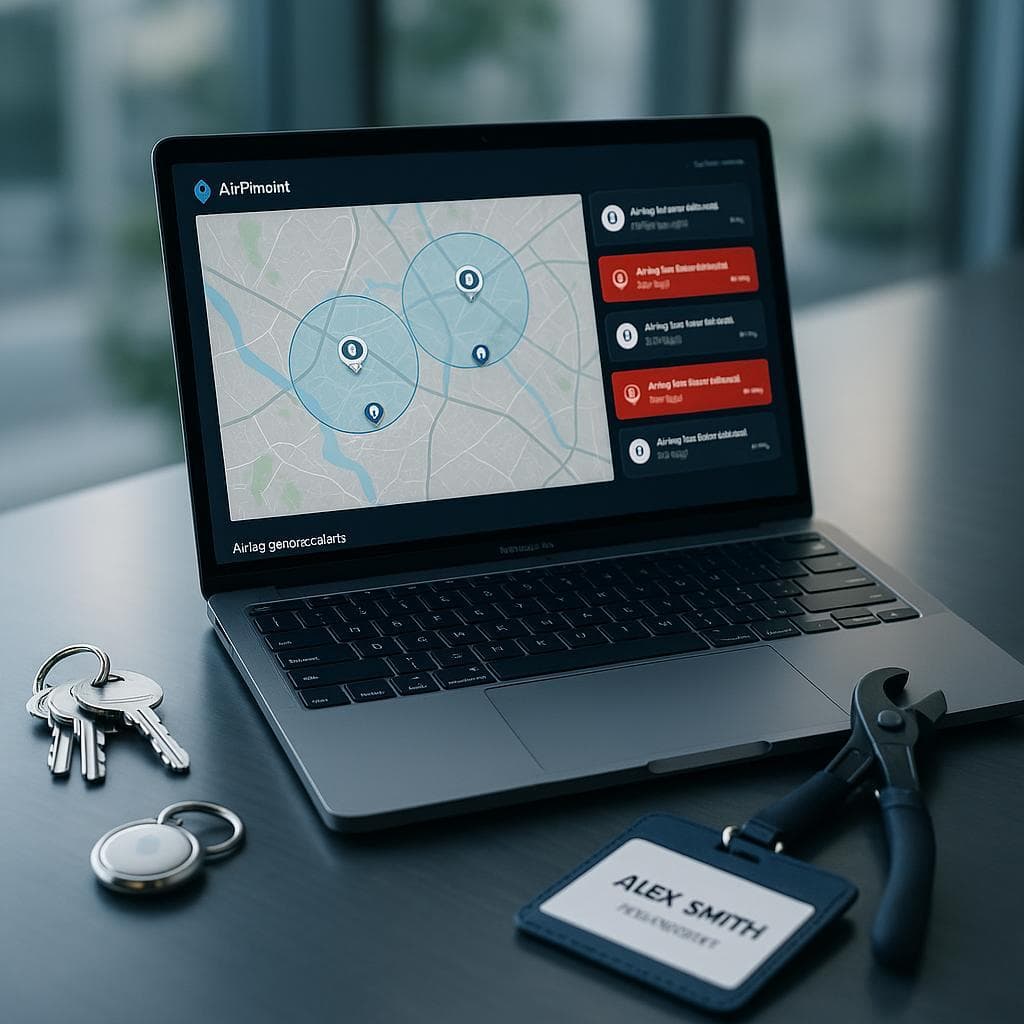
Without tracking, step one of every morning is reconstructing where everything is. With Airpinpoint, the dispatcher opens the dashboard and sees every asset plotted on a map of the service area. Filter by equipment type. See all 6 vac trucks at once. See which sites have generators. Identify the idle fusion machine sitting at a project that wrapped up Friday.
Geofencing Municipal Projects
Set up a geofence around each active project area. For trenchless work, this is usually a few city blocks.
Equipment borrowing alerts. Crew leads on adjacent projects frequently borrow equipment from each other without telling the dispatcher. "We just grabbed the generator from the Elm Street site." A geofence alert catches this within the hour instead of the dispatcher discovering it the next morning when the Elm Street crew needs their generator back.
Project closeout verification. Municipal contracts have closeout deadlines. Equipment left on a completed project wastes money and delays demobilization. Geofence reports show exactly which assets remain at each site.
After-hours theft detection. A vac truck leaving a residential project site at 11pm triggers an immediate alert. Trenchless equipment parked on public streets is more exposed than equipment behind a construction fence.
Mobilization Cost Savings
The economics are straightforward. An HDD rig mobilization requires a lowboy trailer, a tractor, and often a crane for loading. Cost: $3,000-$10,000 depending on distance.
Sending a rig to the wrong site, or discovering that the site isn't ready because the CCTV crew hasn't finished inspection, means a wasted mobilization. Two wasted mobilizations per month at $5,000 each is $120,000/year. That's 10x the annual cost of tracking the entire fleet.
Cost Comparison: Tracking a 50-Asset Trenchless Fleet
GPS Trackers for Everything
| Item | Cost |
|---|---|
| Hardware (50 devices @ $100 avg) | $5,000 |
| Monthly service (50 x $30/mo avg) | $1,500/mo |
| Annual cost | $23,000 |
| 3-year total | $59,000 |
Plus monthly charging for battery-powered units. With 50 devices across 25 project sites, someone is always chasing a dead GPS tracker.
Airpinpoint for Everything
| Item | Cost |
|---|---|
| AirTags (50 x $29) | $1,450 |
| Monthly service (50 x $11.99/mo) | $599.50/mo |
| Battery replacement (50 x $3/year) | $150/yr |
| Annual cost | $8,744 |
| 3-year total | $26,882 |
No charging. No hardwiring. Battery swap once a year during routine maintenance.
Hybrid Approach (Recommended)
| Asset Type | Count | Tracking Method | Annual Cost |
|---|---|---|---|
| HDD rigs & vac trucks (with OEM telematics) | 12 | Existing telematics + AirTag backup | $1,724 (AirTags only) |
| CIPP trucks, crawlers, bursting equipment, support | 38 | Airpinpoint | $5,618 |
| Total | 50 | Hybrid | $7,342 |
Implementation for Trenchless Contractors
Phase 1: High-Rotation Equipment (Week 1)
Start with the assets that move between sites most often and cause the most scheduling headaches.
- CCTV inspection systems (each named: Crawler Unit 01-08)
- Fusion machines
- Pipe bursting equipment
- Generators and bypass pumps
These are the assets that crews borrow, misplace, and forget to return. Tracking them immediately reduces morning phone calls.
Phase 2: Major Equipment (Week 2)
Add AirTags to HDD rigs, CIPP lining trucks, and vacuum excavators. If these already have OEM telematics, AirTags provide backup tracking that works when engines are off.
Phase 3: Trailers and Remaining Assets (Week 3)
Equipment trailers, pipe trailers, lowboys, and any remaining support equipment. Trailers are among the most stolen construction assets (68,000+ stolen annually in the US).
Phase 4: Process Integration
Once all assets are tracked:
- Dispatcher uses the dashboard for daily equipment assignment instead of phone calls
- Crew leads check the dashboard before requesting equipment transfers
- Geofence alerts notify the dispatcher of unauthorized equipment moves
- Monthly reports reveal utilization patterns to inform purchasing and rental decisions
- Municipal project closeout checklists include a dashboard check for remaining equipment
Honest Limitations
Not a replacement for OEM telematics on HDD rigs. AirTag tracking provides location, not bore depth, torque data, engine hours, or fluid levels. For high-value HDD rigs, OEM telematics data matters for maintenance scheduling. Airpinpoint complements telematics.
No underground tracking. AirTags track surface equipment. They don't track tooling that goes into the pipe (CCTV crawlers while deployed, bursting heads during a pull, drill strings). The AirTag goes on the rig or transport case, not the downhole tooling.
Location updates depend on iPhone density. Municipal rehab projects in residential neighborhoods get frequent updates because of nearby residents' iPhones. A rare rural water main project with no nearby houses will get less frequent updates. Crew members' iPhones within Bluetooth range still trigger updates.
Not real-time GPS. For second-by-second tracking during active drilling operations or truck routing, you need a dedicated GPS device. Airpinpoint answers "where are my assets right now" at a fleet level, not "what is this rig doing this second."
Why Trenchless Contractors Choose Airpinpoint
The trenchless rehab use case is a near-perfect fit for AirTag-based tracking:
-
Many small projects, not few large ones. The dashboard's map view with per-site geofencing was built for companies managing 20+ simultaneous locations.
-
Populated operating environment. Trenchless work happens where pipes are: residential neighborhoods, commercial districts, urban corridors. iPhone density is high. AirTag tracking performs best in exactly these environments.
-
Mixed fleet economics. You need to track $1M HDD rigs and $5,000 generators on the same platform. GPS tracker pricing makes no sense for support equipment. Airpinpoint's $11.99/device/month works for both.
-
Zero maintenance overhead. Trenchless crews are already stretched thin across dozens of projects. Nobody has time to charge GPS trackers. AirTag batteries last a year. Swap takes 30 seconds.
-
Scale without complexity. A 50-asset fleet tracked with Airpinpoint costs under $9,000/year. The same fleet with GPS trackers costs $23,000+. That $14,000 annual savings covers a lot of CR2032 batteries.
Trenchless contractors who've tried spreadsheets, whiteboards, or the "call the crew lead" approach know the real cost: wasted mobilizations, borrowed equipment that never comes back, idle assets parked on completed projects, and theft that goes unnoticed until the next inventory audit. Airpinpoint replaces that chaos with a single dashboard showing every asset, at every municipal project site, updated automatically by the Find My network.
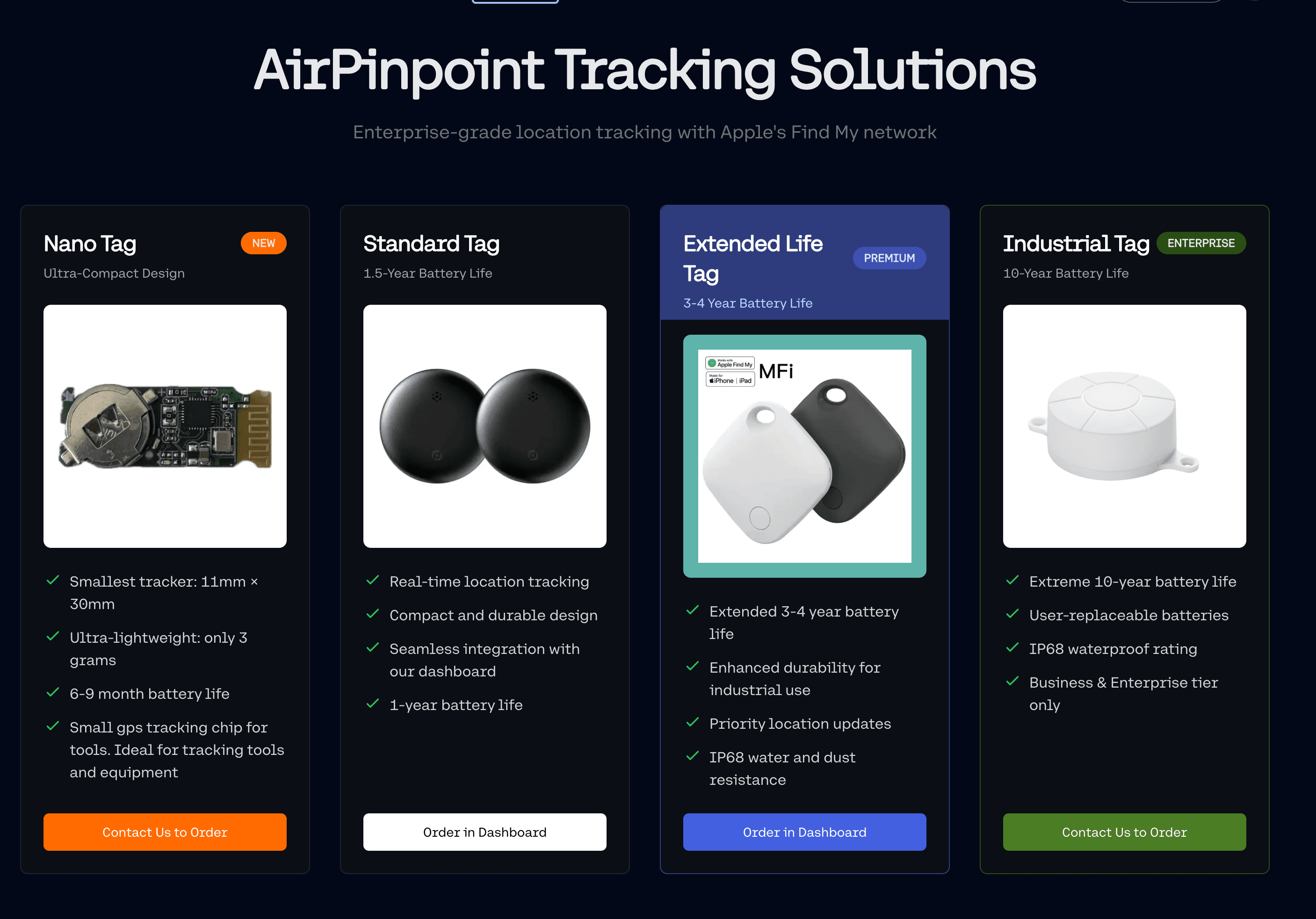
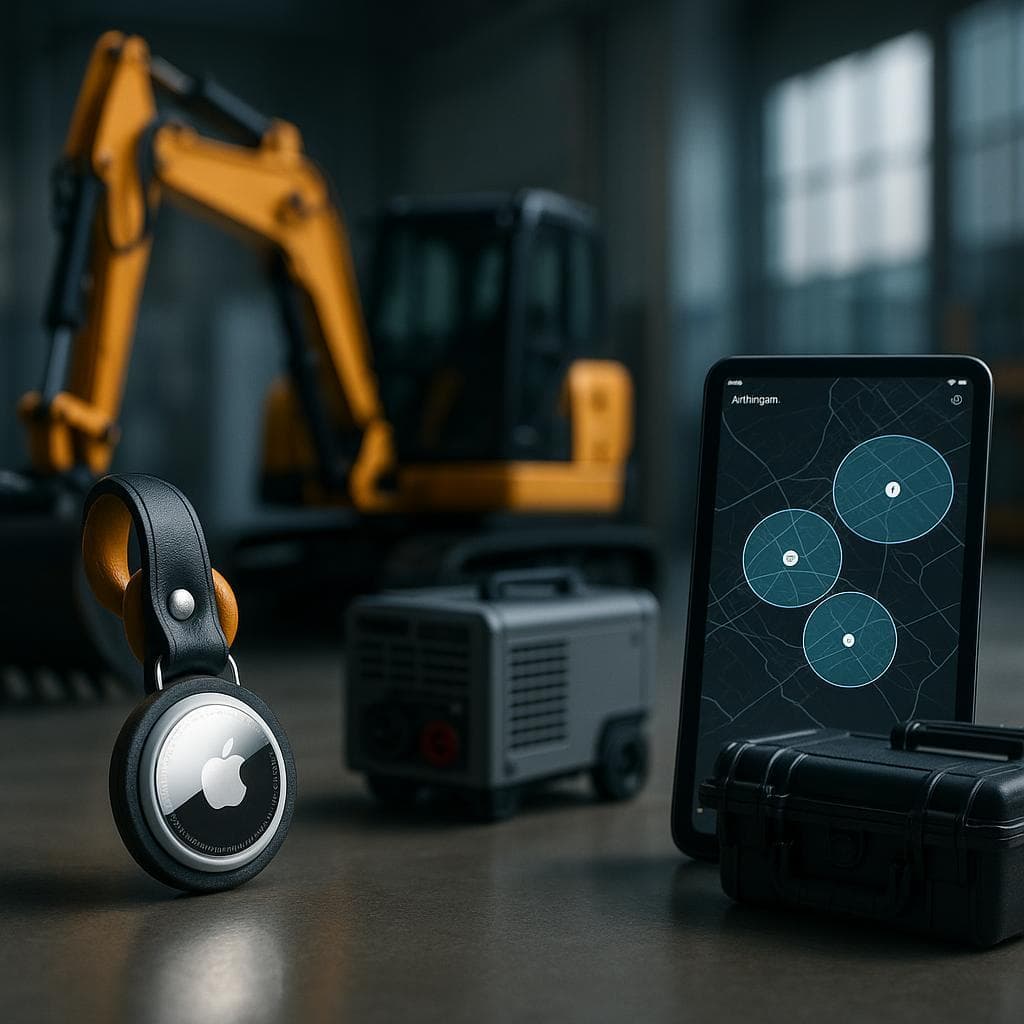



 Our Solution