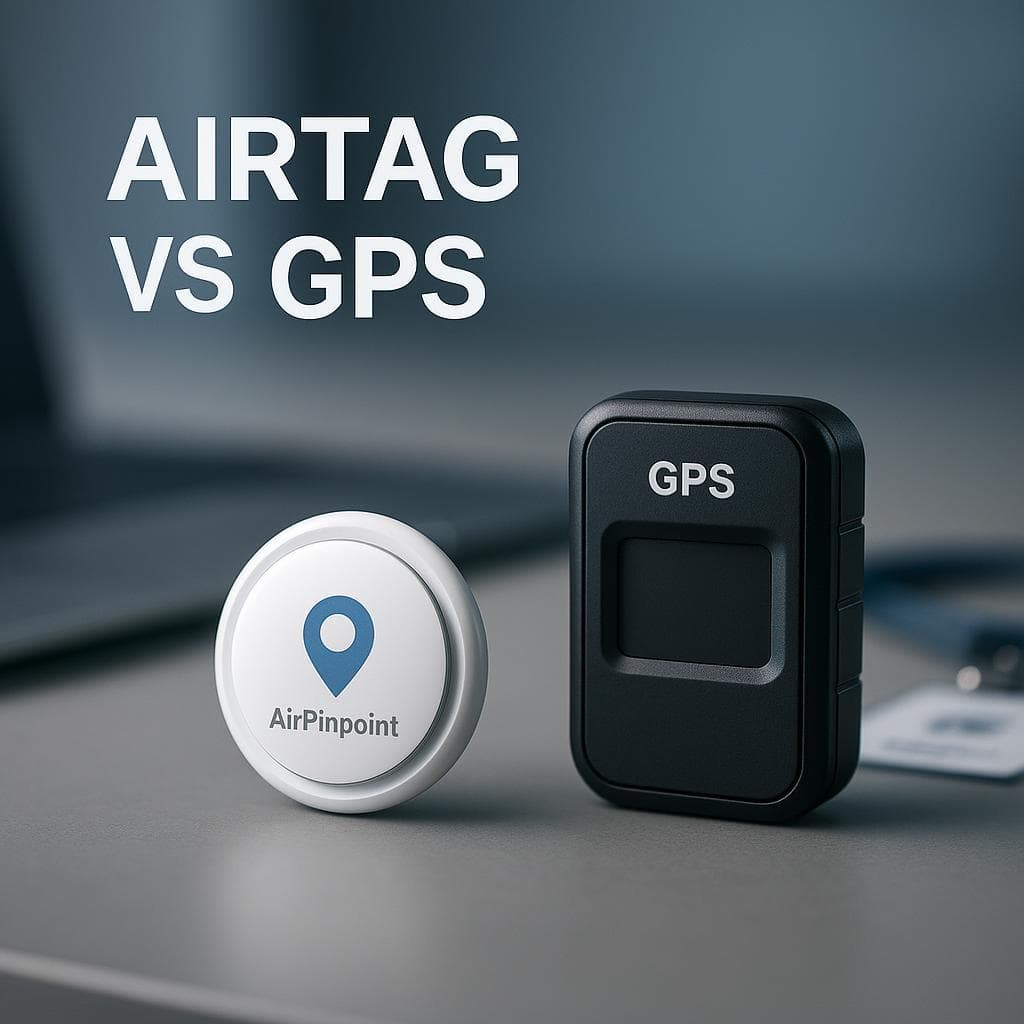
AirTags vs Invoxia: Which Tracker Fits Your Business?
Two Different Tracking Philosophies
Invoxia and Apple AirTags solve the same core problem, but they get there by completely different paths.
Invoxia GPS Tracker Pro is a dedicated GPS tracker with its own cellular radio. It connects to LTE-M networks to report location in near-real-time. The $129 price includes two full years of data service. After that, you pay about $40/year to keep it active. It's a well-engineered piece of hardware with GPS, Wi-Fi, Bluetooth, and cellular all in one compact package.
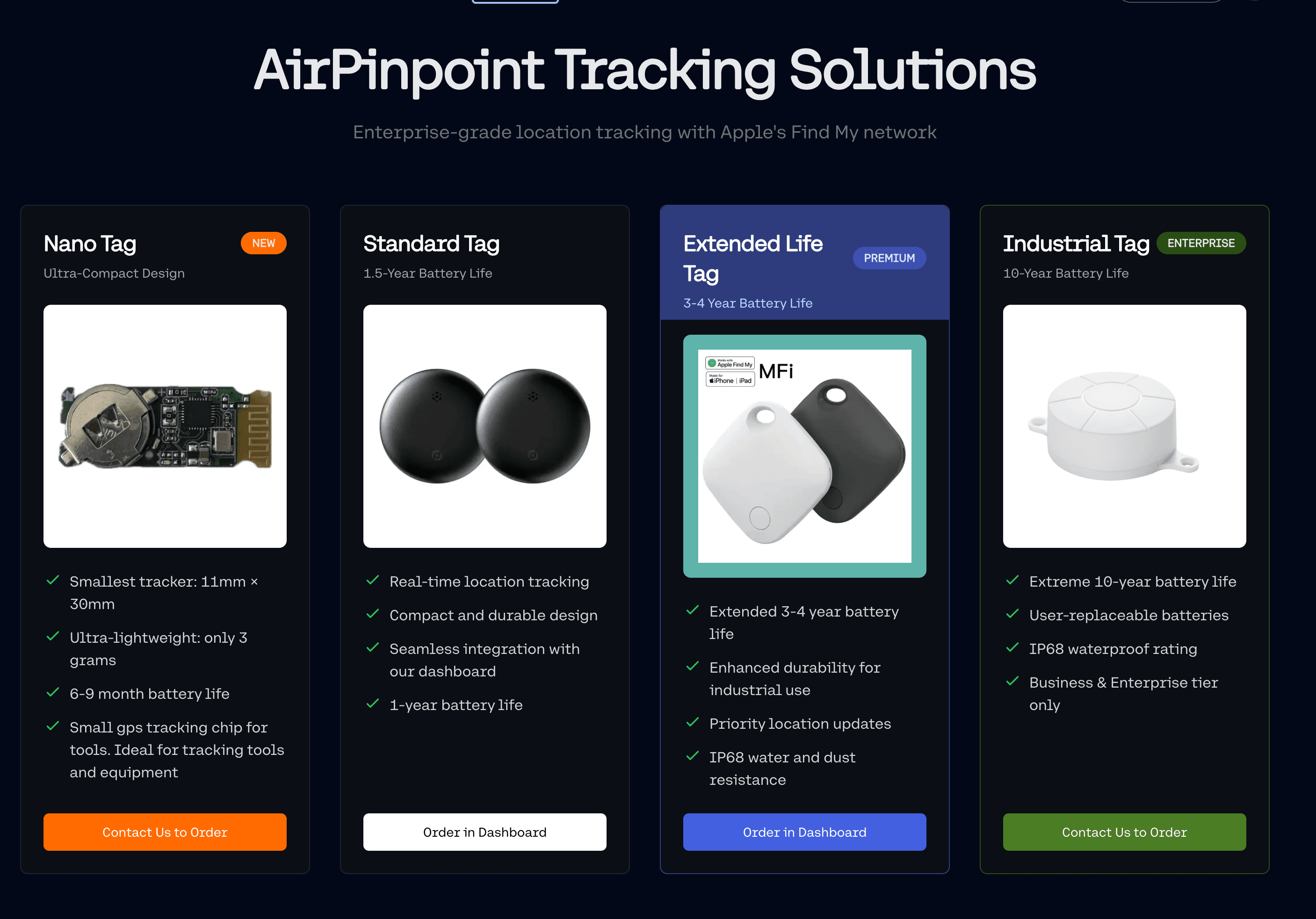
AirTags are Bluetooth beacons that piggyback on Apple's Find My network. No cellular radio, no SIM card, no charging. A CR2032 coin battery lasts roughly a year. The tag costs $29. AirPinpoint adds business features on top: a fleet dashboard, location history, geofencing, team access, and API webhooks at $11.99/device/month.
The core tradeoff: Invoxia gives you real-time GPS with a rechargeable battery you need to manage. AirTags give you passive tracking with almost zero maintenance. For a single car or bike, Invoxia may be the better tool. For a fleet of equipment, vehicles, and tools, the maintenance difference compounds fast.
Invoxia Product Lineup
Invoxia sells three trackers. The GPS Tracker Pro is the flagship, but understanding the full range helps contextualize where they fit.
GPS Tracker Pro (Current Model)
- Price: $129.99
- Included service: 2 years LTE-M cellular
- Renewal: ~$39.90/year after included period
- Battery: Rechargeable, up to 4 months
- Connectivity: GPS + Wi-Fi + Bluetooth + LTE-M
- Size: 2.6 x 1.3 x 0.5 inches
- Weight: 1.2 oz
- Water resistance: IPX7
- Coverage: 100+ countries
GPS Tracker (Classic)
- Price: ~$99 (often discounted)
- Included service: 1-2 years depending on promotion
- Battery: Up to 3 months
- Connectivity: GPS + Wi-Fi + Bluetooth + LTE-M
- Smaller form factor than Pro
Minitailz (Pet Tracker)
- Pet-focused design with health monitoring
- Not relevant for business tracking, but worth noting as part of the product line
Invoxia Pricing: The Full Picture
Invoxia's pricing model looks attractive at first glance. The prepaid cellular service eliminates monthly bills for the first two years. But the math changes depending on your time horizon and fleet size.
Single Tracker, 3-Year Cost
| Cost Component | Year 1 | Year 2 | Year 3 | Total |
|---|---|---|---|---|
| Invoxia GPS Tracker Pro | $129.99 | $0 | $39.90 | $169.89 |
| AirTag + AirPinpoint | $29 + $143.88 | $146.88* | $143.88 | $463.64 |
*Includes one $3 battery replacement in Year 2
For tracking a single asset over three years, Invoxia costs roughly one-third what AirPinpoint costs. That's a clear Invoxia win for individual use.
But Invoxia Has Hidden Maintenance Costs
The dollar comparison above doesn't account for the operational cost of charging. Every Invoxia tracker needs a USB-C charge every 2-4 months. For one device, that's trivial. For a fleet, it becomes a logistics problem.
Charging math for 20 Invoxia trackers:
- Each device charges 3-6 times per year
- Each charge cycle: retrieve device, charge for 2 hours, reinstall
- That's 60-120 charge cycles per year across the fleet
- If each cycle takes 15 minutes of someone's time (travel to asset + swap + return), that's 15-30 hours of labor annually
With AirTags, you swap a CR2032 battery once a year. For 20 tags, that's roughly 2 hours of work total, once per year.
True Cost Comparison at Scale
The per-device cost comparison shifts as you add more assets. Invoxia's prepaid model stays flat per unit. AirPinpoint's subscription model adds up monthly, but the zero-maintenance advantage and fleet management features create value that Invoxia doesn't offer.
5 Assets Over 3 Years
Invoxia GPS Tracker Pro:
- Hardware: 5 x $129.99 = $650
- Year 3 renewal: 5 x $39.90 = $200
- Total: ~$850
AirTags + AirPinpoint:
- AirTags: 5 x $29 = $145
- Subscription: 5 x $11.99 x 36 = $2,158
- Battery replacements: ~$25
- Total: ~$2,328
Invoxia saves ~$1,478 for 5 assets. At this scale, Invoxia is the clear cost winner if you don't need fleet management features.
20 Assets Over 3 Years
Invoxia GPS Tracker Pro:
- Hardware: 20 x $129.99 = $2,600
- Year 3 renewal: 20 x $39.90 = $798
- Total: ~$3,398
AirTags + AirPinpoint:
- AirTags: 20 x $29 = $580
- Subscription: 20 x $11.99 x 36 = $8,633
- Battery replacements: ~$100
- Total: ~$9,313
Invoxia saves ~$5,915 on raw cost. But at 20 devices, Invoxia lacks a centralized dashboard, team access controls, geofence alerts managed from one place, webhook integrations, or location history exports. You're managing 20 separate trackers through a consumer app.
50 Assets Over 3 Years
Invoxia GPS Tracker Pro:
- Hardware: 50 x $129.99 = $6,500
- Year 3 renewal: 50 x $39.90 = $1,995
- Total: ~$8,495
- Charging labor: 150-300 charge cycles/year x 15 min = 37-75 hours/year
AirTags + AirPinpoint:
- AirTags: 50 x $29 = $1,450
- Subscription: 50 x $11.99 x 36 = $21,582
- Battery replacements: ~$250
- Total: ~$23,282
- Maintenance labor: 50 battery swaps/year x 3 min = 2.5 hours/year
At 50 assets, Invoxia still costs less in dollar terms. But you're charging 50 devices 3-6 times per year, managing them through a consumer app without team features, and losing days of tracking during each charge cycle. The $14,787 in "savings" comes at the cost of significant operational overhead and missing fleet management capabilities.
Feature Comparison
| Feature | Invoxia GPS Tracker Pro | AirTag + AirPinpoint |
|---|---|---|
| Hardware cost | $129.99 | $29 |
| Monthly cost (Year 1-2) | $0 (prepaid) | $11.99/device |
| Monthly cost (Year 3+) | ~$3.33/device | $11.99/device |
| Location method | GPS + LTE-M + Wi-Fi + BLE | Apple Find My network (BLE) |
| Update frequency | Every few minutes (configurable) | When Apple devices pass nearby |
| Battery type | Rechargeable (USB-C) | CR2032 replaceable |
| Battery life | 2-4 months | ~12 months |
| Water resistance | IPX7 | IP67 |
| Size | 2.6 x 1.3 x 0.5 in | 1.26 x 1.26 x 0.31 in |
| Real-time tracking | Yes | No (periodic) |
| Geofencing | Yes (in app) | Yes (via AirPinpoint) |
| Trip history | Yes | Yes (via AirPinpoint) |
| Anti-theft alerts | Yes (motion, tow) | Geofence exit alerts (AirPinpoint) |
| Team dashboard | No | Yes |
| Multi-user access | Limited | Yes, with roles |
| API / Webhooks | No | Yes |
| Location history export | Limited | Yes (CSV, API) |
| Works indoors | Wi-Fi positioning (approximate) | Yes (via nearby Apple devices) |
| Global coverage | 100+ countries (LTE-M) | Worldwide (where Apple devices exist) |
| Charging required | Every 2-4 months | Never (battery swap annually) |
What Invoxia Does Well
Invoxia is a genuinely good product for its intended use case. Here's where it earns its reputation:
Real-Time GPS Tracking
Invoxia provides actual GPS coordinates via satellite, not crowdsourced Bluetooth pings. This means:
- Consistent location updates on a predictable schedule
- Accurate positioning in open areas (parking lots, highways, rural areas)
- Location data independent of nearby smartphone density
For tracking a single valuable asset (a car, motorcycle, e-bike, or expensive piece of equipment), this reliability matters.
Anti-Theft Features
The GPS Tracker Pro includes dedicated security features:
- Motion alerts: Notification when the tracker starts moving
- Tow-away detection: Identifies when a vehicle is being towed vs. driven
- Speed alerts: Configurable notifications when speed exceeds a threshold
- Suspicious behavior detection: Flags unusual movement patterns
These are purpose-built security features that AirTags don't natively provide.
Prepaid Simplicity
No monthly bill for two years. You buy the hardware and it just works. For consumers and small business owners who hate subscription management, this is genuinely appealing. The renewal price after two years (~$40/year) is reasonable by any standard.
Compact Form Factor
At 2.6 x 1.3 x 0.5 inches, the GPS Tracker Pro is small for a device that contains GPS, cellular, Wi-Fi, and Bluetooth radios plus a rechargeable battery. It fits in a glovebox, under a seat, or attached to a bike frame without being obvious.
European Market Strength
Invoxia is a French company with strong LTE-M coverage across Europe. For businesses operating in the EU, Invoxia's cellular coverage may be more reliable than Apple's Find My network density in some regions.
Where Invoxia Falls Short for Business Use
Invoxia was designed as a consumer tracker. When you try to scale it for business fleet management, several gaps become apparent.
No Fleet Dashboard
Invoxia's app shows one tracker at a time. There's no unified dashboard showing all 20 or 50 trackers on a single map. No fleet-wide search, no bulk management, no aggregate reporting. For a business tracking multiple assets, this is a serious limitation.
AirPinpoint provides a single dashboard with every asset on one map, filterable by group, status, or location. Team members see what they need to see based on role permissions.
No Team Access Controls
The Invoxia app is tied to one user account. Sharing access with dispatchers, managers, or field teams means sharing login credentials. There's no role-based access, no audit trail of who viewed what, and no way to restrict visibility to specific asset groups.
No API or Webhook Integration
Invoxia doesn't offer a public API or webhook system. You can't integrate tracker data into your existing fleet management software, ERP system, or automated workflows. Location data lives inside the Invoxia app and stays there.
AirPinpoint provides webhooks for geofence events and an API for pulling location data into any system.
No Location History Export
Pulling historical location data out of Invoxia for reporting, compliance, or analysis requires manual effort. There's no CSV export, no API endpoint for historical queries, and no integration with business intelligence tools.
Charging at Scale is a Real Problem
This point deserves emphasis because it's the most underestimated cost of rechargeable trackers.
A single Invoxia tracker with 4-month battery life needs charging three times per year. Manageable. But 20 trackers need 60 charge cycles per year. 50 trackers need 150 cycles.
Each cycle means:
- Locate the asset the tracker is attached to
- Remove or access the tracker
- Plug it in for ~2 hours
- Reinstall it on the asset
During charging, you have no tracking on that asset. If you're charging on a rotation, some percentage of your fleet is always dark.
With AirTags, you pop open the back, drop in a new CR2032 (available at any gas station for $3), and close it. Takes 30 seconds. The tag never goes offline.
When Invoxia Is the Right Choice
Be honest about when Invoxia wins. It does, clearly, for several scenarios:
1. Tracking 1-5 Personal or High-Value Assets
If you're tracking your car, motorcycle, e-bike, or a few pieces of expensive equipment, Invoxia's prepaid model is hard to beat on cost. $130 for two years of real-time GPS is excellent value.
2. Real-Time Location Is Critical
For assets where you need to know the exact location right now, not "sometime in the last hour," Invoxia's GPS + LTE-M provides that. Stolen vehicle recovery, high-value shipment monitoring, or time-sensitive asset location.
3. Rural or Low-Population Areas
AirTags depend on nearby Apple devices for location updates. In rural areas with sparse population, updates may come hours apart. Invoxia's cellular radio reports independently of nearby devices, giving more consistent coverage in remote locations.
4. Anti-Theft Is the Primary Use Case
If your main concern is theft detection and recovery for a specific vehicle or asset, Invoxia's dedicated anti-theft features (motion alerts, tow detection, speed alerts) are more purpose-built than AirTag-based alternatives.
When AirTags Are the Right Choice
1. Fleet Management with 10+ Assets
Once you cross the threshold where you need a dashboard, team access, geofencing, and exportable data, the consumer-oriented Invoxia app becomes a bottleneck. AirPinpoint was built for this use case.
2. Mixed Asset Types
Most businesses don't just track vehicles. They track trailers, generators, toolboxes, containers, scaffolding, and other equipment. AirTags work identically on all of them. No wiring, no power source, no special mounting hardware.
3. Zero-Maintenance Priority
If the labor cost of managing hardware matters to you, AirTags win outright. A $3 battery swap once a year versus USB-C charging every 2-4 months. At fleet scale, this difference adds up to days of saved labor annually.
4. Indoor and Dense Urban Tracking
AirTags leverage 2+ billion active Apple devices worldwide. Inside buildings, parking garages, and warehouses, where GPS signals are blocked, AirTags often provide better location data than GPS-based trackers. Invoxia uses Wi-Fi positioning as a fallback indoors, but it's less accurate.
5. Budget for Large Deployments
If you need to track 50 or 100 assets and the upfront hardware cost matters, AirTags at $29 each versus Invoxia at $130 each makes a significant difference. 50 AirTags cost $1,450. 50 Invoxia trackers cost $6,500.
6. Integration Requirements
If you need location data flowing into other business systems via API or webhooks, AirPinpoint supports that. Invoxia does not.
The Practical Decision Framework
Here's a straightforward way to decide:
Choose Invoxia if ALL of these are true:
- You're tracking fewer than 5 assets
- You need real-time GPS accuracy
- You don't mind charging devices every few months
- You don't need team dashboards or API access
- Your assets are in areas with LTE-M cellular coverage
Choose AirTags + AirPinpoint if ANY of these are true:
- You're tracking 10 or more assets
- Multiple team members need access to location data
- Your assets include unpowered equipment, not just vehicles
- You need geofence alerts, location history, or webhook integrations
- Minimal hardware maintenance is a priority
- You want to start tracking this week without configuring cellular plans
The Hybrid Approach
For some businesses, the right answer is both.
Put Invoxia GPS Tracker Pro on 2-3 high-value vehicles where real-time location and anti-theft features justify the $130/device cost. Put AirTags on everything else: the trailer fleet, equipment yard, tool inventory, and lower-priority vehicles. Manage the AirTags through AirPinpoint's dashboard.
This gives you real-time GPS where it matters most and broad fleet visibility everywhere else, at a fraction of the cost of putting GPS on every asset.
Invoxia vs. AirTags vs. Other Trackers
| Tracker | Hardware | Year 1 Cost | Year 2 Cost | Year 3 Cost | 3-Year Total | Battery | Real-Time GPS |
|---|---|---|---|---|---|---|---|
| Invoxia GPS Pro | $130 | $0/mo | $0/mo | $3.33/mo | ~$170 | Rechargeable, 4 mo | Yes |
| AirTag + AirPinpoint | $29 | $11.99/mo | $11.99/mo | $11.99/mo | ~$461 | CR2032, 12 mo | No |
| Tracki | $20 | $16.99/mo | $16.99/mo | $16.99/mo | ~$632 | Rechargeable, 5 days | Yes |
| LandAirSea Overdrive | $30 | $19.95/mo | $19.95/mo | $19.95/mo | ~$749 | Rechargeable, 2 weeks | Yes |
| One Step GPS | Free (leased) | $13.95/mo | $13.95/mo | $13.95/mo | ~$502 | Vehicle-powered | Yes |
Per-device, Invoxia offers the lowest 3-year cost of any GPS tracker on this list. AirPinpoint costs more per device but provides fleet management features none of the GPS trackers offer.
Our Recommendation
Invoxia makes an excellent personal tracker. The prepaid cellular model, compact form factor, and genuine GPS capability make it one of the best consumer trackers available. For tracking your car, bike, or a handful of valuable items, it's a smart buy at $130 for two years of service.
It's not a fleet management solution. The moment you need to track more than a few assets, share access with a team, set up geofence alerts across a dashboard, or integrate location data with other systems, Invoxia's consumer app becomes the limiting factor.
For business fleet tracking, start with AirTags and AirPinpoint. Deploy tags on every asset for $29 each. Use the dashboard to manage your entire fleet from one screen. Set up geofences. Give your team access. Export data when you need it. If specific high-value assets need real-time GPS, add Invoxia or another GPS tracker to just those units.
The goal isn't to find the single cheapest tracker. It's to build a tracking system that gives you visibility across your entire operation without creating a second job managing hardware.
 Our Solution