Portable Toilet GPS Tracking: Fleet Visibility for Sanitation Companies
The U.S. portable toilet rental industry generates $3.3 billion in annual revenue, with an estimated 3.6 million units in circulation serviced by over 10,000 trucks. It's a fragmented market: no single company holds more than 5% market share, and most operators manage fleets of 200 to 5,000+ units spread across dozens of construction sites, events, and long-term commercial placements.
The operational challenge is simple: you can't manage what you can't find. And portable toilets, by definition, are portable. They get moved by contractors without notice, left behind after events, placed at wrong addresses, and occasionally stolen outright. For a company running 1,000 units, losing track of 30-50 per year is not unusual. At $600-$1,200 per standard unit, that's $18,000-$60,000 in annual replacement costs before you count the lost rental revenue.
This page covers how GPS tracking with AirTags and AirPinpoint solves the visibility problem for portable sanitation fleets.
The Lost Unit Problem
Portable sanitation companies deal with a unique inventory challenge. Unlike dumpsters or construction equipment, porta potties are light enough for two people to lift onto a pickup truck. They're placed at temporary locations for days or months, then picked up and redeployed. The constant movement creates tracking gaps.
Where Units Disappear
Construction sites. A general contractor orders 8 units for a housing development. Three months into the project, two units get moved to a different site by a subcontractor. Your records still show 8 at the original address. When you send a truck for weekly service, the driver finds 6, wastes time searching for the other 2, and calls dispatch. Multiply this by 20 active construction sites and your dispatcher spends half the day on "where's the unit?" calls.
Events. A music festival orders 100 units for a weekend. After the event, your crew picks up 94. The other 6 were placed in a remote parking area that nobody remembers to check. By the time someone notices, the festival site has been cleared and your units are sitting in an empty field 30 miles away. You may not find them for weeks.
Long-term rentals. A commercial property rents 4 units for a year-long renovation project. The project finishes and the customer cancels. But they only call about 3 of the 4 units. The fourth one sits behind a building, forgotten by everyone. It's still your asset, still depreciating, and generating zero revenue.
Theft. Standard porta potties are made of high-density polyethylene, the same material as recycling bins. They have scrap value, and in some regions, organized theft of portable toilets for resale or scrap plastic is a real problem. Unlike equipment with serial numbers, stolen porta potties are nearly impossible to identify or recover without tracking.
Quantifying the Loss
For a fleet of 1,000 standard units:
| Loss Category | Units/Year | Cost/Unit | Annual Loss |
|---|---|---|---|
| Moved without notice (search labor) | 50-80 | $50-$100 in labor/incident | $2,500-$8,000 |
| Left behind after events | 10-20 | $600-$1,200 replacement | $6,000-$24,000 |
| Not returned after rental ends | 10-15 | $600-$1,200 replacement | $6,000-$18,000 |
| Stolen | 5-10 | $600-$1,200 replacement | $3,000-$12,000 |
| Total | $17,500-$62,000 |
These numbers don't include the lost rental revenue from units sitting idle because you don't know where they are. A standard porta potty rents for $75-$175/month. A unit that goes untracked for 6 months represents $450-$1,050 in lost revenue on top of the replacement cost.
OSHA Compliance and Placement Verification
OSHA requires portable toilet access on construction sites. The specific regulations (29 CFR 1926.51) mandate:
- 1-20 workers: At least 1 toilet
- 20+ workers: 1 toilet seat and 1 urinal per 40 workers
- 200+ workers: 1 toilet seat and 1 urinal per 50 workers
- Location: Within a 10-minute walk from any work area
OSHA also requires that toilets be maintained in sanitary condition, with weekly servicing as the minimum standard.
For portable sanitation companies, OSHA compliance creates both an obligation and an opportunity. Your customers need you to place the correct number of units in the right locations. If an OSHA inspector visits a construction site and finds insufficient or improperly placed units, the general contractor gets fined. That contractor then calls you, and the conversation is never pleasant.
How tracking helps: AirPinpoint shows the exact GPS coordinates of every unit. When a customer calls to verify placement for an OSHA inspection, you can confirm unit locations from the dashboard instead of sending a truck out to check. When a contractor claims you never delivered the units, your location history proves otherwise.
Service Route Optimization
The backbone of portable sanitation profitability is service efficiency. Every unit needs regular pumping and cleaning, typically once per week for standard use. High-traffic units at events or busy construction sites need service every 2-3 days.
The average service time per unit is about 30 minutes, including drive time between stops. A service truck can handle 30-50 units per day depending on route density. The math is tight: a driver making $20-$25/hour, diesel fuel, and truck maintenance mean every wasted minute on a service route cuts directly into margins.
The Address Problem
Most sanitation companies route their service trucks based on customer addresses in their scheduling software. This works when units stay where you put them. In practice:
- Contractors move units within a construction site or between adjacent sites. Your records say the unit is at 400 Industrial Blvd, but it's actually behind a building at 420 Industrial Blvd.
- Event locations change. The festival put units in Lot C this year, not Lot B like last year. Your driver burns 20 minutes finding them.
- Addresses are approximate. "Behind the new apartment complex on Oak Street" is not a routable address.
With AirPinpoint, your dispatcher sees where units actually are on a map, not where they're supposed to be. Route planning uses real locations instead of stale addresses.
Fuel and Labor Savings
For a fleet of 500 units serviced weekly, even small efficiencies compound:
| Efficiency Gain | Minutes Saved/Unit/Week | Annual Hours Saved (500 units) | Value at $25/hr |
|---|---|---|---|
| Eliminating "can't find unit" incidents | 5-10 min for 10% of units | 217-434 hours | $5,425-$10,850 |
| Accurate routing (real vs. assumed locations) | 2-3 min average | 867-1,300 hours | $21,675-$32,500 |
| Fewer dispatch calls ("where is unit X?") | 1-2 min for 15% of units | 65-130 hours | $1,625-$3,250 |
| Total annual savings | $28,725-$46,600 |
These are conservative estimates. Companies with units spread across a large geographic area (multiple counties or metro regions) see even bigger gains because the cost of driving to the wrong location is proportionally higher.
Event Rental Logistics
Music festivals, county fairs, sporting events, and outdoor weddings are high-volume, high-pressure deployments. A mid-sized music festival needs 50-100 porta potties. A large festival can require 200-500+.
The planning formula is roughly 1 unit per 50-75 attendees for an all-day event, with 15-20% more if alcohol is served. For a 10,000-person festival serving beer and wine, that's 130-200+ standard units plus ADA-compliant units and hand wash stations.
Pre-Event: Placement Verification
When your crew delivers 150 units to a festival site on Thursday before a Saturday event, the event coordinator needs to verify placement. Units should be clustered near stages, food vendors, and entrance/exit points. ADA-compliant units need level ground with clear pathways.
Without tracking, verifying 150 placements means walking the entire site with a clipboard. With AirPinpoint, the event coordinator can see a map of every unit's position and confirm correct placement from their phone.
Post-Event: Recovery
Post-event pickup is where the real losses happen. The event is over, the site is being torn down, and your crew has 8 hours to load 150 units. Some units were moved by event staff during the festival. Some are in areas your crew didn't know about. Some are behind vendor tents that haven't been struck yet.
AirPinpoint turns this from a scavenger hunt into a systematic pickup. The dashboard shows every unit's location. Your crew works methodically through the map, confirming each pickup. At the end, any remaining units on the map are immediately visible, and you can send a truck back before the site is cleared.
The Economics of Event Recovery
Leaving behind 5 units at a large event costs:
- 5 units x $800 average replacement: $4,000 in lost assets
- Revenue loss if units aren't redeployed: $375-$875/month while missing
- Pickup trip once found (if found): $200-$500 in fuel and labor
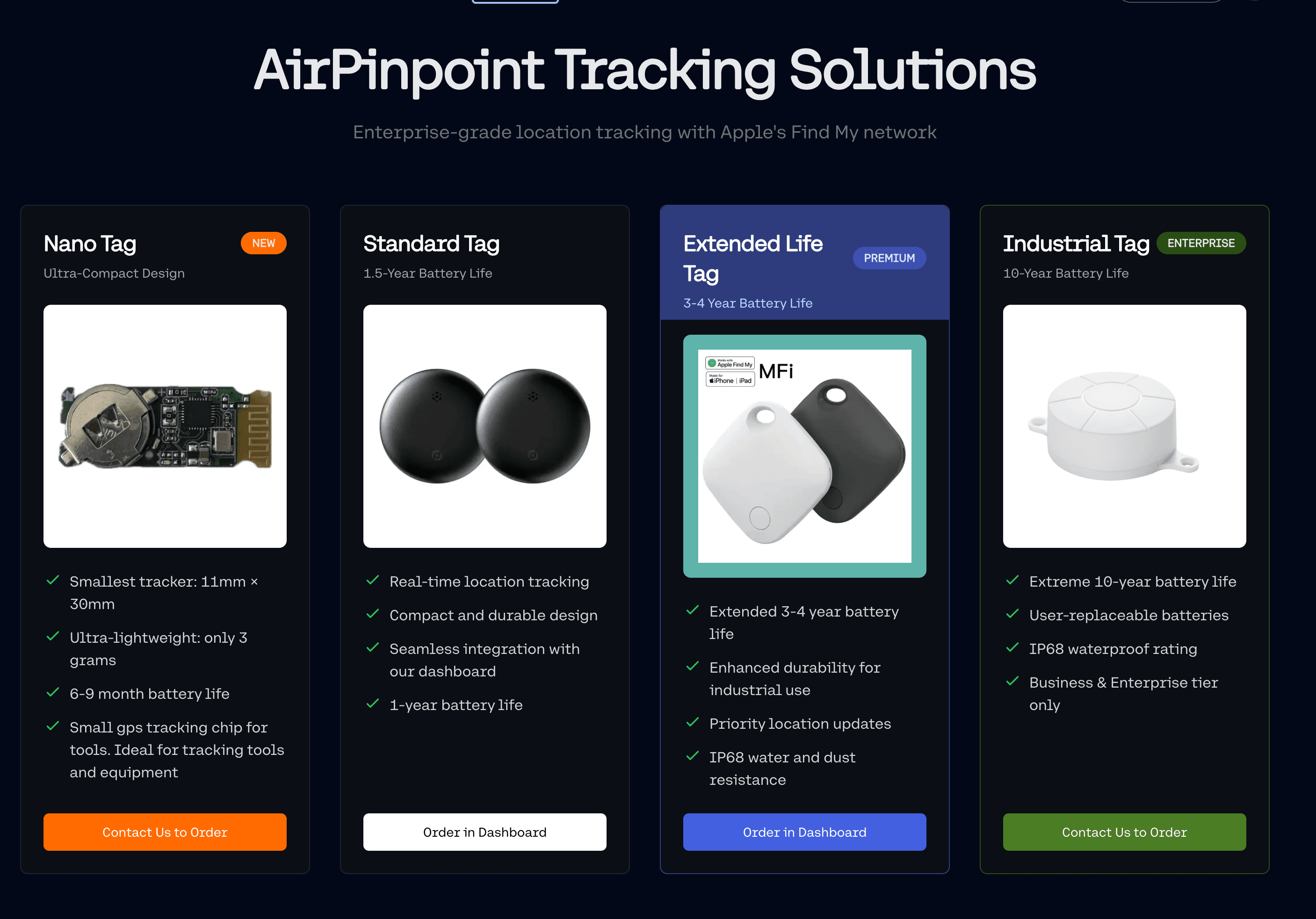
One AirTag per unit ($29) plus an AirPinpoint subscription ($11.99/unit/month) for a 150-unit event deployment costs $4,350 for the AirTags and $1,798.50/month for tracking. Preventing a single 5-unit loss event pays for the AirTags across the entire deployment.
How AirPinpoint Works for Portable Sanitation
Setup
-
Tag each unit. Attach an AirTag inside the holding tank compartment, under the urinal housing, or in the roof vent cavity. Use a weatherproof mount secured with industrial adhesive or cable ties. The polyethylene shell protects the AirTag from weather while still allowing Bluetooth signals to pass through.
-
Register in AirPinpoint. Add each unit to your AirPinpoint dashboard. Label units by type (standard, ADA, deluxe, hand wash station), serial number, or fleet ID.
-
Set up geofences. Create geofences around your storage yard, active construction sites, and event venues. Set alerts for when units move outside their designated area.
Daily Operations
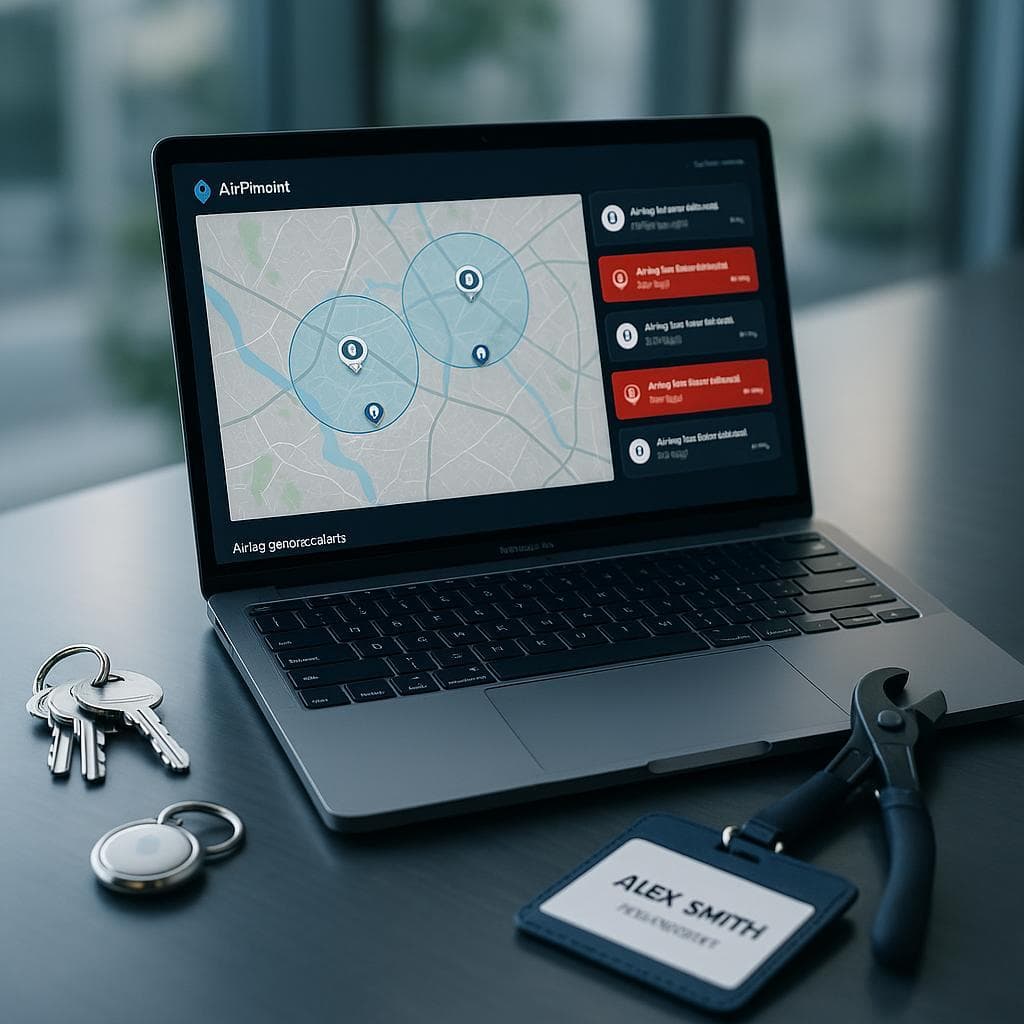
Fleet dashboard. Every unit appears on a single map with its last known location and timestamp. Filter by unit type, location, customer, or service date. Spot units that haven't moved in weeks (potential unreturned rentals). Identify units that moved unexpectedly (possible theft or unauthorized relocation).
Service routing. Export or view unit locations to plan efficient service routes. When a driver reports a unit missing from its expected location, check the dashboard for its actual GPS position instead of calling the customer.
Alerts. Receive notifications when a unit leaves a geofenced area outside of scheduled pickup times. Get alerts for units that haven't reported a location update in 7+ days (potential battery issue or unit in a low-traffic area).
History. Review the location history of any unit. Useful for resolving disputes with customers ("You never delivered the unit" / "Here's the location record showing delivery on March 3rd at 2:14 PM").
AirTag Durability in the Field
Portable toilets operate in tough conditions: rain, snow, extreme heat, UV exposure, and chemical cleaning agents. The AirTag itself is IP67 rated (water resistant to 1 meter for 30 minutes). Placed inside the unit's structure, it's protected from direct weather exposure.
Key placement considerations:
- Inside the holding tank compartment (rear panel access): Protected from users and weather. Service technicians can access it during pumping for battery checks.
- Under the urinal housing: Hidden from view, protected by the unit's shell.
- Inside the roof vent cavity: Elevated position gives better Bluetooth range but harder to access for battery changes.
Avoid external mounting. External AirTag holders are visible, can be removed by curious workers, and are exposed to pressure washing during cleaning.
Cost Analysis: Tracking vs. Not Tracking
For a 500-Unit Fleet
| Category | Without Tracking | With AirPinpoint |
|---|---|---|
| Annual unit losses (3-5%) | 15-25 units | 3-5 units (80% reduction) |
| Replacement cost | $9,000-$30,000 | $1,800-$6,000 |
| Lost rental revenue | $6,750-$26,250 | $1,350-$5,250 |
| Search labor (wrong locations) | $15,000-$25,000 | $2,000-$4,000 |
| AirTags (one-time, Year 1) | $0 | $14,500 |
| AirPinpoint subscription | $0 | $71,940/year |
| Battery replacement | $0 | $1,500/year |
| Total annual cost | $30,750-$81,250 in losses | $91,090 (Year 1) / $76,790 (Year 2+) |
For a 500-unit fleet, the math is tight in Year 1 because of the upfront AirTag cost. Starting in Year 2, tracking costs $76,790/year while preventing $30,750-$81,250 in losses. The ROI gets stronger as fleet size grows and unit losses compound.
The real payoff is operational. The loss prevention numbers above are conservative and only count direct replacement costs. The route efficiency gains (covered earlier) add another $28,725-$46,600 in annual savings. Combined, a 500-unit fleet saves $59,475-$127,850 annually against a $76,790 tracking cost (Year 2+).
For a 1,000-Unit Fleet
| Item | Year 1 | Year 2+ |
|---|---|---|
| AirTags (one-time) | $29,000 | $0 |
| AirPinpoint subscription | $143,880 | $143,880 |
| Battery replacement | $3,000 | $3,000 |
| Total tracking cost | $175,880 | $146,880 |
| Estimated losses prevented | $60,000-$125,000 | $60,000-$125,000 |
| Route efficiency savings | $57,450-$93,200 | $57,450-$93,200 |
| Net savings (Year 2+) | -$29,200 to +$71,320 |
Enterprise pricing is available for fleets over 200 devices. Per-device costs come down significantly at scale, improving the ROI for large operators.
Specialty and High-Value Units
Standard porta potties represent the bulk of most fleets, but specialty units carry much higher replacement costs:
| Unit Type | Purchase Cost | Weekly Rental Rate |
|---|---|---|
| Standard porta potty | $600-$1,200 | $75-$175 |
| ADA-compliant unit | $2,000-$3,500 | $125-$250 |
| Deluxe flushing unit | $1,200-$2,500 | $150-$300 |
| Hand wash station | $500-$1,500 | $50-$125 |
| Luxury restroom trailer (2-station) | $15,000-$30,000 | $500-$1,500 |
| Luxury restroom trailer (8-station) | $30,000-$75,000 | $1,500-$4,000 |
For restroom trailers costing $15,000-$75,000 each, GPS tracking is not optional. A single stolen or lost trailer represents a catastrophic financial loss. AirPinpoint's geofence alerts provide immediate notification if a trailer moves from its event site or storage yard.
Even for the less expensive specialty units, the higher replacement cost and limited inventory (most companies own fewer ADA units than standard ones) makes tracking worthwhile. Losing one of your 20 ADA-compliant units is not the same as losing one of your 800 standard units.
Integration with Existing Sanitation Software
Most portable sanitation companies already use industry software like ServiceCore, Slate Pages, or Basestation for scheduling, billing, and route management. AirPinpoint doesn't replace these tools. It adds a layer of physical location data that scheduling software can't provide.
Where they overlap:
- Both track which units are assigned to which customers
- Both help with route planning
Where AirPinpoint fills the gap:
- Scheduling software knows where a unit should be. AirPinpoint knows where it is.
- When a unit is moved without a work order, scheduling software has no idea. AirPinpoint's geofence alert catches it immediately.
- After an event, scheduling software shows 100 units as "on-site." AirPinpoint shows that 4 are actually half a mile away in a parking lot.
The combination of operational software (ServiceCore) and physical tracking (AirPinpoint) gives you complete visibility: what should be happening and what is actually happening.
Getting Started
Pilot program: Start by tagging your highest-value units (restroom trailers, ADA units, deluxe flushing units) and any units assigned to event rentals. This covers your most expensive assets and your highest-risk deployment type with the smallest upfront investment.
Full fleet rollout: Once you've validated the workflow with 50-100 units, tag the rest of your fleet during routine weekly servicing. A service technician can install an AirTag in under 2 minutes during a pumping visit.
Battery schedule: Add AirTag battery checks to your existing service checklist. Replace batteries every 10 months to stay ahead of the 12-month average lifespan. At $3 per battery, the cost is negligible compared to losing a single unit.
For fleets of 200+ units, contact our sales team for enterprise pricing and onboarding support.
 Our Solution