Lab Equipment Tracking: RFID Systems for Universities and Research Facilities
Research laboratories contain millions of dollars in scientific instruments, much of it purchased with federal grant funds that require rigorous accountability. Yet many institutions still rely on spreadsheets and manual inventory counts that consume valuable researcher time.
Modern lab equipment tracking systems solve this problem while ensuring compliance with NIH, NSF, and other funding agency requirements.
The Problem: Lost Equipment, Wasted Time
Time Lost Searching
Scientists in federal labs report losing up to 20% of their productive time searching for equipment. In a typical research university:
| Activity | Time Spent Weekly | Annual Cost (per researcher) |
|---|---|---|
| Searching for shared equipment | 2-4 hours | $5,000-10,000 |
| Manual inventory counts | 1-2 hours | $2,500-5,000 |
| Tracking down calibration records | 30-60 minutes | $1,250-2,500 |
| Total waste | 3.5-6.5 hours | $8,750-17,500 |
For a department with 20 researchers, that's $175,000-350,000 annually in lost productivity.
Equipment Values at Risk
| Equipment Category | Price Range | Common Issues |
|---|---|---|
| Confocal microscopes | $100,000-500,000 | Booking conflicts, maintenance gaps |
| Analytical centrifuges | $5,000-25,000 | Missing rotors, calibration lapses |
| Spectrophotometers | $5,000-50,000 | Shared across labs, location unknown |
| PCR machines | $2,000-15,000 | Consumable tracking needed |
| Portable analyzers | $1,000-10,000 | Frequently borrowed, not returned |
Compliance Risks
Universities receiving federal grants face audit requirements:
- $750,000+ threshold: Annual audit required per 2 CFR 200
- Equipment disposition: Must document when grant-funded items are sold/disposed
- Location tracking: Auditors may request proof of equipment presence
- Calibration records: Required for research validity and compliance
Common audit findings:
- Failure to document equipment monitoring and oversight
- Inability to locate grant-funded assets during site visits
- Missing calibration and maintenance records
How Lab Equipment Tracking Works
RFID Technology
RFID (Radio Frequency Identification) provides the foundation for modern lab tracking:
Components:
- RFID tags - Attached to each piece of equipment
- Fixed readers - Installed at doorways and key locations
- Handheld readers - For inventory audits and search
- Software platform - Manages data, alerts, and reporting
How it works:
- Tags contain unique identifiers and can store additional data
- Readers detect tags within range (up to 30 feet for UHF tags)
- No line-of-sight required—works through packaging, in drawers
- Automatic logging when equipment enters or leaves zones
Tag Types for Labs
| Tag Type | Cost | Read Range | Best For |
|---|---|---|---|
| Passive UHF | $0.50-2 | Up to 30 ft | General equipment |
| Passive HF | $1-5 | Up to 3 ft | Small instruments, samples |
| On-Metal Tags | $3-15 | Up to 20 ft | Metal equipment, centrifuges |
| Temperature Logging | $10-50 | Up to 10 ft | Cold storage, samples |
Integration Capabilities
Modern lab tracking systems integrate with:
- LIMS (Laboratory Information Management Systems)
- ERP systems for asset depreciation
- Calibration management software
- Room booking and scheduling systems
- Grant management platforms
Federal Compliance Requirements
NIH Requirements
For NIH grant recipients:
- Equipment purchased with grant funds must be tracked throughout useful life
- Institutions must have written procedures for equipment management
- Records must be maintained for 3 years after grant closeout
- Equipment disposition requires NIH approval for items over $5,000
NSF Requirements
NSF's Uniform Guidance (2 CFR 200) requires:
- Systematic method for equipment tracking
- Documentation of equipment condition and location
- Records of how equipment is used for grant purposes
- Resolution of audit findings within 30 days
Audit Preparation
RFID tracking simplifies compliance by providing:
| Requirement | Manual Approach | RFID Approach |
|---|---|---|
| Equipment location | Walk-through inventory | Real-time dashboard |
| Last seen date | Memory/logbooks | Automatic timestamps |
| Usage history | Sign-out sheets | Automated logging |
| Calibration status | Spreadsheet tracking | Integrated alerts |
| Audit report generation | Days of preparation | One-click export |
Implementation Guide
Phase 1: Assessment (2-4 weeks)
-
Inventory current equipment
- List all items over $5,000
- Identify grant-funded equipment
- Note high-movement shared items
-
Map facility layout
- Identify lab entrances and exits
- Note shared equipment areas
- Plan reader placement
-
Define requirements
- Compliance needs (NIH, NSF, institutional)
- Integration requirements (LIMS, ERP)
- Reporting needs
Phase 2: Pilot (4-8 weeks)
-
Select pilot area
- One building or department
- 50-100 pieces of equipment
- Mix of shared and dedicated items
-
Deploy infrastructure
- Install 4-6 fixed readers
- Tag pilot equipment
- Configure software
-
Train users
- Lab managers
- Researchers (basic location lookup)
- Grants administrators
-
Measure baseline
- Search time before/after
- Inventory accuracy
- User satisfaction
Phase 3: Expansion (3-6 months)
- Roll out by building/department
- Add equipment categories
- Integrate with existing systems
- Refine workflows based on pilot learnings
Solution Comparison
Enterprise RFID Platforms
| Vendor | Focus | Starting Price | Key Strengths |
|---|---|---|---|
| AssetPulse | Lab-specific | $5,000+ | Calibration management, compliance |
| RFID4U/TagMatiks | General + Lab | $3,000+ | Flexible, good integrations |
| inLogic | Research labs | Custom | NIH/NSF compliance focus |
| Xemelgo | Manufacturing + Lab | $10,000+ | Real-time visibility |
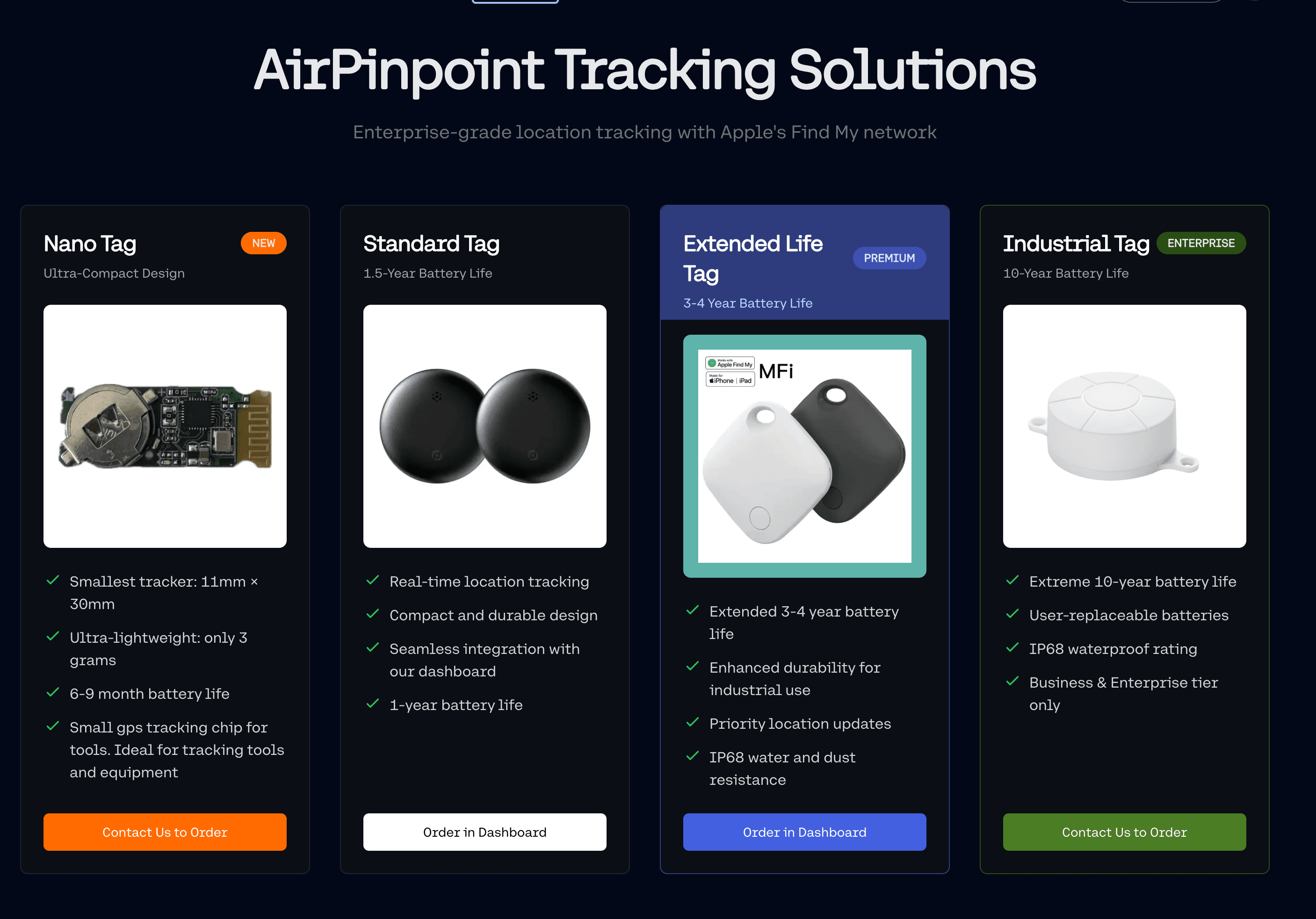
Recommended: AirTags with AirPinpoint
For most university labs, AirTags with AirPinpoint provide the best starting point:
| Solution | Hardware | Monthly Fee | Dashboard | Best For |
|---|---|---|---|---|
| AirTags + AirPinpoint | $29/item | From $11.99/tag | Yes | Portable equipment, quick deployment |
| Enterprise RFID | $5,000+ | $50-200 total | Yes | Full automation, large facilities |
| QR code systems | $500-2,000 | Varies | Limited | Manual check-in acceptable |
Why AirPinpoint wins for labs:
- Start tracking today - No infrastructure installation or IT approval required
- Professional dashboard - Essential for managing shared equipment across labs (not Apple's consumer app)
- Grant compliance - Export location history for NIH/NSF audit documentation
- Share with team - Multiple lab managers can access the same dashboard
- Geofence alerts - Know instantly when equipment leaves your building
- Prove value first - Demonstrate ROI before committing to $50K+ RFID infrastructure
Ideal for:
- Portable centrifuges, microscopes, and analyzers
- Equipment shared across multiple labs or buildings
- Loaner items sent to collaborators or field sites
- High-theft-risk items
- Departments wanting to prove tracking value before RFID investment
When to add RFID:
- You need automated check-in/check-out at doorways
- Tracking thousands of items (RFID scales better)
- Integration with LIMS or ERP is required
- Consumable and sample tracking needed
ROI Analysis
Medium Research University (500 tracked items)
Investment:
| Item | Cost |
|---|---|
| RFID tags (500 × $5) | $2,500 |
| Fixed readers (10 × $1,500) | $15,000 |
| Handheld readers (3 × $1,000) | $3,000 |
| Software (Year 1) | $6,000 |
| Implementation services | $8,000 |
| Total Year 1 | $34,500 |
Annual Savings:
| Category | Savings |
|---|---|
| Researcher time (50 researchers × 2 hrs/week × $50/hr × 50 weeks) | $250,000 |
| Avoided equipment loss (2% reduction × $2M inventory) | $40,000 |
| Reduced duplicate purchases | $25,000 |
| Audit preparation time | $15,000 |
| Total Annual Savings | $330,000 |
Payback period: 6 weeks
Common Challenges
Challenge: Metal Equipment
Problem: Metal interferes with standard RFID signals.
Solution: Use specialized on-metal tags designed for centrifuges, freezers, and metal instruments. These cost $5-15 more but provide reliable reads.
Challenge: Multi-Building Operations
Problem: Equipment moves between buildings with different systems.
Solution: Cloud-based platforms that centralize data. Ensure consistent tag standards across locations.
Challenge: Researcher Adoption
Problem: Scientists resist "administrative overhead."
Solution:
- Make the system save time (easy location lookup)
- Mobile-friendly interfaces
- Demonstrate value with pilot success stories
- Automate as much as possible (no manual check-in required)
Challenge: Sample and Consumable Tracking
Problem: Tracking thousands of samples and reagents.
Solution:
- RFID tags with temperature logging for critical samples
- Focus tracking on high-value or expiring items
- Integrate with LIMS for sample management
The Bottom Line
Lab equipment tracking has evolved from compliance burden to competitive advantage:
- 20% time savings for researchers finding equipment
- Automated compliance with NIH, NSF, and institutional requirements
- 6-week payback typical for medium-sized implementations
- Reduced losses of expensive shared equipment
Start with:
- Grant-funded equipment (compliance requirement)
- Shared instruments (highest search time)
- High-value items (greatest loss risk)
- RFID for core tracking, AirTags for mobile supplements
The institutions that track their equipment effectively spend more time doing research and less time searching for microscopes.
 Our Solution