Updated
AirTags vs Bouncie: Personal Tracker vs Fleet Dashboard
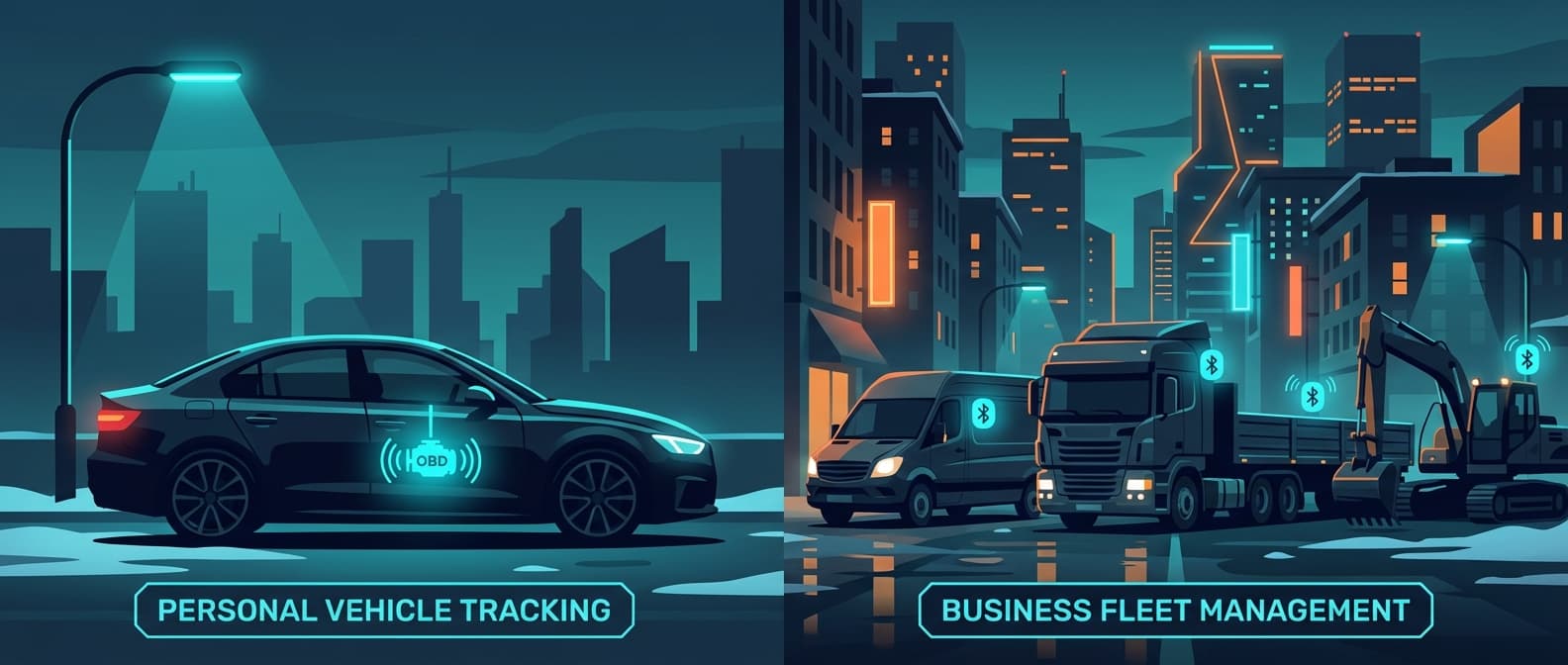
Bouncie Tracks Cars. Airpinpoint Tracks Your Business.
Bouncie is a solid personal vehicle tracker. For $67 hardware and $8/month, you get real-time GPS, trip logs, and check-engine alerts on a single car. If that's all you need, it works great.
But the moment you need to track more than a few vehicles, or anything that isn't a vehicle at all (trailers, equipment, tools, containers), Bouncie hits a wall. No fleet dashboard. No team access. No way to track unpowered assets. No API.
AirTags with Airpinpoint give you a purpose-built fleet platform: every asset on one map, team access with permissions, polygon geofencing, webhook integrations, and the ability to track anything, powered or not. All at $11.99/device/month with no contracts.
The question isn't which tracker is cheaper per vehicle. It's which platform actually runs your fleet.
Bouncie Pricing Breakdown
What You Actually Pay
| Cost Component | Amount |
|---|---|
| Hardware | $67 (one-time purchase) |
| Monthly subscription | $8/vehicle |
| Contract | None required |
| Cancellation | Anytime, keep the hardware |
| OBD-II port required | Yes (1996+ vehicles) |
| App | Free (iOS and Android) |
Bouncie's pricing is simple and transparent. No activation fees, no hidden costs. You buy the device, plug it in, and pay $8/month. If you cancel, you keep the hardware and can reactivate anytime.
How Bouncie Compares on Price
At $8/month, Bouncie is one of the cheapest GPS trackers available. For context:
| Tracker | Hardware | Monthly Fee | Annual Cost (1 vehicle) |
|---|---|---|---|
| Bouncie | $67 | $8 | $163 |
| Vyncs | $59 | $6.58 (annual plan) | $138 |
| MOTOsafety | $80 | $20 | $320 |
| LandAirSea Overdrive | $30 | $20 | $270 |
| CarLock | $60 | $7.42 (annual) | $149 |
| One Step GPS | Free | $13.95 | $167 |
Bouncie sits in the sweet spot: cheaper than most GPS trackers, more reliable than the cheapest options, and backed by 20,000+ Amazon reviews at 4.3/5 stars.
What Bouncie Does Well
Bouncie earned its reputation as the best consumer OBD-II tracker for good reasons.
Real-Time GPS Tracking
- 15-second update intervals while driving
- Trip history with exact routes driven
- Location sharing with family members
- Geo-circle alerts (enter/exit notifications)
Vehicle Health Monitoring
This is where Bouncie genuinely differentiates. By reading your vehicle's OBD-II port, it provides:
- Check engine light interpretation (DTC codes translated to plain English)
- Maintenance reminders based on actual mileage
- Battery voltage monitoring
- Estimated fuel costs per trip
For someone managing a personal vehicle, getting a push notification that says "your check engine code means your oxygen sensor is failing" is useful information you won't get from any Bluetooth tracker.
Driving Insights
- Speed alerts (customizable thresholds)
- Rapid acceleration and hard braking detection
- Trip scoring
- Daily/weekly driving summaries
Build Quality and Reliability
Bouncie's 4.3/5 across 20,000+ Amazon reviews is earned through consistency. Users report months of reliable tracking without dropped connections. The OBD-II plug-in design means no batteries to charge, no wiring to install, and no weather exposure.
What Bouncie Can't Do
For all its strengths as a personal tracker, Bouncie has real limitations for business use.
No Fleet Dashboard
This is the critical gap. Bouncie was designed for individual vehicle tracking. There is no combined fleet view showing all your vehicles on one map. No consolidated reporting across multiple vehicles. No way to compare utilization or identify which vehicle is closest to a job site.
If you have 10 vehicles, you're managing 10 separate tracking views.
No Team Access
Bouncie accounts are personal. There's no way to add team members with different permission levels. Your dispatcher can't have read-only access while your operations manager has full control. Every person who needs access shares the same login credentials.
Only OBD-II Vehicles
Bouncie requires an OBD-II port. That means it cannot track:
- Trailers (the most common unpowered fleet asset)
- Generators and compressors
- Construction equipment without standard OBD ports
- Containers and dumpsters
- Tools, parts bins, or storage units
- Heavy equipment with proprietary diagnostic systems
If your business owns anything beyond passenger vehicles and light trucks, Bouncie leaves those assets completely untracked. And the obvious fallback, adding a battery-powered cellular GPS tracker for non-OBD assets, runs into the battery fine print: those trackers advertise multi-year batteries by updating roughly once per day. A generator tracker that pings once a day tells you where the generator was yesterday, not where it is now. AirTag + Airpinpoint delivers updates every 1-5 minutes in populated areas for 12+ months on a $3 coin cell, because nearby iPhones do the GPS fix and cellular upload on their own batteries. Bouncie is exempt from this trade-off (vehicle power is genuine real-time). The rest of your fleet is not.
No API or Integrations
Bouncie doesn't offer an API for businesses. You can't pipe location data into your dispatch software, ERP, or custom workflows. What you see in the app is all you get.
Consumer-Grade Alerts
Bouncie's geo-circles and speed alerts work fine for monitoring a teenager's driving. For business operations with dozens of geofenced job sites, configurable alert routing, and webhook integrations, the system wasn't built for that complexity.
True Cost Comparison
Bouncie looks cheaper on paper per vehicle. But businesses don't just track vehicles, and Bouncie can't track anything else. When you account for actual fleet needs, Airpinpoint delivers far more value.
Single Vehicle Over 3 Years
Bouncie:
- Hardware: $67
- Monthly subscription: $8 x 36 = $288
- Total: $355
AirTag + Airpinpoint:
- AirTag: $29
- Airpinpoint subscription: $11.99 x 36 = $432
- Battery replacements: ~$3
- Total: ~$464
Bouncie saves $109 for a single personal vehicle. If tracking one car with driving data and diagnostics is your only need, Bouncie works. But this is a personal tracking use case, not a business one.
5 Vehicles Over 3 Years
Bouncie:
- Hardware: 5 x $67 = $335
- Monthly subscription: 5 x $8 x 36 = $1,440
- Total: $1,775
AirTags + Airpinpoint:
- AirTags: 5 x $29 = $145
- Airpinpoint subscription: 5 x $11.99 x 36 = $2,158
- Battery replacements: ~$25
- Total: ~$2,328
Bouncie is $553 cheaper in raw per-device cost. But at 5 vehicles, you're managing 5 separate tracking views with no combined dashboard, no team access, and zero ability to track the trailers and equipment that make up the rest of your fleet. Airpinpoint gives you a single dashboard for everything your business owns.
10 Vehicles Over 3 Years
Bouncie:
- Hardware: 10 x $67 = $670
- Monthly subscription: 10 x $8 x 36 = $2,880
- Total: $3,550
AirTags + Airpinpoint:
- AirTags: 10 x $29 = $290
- Airpinpoint subscription: 10 x $11.99 x 36 = $4,316
- Battery replacements: ~$50
- Total: ~$4,656
Bouncie saves $1,106 on vehicle-only tracking. But that $1,106 "savings" comes at the cost of everything that makes fleet tracking actually useful: a combined dashboard, team member access, the ability to track trailers and equipment, polygon geofencing with automated alerts, and webhook integrations. For a business, those aren't nice-to-haves. They're the reason you're buying tracking software.
The Real Fleet Comparison (This Is What Actually Matters)
Most businesses don't just track vehicles. A typical 10-vehicle operation also owns:
- 5 trailers
- 10 pieces of equipment or tools
- 3 storage containers
Bouncie: Tracks only the 10 vehicles. Total: $3,550 over 3 years. The other 18 assets? Completely invisible. Lost trailers, stolen equipment, misplaced tools: Bouncie can't help.
Airpinpoint: Track all 28 assets on one dashboard.
- AirTags: 28 x $29 = $812
- Subscription: 28 x $11.99 x 36 = $12,086
- Battery replacements: ~$140
- Total: ~$13,038 for complete fleet visibility from one dashboard
To match Airpinpoint's coverage with Bouncie, you'd need separate battery GPS trackers for the 18 non-vehicle assets. At $15-25/month each, that's $9,720-$16,200 over 3 years on top of Bouncie's $3,550. That's $13,270-$19,750 total, more expensive than Airpinpoint, and you'd still be managing two separate platforms with no unified view.
There's also the battery fine print on those non-vehicle GPS trackers. Because trailers and generators have no power source, you're in battery-GPS territory. Battery GPS trackers advertising multi-year life achieve that by updating roughly once a day. At once-per-minute updates, those batteries hold days. AirTags update every 1-5 minutes in populated areas for 12+ months on a $3 coin cell. For the 18 unpowered assets Bouncie can't touch, AirTag + Airpinpoint is both cheaper and more frequent than any battery GPS alternative.
Airpinpoint gives you one dashboard for everything at a lower total cost. That's the comparison that matters for a business.
Feature Comparison
| Feature | Bouncie | AirTags + Airpinpoint |
|---|---|---|
| Real-time GPS | Yes (15-second updates) | No (Bluetooth-based, variable) |
| Trip history | Yes (exact routes) | Location history (point-to-point) |
| Speed alerts | Yes | No |
| Driving behavior | Yes (acceleration, braking) | No |
| Vehicle diagnostics | Yes (OBD-II DTC codes) | No |
| Maintenance reminders | Yes (mileage-based) | No |
| Geofencing | Geo-circles | Polygon geofences with alerts |
| Fleet dashboard | No | Yes |
| Team access | No | Yes (role-based) |
| API/Webhooks | No | Yes |
| Unpowered assets | No (OBD-II required) | Yes (any asset) |
| Indoor tracking | No (GPS only) | Yes (Find My network) |
| Hardware cost | $67/device | $29/tag |
| Monthly cost | $8/vehicle | $11.99/device |
| Contract | None | None |
| Installation | Plug into OBD port | Attach anywhere |
What Bouncie Users Say
The Positives
Bouncie's Amazon reviews highlight consistent themes:
- Reliability: "Set it and forget it. Haven't touched it in 8 months and it still works perfectly."
- Vehicle health: "Told me my battery was dying before I noticed any symptoms."
- Value: "Can't beat $8/month for what you get."
- App quality: "Clean, intuitive app. My wife figured it out in two minutes."
The Negatives
Common complaints in the 1-2 star reviews:
- Cellular coverage gaps: Some rural users report location drops where cell service is weak.
- No multi-vehicle view: "Works great for one car. Terrible for managing a small fleet."
- App stability: Occasional crashes and slow loading, particularly after app updates.
- Customer support: Mixed experiences. Some users report fast resolution, others describe long waits.
- Limited alert customization: Geo-circles only (no polygon geofences), and alert options are basic compared to fleet platforms.
The pattern is clear: people who use Bouncie for 1-2 personal vehicles love it. People who try to scale it to business use hit walls quickly.
When Bouncie Makes Sense (Personal Use)
Bouncie fits a narrow but specific use case:
-
You're tracking 1-3 personal vehicles. Monitoring a teenager's driving, keeping tabs on family vehicles, or watching a single company car. This is what Bouncie was built for.
-
Vehicle diagnostics are your primary goal. You want check-engine code alerts and maintenance reminders more than fleet-wide visibility.
-
You have no non-vehicle assets to track. If trailers, equipment, tools, or containers are part of your operation, Bouncie can't help with those.
If any of these descriptions don't match your situation, Airpinpoint is the better tool.
When to Choose AirTags with Airpinpoint (Any Business Use)
If you're tracking assets for a business, Airpinpoint is the right platform:
-
You manage any number of business assets. One dashboard for your entire fleet. Role-based team access so dispatchers, managers, and field crews all see what they need. This is what Bouncie fundamentally lacks.
-
You track more than just vehicles. Vehicles, trailers, equipment, tools, and containers all on the same map. Bouncie is physically limited to OBD-II ports, which excludes most business assets.
-
You need your tracking data to connect to other systems. Webhook alerts, API access, and data export for compliance reporting. Bouncie has no API, no integrations, no export.
-
Your assets include anything without a power source. Trailers, generators, storage containers, toolboxes, scaffolding. AirTags work on all of them. Bouncie works on none of them.
-
You want to deploy in hours, not days. 50 AirTags deployed in an afternoon. No OBD ports to find, no connections to verify, no vehicle downtime.
-
Your assets move through buildings. Warehouses, parking garages, dense urban areas. Apple's Find My network (1B+ devices) provides location data where GPS signals degrade. Bouncie goes dark indoors.
The Hybrid Approach
Bouncie and Airpinpoint aren't mutually exclusive. Many business owners find the best setup uses both:
Use Bouncie For:
- Your personal vehicle where driving data, trip logs, and vehicle health monitoring provide daily value
- A small number of high-priority vehicles where 15-second GPS updates genuinely matter
- Any vehicle where OBD diagnostics (engine codes, maintenance tracking) justify the $8/month
Use Airpinpoint For:
- Your business fleet, visible on one dashboard with team access
- Every trailer, container, and piece of equipment your business owns
- Geofenced job sites with automated entry/exit alerts
- Assets where "location within the last hour" is sufficient
A plumbing company owner might keep Bouncie on their personal truck for the driving data and vehicle health alerts, then use Airpinpoint across their 8 work vans, 4 trailers, and 20 pieces of equipment. One personal tracker for the vehicle they care about most, one business platform for everything else.
Bouncie vs. Other GPS Trackers
| Platform | Hardware | Monthly | OBD Required | Fleet Dashboard | Best For |
|---|---|---|---|---|---|
| Bouncie | $67 | $8 | Yes | No | Personal vehicle tracking |
| Vyncs | $59 | $6.58 | Yes | No | Budget-conscious individuals |
| MOTOsafety | $80 | $20 | Yes | Basic | Teen driver monitoring |
| One Step GPS | Free | $13.95 | No (multiple options) | Yes | Small business fleets |
| Samsara | $99-148 | $27-33 | No | Yes | Enterprise fleets, ELD |
| AirTags + Airpinpoint | $29 | $11.99 | No | Yes | Mixed fleets, any asset type |
Bouncie occupies a specific niche: cheap personal vehicle GPS tracking. It was never designed for business fleet management. If you're reading this comparison because you're evaluating fleet tracking options, Airpinpoint is the solution built for that purpose.
Our Recommendation
If you're tracking a personal car, Bouncie works. The $8/month price with OBD diagnostics is fair value for monitoring a single vehicle.
If you're tracking anything for a business, start with Airpinpoint. Deploy AirTags on every vehicle, trailer, piece of equipment, and tool your business owns. Get fleet-wide visibility from one dashboard with team access, polygon geofencing, location history, and webhook integrations. You'll be up and running in an afternoon with coverage across your entire operation, not just vehicles with OBD ports.
Bouncie is a personal tracker that some people try to use for business. Airpinpoint is a fleet tracking platform built for business from day one. The gap in capability is massive: team management, multi-asset tracking, API integrations, and the ability to track anything with a $29 tag and no wiring.
Start tracking your fleet with Airpinpoint and see every asset on one dashboard today.
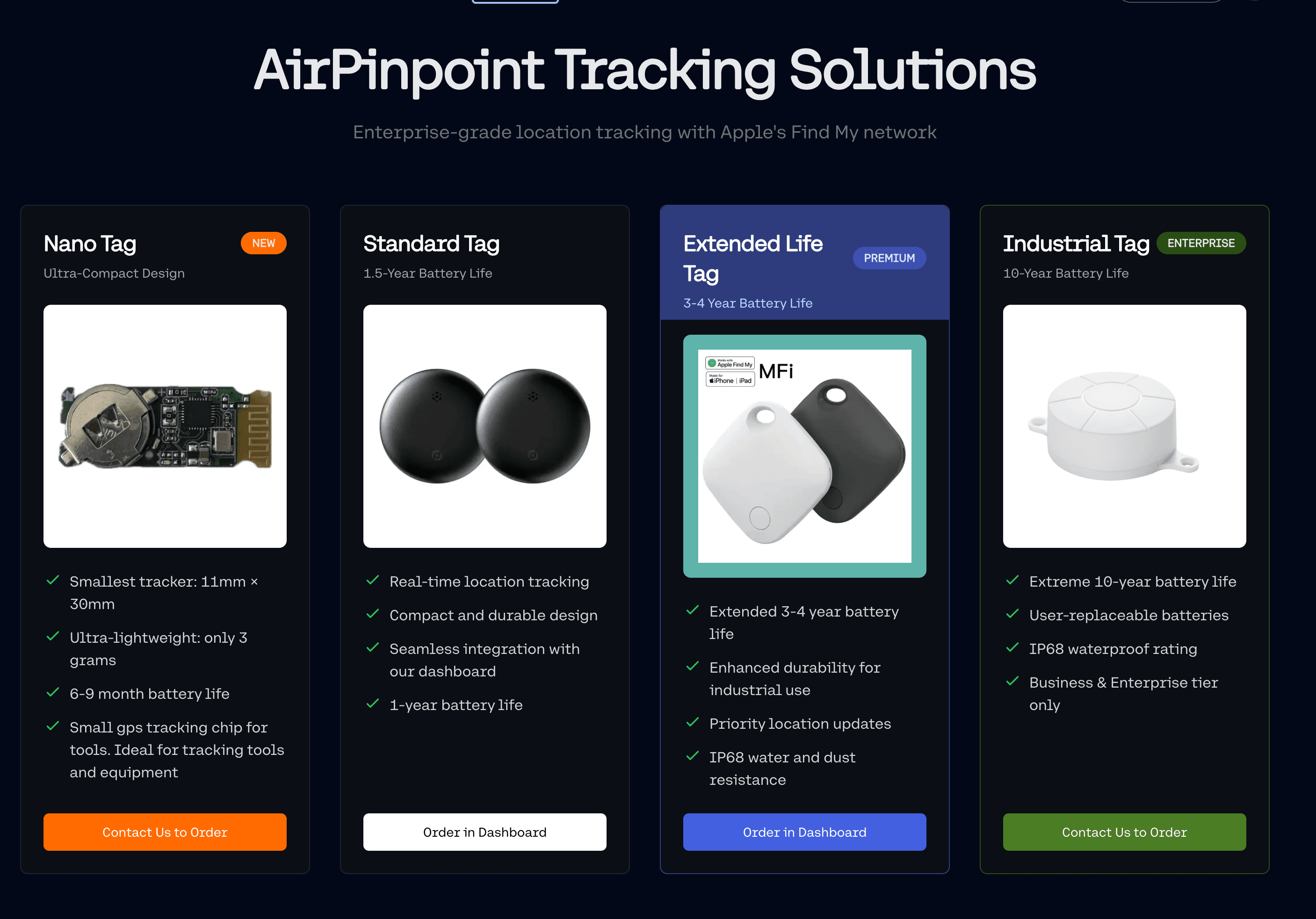
 Our Solution