Updated
Sports Equipment Management: Tracking & Inventory for Athletic Programs
A Division I football equipment manager receives 40,000 items before the season starts. Some programs get 300,000. Helmets, shoulder pads, jerseys, practice shorts, cleats, gloves, thousands of T-shirts. Every item needs to be cataloged, assigned to a player, tracked through the season, and accounted for at the end.
Most of this tracking still happens on spreadsheets and whiteboards.
The equipment manager role is one of the most operationally demanding jobs in athletics. They outfit every athlete, maintain compliance with safety standards, manage gear across multiple facilities, pack for away games, and do the team's laundry. When something goes missing, it's their problem. When a helmet fails inspection, it's their liability.
This guide covers how athletic programs manage equipment at every level, the technology options available, and where the industry is headed.
The Scale of Athletic Equipment
Cost Per Player
Equipping athletes is expensive. Football is the most costly sport, but every program faces significant per-player costs.
Football Equipment Costs:
| Item | Cost Range | Lifespan |
|---|---|---|
| Helmet | $175-$400 | 10 years (with annual reconditioning) |
| Shoulder pads | $150-$300 | 3-5 years |
| Thigh and knee pads | $50-$100 | 1-2 seasons |
| Cleats | $80-$200 | 1 season |
| Game jersey | $75-$150 | 2-3 seasons |
| Practice jersey set | $40-$80 | 1 season |
| Girdle/compression gear | $40-$80 | 1-2 seasons |
| Gloves | $30-$60 | 1 season |
| Total per player (game day) | $1,200+ |
NFL helmets run $1,200 to $1,800+ per unit. At the college level, athletic departments typically pay $175-$200 for helmets that last up to 10 years with proper reconditioning.
Other Sports:
| Sport | Key Equipment | Cost Per Player |
|---|---|---|
| Ice hockey | Helmet, pads, skates, stick | $800-$2,000+ |
| Lacrosse | Helmet, pads, stick, gloves | $500-$1,200 |
| Baseball/softball | Helmet, bat, glove, catcher's gear | $300-$800 |
| Basketball | Shoes, uniforms, practice gear | $200-$500 |
| Soccer | Cleats, shin guards, uniforms | $150-$400 |
| Track & field | Shoes, uniforms, throwing implements | $150-$400 |
Program-Level Budgets
At the high school level, a single school's athletic department spends $150,000+ per year on equipment across all sports. One report found that at least half of annual equipment budgets go to reconditioning and replacing helmets alone, leaving little room for new purchases.
High school athletic directors report that 23.8% of their budgets come from fundraising. Equipment costs keep rising, but budgets do not.
At the college level, FBS football operating budgets average over $22 million (tripling since 2003). Equipment is one line item in that total, but for a program outfitting 120+ players with multiple uniform combinations, practice sets, and cold/warm weather gear, equipment spending runs well into six figures annually.
The Volume Problem
The raw numbers are staggering. One D-I equipment manager described receiving 39,000 items scheduled for distribution, with more than half being non-football apparel going to other sports. Brand partnerships with Nike, Adidas, or Under Armour can push total item counts past 100,000 per year at major programs.
Every one of those items needs:
- A record of who received it
- A timestamp of when it was issued
- A current location or status
- A return/end-of-life disposition
Multiply that across 20+ varsity sports at a D-I school, and you understand why equipment managers work 80-hour weeks during season.
Compliance: NOCSAE and Safety Standards
What Equipment Managers Must Track
The National Operating Committee on Standards for Athletic Equipment (NOCSAE) sets safety standards for helmets used in football, lacrosse, baseball, and softball. NCAA rules have mandated NOCSAE-certified helmets since 1978. NFHS (high school) rules require the same.
Every football helmet in an athletic program must have:
- NOCSAE certification at time of purchase
- Annual reconditioning by a licensed reconditioner (NAERA member)
- Recertification testing per the NOCSAE ND004 standard
- Retirement after 10 years from manufacture date
- Complete maintenance history documenting every reconditioning cycle
Reconditioning involves full disassembly, cleaning, sanitizing, worn-part replacement, and shell inspection. A statistically significant sample of helmets from each batch is drop-tested before and after reconditioning. If helmets fail, they cannot be recertified.
The Compliance Tracking Burden
For a football program with 200 helmets (practice and game sets), the equipment manager must know:
- The manufacture date and model of every helmet
- Which reconditioning cycle each helmet is in (year 1, year 2, ... year 10)
- When each helmet was last reconditioned and by whom
- Whether each helmet passed its most recent drop test
- Which player is currently assigned to each helmet
Getting this wrong has real consequences. Playing a student-athlete in an expired or non-recertified helmet is a safety violation and a liability issue. Programs have faced lawsuits over equipment failures.
Most equipment managers track this in SportSoft, HelmetTracker, or spreadsheets. None of these tools tell you where a specific helmet physically is right now.
How Equipment Gets Lost
Athletic equipment disappears through predictable channels:
Multi-Facility Sprawl
A typical D-I athletic department operates out of multiple buildings: the main equipment room, a football-only facility, an arena, satellite weight rooms, practice fields with storage, and an indoor facility. Equipment moves between these locations constantly. A set of shoulder pads checked out for a Tuesday practice at the auxiliary field may not return to the main equipment room for days.
Away Games and Travel
Equipment managers pack everything for road trips, sometimes filling entire trucks. At the destination, gear gets stored in visitor locker rooms, spread across hotel rooms, and used at the game venue. After the game, everything must be repacked under time pressure. Items left behind at away venues are a regular occurrence, and recovering them requires phone calls, shipping, and hope.
Player Hoarding
Athletes keep gear in their lockers, dorm rooms, cars, and apartments. End-of-season collection is a multi-week effort. Programs report that 5-15% of issued apparel is never returned. At schools with transfer portal activity, departing athletes sometimes leave with program-issued equipment.
Shared Equipment Between Sports
Some items, like blocking sleds, tackling dummies, or training equipment, are shared between programs. When the football team finishes with a set of resistance bands and the track team borrows them, there may be no formal handoff. The equipment manager finds out when someone asks where the bands are and nobody knows.
Current Tracking Methods
Spreadsheets
Still the most common approach at the high school level and many smaller college programs. Equipment managers maintain Excel or Google Sheets files with columns for item type, serial number, player assignment, and condition. The problem: spreadsheets require manual updates, have no location awareness, and break down at scale.
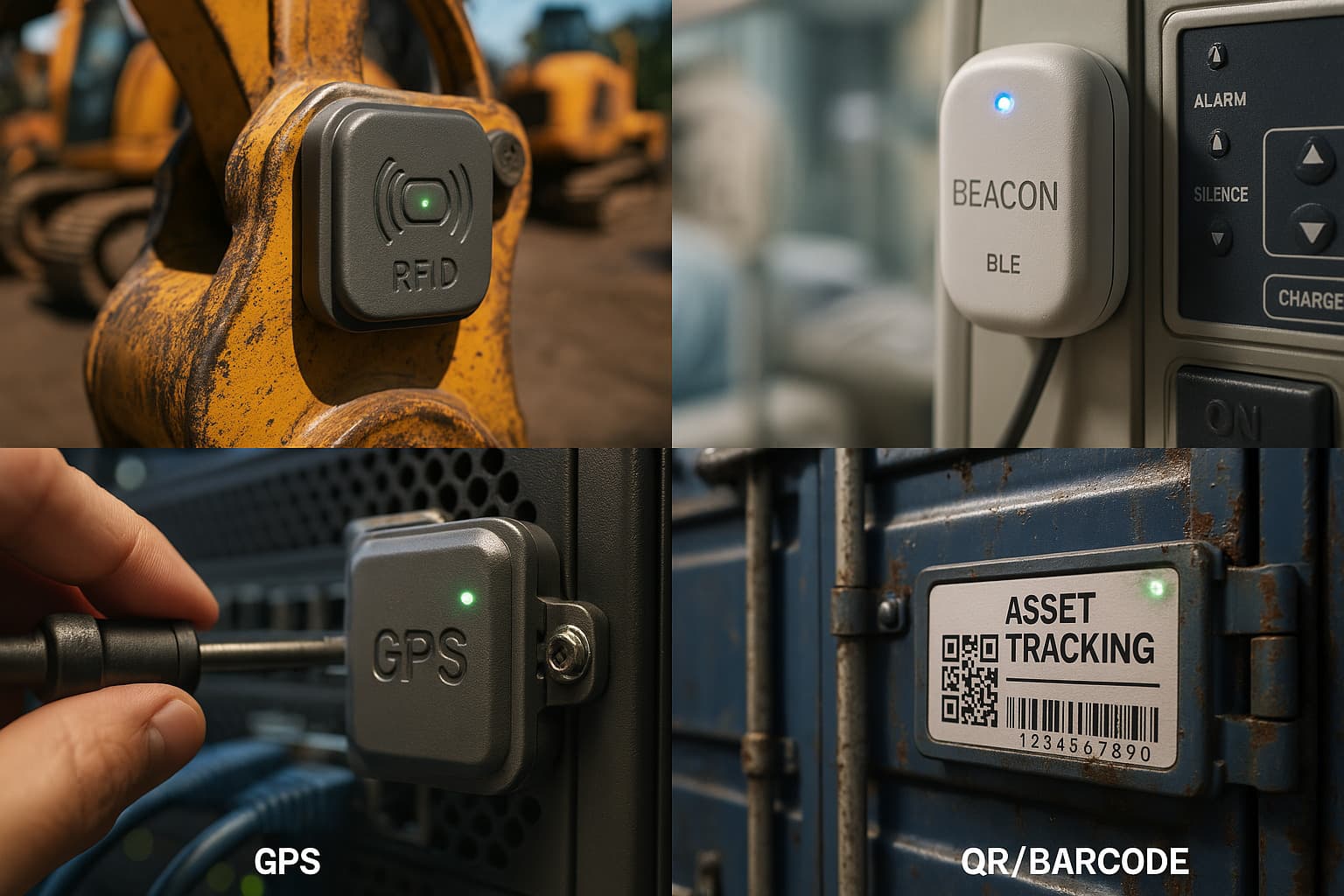
Barcode and QR Code Systems
SportSoft, CompuSports, and HelmetTracker all support barcode scanning. Each item gets a barcode label. Staff scan items during check-out and check-in. This approach works well for tracking assignments (who has what) but has significant gaps:
- No real-time location. Barcodes only record the last scan event. If an item was scanned out three weeks ago and never scanned back in, you know it's missing, but not where it is.
- Scan discipline required. The system is only as good as the staff's consistency in scanning every item at every transition. Under game-day pressure, scans get skipped.
- No alerts. Barcodes are passive. They cannot notify you when equipment leaves a building.
RFID
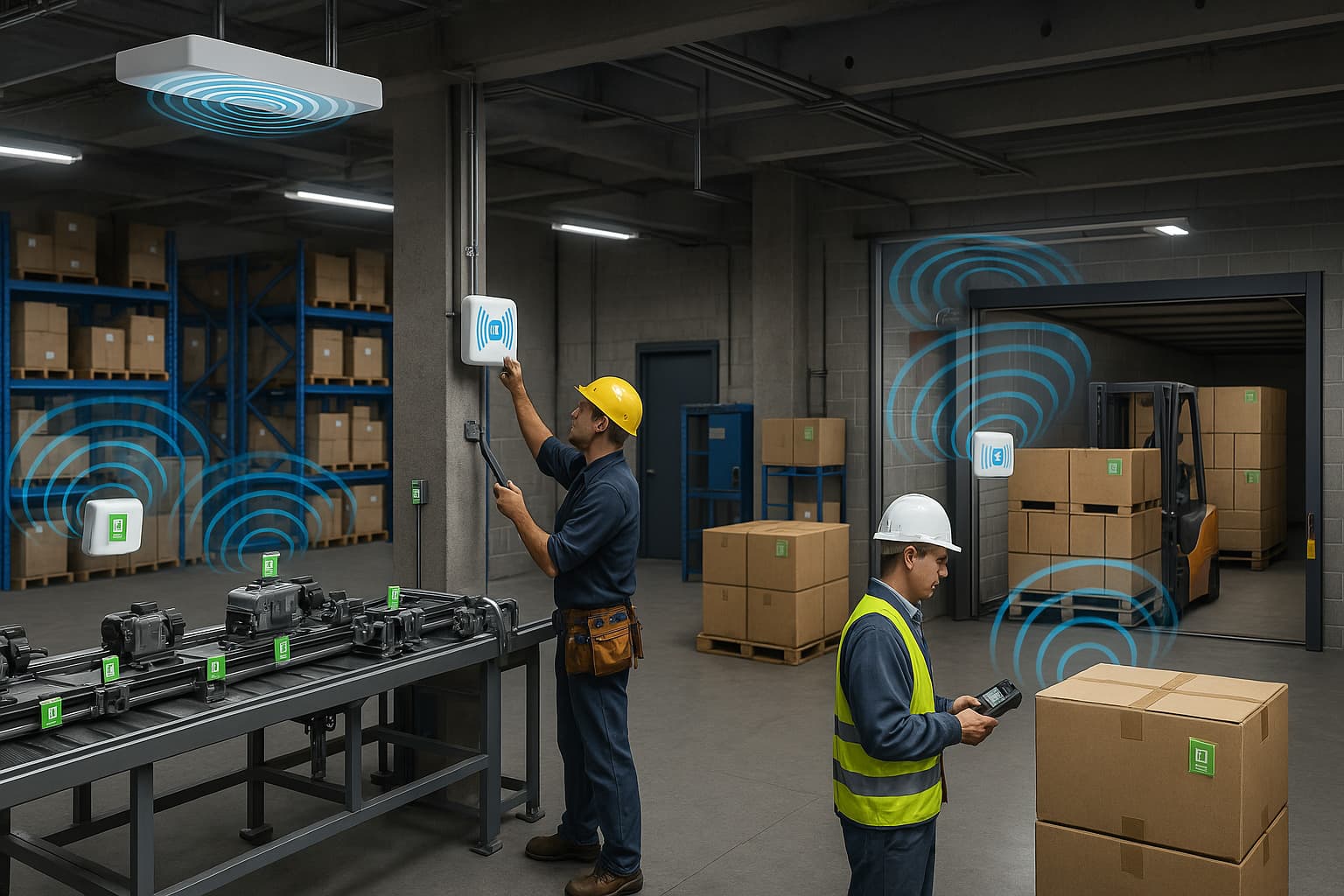
Some larger athletic departments have invested in RFID (Radio Frequency Identification) for equipment tracking. RFID readers at doorways can automatically detect tagged items passing through, eliminating the need for manual scans.
RFID Pros:
- Automatic detection at chokepoints
- Can scan multiple items simultaneously
- No line-of-sight required
RFID Cons:
- Infrastructure cost: readers at every doorway run $1,000-$5,000+ each
- Tags cost $0.10-$10 depending on type
- Limited range (passive RFID: 1-30 feet)
- Cannot track items once they leave the building
- Requires wiring, installation, and IT support
RFID tells you what passed through a door. It does not tell you where something is right now if it left the building.
The Gap
All of these methods share a fundamental limitation: they track check-out events, not current physical location. When the football operations coordinator asks "Where are the 12 helmets that were supposed to go out for reconditioning?" the answer requires walking buildings, checking shelves, and making phone calls.
BLE Tracking: Filling the Location Gap
Bluetooth Low Energy (BLE) tracking, specifically through Apple's Find My network, addresses the location problem that barcode and RFID systems cannot solve.
How It Works for Athletics
An AirTag or Find My-compatible tracker attached to a piece of equipment broadcasts a Bluetooth signal. Any nearby iPhone, iPad, or Mac detects that signal and relays the equipment's location to the owner, anonymously and encrypted. On a college campus with thousands of iPhones walking past equipment rooms, practice fields, and stadiums, network coverage is dense.
Battery-powered GPS trackers are sometimes considered for unpowered sports equipment, but they do not fit this use case well. GPS requires a satellite fix and a cellular transmit for every update, which drains batteries in days at useful update rates. The multi-year battery claims GPS trackers advertise assume roughly one update per day. A helmet sitting in an auxiliary building and updated once every 24 hours is not tracked equipment, it is a breadcrumb trail from yesterday. An AirTag on a campus updates every few minutes for 12+ months on a $1-3 coin cell, because the GPS and cellular work gets done by the phones already in the building.
What BLE Tracking Adds
| Capability | Barcode/QR | RFID | BLE (Airpinpoint) |
|---|---|---|---|
| Assignment tracking (who has what) | Yes | Yes | Via integration |
| Check-in/check-out logging | Yes | Automatic at doors | Automatic via geofence |
| Real-time location | No | At chokepoints only | Yes, campus-wide |
| Off-campus tracking (away games) | No | No | Yes |
| Geofence alerts | No | No | Yes |
| Multi-facility visibility | No | Per-building only | Yes, all locations |
| Infrastructure required | Scanner | Readers + wiring | None |
| Cost per item | $0.01-$0.10 (label) | $0.10-$10 (tag) | $29 (AirTag) |
| Monthly cost | Software license | Software + maintenance | $11.99/tag |
Where BLE Tracking Makes Sense for Athletics
BLE tracking is not a replacement for barcode systems that manage player assignments and sizing. It fills a different role: knowing where high-value, mobile equipment physically is at any given time.
Best candidates for BLE tracking:
- Football helmets ($175-$400 each, NOCSAE compliance tracking required)
- Shoulder pad sets ($150-$300, assigned to individual players)
- Equipment trunks and cases (contain thousands of dollars in gear for travel)
- Training equipment (shared across sports, frequently moves between facilities)
- Medical/athletic training kits (AED units, taping supplies, moved to fields daily)
- Film and video equipment (cameras, tripods, tablets used at practice and games)
You would not tag every pair of socks. But tagging every $200+ item and every equipment trunk changes how an equipment room operates.
Airpinpoint for Athletic Programs
Airpinpoint turns Apple AirTags into a team-wide tracking system. Instead of each tag being tied to one person's iCloud account, Airpinpoint provides a shared dashboard where the entire equipment staff sees every tagged item.
Key Features for Athletics
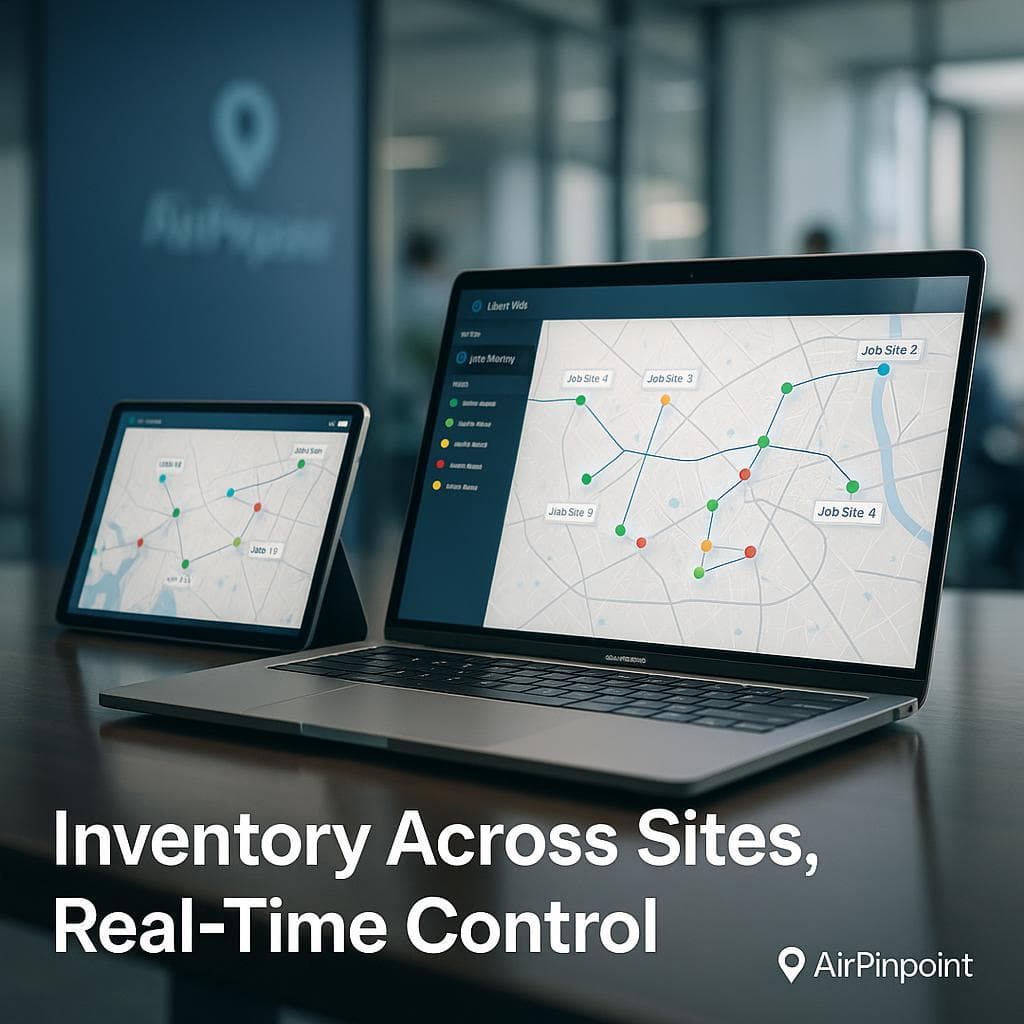
Multi-Facility Visibility See every tagged item across the main equipment room, satellite facilities, practice fields, and the stadium on a single map. No more walking buildings to find missing gear.
Polygon Geofencing Draw geofences around your equipment room, each practice facility, and the stadium. Get alerts when tagged equipment leaves or arrives at any location. Know within about 40 minutes whether a trunk of helmets headed to reconditioning actually left the building.
Location History Review where equipment has been over the past days and weeks. When a set of pads goes missing, trace its last known location instead of guessing.
Team Access Multiple equipment staff members access the same dashboard. The head equipment manager, assistant managers, and student workers can all see equipment locations without sharing a single login.
Away Game Tracking Tag equipment trunks and cases. Track their location from departure through arrival at the away venue and back. Know while the bus is still close enough to turn around if a case was left behind.
Pricing for Athletic Departments
| Component | Cost |
|---|---|
| AirTag (one-time) | $29 each |
| Airpinpoint subscription | $11.99/month per tracked tag |
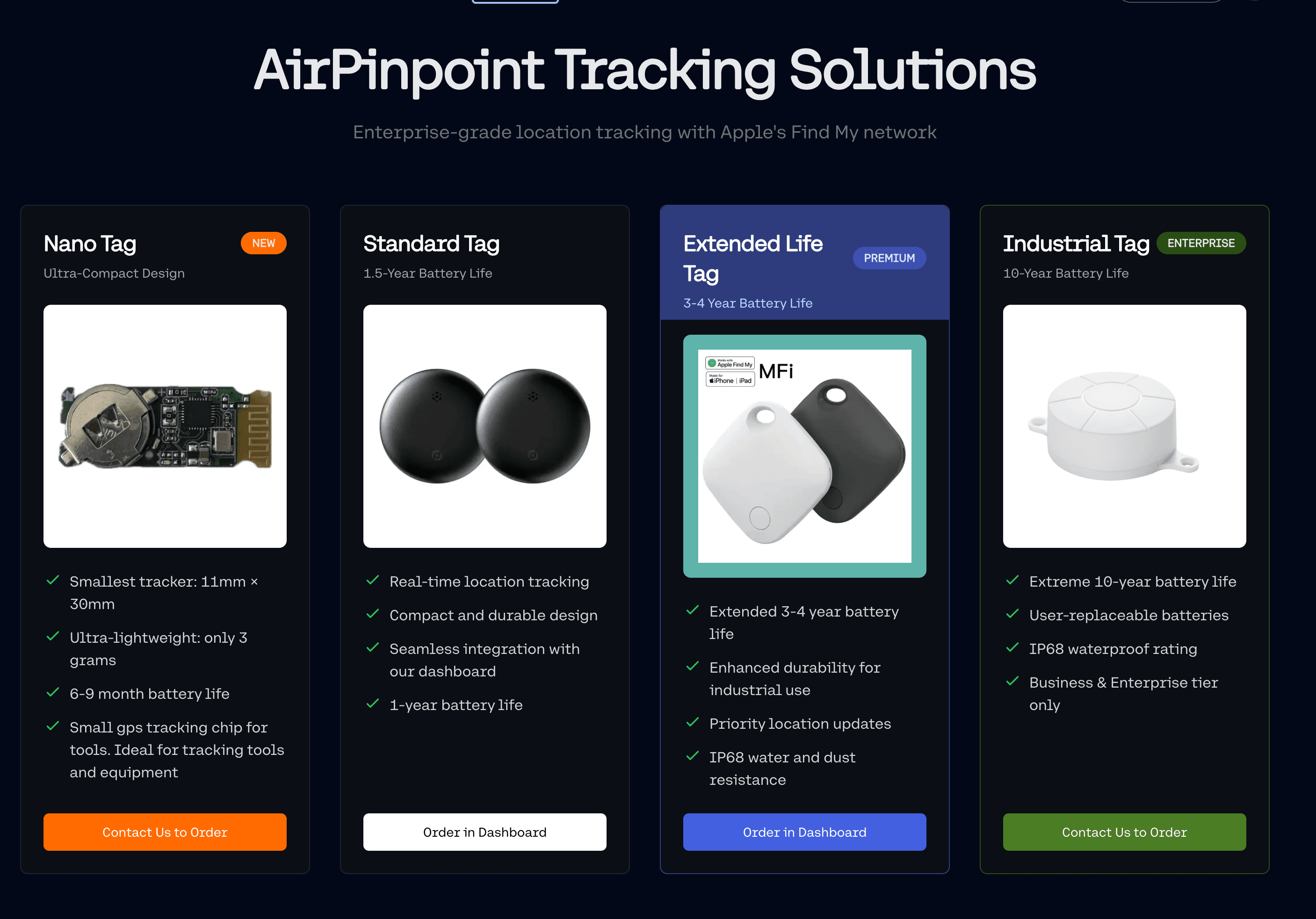
| Custom Find My-compatible tag | Available for bulk orders |
| Infrastructure required | None |
For a football program tracking 100 helmets and 50 additional high-value items:
- Hardware: 150 tags x $29 = $4,350 (one-time)
- Monthly: 150 x $11.99 = $1,798.50/month
- Annual: $21,582
Compare that to a single set of lost shoulder pads ($300), a missing helmet that delays reconditioning compliance, or an equipment trunk left at an away venue ($5,000+ in contents).
Implementation Guide
Phase 1: High-Value Items (Month 1)
Start with the most expensive and compliance-critical equipment:
- Tag all game helmets with AirTags (inside padding or attached to cage)
- Tag equipment trunks used for travel
- Set up geofences around the main equipment room and stadium
- Add equipment staff to the Airpinpoint dashboard
Phase 2: Expand Coverage (Months 2-3)
Add tracking to:
- Shoulder pad sets
- Shared training equipment (sleds, dummies, medical kits)
- Film/video equipment
- Satellite facility equipment
Phase 3: Full Integration (Months 3-6)
- Set up geofences for all facilities including practice fields
- Establish check-out workflows using geofence departure alerts
- Create standard operating procedures for away game equipment verification
- Train student managers on the dashboard
Tag Placement Tips
- Helmets: Inside the crown padding or attached to the rear bumper mount. Avoid locations that affect fit.
- Shoulder pads: Inside the back panel pocket or attached to the harness.
- Equipment trunks: Inside a zippered pocket or taped to the interior lid.
- Training equipment: Inside hollow tubes on blocking sleds, inside medicine ball storage cases.
The Equipment Manager's Technology Stack
Most athletic programs will use a combination of tools:
| Layer | Tool | Purpose |
|---|---|---|
| Player assignments & sizing | SportSoft / HelmetTracker / CompuSports | Track who has what, manage reconditioning schedules |
| Check-in/check-out | Barcode scanner + software | Log equipment transactions |
| Compliance tracking | HelmetTracker / SportSoft | NOCSAE dates, reconditioning history, retirement alerts |
| Physical location tracking | Airpinpoint | Know where equipment is right now, geofence alerts |
| Communication | Team messaging app | Coordinate with coaches, players, and staff |
Airpinpoint does not replace equipment management software. It adds the location layer that existing tools lack. When SportSoft says a helmet was last checked out on September 3 but nobody scanned it back in, Airpinpoint shows you it's sitting in the auxiliary building's storage closet.
Summary
Sports equipment management is a logistics problem at industrial scale, handled by small teams with limited technology. A D-I equipment manager tracks tens of thousands of items across multiple buildings, packs for road games under pressure, and carries compliance liability for every helmet on the field.
Barcode systems handle assignment tracking. RFID adds automated scanning at doorways. Neither tells you where equipment is once it leaves the scan point.
BLE tracking through Airpinpoint fills that gap. For $29 per tag and $11.99/month, athletic programs get real-time location visibility, geofence alerts, and a shared dashboard, with zero infrastructure to install.
Tag the helmets first. You will find things you didn't know were missing.
 Our Solution