
Forklift Tracking System: Telematics & Fleet Management for Warehouses
Forklifts are among the most expensive and dangerous equipment in warehouse operations. Without tracking, you're flying blind: no visibility into utilization, operator behavior, or developing maintenance issues. Modern forklift telematics changes this, providing data that reduces costs, improves safety, and optimizes fleet size.
Why Forklift Tracking Matters
The Safety Problem
Forklifts are involved in 85 deaths and 34,900 serious injuries annually in the US (OSHA). The leading causes:
| Cause | % of Incidents |
|---|---|
| Tip-overs | 42% |
| Workers struck by forklift | 25% |
| Workers crushed between forklift and surface | 11% |
| Falls from forklift | 8% |
| Other | 14% |
The cause breakdown above is the commonly cited industry split and, like most figures in this market, it is repeated more often than it is sourced. The OSHA fatality and injury estimates are solid; treat the percentage split as approximate.
What telematics addresses. Note that every item here requires a wired telematics unit with sensors. None of it is possible from a Bluetooth location tag, ours included:
- Speed monitoring, which reduces tip-over risk
- Impact sensors, which catch dangerous driving and unreported damage
- Operator certification verification via badge or PIN
- Pre-shift inspection compliance via an operator checklist
The Utilization Problem
Most warehouse managers don't know how their forklifts are actually used:
- Average fleet utilization: figures in the 35-50% range get quoted constantly in this industry and we could not trace any of them to a study. Treat them as vendor folklore
- Peak demand visibility: genuinely nonexistent without data, which is the real point
- Right-sizing opportunity: unknown until you measure your own fleet. Anyone quoting you a percentage before seeing your data is guessing
Without tracking, you can't answer:
- Which forklifts are being used?
- When do we hit capacity?
- Do we need to buy more, or fewer?
The Maintenance Problem
Reactive maintenance costs 3-5x more than preventive:
- Unplanned breakdowns disrupt operations
- Damage often goes unreported (operators hide impacts)
- Service intervals based on guesswork, not actual hours
With telematics:
- Maintenance scheduled by actual runtime hours
- Impact events logged automatically
- Battery health monitored continuously
- Parts failure predicted from usage patterns
How Forklift Telematics Works
Core Components
- Telematics device: Hardware installed on forklift
- Sensors: GPS, accelerometer, impact detection
- Operator interface: Card reader, display, RFID badge
- Connectivity: Cellular, Wi-Fi, or local network
- Cloud platform: Dashboard, analytics, reporting
What Gets Tracked
| Data Point | How It's Captured | Business Value |
|---|---|---|
| Location | GPS + indoor positioning | Fleet visibility, utilization |
| Hours/distance | Engine on-time, wheel sensors | Maintenance scheduling |
| Speed | GPS, wheel speed | Safety monitoring |
| Impacts | Accelerometer | Damage prevention, accountability |
| Operator ID | RFID badge, PIN entry | Certification compliance, accountability |
| Battery status | OBD integration | Charging optimization |
| Pre-shift checks | Operator checklist app | OSHA compliance |
Indoor vs. Outdoor Tracking
| Environment | Technology | Accuracy | Notes |
|---|---|---|---|
| Outdoor yard | GPS | 3-5 meters | Standard, works everywhere |
| Warehouse | BLE beacons | Zone level | Requires beacon infrastructure |
| Warehouse | UWB | Sub-meter | Higher cost, precision applications |
| Warehouse | Wi-Fi | Zone level | Uses existing Wi-Fi APs |
Most enterprise solutions combine GPS + indoor positioning for seamless tracking across facility boundaries.
Leading Forklift Telematics Solutions
OEM Solutions
Raymond iWAREHOUSE
Raymond's industry-leading telematics platform for powered industrial vehicles.
Features:
- Compatible with 100+ forklift makes/models
- Impact sensing and alerts
- Operator access control
- Maintenance management
- Labor tracking and analytics
- Multi-site visibility
Editions:
- iWAREHOUSE Essential: Basic monitoring, reporting
- iWAREHOUSE Fleet: Full telematics, maintenance
- iWAREHOUSE Evolution: Labor management, advanced analytics
Cost: $50-$100/unit/month depending on features
Toyota T-Matics
Launched April 2025, Toyota's telematics offering:
Products:
- T-Matics MOBILE: Cellular-based, portable between facilities
- T-Matics COMMAND: Fixed-location, comprehensive
Features:
- Fleet monitoring dashboard
- Impact detection
- Utilization reporting
- Maintenance scheduling
- Operator management
Best for: Toyota forklift fleets, multi-brand environments
Crown InfoLink
Crown's telematics system for fleet management.
Features:
- Real-time fleet status
- Operator performance metrics
- Impact management
- Battery and maintenance monitoring
- Labor standards compliance
Integration: Deep integration with Crown equipment, supports other brands
Jungheinrich
European manufacturer with modular telematics.
Features:
- Cloud-based dashboard
- Cross-brand compatibility
- Multi-location management
- Configurable KPIs
- Safety analytics
Best for: Mixed-brand fleets, European operations
Third-Party Solutions
Powerfleet
Independent telematics platform (formerly Fleet Complete).
Features:
- OEM-agnostic (works with any forklift)
- Advanced AI analytics
- Impact event management
- Operator scoring
- Integration APIs
Advantages:
- Not locked to one forklift brand
- Unified view across equipment types
- Mature platform with deep features
Cost: $25-$50/unit/month
Teletrac Navman
Fleet management platform extending to forklifts.
Features:
- Indoor/outdoor tracking
- Driver behavior monitoring
- Maintenance scheduling
- Compliance reporting
Best for: Companies already using Teletrac for vehicles
Where Airpinpoint Fits, and Where It Does Not
Everything above is telematics. Airpinpoint is not telematics, and on a forklift the difference is large enough that we would rather spell it out than let you find out after buying.
What Airpinpoint does not do on a forklift. No impact sensors. No accelerometer. No operator ID, no RFID badge reader, no PIN pad, no way of knowing who is driving. No speed monitoring. No engine hours, no runtime, no battery state of charge. No pre-shift inspection checklist. No maintenance scheduling. No OSHA compliance documentation. If any of those are why you came to this page, buy one of the systems above. Raymond, Crown, Toyota, Jungheinrich and Powerfleet all genuinely do this, and a $29 Bluetooth tag is not a substitute for a $400 telematics unit wired into the truck.
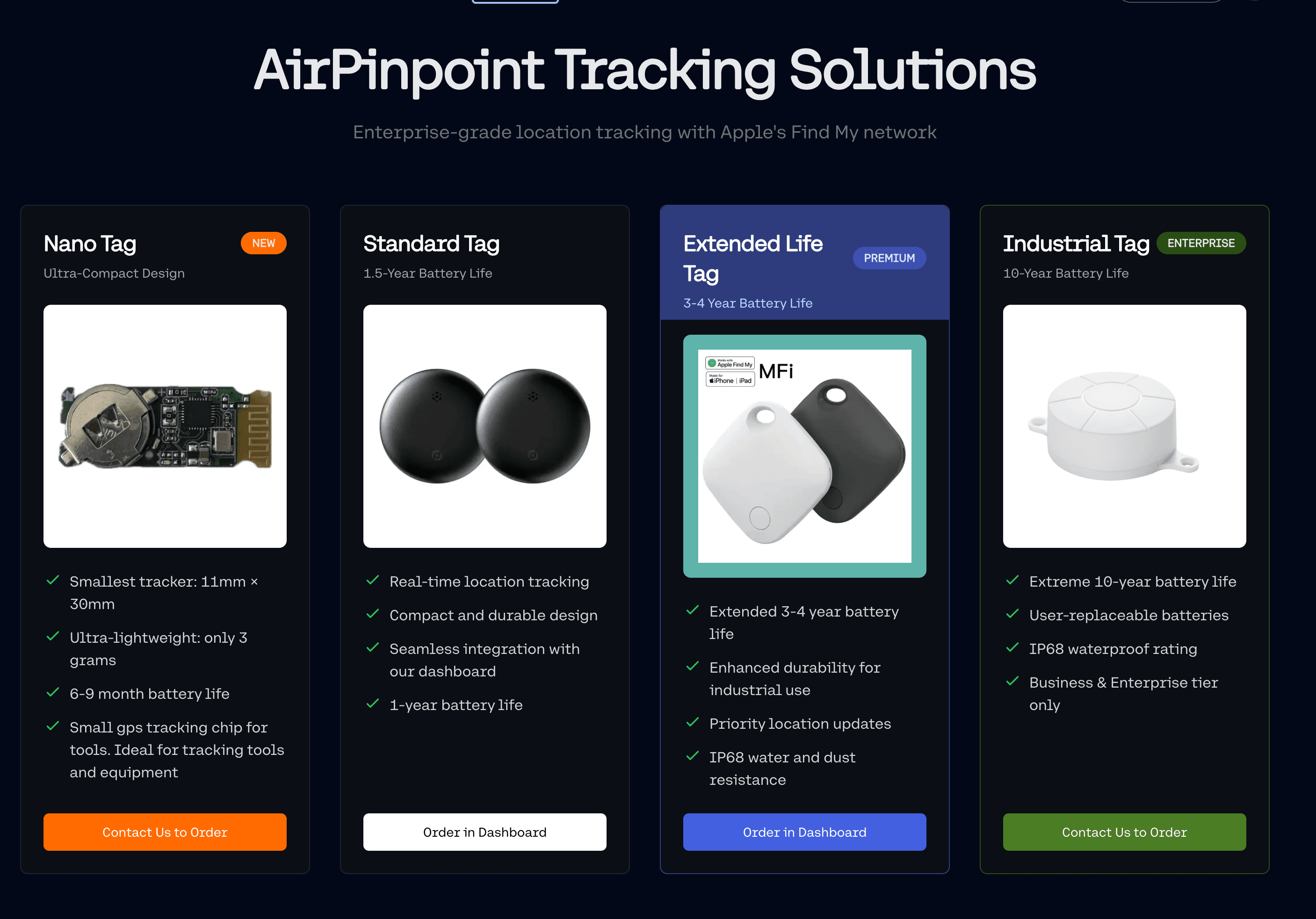
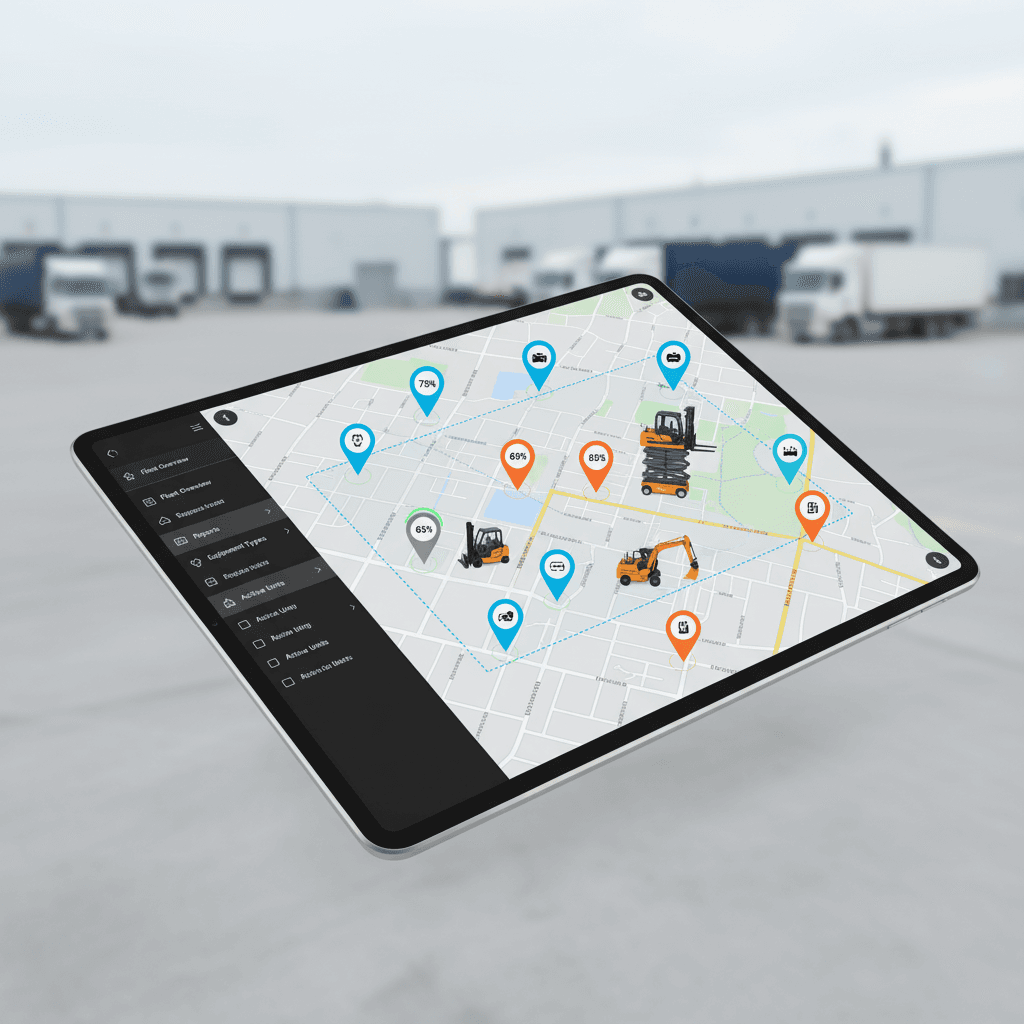
What it does do. It reports where the truck is and how long it has been there, for $29 per tag and $11.99 per tag per month, with no installation and no wiring.
Why a warehouse is the good case for this. A Find My tag reports its position when an Apple device passes within Bluetooth range. That makes coverage a function of how many iPhones move through a space, which is the whole weakness of the technology in a rural yard and its quiet strength in a warehouse. Warehouses are full of people, and those people are carrying phones. Picking, receiving, shipping and maintenance staff walk the floor all shift. In a busy building, tagged equipment tends to report frequently without you installing a single BLE beacon, UWB anchor or Wi-Fi access point, which is the infrastructure the indoor positioning options in the table above require.
The honest limits of that. Accuracy is roughly 10 to 30 meters. That is building and zone level, not aisle level and certainly not sub-meter. It will tell you a truck is in the north dock area. It will not tell you it is in aisle 14. Compare that to the table earlier on this page: UWB gets sub-meter and BLE beacon networks get zone level, both at the cost of installed infrastructure. We are cheaper and coarser. Geofence alerts are also not instant: a confirmed alert typically lands 15 to 40 minutes after an asset leaves an authorized area, because it waits for consecutive readings to agree rather than firing on one stray fix.
So who should actually use this on forklifts? Mostly people whose problem is not forklifts. Multi-building sites where trucks migrate and nobody is sure which building has how many. Yards where trucks go outside and get left. Operations with a mixed pool of forklifts, pallet jacks, scissor lifts, sweepers and attachments, where the powered trucks have telematics and the rest of it has nothing. The unpowered and low-value equipment is usually where the visibility gap is, and it is exactly the equipment nobody will ever install a $400 telematics unit on.
Implementation Guide
Phase 1: Requirements Definition
Assess your needs:
- How many forklifts? (affects cost model)
- Single site or multiple?
- What problems are you solving? (safety, utilization, maintenance)
- Integration requirements? (WMS, ERP)
- Budget range?
Key questions:
- Do you need indoor positioning or is zone-level sufficient?
- Is impact detection critical?
- How important is multi-brand support?
- What reporting do you need?
Phase 2: Vendor Evaluation
Create shortlist based on:
- Compatibility with your forklift brands
- Feature match to requirements
- Total cost of ownership
- Implementation support
- Customer references
Request demos and pilots:
- Install on 3-5 forklifts
- Run for 30-60 days
- Evaluate data quality and usability
- Assess support responsiveness
Phase 3: Installation
Hardware installation:
- 1-2 hours per forklift for basic telematics
- Longer for advanced sensors (cameras, etc.)
- Professional installation recommended
- Verify connectivity before release
Software configuration:
- Set up operator accounts and RFID badges
- Configure alert thresholds
- Create geofences/zones
- Establish reporting schedules
Phase 4: Training and Rollout
Operator training:
- Badge-in/badge-out procedures
- Pre-shift checklist completion
- What gets monitored (transparency builds trust)
- Impact event process
Manager training:
- Dashboard navigation
- Alert response procedures
- Report interpretation
- Investigation workflow
Phase 5: Optimization
Weekly review:
- Impact events
- Speeding patterns
- Pre-shift check compliance
- Maintenance alerts
Monthly analysis:
- Utilization by unit and shift
- Operator performance trends
- Fleet right-sizing opportunities
- Safety improvement metrics
ROI Analysis
This page used to carry a table of dollar savings per category and a headline "ROI: 525%, payback 2 months." Those figures were not derived from anything. We have removed them rather than dress them up, and replaced them with the inputs a real business case needs. The left column is what to look up. The right column says who has it.
Safety ROI
Safety is the category where vendor ROI numbers are least trustworthy and where your own data is most available, because insurers and OSHA already make you record it.
| Input | Where to find it | Who has it |
|---|---|---|
| Recordable forklift incidents, last 3 years | Your OSHA 300 logs | You |
| Workers' comp claims and settled cost | Your carrier's loss runs. Ask for a three year history | You, on request |
| Racking, product and building damage | Maintenance and facilities invoices, which is where unreported impacts show up as mystery repairs | You |
| Premium credit for telematics | Ask your broker directly. Some carriers offer one, many do not | Your broker |
| Claimed accident reduction | Ask each vendor for the study behind the number, not the number | The vendor, if it exists |
On that last row: we looked for peer-reviewed evidence that forklift telematics reduces accidents by a specific percentage and did not find any. Vendor case studies report improvements, some substantial, but they are self-published and uncontrolled. The mechanism is plausible, which is not the same as measured.
Utilization ROI
| Input | Where to find it | Who has it |
|---|---|---|
| Lease or ownership cost per truck per year | Your lease schedule | You |
| Peak concurrent trucks in use | Only telematics engine hours answer this properly | The system, after 60 days |
| Short-term rental spend during peaks | Rental invoices | You |
| Trucks that could be dropped at renewal | Falls out of the two rows above | You, after a quarter of data |
Fleet right-sizing is the most defensible line in a forklift telematics business case, because dropping one truck at lease renewal is a hard, checkable number, not an estimated one.
Maintenance ROI
| Input | Where to find it | Who has it |
|---|---|---|
| Current annual maintenance spend per truck | Service invoices | You |
| Split of emergency versus scheduled work | Same invoices, sorted | You, after an afternoon |
| Battery replacement frequency and cost | Purchasing records | You |
| Repairs with no incident report attached | Compare damage invoices to your incident log. The gap is the unreported impacts | You |
That last row is the one worth doing before you buy anything. If the gap is near zero, impact sensing will not pay for itself in your building.
Total ROI Example
20-forklift operation, investment side only:
| Investment | Cost |
|---|---|
| Hardware (20 x $400) | $8,000 |
| Installation (20 x $200) | $4,000 |
| Annual software (20 x $40 x 12) | $9,600 |
| Year 1 Total | $21,600 |
That is the number we can state, because it comes from published vendor pricing. The savings side belongs to you, and it is the product of the tables above. If your OSHA logs show one recordable forklift incident in three years and your maintenance invoices reconcile cleanly against your incident reports, a $21,600 telematics deployment may not be justified, and no vendor will tell you that.
Best Practices
Safety Culture
- Don't use telematics punitively at first: focus on coaching
- Celebrate improvements in safety metrics
- Investigate impacts promptly (within 24 hours)
- Share aggregate data with operators (transparency)
Data-Driven Decisions
- Review utilization monthly to identify right-sizing opportunities
- Track trends over time (don't react to single data points)
- Correlate maintenance costs with usage patterns
- Benchmark across shifts to identify best practices
Integration
- Connect to WMS for location context
- Feed maintenance data to CMMS
- Export to BI tools for deeper analysis
- Consider ERP integration for cost accounting
Common Challenges
Challenge: Operator Resistance
Problem: Operators view telematics as surveillance.
Solutions:
- Communicate benefits (safety, fairness)
- Start with fleet-level data, not individual targeting
- Use data for coaching, not punishment initially
- Involve operators in improvement initiatives
Challenge: Data Overload
Problem: Too much data, not enough insight.
Solutions:
- Focus on 3-5 key metrics initially
- Set up exception-based alerts
- Schedule regular (not constant) review
- Start simple, add complexity over time
Challenge: Multi-Brand Complexity
Problem: Different forklifts, different systems.
Solutions:
- Choose platform with multi-brand support
- Accept some feature variation by brand
- Prioritize unified dashboard view
- Consider third-party solutions for mixed fleets
The Bottom Line
Forklift telematics is mature technology and every major OEM now ships a platform for it. What is not mature is the evidence base. The percentages that circulate in this market, including several that were previously on this page, do not survive being chased back to a source.
Key takeaways:
- The safety case is real but unquantified. OSHA's estimate of roughly 85 deaths and 34,900 serious injuries a year is solid. The specific "telematics cuts accidents by 20-30%" claim is not, and we removed it from this page because we could not find a study behind it
- Fleet right-sizing is the most provable line item, because dropping a truck at lease renewal is a real invoice, not an estimate
- Your own records already hold the business case: OSHA 300 logs, carrier loss runs, maintenance invoices and lease schedules
- Ask every vendor for the study, not the number. Including us
Start with:
- Define primary goal (safety, utilization, or maintenance)
- Pull your own baseline from the four record sets above before talking to anyone
- Evaluate OEM solution vs. third-party
- Pilot on 10-20% of fleet for at least 60 days
- Scale based on what the pilot actually showed, including the possibility that it showed nothing
The question is not whether to implement forklift tracking. It is which problem you are solving, because the answer decides the product. Impacts, operators and engine hours mean telematics. Knowing where the equipment is, across buildings and including everything nobody will wire a unit into, is where a Find My tag earns its $11.99.
 Our Solution