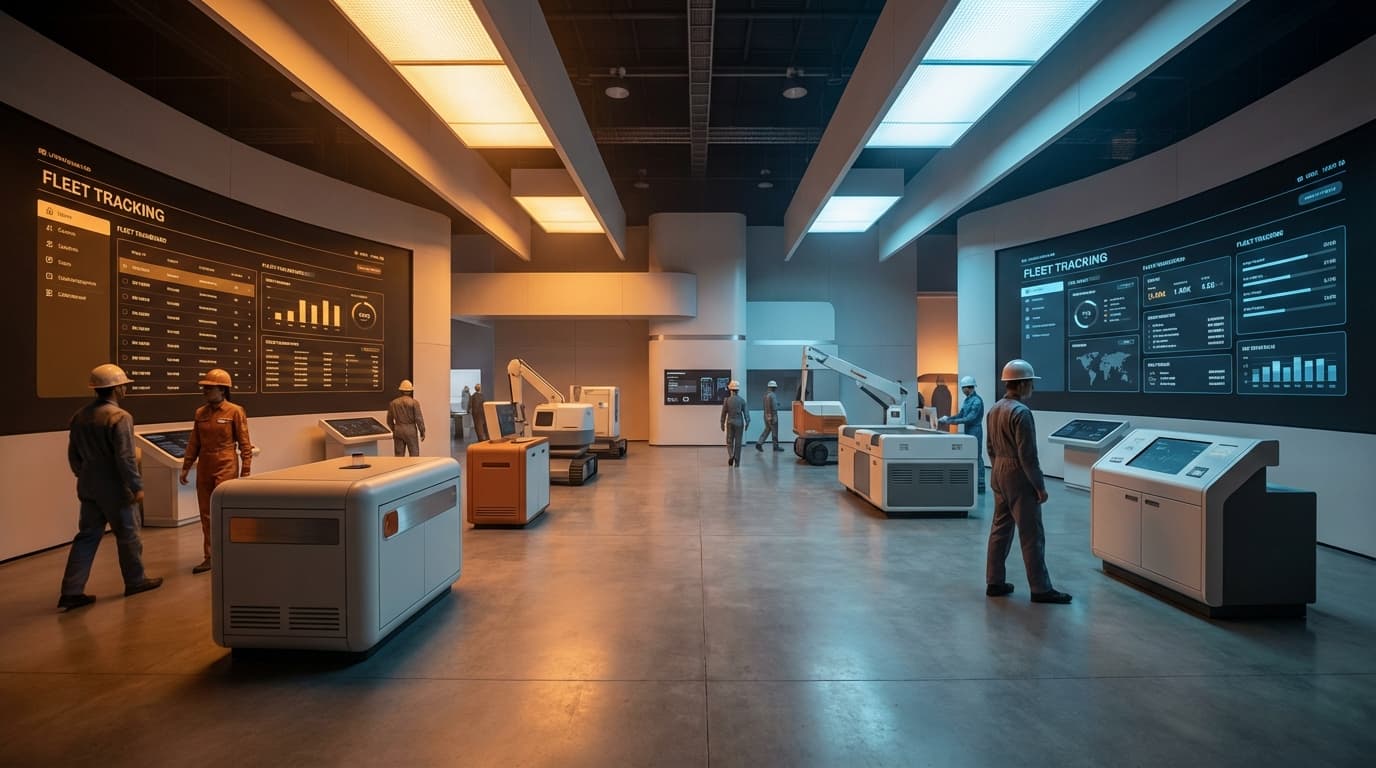
ConExpo-Con/AGG 2026 opens March 3-7 at the Las Vegas Convention Center and Las Vegas Festival Grounds, bringing together more than 2,000 exhibitors and 139,000+ attendees across 2.9 million square feet of exhibit space. Show hours run 9 AM - 5 PM (March 3-6) and 9 AM - 3 PM on closing day. Over 150 education sessions are scheduled.
It is the largest construction trade show in North America, and this year, one theme dominates the agenda: knowing where your equipment is at all times.
If you manage a fleet of excavators, loaders, generators, or even hand tools, ConExpo 2026 is the clearest signal yet that equipment tracking has moved from nice-to-have to non-negotiable.
Equipment Tracking Is the Defining Theme of 2026
The signs have been building for years, but the last 12 months removed any ambiguity. Three events tell the story:
John Deere acquired Tenna. On December 22, 2025, Deere announced the purchase of the construction asset tracking platform -- a company with $15 million in revenue, 450 customers, and 3,400% four-year growth. Tenna will continue operating independently under its own brand. The acquisition signaled that even Deere, with just 5.4% of global construction equipment market share, recognizes that tracking every asset on a jobsite -- not just Deere machines -- is table stakes.
Motive filed for its IPO. On December 23, 2025, the fleet management platform filed its S-1 with the SEC, revealing $501 million in annual recurring revenue and nearly 100,000 customers. Backed by Alphabet's GV and set to list on NYSE under ticker MTVE, this is Wall Street confirming that connected fleet management has decades of runway.
The AirTag 2 launched. On January 26, 2026, Apple released its second-generation tracker with a U2 Ultra Wideband chip, 50% louder speaker, and extended Precision Finding range. Real-world testing shows the AirTag 2 can locate items at 74-115 feet vs. 50-66 feet for the original. At $29 with no subscription, it's pushing tracking economics into territory that makes every asset worth monitoring.
Who's Exhibiting What
Here's what specific companies are bringing to the show floor:
Komatsu: Smart Construction
Komatsu's theme is "Connected performance, driving your success." They're showcasing:
- Smart Construction Dashboard mobile for planning, tracking, and precise digging
- My Komatsu enterprise platform with AI and data analytics for mixed-fleet management
- KOMTRAX telematics -- now in its 5th generation, standardized in Komatsu machines since 2007, and 100% free for the life of the machine
- HD605-10 with Smart Quarry Autonomous solution
Caterpillar: VisionLink Goes Free
Cat relaunched VisionLink three years ago as a free job-site management solution -- no subscription required. Key stats:
- 1.5 million+ connected assets on the platform
- ISO telematics API integration for mixed-fleet management
- Product Link devices that bring connectivity to non-Cat equipment
- Integrates with third-party fleet management systems
This is a direct competitive response to platforms like Tenna and Trackunit, and it changes the calculus for contractors evaluating mixed-fleet options.
Bobcat: AI-Powered Diagnostics
- Machine IQ telematics with built-in theft protection on the MT120 mini track loader
- Service.AI -- an AI-powered service platform offering instant diagnostics, eliminating troubleshooting delays
SANY: Digital Fleet Management
- EVI -- SANY's new telematic tool for digital fleet management, designed for the North American market
HCSS: AI Copilot for Construction
- Integration across HeavyBid, HeavyJob, and HCSS Fleet
- HCSS Copilot AI embedded directly into workflows
- Expanded telematics integrations for real-time field visibility
AlignOps: Camera + Telematics Fusion
- FleetWatcher Camera Systems -- industrial dual-facing cameras integrated with telematics
- Combines tracking, load-cycle tracking, e-ticketing, and safety intelligence in one platform
AWS Keynote
Amazon Web Services is headlining ConExpo 2026 with a premiere keynote focused on digital integration and cloud technologies for construction. This is notable -- it signals that hyperscale cloud providers see construction as a growth vertical.
Three Trends to Watch
1. AI-Powered Fleet Intelligence
The era of "dots on a map" is ending. The next generation of equipment tracking uses machine learning to transform location data into operational intelligence.
Predictive maintenance is the headliner. Early adopters are reporting:
- 45% reduction in equipment downtime
- 92%+ prediction accuracy by Month 6 of deployment
- 48-72 hours lead time for repair scheduling
- Hydraulic systems -- responsible for 65% of equipment downtime and $35,000-$85,000 per major failure -- are the primary target
The industry is shifting from reactive to predictive, and ConExpo 2026 is where that becomes tangible.
AI adoption in construction is accelerating fast. According to recent industry surveys:
- 49% of construction professionals are already using AI daily
- 83% trust AI to improve productivity
- 34% plan to increase tech usage in 2026 specifically to combat labor shortages
The fundamental shift: tracking used to answer "where is my equipment?" Now it answers "what should I do about my equipment?"
2. Mixed Fleet Management at Scale
If 2025 was the year the industry acknowledged OEM-locked telematics silos, 2026 is the year solutions ship at scale.
A typical mid-size contractor operates equipment from five to eight different manufacturers. Each OEM offers its own telematics portal -- John Deere Operations Center, Cat VisionLink, Komatsu KOMTRAX, Volvo ActiveCare Direct, JCB LiveLink. None of them talk to each other natively.
The ISO 15143-3:2020 standard (formerly AEMP 2.0) is the industry's attempt to solve this. Published by ISO and maintained by the Japan Construction Machinery and Construction Association (JCMA), it defines:
- Common JSON and XML payload structures
- Standardized parameters: position, hours, fuel, machine status
- Same field names and types across OEM portals
- Web service interface for data exchange
Companies at ConExpo are pitching mixed-fleet solutions that ingest data from multiple OEM APIs through this standard. The challenge remains that not all OEMs expose the same data at the same refresh rate, and smaller manufacturers often don't support the standard at all.
The bottom line: The companies that win the mixed-fleet tracking battle will be the ones that work with everything -- including older equipment, non-powered assets, and machines from manufacturers that don't offer telematics at all.
3. Anti-Theft Technology
Construction equipment theft costs the industry between $300 million and $1 billion annually in the United States. The numbers are stubbornly bad:
- ~12,000 thefts per year (nearly 1,000 per month)
- Average loss per incident: $30,000-$46,000
- Recovery rate: just 21-25% without tracking
- Recovery rate with GPS tracking: 69% -- a 3x improvement
These numbers have not improved meaningfully in a decade. What has changed is the technology available to fight back.
At ConExpo, anti-theft technology is everywhere:
- Geofencing with instant alerts. Modern platforms draw virtual boundaries and push alerts within minutes when equipment moves outside authorized zones.
- Covert placement options. Trackers small enough to hide in engine compartments, tool boxes, and structural cavities. The AirTag 2 at 31.9mm diameter is small enough to conceal almost anywhere.
- Insurance benefits. Companies like The Hartford now waive theft deductibles for equipment fitted with GPS trackers. Many commercial insurers offer 5-20% premium discounts for fleets with tracking.
The ROI math: a single recovered excavator pays for a decade of tracking across an entire fleet.
The Labor Shortage Is Accelerating Tracking Adoption
The construction labor crisis is directly driving technology investment:
- 499,000 new workers needed in 2026 (up from 439,000 in 2025)
- $124 billion in potential lost construction output from unfilled positions
- 41% of the workforce expected to retire by 2031
- Only 10% of current workers are under age 25
When you can't hire enough people, you need to maximize the productivity of the people you have. That means less time searching for equipment, less downtime from preventable breakdowns, and less money lost to theft and misplacement.
Proper equipment optimization can increase productivity by 25% and reduce operating costs by 15%, according to the Association of Equipment Manufacturers. Eliminating just 5% of underutilized assets could save $750,000 in carrying costs for a mid-size contractor.
What to Evaluate on the Show Floor
ConExpo will have hundreds of tracking vendors. Five questions separate serious solutions from trade show demos:
Does it work on ALL your equipment? If a solution requires specific OEM hardware or a particular model year, it leaves gaps. Ask about aftermarket devices for older equipment and non-powered assets.
What is the true per-device cost? Calculate total cost of ownership over three years. Some vendors advertise low hardware prices but charge $20-50 per device per month. Others bundle hardware into the subscription. Compare apples to apples.
Is there an API? If tracking data lives in a silo, its value degrades. A REST API for integrating with your project management, ERP, or custom reporting is a must for any modern platform.
How does geofencing work? Basic geofencing draws circles. Advanced geofencing draws polygons matching real jobsite boundaries, with time-based rules and consecutive-check logic to avoid false alarms from GPS drift.
What is the battery life? For non-powered equipment, battery life is the practical constraint. A tracker that dies after three months creates maintenance overhead. Look for 12+ months.
You Do Not Have to Wait for ConExpo
ConExpo is a great place to learn and compare. But if your fleet is untracked today, every day you wait is a day your equipment is invisible.
AirPinpoint lets construction teams start tracking equipment immediately:
- Works on any equipment. Powered or non-powered, new or 20 years old. Attach a tracker and go.
- Five-minute setup. No wiring, no OEM integration, no IT department needed.
- Polygon geofencing with smart alerts. Draw boundaries matching your real jobsite layout. Consecutive-check logic eliminates false alarms.
- Full REST API. Integrate tracking data into your existing systems.
- Real-time dashboard. See every tracked asset on a single map, regardless of manufacturer.
View pricing and start a free trial or create your account now.
Will AirPinpoint Be at ConExpo?
We won't have a booth at ConExpo this year, but our platform is already being used by construction teams across the country to track mixed fleets, prevent theft, and improve equipment utilization.
If you're heading to Las Vegas and want to see AirPinpoint in action, reach out to our team and we'll set up a live demo on your schedule.
Or skip the trade show and try it free today. Your fleet will thank you.
Related reading:
