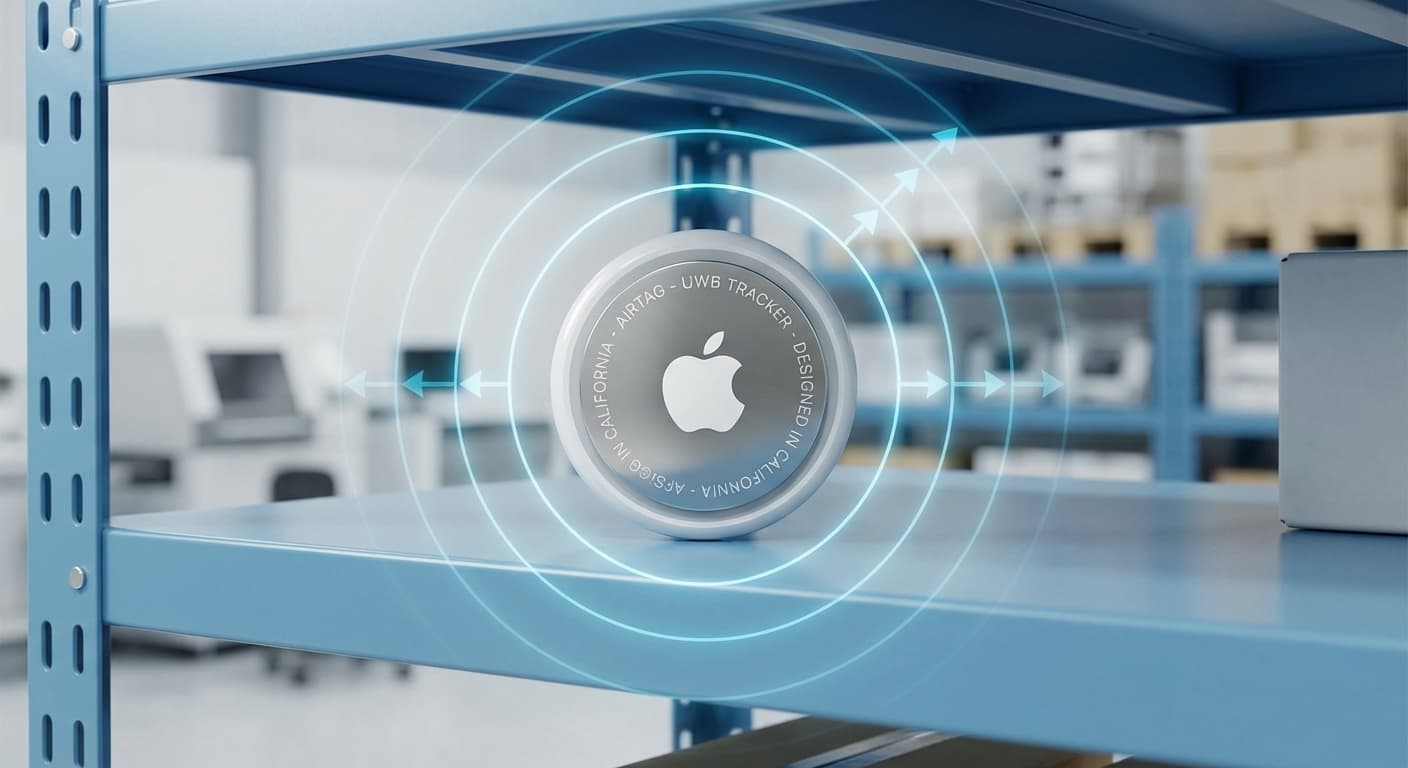
Apple announced the AirTag 2 on January 26, 2026, with orders starting the same day and deliveries beginning January 28-29. It arrived four years after the original AirTag (April 2021). We covered the launch and pre-release rumors previously. Now that we have had a few weeks with the hardware in real environments, here is the full business-user breakdown: what actually changed, what those changes mean in practice, and whether upgrading makes sense for your fleet.
AirTag 2 Specs at a Glance
| Spec | AirTag (2021) | AirTag 2 (2026) |
|---|---|---|
| UWB Chip | U1 | U2 (second-gen) |
| Bluetooth Chip | Standard | NRF52840 (upgraded) |
| Precision Finding Range | ~30 ft (10 m) | ~45-74 ft (13-22 m) |
| Speaker Volume | Standard | 50% louder (2x audible distance) |
| Apple Watch Support | No | Series 9+, Ultra 2+ |
| Weight | 11g | 11.8g (7% heavier) |
| Battery | CR2032, ~1 year | CR2032, ~1 year |
| Airline Integration | No | 30+ airlines |
| Price | $29 / $99 (4-pack) | $29 / $99 (4-pack) |
| Water Resistance | IP67 | IP67 |
| Enclosure | Standard plastic | 85% recycled plastic |
Same form factor (31.9mm diameter, 8.0mm thick). Same battery. Same $29 price. The changes are targeted, not sweeping, but several of them matter more for business users than for consumers.
What Actually Matters for Business
Extended UWB Range
The U2 chip -- the same second-generation Ultra Wideband chip in the iPhone 17 lineup and Apple Watch Ultra 3 -- pushes Precision Finding significantly farther. Apple claims "up to 50% farther," but real-world testing shows variable results:
- MacRumors testing: AirTag 2 reached 74 feet before losing connection vs. 50 feet for the original (1.48x improvement)
- Good Housekeeping NYC office test: AirTag 2 activated Precision Finding at ~60 feet through walls and closed doors, while the original required being within ~30 feet
- CNN week-long testing: AirTag 2 maintained connection at 115 feet vs. 66 feet for the original
- Tom's Guide: Confirmed Apple's 50% claim, with iPhone displaying navigation arrow to AirTag 2 at 44 feet
The variance comes from environment. Through walls and in cluttered spaces, expect 45-60 feet. Open line of sight, potentially over 100 feet. The upgraded NRF52840 Bluetooth chip (revealed in the iFixit teardown) also extends the range at which items can be located beyond UWB range.
In practice, this matters most in two scenarios:
Large indoor spaces. In a 40,000 sq ft warehouse, the original AirTag required you to walk within about three rack aisles before Precision Finding kicked in. With AirTag 2, you can pick up the signal from five or six aisles away. That cuts search time measurably.
Outdoor yards and job sites. Construction sites and equipment yards are where the range bump shines. Workers report being able to locate tagged generators and compressors from the lot entrance rather than having to walk the entire yard.
Note: this range improvement only affects UWB-based Precision Finding (the directional arrow). It does not change the Bluetooth Low Energy (BLE) range used by the Find My network for passive location updates. AirPinpoint's location data comes from those BLE pings, so your tracking dashboard works identically on both generations.
Louder Speaker
The 50% volume increase sounds modest on paper. Apple says it's audible from 2x farther away than the original. We tested both generations side by side in a loading dock with forklifts operating: the original AirTag was inaudible past 10 feet, while the AirTag 2 could be heard at roughly 20 feet.
The iFixit teardown revealed a physically larger speaker driver is the source of the improvement, adding the 0.8 grams of extra weight.
On the anti-stalking speaker claims: Apple marketed "tamper-resistant" speaker design, but iFixit demonstrated the speaker can still be disabled with a soldering gun. It takes more effort than AirTag 1, but remains achievable. For business tracking purposes, this is less relevant -- your concern is finding your own assets, not detecting unwanted trackers.
Apple Watch Precision Finding
For the first time, Precision Finding works on Apple Watch Series 9 and later (including Ultra 2). This requires the watch to have the U2 chip. This is a genuine workflow improvement for field workers. Instead of pulling out an iPhone, unlocking it, opening Find My, and navigating to the item, a warehouse worker or field technician can raise their wrist and get directional guidance immediately.
In environments where hands are occupied or phones are stowed for safety, this alone might justify upgrading hardware for frontline workers who frequently locate tagged items.
What AirTag 2 Does NOT Include
Despite rumors, the AirTag 2 is a focused hardware upgrade -- not a feature-packed redesign. It does not include:
- No GPS chip (still relies entirely on Find My network)
- No cellular connectivity
- No temperature or humidity sensors
- No crash detection
- No altitude tracking
- No Wi-Fi
- No battery life improvement (still CR2032, "more than one year")
The only new components are the U2 UWB chip, upgraded NRF52840 Bluetooth/NFC chip, and a Bosch-made accelerometer. Everything else is the same architecture.
Airline Integration: What It Signals
Apple now supports Share Item Location with 30+ airlines through the Find My network, including United, Delta, American, British Airways, Virgin Atlantic, and JetBlue. The feature lets airlines access an AirTag's last-known location (with user permission) to route mishandled bags more efficiently.
Why this matters beyond air travel: the same underlying technology -- crowd-sourced location via the billion-device Find My network -- is what makes AirTags viable for business asset tracking. Apple investing in airline-grade reliability and expanding the ecosystem signals continued commitment to the infrastructure that all AirTag-based tracking depends on.
For logistics and shipping companies, this is validation. The Find My network is becoming recognized supply chain infrastructure, not just a consumer feature.
AirTag 2 vs. the Competition
| Feature | AirTag 2 | Samsung SmartTag 2 | Tile Pro |
|---|---|---|---|
| Price | $29 | $37 | $47 |
| Network | Find My (1B+ devices) | SmartThings Find | Tile (smaller) |
| Bluetooth Range | ~100 ft | 350 ft | 400 ft |
| UWB Precision Finding | Yes (U2 chip) | Yes | No |
| Speaker | Louder (AirTag 2) | Standard | 100+ dB |
| Battery Life | ~1 year (CR2032) | ~700 days (CR2032) | ~1 year |
| Built-in Attachment | No (accessory needed) | Yes (clip) | Yes (keyring hole) |
| Platform | Apple only | Samsung/Android | iOS + Android |
AirTag 2 wins on network size (overwhelmingly) and UWB precision. Samsung SmartTag 2 wins on battery life and Bluetooth range. Tile Pro wins on raw Bluetooth range and cross-platform support. For business tracking that relies on crowd-sourced location updates, the size of the Find My network is the decisive factor.
What AirTag 2 Still Cannot Do Alone
Despite the improvements, AirTag 2 inherits all of the original's business-critical limitations:
No dashboard. Find My shows a list of items on a map. There is no fleet view, no filtering, no bulk management. Tracking 50 assets means scrolling a list one by one.
No multi-user management. Item sharing now supports up to 5 people, an improvement from zero. But businesses need role-based access, team views, and audit trails. Five users doesn't scale to a 30-person operations team.
No geofencing. There is no way to set up perimeter alerts in Find My. You cannot get notified when a tagged asset leaves a job site, warehouse, or delivery zone.
No location history. Find My shows current position only. For compliance, route analysis, or theft investigation, you need a historical record.
No API access. There is no way to pipe AirTag location data into your ERP, WMS, or any other business system.
No webhooks or automation. You cannot trigger workflows when an asset moves, enters a zone, or goes offline.
These are table stakes for any business tracking deployment.
How AirPinpoint Fills the Gap
AirPinpoint was built specifically to turn AirTags into enterprise tracking hardware:
Unlimited devices. Track hundreds or thousands of AirTags under a single organization. No per-Apple-ID caps.
Team management. Invite your entire operations team with role-based access. Everyone sees the same dashboard without sharing Apple ID credentials.
Geofence alerts. Draw polygon geofences around any area. Get email and webhook notifications when tagged assets enter or leave. Configurable thresholds prevent false alarms from GPS drift.
Full location history. Every location ping is stored with timestamps. Search, filter, and export for compliance, route optimization, or loss investigation.
REST API. Pull location data, beacon status, and geofence events into any system. See the API documentation.
Webhooks. Push real-time events to Slack, your ERP, or any HTTP endpoint.
The AirTag 2's hardware improvements make the physical tracker better. AirPinpoint makes it work at business scale. The two are complementary, not competing.
Should You Upgrade from AirTag 1?
Upgrade now if:
- You operate large facilities (warehouses, yards, campuses). The extended Precision Finding range saves real search time. CNN measured 115 feet vs. 66 feet -- that's meaningful in a 5-acre equipment yard.
- Your environment is noisy. The louder speaker makes a genuine difference in workshops, loading docks, and construction sites where the original was inaudible.
- Your field team uses Apple Watch. Wrist-based Precision Finding is a meaningful workflow improvement for workers who cannot easily pull out a phone.
No rush to upgrade if:
- Your tracking is primarily passive. If you rely on AirPinpoint's dashboard and geofence alerts rather than physically searching for items, AirTag 2 does not improve your location data. The Find My network BLE pings work identically on both generations.
- Your current AirTags still have battery life. The CR2032 lasts 6-24+ months depending on brand and usage. Panasonic CR2032 lasts longest (12+ months). No reason to pull working AirTags early.
- You are cost-sensitive at scale. At $29 per tag, replacing 200 AirTags costs $5,800. Meanwhile, original AirTags are now available for as low as $17 on Amazon (all-time low after AirTag 2 launch). Budget may be better spent elsewhere.
A phased approach:
Most of our customers are deploying AirTag 2 on new assets and replacing original AirTags as batteries die. Since AirPinpoint treats both generations identically, there is no migration friction. Mix AirTag 1 and AirTag 2 in the same deployment indefinitely.
The Bottom Line
The AirTag 2 is a solid hardware refresh. The U2 chip extends Precision Finding range by 50%+, the speaker is audible from twice the distance, and Apple Watch support brings wrist-based finding to field workers. The unchanged $29 price and airline integration signal Apple's growing commitment to the Find My network as serious infrastructure.
But the hardware was never the bottleneck for business use. The bottleneck is software: dashboards, geofencing, history, API access, and team management. That is the layer AirPinpoint provides, and it works the same whether you are running first-gen AirTags or the latest hardware.
If you are evaluating AirTag-based tracking for your business, the hardware choice is straightforward: buy AirTag 2 for new deployments, replace AirTag 1 units as batteries expire. The real decision is which platform you use to manage them at scale.
Ready to track assets beyond what Find My offers? See pricing and start a free trial.
Already on AirPinpoint? AirTag 2 works out of the box. No configuration changes needed. Swap in the new hardware and your dashboard picks it up automatically.
