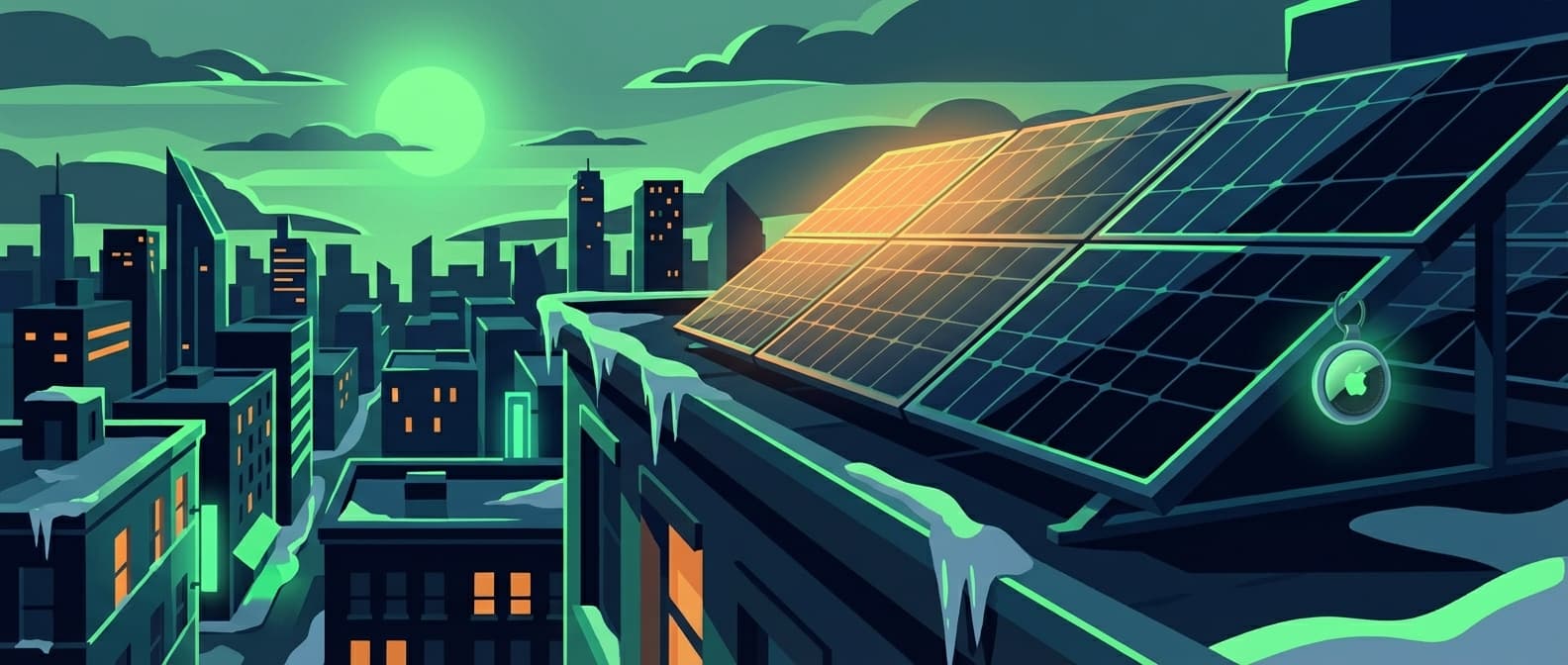
Solar Panel Theft: Statistics, Prevention, and Tracking in 2026
Solar panel theft has increased 65% over the past two years, with the average residential theft incident costing homeowners $15,000 in panels, labor, and downtime. Commercial solar farms face far larger losses — a single organized raid in Northumberland, UK took an estimated 75,000 to 100,000 panels. In Fresno, California, a copper theft at a solar farm serving a county juvenile justice campus caused up to $2.8 million in damage.
The solar boom created a theft boom. More panels installed means more panels to steal, more demand from buyers who do not ask questions, and more organized criminal networks that have figured out the logistics.
This guide covers the full picture: who steals solar panels, what they cost to lose, which prevention methods actually work, and an honest assessment of how tracking — AirTags and GPS — fits into a solar security strategy.
How Big Is the Solar Panel Theft Problem?
Solar theft statistics are underreported by nature. Remote farms often do not discover theft until a generation report shows anomalies. Homeowners sometimes assume panels failed rather than disappeared. Many incidents never get filed.
What we can document:
- 65% increase in solar panel theft incidents over the past two years (residential incidents), with average losses of $15,000 per incident per industry reports
- 93% rise in solar-related crime reports in the UK from 2021 to 2022; UK police documented £574,300 ($691,500) in solar site property stolen, acknowledged as an undercount
- 48% increase in cabling and panel theft from UK solar sites in a single year
- 5,000+ major solar thefts annually across Europe, including 400+ in Germany alone
- $100,000+ in copper stolen from a single Fresno, California solar farm in one incident; total repair cost estimated at $2.8 million
- 400+ solar panels worth over $400,000 stolen from Napa Valley vineyards over a single year, per NPR reporting
- Japan's Kanto region saw a 300%+ increase in solar theft between 2022 and 2023
The US Department of Energy separately estimates approximately $1 billion in copper is stolen from various sites including solar farms annually.
These numbers do not capture the full scale. The actual theft rate is substantially higher than what gets reported to police and insurance.
Why Solar Panels Became a Target
Three things converged to make solar panels attractive to thieves:
High resale value relative to removal effort. A modern residential panel sells for $200-500 retail. Thieves can remove 8-12 panels in an hour or two with basic tools — a team makes $2,000-6,000 in a single night. Commercial panels run $150-300 each but are installed in far larger arrays. Criminal gangs can net tens of thousands in a single operation.
Copper inside the system. The panels themselves are one target. The copper wiring interconnecting them is another. Copper prices have increased roughly 30% over the past five years, reaching $4.50-5.00/lb in 2024-2026. A solar farm contains hundreds or thousands of feet of copper cable — organized thieves strip cable not just to sell the panels but as a copper harvest.
Solar installation is booming. US solar generation is projected to grow 75% between 2023 and 2025. More installations mean more targets. Rural solar farms in particular are being built faster than physical security can keep pace.
Who Steals Solar Panels
Solar theft is not one type of criminal. It falls into four distinct categories with different targets and methods.
Organized Criminal Networks
The largest and most damaging theft comes from organized gangs. Evidence from UK and European investigations points to operations with:
- Advanced scouting: Using Google Earth and satellite imagery to identify solar sites, map access points, and estimate panel counts before arriving
- Coordinated distraction: In documented cases, gangs "lured" mobile security patrols to a decoy location before hitting the real target — a deliberate, multi-person operation
- International disposal routes: When UK police recovered stolen panels from a Staffordshire address, they found paperwork indicating planned shipments to Madrid for resale
- Scale that defies belief: One documented operation removed 15,000 panels in a single weekend; another stripped 20+ km of cable in a five-hour nighttime raid
- Eastern European and transnational involvement: UK and European police have documented organized criminal networks crossing borders with stolen solar materials
These operations treat solar farms as commercial harvests. They have the tools, vehicles, and markets established before they arrive.
Opportunistic Thieves
At smaller scales, opportunistic theft targets:
- Residential ground-mount arrays in rural areas where neighbors cannot see the system
- Commercial rooftop systems accessible from adjacent buildings or parking structures
- Construction sites where panels are stacked and unguarded overnight
An opportunistic thief does not need sophistication. A pickup truck, a basic toolkit to remove panel mounts, and knowledge of a local scrap buyer is all it takes.
Construction Site Pre-Installation Theft
This category gets underreported because it sits in a legal gray area — who is responsible, the installer or the homeowner, for panels sitting on pallets at a job site before they go on the roof?
The answer is the installer bears responsibility, but recovery is nearly impossible. Panels on pallets at a residential or commercial installation site are high-value, portable, and often unattended overnight or over weekends. A crew delivers two pallets of panels on a Friday afternoon. By Monday morning, they are gone.
An hour or two of removal time, a truck, and a ready buyer. That is all it takes.
Copper and Component Theft
Many "solar theft" incidents are not about panels at all. The copper wiring, inverters, and other components are targeted independently:
- String cable: The most common target at solar farms. Thieves pull string cables across entire rows, immediately disabling power generation
- Inverters: String and string-optimized inverters ($500-5,000 each) are removed from their mounts and taken as units
- Racking hardware: Aluminum racking has scrap value; gangs have stripped entire arrays of mounting hardware
- Disconnects and combiner boxes: For the copper and breaker components inside
What Solar Panel Theft Actually Costs
The panel price is a small part of the real loss.
Residential Theft Cost Breakdown
A typical residential solar system is 10-20 panels. If thieves take half — say 8 panels from a 16-panel rooftop system:
| Cost Category | Low Estimate | High Estimate |
|---|---|---|
| Panel replacement (8 x $350 avg) | $2,800 | $4,000 |
| Labor for reinstallation | $1,500 | $3,000 |
| System downtime (lost generation credit) | $200 | $600 |
| Insurance deductible | $500 | $2,500 |
| Insurance premium increase (year 1) | $300 | $800 |
| Roof damage from forced panel removal | $0 | $3,000 |
| Total real cost | $5,300 | $13,900 |
The $15,000 average loss figure from industry reports is consistent with larger system theft or whole-system removal.
Why the Labor Cost Is Often Larger Than the Panel Cost
Solar installation is skilled labor. Panels are installed with specific racking configurations, torque specifications, and electrical connections. When panels are replaced, the work cannot be done in isolation — the system needs inspection, rewiring, and recommissioning. On a residential system, reinstallation labor often exceeds the material cost of the stolen panels.
Commercial and Farm-Scale Theft
Commercial losses scale dramatically:
- $2.8 million in total damages from a single copper cable theft at a Fresno solar farm (the copper itself was ~$100,000; damage to the system forced months of downtime)
- $400,000+ in panels stolen from Napa Valley in a single year period
- 75,000-100,000 panels removed from a Northumberland farm in one organized operation — replacement cost in the millions
The downtime cost at commercial scale dwarfs the asset cost. A solar farm that generates $10,000-50,000/month in power purchase agreements loses that revenue while offline for repairs. Insurance may cover the hardware; it rarely fully covers the generation losses.
NREL Replacement Cost Data
The National Renewable Energy Laboratory estimates replacement cost for stolen or damaged solar panels runs $500 to $1,000 per panel when accounting for procurement, labor, and recommissioning — not just the panel hardware price.
Types of Solar Installations and Their Risk Profile
Different installation types have very different theft risk profiles.
Residential Rooftop
Risk level: Moderate
Rooftop panels on homes are somewhat protected by height and visibility — a thief removing roof panels makes noise and is visible to neighbors. That said, in less-dense suburban areas, panels have been taken from roofs, particularly ground-floor or garage-adjacent installations. The more significant residential risk is from ground-mount systems in rural areas.
Key vulnerabilities: Panels installed but not in an app-based monitoring system, no serial numbers recorded, homeowner unaware panels can be individually removed
Ground-Mount Residential and Agricultural
Risk level: High
Ground-mount systems on rural properties — farms, ranches, rural homes — are the highest-risk residential category. They are:
- Accessible without ladders or scaffolding
- Often not visible from roads or neighbors
- Located in areas with minimal police patrol frequency
- In areas with lower Apple device density (relevant for AirTag effectiveness, discussed below)
Wineries, farms, and agricultural operations in California's Napa Valley, Central Valley, and other rural regions have been disproportionately targeted.
Commercial Rooftop
Risk level: Moderate
Commercial rooftop systems on warehouses, office buildings, and retail centers face different threats than residential. The scale makes whole-system removal impractical, but component theft — inverters, copper wiring, monitoring equipment — is common. Access during business hours via service vehicles is a documented vector.
Utility-Scale and Commercial Solar Farms
Risk level: Very High
Large solar farms are the highest-dollar-loss target. They combine:
- Remote locations: Most utility-scale farms are built in rural areas far from populated centers, with minimal natural surveillance
- Minimal on-site staffing: Many farms have no permanent staff; monitoring is remote
- Large perimeters: A 50 MW farm might have a 5-10 mile perimeter fence — impractical to continuously monitor
- Overnight vulnerability: Farms generate power during the day but have zero human presence at night
- High asset concentration: $10-50 million in equipment in one location
The combination makes them ideal targets for organized operations. The remoteness that makes land cheap also makes security expensive.
Construction Sites Pre-Installation
Risk level: Very High
Panels on pallets at a job site before mounting are among the easiest targets. They sit at ground level, often with no security infrastructure yet installed, sometimes in an unfenced staging area. Weekend deliveries are particularly vulnerable — panels arrive Friday, installation begins Monday, theft happens Saturday night.
RV, Camper, and Portable Systems
Risk level: Moderate (portable panels: High)
Portable solar panels used for camping, boondocking, and RV travel face regular theft from campgrounds and parking areas. Roof-mounted RV panels are reasonably protected; portable ground-deployed panels left unattended are high-theft items. Multiple forums (Forest River, Airstream, DIY Solar) document regular theft from campgrounds and rest stops.
Prevention Methods That Work
No single measure stops a determined organized crew. The goal is layered security that makes your installation significantly harder to hit than the next one.
Anti-Theft Mounting Hardware
Standard panel mounting uses regular fasteners that any competent thief can remove with common tools. Specialty fasteners change that calculation:
- Tamper-resistant security bolts: Require a specific driver bit to remove. Cost $2-5 per fastener. Available from ProSolar, Ecosol, and others who make solar-specific security hardware.
- One-way screws: Can be installed but not removed with standard tools. Forces use of special extraction bits, adding time and noise.
- Locking cable systems: Steel cables threaded through racking systems, secured with tamper-resistant locks, physically connect panels together so individual removal requires cutting the cable first
Anti-theft fasteners do not stop someone with an angle grinder, but they eliminate casual opportunistic removal. The extra time and tools required push most thieves to easier targets.
Panel Identification and Marking
Serial number documentation is the most consistently neglected prevention measure — and the one that most affects recovery probability.
- Record serial numbers: Every panel has a serial number on the back. Photograph it or enter it into a spreadsheet before installation. Police need serial numbers to prove recovered panels are yours.
- Manufacturer verification: Major brands (JinkoSolar, Astronergy, LG, SunPower) maintain databases that can verify panel provenance. A buyer who checks a stolen panel's serial number can identify it as stolen.
- UV-reactive marking: UV ink pens ($5-10) allow you to mark panels with identification that is invisible normally but shows under UV light. Police and investigative teams know to check.
- Physical etching: An electric engraver ($15-30) etched into the panel frame with a property registration number or DL number is permanent and cannot be removed without obvious damage.
- Property registration programs: Some jurisdictions maintain stolen property databases. Programs like STOP (Security, Technology, and Organization Prevention) offer metal-etched coded tags.
The resale market for stolen panels does exist, but stolen panels with documented serial numbers are harder to move. Manufacturers explicitly void warranties on panels identified as stolen through serial number checks.
Perimeter Security for Farms
For ground-mount and utility-scale installations:
- Fencing: Standard chain-link with barbed wire is baseline. Anti-climb additions (roller barriers, electric fence topping) add deterrence. A well-fenced perimeter forces organized thieves to cut through, making noise and leaving evidence.
- Motion-activated lighting: Inexpensive LED floods triggered by motion change the risk calculation for nighttime operations. Portable solar-powered units can be deployed without wiring.
- CCTV with cellular uplink: Modern surveillance cameras can run on solar power with cellular data backhaul, making them deployable at remote sites without infrastructure. Image capture of vehicle plates is the most useful law enforcement tool.
- Remote monitoring services: Companies offering 24/7 monitoring can trigger law enforcement response when motion is detected outside business hours.
Alarm Systems
- Vibration sensors on racking: Detect the physical act of unbolting panels. Trigger a local siren and a remote alert.
- Perimeter beam sensors: Infrared or laser barriers across access points. When broken, trigger an alert.
- Panel-level monitoring: Some inverter systems (Enphase, SolarEdge) provide per-panel output monitoring. A panel going offline can trigger an alert — though this requires the rest of the system to remain operational.
Operational Measures
- Serial number photography: Before installation, photograph every panel's serial number label. Store in the cloud, not just locally.
- Insurance documentation: Most insurance claims for theft require the serial numbers of stolen panels. Without them, recovery from insurance is slower and sometimes disputed.
- Night-before delivery: For construction sites, try to time deliveries so panels arrive the morning of installation rather than sitting overnight or over a weekend.
- Security signage: "GPS TRACKED" and "VIDEO MONITORED" signs on fencing and racking create uncertainty. Even if not accurate, they change the risk calculation for opportunistic thieves.
Electronic Tracking: AirTags and GPS for Solar Panels
This is where honest limitations matter. Solar panels present a unique tracking challenge that does not exist for generators, vehicles, or tools.
The core problem: solar panels have no reliable power source for a tracker.
A GPS tracker on a solar panel faces an impossible power situation. The panel generates power only during daylight and when connected to the inverter system. A standalone tracker cannot tap panel voltage directly. Any GPS tracker attached to a panel needs either:
- Its own battery (and therefore a battery life limit)
- A hardwired connection to the inverter or battery bank (complex, expensive)
AirTags solve the power problem through Bluetooth (not GPS) and a coin cell battery that lasts approximately one year. They do not need the panel's power at all.
How AirTags Work for Solar Panels
AirTags are passive Bluetooth devices. They broadcast a signal that any Apple iPhone, iPad, or Mac within ~30 feet picks up. That Apple device anonymously relays the AirTag's encrypted location to Apple's servers. You see the location in Find My.
The AirTag network has over 2.5 billion active Apple devices. In urban and suburban areas, this creates near-continuous coverage — if an AirTag moves, you typically get a location update within minutes.
Where to place AirTags on solar installations:
Residential rooftop systems:
- Inside the junction box on the back of a panel (before closing the lid; the box protects it from weather and heat)
- Inside the string inverter enclosure (mounted on the wall next to the panel; accessible for battery changes)
- Behind the disconnect switch cover on the roof edge
- In a weatherproof enclosure attached to the racking, hidden under panels
Ground-mount systems:
- Inside hollow racking tube sections (cap-off the end after inserting to prevent moisture)
- Inside the combiner box or junction boxes at the base of the array
- Attached with VHB tape inside the inverter enclosure
- In a weatherproof project box mounted to racking, out of sight from ground level
Construction sites (pre-installation):
- Tucked inside a pallet of panels under the top unit before wrapping
- Inside a panel carton on the pallet, buried under some packaging
- On the job box or staging equipment near the delivery
Pro tip: Use two AirTags per installation location. One visible spot that a thief might find, and one hidden. If they find the first, the second still tracks. The cost is $58 — cheap insurance on a $10,000+ system.
The Critical Limitation: Find My Network Density
This is where honesty matters more than sales pitch.
AirTags work where iPhones go. In suburban neighborhoods, shopping areas, and anywhere people are, AirTags get location updates frequently. If someone steals rooftop panels from a home in a residential neighborhood and drives them through town, you will likely see movement updates.
AirTags have limited effectiveness in rural areas. Most utility-scale solar farms are in rural or semi-rural locations specifically because land is cheap and sun is plentiful. If a farm is 20 miles from the nearest town, an AirTag on a stolen panel may not ping for hours or days — not until the thieves drive through a populated area. By then, the panels may have already been offloaded.
The honest breakdown by installation type:
| Installation Type | AirTag Effectiveness | Notes |
|---|---|---|
| Suburban residential rooftop | High | Dense iPhone neighborhood; movement tracked quickly |
| Urban commercial rooftop | High | Very dense network; near-real-time updates |
| Agricultural ground-mount (rural) | Moderate | Updates delayed; best if panels move toward towns |
| Remote solar farm | Low-Moderate | Limited coverage at site; better coverage once panels move |
| Construction site (urban/suburban) | High | Good coverage during transit of stolen materials |
For remote solar farms, a hybrid approach works best: AirTags for tracking when panels enter populated areas, plus cellular GPS trackers for the farm perimeter and high-value equipment like inverters.
GPS Trackers for Solar: Use Cases and Trade-offs
Dedicated cellular GPS trackers solve the rural coverage problem but introduce the power problem.
| Option | Hardware Cost | Monthly Cost | Best For |
|---|---|---|---|
| AirTag (via AirPinpoint) | $29 | $11.99-14.99/mo (platform) | Residential, suburban, construction sites |
| Spot Trace (satellite) | $150 | $12/mo | Remote farms; works without cellular |
| LandAirSea 54 | $30 | $20/mo | Inverters with hardwired power |
| CalAmp LMU | $200-400 | $25-40/mo | Commercial fleet-grade monitoring |
| Solar-powered GPS (Piccolo ATX2S) | $300+ | $25+/mo | Remote equipment with no external power |
For the solar farm use case specifically, solar-powered GPS trackers solve both problems: they draw power from a small integrated solar panel, eliminating battery maintenance, and use cellular or satellite communication for location updates. Globalstar's GSatSolar is designed explicitly for this use case. These are expensive ($200-500+ per unit) but appropriate for commercial installations.
Satellite-based trackers (Spot Trace, SPOT Gen4) do not depend on cellular coverage, making them viable for truly remote locations. They update less frequently and have higher subscription costs, but they work where cellular cannot.
AirPinpoint for Solar Fleets
A single AirTag reports to one Apple ID. AirPinpoint turns AirTags into a managed fleet: multiple users see all tags on one dashboard, with location history, geofence alerts, and inventory management.
For solar installation companies or commercial operators managing multiple systems:
- Tag every installation during setup
- Set geofences on each property
- Get immediate alerts if panels move outside the property boundary
- See all systems on one map rather than checking individual Apple accounts
Plans run $11.99-14.99/month per tag — significantly cheaper than a dedicated cellular GPS subscription for each panel location.
Solar Theft and Insurance
Residential Homeowner Insurance
Most homeowner policies cover rooftop solar panels as part of the dwelling structure. Coverage typically includes:
- Theft and vandalism: Standard peril coverage applies to solar panels
- Replacement cost vs. actual cash value: Replacement cost is better — you get enough to buy equivalent new panels. Actual cash value deducts depreciation, which on panels 5+ years old can be substantial.
- Coverage limits: A $250,000 dwelling policy may have sub-limits that are insufficient for a $25,000 solar system. Check your dwelling coverage limit against your system's replacement value.
Ground-mount systems are different. Panels not attached to the main dwelling structure may fall under "other structures" coverage, which typically has 10% of the dwelling limit — often not enough.
What to do before installation:
- Call your insurance agent and tell them you are adding solar
- Get confirmation that the system value is within your dwelling or scheduled property coverage
- Consider an umbrella or inland marine rider if needed
- Record serial numbers and share the list with your insurer
Commercial and Farm-Scale Insurance
Commercial solar farm insurance requires specialized policies. Standard commercial property insurance typically does not adequately cover:
- Business income loss during downtime after theft
- Equipment installed in remote locations
- The replacement cost of large-scale panel arrays
Commercial insurers increasingly require documented security measures as a condition of coverage or for preferred rates. Perimeter fencing, surveillance, and active monitoring are frequently specified. Some policies require notification of theft within specific time windows — monitoring systems that alert you quickly can mean the difference between a covered and denied claim.
Inland marine insurance (equipment floater policies) covers equipment at construction sites before permanent installation — directly addressing the pre-installation theft risk.
Real Incidents: What Actually Happens
Napa Valley Wineries
California's Napa Valley became one of the hardest-hit regions for ground-mount solar theft. The combination of rural locations, valuable systems, and the wine industry's adoption of solar created a concentrated target. Over a year-long period, more than 400 panels worth over $400,000 were stolen from vineyards throughout Napa County. The winery at Rutherford specifically had panels stolen. Wine Spectator documented the crime wave across the valley.
Fresno County Solar Farm
In December 2023, thieves stole more than $100,000 in copper wire from a solar farm serving the Fresno County Juvenile Justice Campus. The farm — 9,000 panels that went online in 2022 — could not operate without the stolen cable. Total repair cost was estimated at $2.8 million. Two people were arrested. Jerald Ross faced felony grand theft charges.
California Water Treatment Plant
90 solar panels were stolen from a Las Gallinas Valley water treatment plant in Marin County, California, a county-owned facility. The theft targeted critical infrastructure.
UK Northumberland Farm
An organized criminal operation removed an estimated 75,000 to 100,000 solar panels from a single Northumberland, England solar farm in 2023. The scale — tens of thousands of panels — points to a sophisticated logistics operation with multiple vehicles, multiple crews, and a ready buyer for the volume.
Newport Beach Panels Recovered
In California, panels stolen from a toll road installation near Newport Beach were recovered — panels individually valued at $1,500 each. The thief was arrested. This represents the type of case where serial number documentation enables prosecution.
RV Forum Reports
On Forest River and Airstream forums, reports of RV solar panel theft are common enough that threads about security run to multiple pages. One member reported a 100W rooftop panel stolen from their RV parked overnight at a hotel in Sandusky, Ohio. Portable ground-deployed panels are consistently identified as high-theft items at campgrounds and boondocking spots.
Legal Considerations
Theft Charges Are Driven by Dollar Value
Solar panel theft is charged under standard theft statutes — the charge level depends on the value stolen:
- Texas: Theft over $2,500 is a state jail felony (180 days to 2 years). Over $150,000 is a first-degree felony (5-99 years).
- California: Panels are property. Grand theft (over $950) is a wobbler — misdemeanor or felony at prosecutor's discretion. Multiple panels easily reach felony thresholds.
- Most states: A single panel theft ($200-500 retail) may be a misdemeanor. A set of panels ($5,000-50,000) quickly reaches felony territory.
No US states have specific enhanced-penalty statutes exclusively targeting solar panel theft. Some have critical infrastructure protection laws that could apply to utility-scale farm theft, potentially elevating charges.
Critical Infrastructure Considerations
Large solar farms feeding the grid may qualify as critical infrastructure under federal and state law. Theft from critical infrastructure can trigger federal jurisdiction and enhanced penalties beyond standard theft statutes. The Fresno case — targeting a county facility — was prosecuted under California's grand theft of copper materials statute specifically, which carries up to three years in prison.
Police Report Requirements
Filing a police report requires:
- Serial numbers of stolen panels (without these, police cannot identify recovered panels as yours)
- Photos of the installation and panels
- Purchase receipts or installer documentation
- Any tracking data you have (GPS coordinates, AirTag location history)
Tracking data with a specific current location transforms a standard theft report into an actionable lead that police can act on immediately.
The Full Prevention Stack: Cost vs. Protection
What does a complete security setup cost for a residential ground-mount system?
| Measure | One-Time | Annual | What It Does |
|---|---|---|---|
| Anti-theft mounting fasteners (50 bolts) | $150 | $0 | Makes removal slow and loud |
| Serial number documentation | $0 | $0 | Insurance and recovery |
| UV ink marking + engraver | $25 | $0 | Invisible ID on all panels |
| Security signage (4 signs) | $20 | $0 | Deters opportunistic thieves |
| Motion-activated lights (2 units) | $80 | $0 | Illuminates nighttime attempts |
| Trail camera with cellular alert | $150 | $60 | Photo evidence, remote alert |
| AirTags x 2 (hidden in different locations) | $58 | $0 hardware | Location tracking |
| AirPinpoint platform | $0 | $144-180 | Dashboard, geofencing, alerts |
| Total | $483 | $204-240 | Full layered protection |
First-year total: approximately $687-723. Against a residential solar system worth $15,000-35,000, that is 2-5% of system value for comprehensive protection.
FAQ
How common is solar panel theft?
More common than most solar owners realize, and growing. Industry data shows a 65% increase in residential theft incidents over two years. The US and Europe both saw sharp increases as solar adoption accelerated — more panels installed means more targets. Remote and rural installations face the highest risk; urban rooftop installations face lower but non-zero risk.
How do thieves steal solar panels quickly?
With basic tools and knowledge, panels can be removed faster than most people expect. Standard mounting hardware is not theft-resistant. A team with ratchets and a truck can unload 10-15 ground-mount panels in under an hour. Organized crews are faster — they arrive with specific tools for the mounting hardware type, work in parallel across the array, and load directly into waiting vehicles. Some organized operations remove 100-300 panels in a single night.
Do AirTags work for solar panels in rural areas?
Honestly, AirTags work well for suburban and urban solar installations — residential rooftop, construction sites, panels in transit. Their effectiveness decreases for rural ground-mount and farm-scale installations because the Find My network relies on nearby Apple devices. In a remote field with no neighbors, an AirTag may not report for hours. The best approach for rural installations is a hybrid: AirTags placed in panels for tracking once stolen equipment moves toward populated areas, plus a cellular GPS tracker on the inverter (which can tap the system's power).
Where should I hide an AirTag on solar panels?
Good hiding spots include the junction box on the back of a panel (close it again after placing the AirTag inside), inside the string inverter enclosure, inside a weatherproof project box attached to the racking behind a panel, or inside hollow racking tube sections. The goal is a spot that is weatherproof, hidden from outside inspection, and accessible for battery replacement once per year. Avoid placement near high-heat areas — panel backs in direct sun can exceed safe operating temperatures for electronics.
Does homeowner insurance cover stolen solar panels?
Usually yes, with caveats. Most policies cover rooftop solar panels as part of the dwelling structure under theft coverage. Critical issues: (1) Check that your dwelling coverage limit is high enough — a $250,000 limit with a $30,000 solar system may have insufficient headroom. (2) Ground-mount panels may fall under the lower "other structures" limit. (3) You need serial numbers to file a claim effectively. Contact your insurer before installation to confirm coverage and adjust limits if needed.
What happens if solar farm panels get stolen and no tracking is in place?
Recovery is very difficult. Without serial numbers, police cannot identify your panels even if they find them. Without tracking data, there is no location evidence. Organized operations move stolen panels quickly — to staging locations, then to buyers, sometimes across state or national borders within 48 hours. Recovery rates for stolen property without tracking data sit at 7-25%. That is why pre-installation documentation and even basic tracking vastly outperform post-theft investigation.
Are organized crime rings specifically targeting solar farms?
Yes, with documented evidence. UK police have identified "fully industrialized" criminal networks targeting solar farms with sophisticated scouting, coordinated multi-vehicle operations, and international disposal routes. European law enforcement documents 5,000+ major solar thefts annually. In the US, the pattern of large-scale overnight theft at remote farms points to organized operations rather than opportunistic crime. The same crews that target copper wiring and generators at construction sites have shifted attention to the concentrated value in solar farm installations.
What is the best GPS tracker for solar panels?
It depends on the installation type. For residential and suburban installations, AirTags are the best starting point — they run on a coin cell for a year, require no power from the system, and leverage the 2.5 billion-device Find My network. For remote farm installations, a solar-powered cellular GPS tracker (like the Piccolo ATX2S or similar industrial units) solves both the power problem and the connectivity problem, though at a higher cost ($300+ hardware, $25+/month cellular). Satellite trackers (Spot Trace) work at any location but update infrequently. For most homeowners, starting with AirTags and AirPinpoint is the lowest-friction, lowest-cost option.
Solar panels are a significant investment. A theft that goes undetected for a weekend can cost $15,000 or more — and without serial numbers or tracking, recovery is close to impossible. Start tracking with AirPinpoint and get notified the moment a panel leaves its installation location.
